

Brief

Telecommunications companies are the cornerstone of the digital revolution: Everything that happens over a network requires their participation. Yet, many telcos struggle to realize the digital technology advantages that their services deliver to customers. Large telecom companies invest billions of dollars in the networks and operations that make a digital lifestyle possible for their customers, but their performance can be inconsistent, which sometimes results in poor service and creates dissatisfied customers.
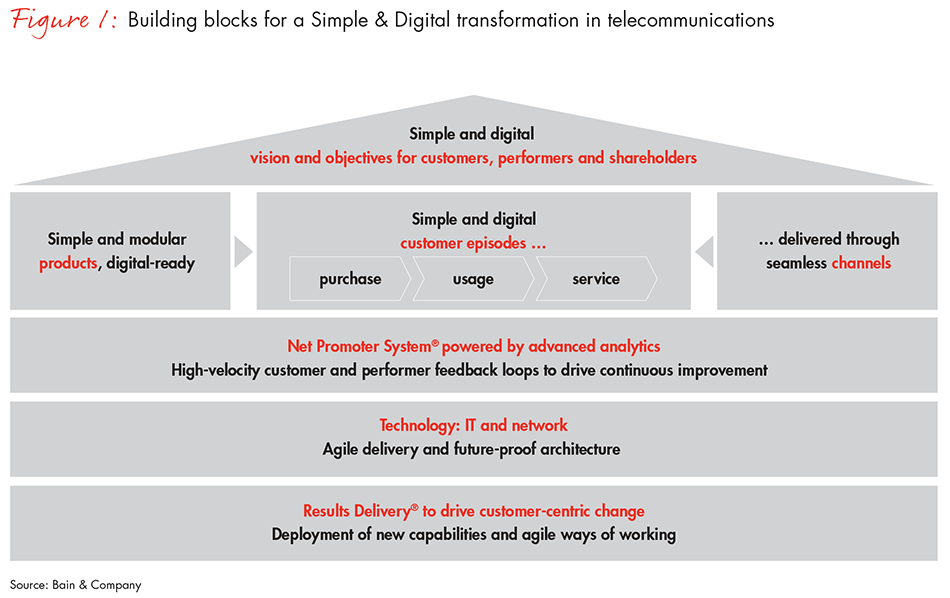
At the same time, telecom executives are under pressure from their customers, shareholders and other stakeholders to become more digital, to exploit the new technologies and opportunities that will enable them to deliver more services and operate more efficiently. Some companies approach their digital transformation as a series of boxes to be ticked: mobile apps, better web services, more online transactions. But these companies are missing out on an opportunity to reinvent themselves. The most forward-looking executives will go further, taking advantage of this pressure not merely to digitalize their companies, but to reimagine and reinvent how they operate, to radically lower costs and deliver remarkably better experiences for customers (see Figure 1).
Toward Simple & Digital
A guiding principle for a more complete transformation is to aim to produce customer episodes that are simple and digital. It starts by putting yourself in the shoes of your customers and your performers—that is, the employees or contractors who are delivering your services to them.
You can learn a lot just by watching and gaining an understanding of how customers and performers feel when they go through a service experience. For example, what delights or irritates them? Taking an ethnographic approach to this kind of research helps companies see episodes from the customer’s perspective rather than only the company’s—and that’s more likely to deliver better customer episodes.
Another principle that helps deliver better outcomes is to apply lessons from behavioral science to make it easy for both the customer and the performer to do the right things. For example, giving call center reps the authority to fix minor issues without needing to involve a supervisor or allowing customers to upgrade services through a mobile app are the types of solutions that make it easy for people to do the things they should do to create better customer episodes. Giving them the tools and authority to act on their motivations can create a virtuous cycle in which they continue to improve their own and customer episodes.
Of course, companies should also apply the principles of simple and digital to their own operations and product development as these constraints can help encourage lean thinking. This entails looking beyond traditional measures to identify waste—for example, treating time delays in the same way you treat inventory. Both represent barriers that should be reduced to improve efficiency.
What makes a good customer episode?
It helps to think about the ways that customers experience their relationship with their telecom carrier. Most of their experience is daily usage: making and receiving calls, sending texts, using their connected smartphone. Many telcos do a good job delivering basic usage, though some still struggle with this.
Customers spend much less time on service episodes, which includes things such as paying bills, calling to correct a problem or starting new services. However, these episodes can be more emotional for customers, so they carry a greater risk to the relationship if executed poorly. When customers feel acknowledged and valued, rather than ignored or disrespected, they are more likely to remain loyal. Experiences that create that level of trust with customers typically show some combination of the following traits.
- Effortless: Telcos make life easy for themselves and their customers when they get it right the first time, delivering seamlessly across channels with clear interfaces that help customers live their lives and get things done. For example, giving customers the ability to improve the quality of streaming video by purchasing higher bandwidth in real time through the app.
- Personalized: Anticipating customers’ needs requires an understanding of context and preferences, assisted by advanced analytics. Bill shocks are a common source of customer dissatisfaction. To reduce such shocks, one Western European telco is adding features to its mobile app that alert customers about potential surprises in their bills, and in some cases, customers can still act to mitigate them—for example, by purchasing a roaming package to reduce high roaming charges while traveling.
- Delivered with a human touch: And of course, all of this should be delivered with empathy for the customer’s situation in a way that makes it easy for customers to understand what they’re paying for and what else is available. Digital technologies can assist here: One telco is building a visual interactive voice response into its remote troubleshooting app for fixed-line products. Customers who fail to solve an issue on their own are directly connected to an agent who can see what they already did in the app.
Telcos aiming to deliver great customer episodes should also radically simplify and modularize their product offers. Most have too many product configurations and offers with inconsistent pricing and service agreements that are difficult for performers to explain and hard for customers to understand. They can simplify these systems by moving to a smaller set of modular building blocks—products and services that can be bundled together into offers.
Tying all these things together allows telcos to completely rethink every customer episode, improving their ability to deliver while reducing effort and costs. One Western European company reviewed its online sales channel and found that customers needed to click 10 times to purchase a certain product. The process frustrated customers, many of whom dropped out before reaching the end. The telco redesigned the site and experience so that customers could purchase in only three clicks by using a radically simplified user flow that wove personalized offers into the experience. The effort paid off drastically, improving conversion rates and customer satisfaction ratings.
Frédéric Debruyne, a partner with Bain's Customer Strategy & Marketing practice, describes three core elements that companies could focus on to make their processes simple and digital while keeping the customer in mind.
Reinventing customer episodes
Of course, telcos must deliver great customer episodes on an industrial scale based on Repeatable Models® that empower call center agents, retail employees, service technicians and everyone else on the team to deliver a great customer episode every time. Since few telcos are doing this today, most will need to invest in new capabilities, changing the way they operate and building up their abilities to collaborate across functions.
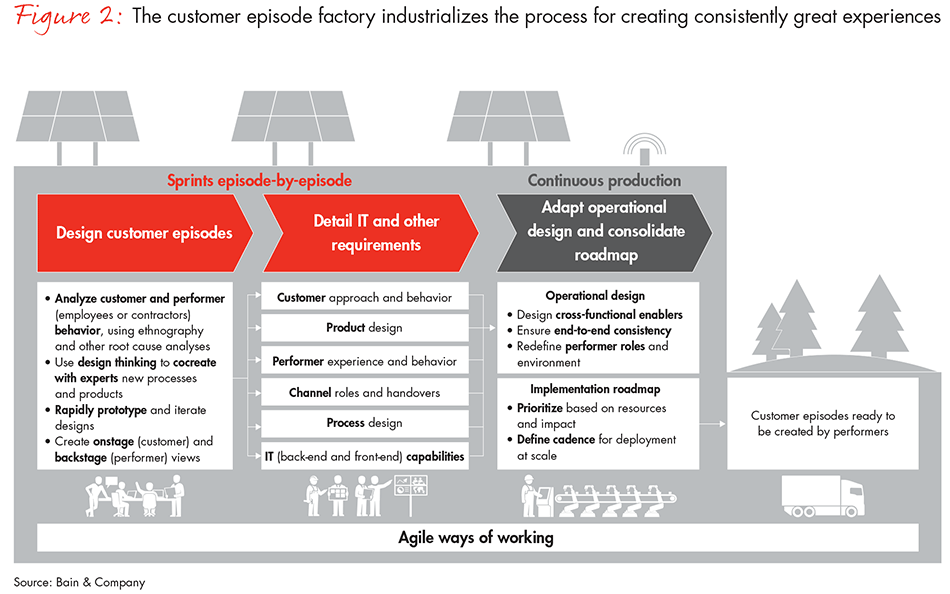
An important part of that change is building capabilities to redesign and deliver great customer episodes—think of it as a customer episode factory (see Figure 2). This requires a leap of imagination for many executives to think of the business as a factory that’s delivering customer episodes and making it easy for the performers who deliver the service.
In designing these episodes, it’s helpful to think about three guidelines.
- First, design episodes with an ambition to substantially reduce costs and deliver a radically better experience. Adopt Agile development methods that move teams forward in short sprints. Set targets that will improve economic performance.
- Second, link episodes to products in ways that aspire to deliver fantastic results. For example, if a customer calls to discuss ending a service before the contract expires, rather than forcing the customer service representative to read chapter and verse from an early termination clause, could you instead encourage a great conversation that would result in a happy customer starting again with a new phone? Flexible rules, empowered performers and high aspirations make it easy for people to do the right thing.
- Finally, make it scalable from day one. A common mistake is to design an episode with supporting processes and rules that work in small or unrealistic environments, but fail when they scale up to real-world levels. Save time by designing for scale.
Beyond the factory
Of course, there is more to creating a simple and digital experience than the customer episode factory. A truly transformative program starts with a bold ambition for better experiences for customers and the employees serving them, as well as improved economic and operational performance. Other elements include the following:
Implement a customer loyalty program like Net Promoter System®. Customer feedback is essential. But metrics are just a starting point—it’s what you do with the data that counts. In a well-functioning Net Promoter System, the feedback flows directly to frontline employees and others responsible for the customer episode, triggering actions that further improve episodes.
Build a digital-ready technology stack. Most companies have upgraded their networks, but over the next few years they will need to focus on three areas in particular to improve their IT, data and network capabilities.
- Transforming the IT architecture requires decoupling the front end from the back end, relying on flexible middleware to make connections between them. When telcos have to invest time and resources connecting new front-end services to the back end, it can slow innovation.
- Improving data capabilities will help telcos gain a comprehensive understanding of customer preferences and behaviors that can inform development and marketing of new and relevant products.
- Network improvements include measuring and managing customers’ perceived experience, particularly in terms of how customers engage with the telco online and through the mobile app. For example, a customer might be unsatisfied with the quality of video, even while the network stats look fine to the telco.
Develop new capabilities for the organization and its people. Great companies make it easy for their employees to deliver amazing experiences to customers. Telcos and other service organizations rely every day on the empathetic connection that their performers make with their customers. In a fast-moving digital environment, cross-functional collaboration becomes the norm to connect customer episodes from end to end, across channels or to mine data to deliver customer insights that allow for better business decisions.

Sébastien Meeus: Simple and Digital in Telecom—the Core Commercial Engine
Forward-looking executives will not only digitalize their companies, but reimagine and reinvent how they operate.
The telecom industry enables the world’s technology transformation, from streaming video to online health monitoring to the Internet of Things and so much more. But it is difficult to claim to be an enabler unless you’re leading the game. Incumbent telcos are well positioned to lead with their well-established brands, deep technology expertise and broad customer bases. But to continue to thrive, telcos will need to continue to nurture their relationships with their customers, and they can only do that by delivering great customer episodes. Transforming the organization to provide simple and digital customer episodes will be a key to delivering on their customer expectations while also reducing the complexity and costs that have so often hindered them from doing so.
Frédéric Debruyne is a partner with Bain & Company in Brussels, and Jeff Melton is a Bain partner in Melbourne. Fred leads Bain’s Telecommunications practice in Europe, the Middle East and Africa, and Jeff is the global leader of Bain’s Service Design & Operations capability.
The authors would like to thank Jens Engelhardt and Richard Hawker, principals with Bain & Company, and Sebastian Ludolph, a Bain consultant, for their contributions to this brief. Jens is based in Bain’s Zurich office, and Sebastian is based in Munich. Richard is based in Melbourne.
Great Repeatable Models® and Repeatable Models® are registered trademarks of Bain & Company, Inc.
Net Promoter System® is a registered trademark of Bain & Company, Inc., Fred Reichheld and Satmetrix Systems, Inc.

Bart Delmulle: Enablers for a Simple and Digital Transformation in Telecom
A simple and digital approach can bring better customer experiences, significant growth and more profitability for telcos.
First published in 8월 2016