

Brief

New digital technologies are changing the way businesses operate in nearly every industry. However, few industries will be transformed as thoroughly as industrial machinery, where digital technologies are not merely changing the way products are sold, but how companies operate. Products themselves are being dramatically altered—in some cases expanding from a piece of machinery needing only occasional maintenance and upgrades to a complete service both requiring and taking advantage of automatic updates to improve performance.
As part of this evolution, manufacturers have to plan and decide how to upgrade and manage many thousands of pieces of machinery that have been deployed, are increasingly connected and deliver huge volumes of data needing to be analyzed and understood. It will take years to digitalize this installed base, but machinery executives cannot afford to adopt a wait-and-see attitude. The foundations are being laid today, and digital leaders are already putting their strategic plans in motion.
Given the tasks at hand, you might expect machinery executives to lose sleep over the digital challenge. But our recent survey found that less than 10% of the industry’s executives see digital technologies as their highest priority, and more than half do not consider it a top priority.
Michael Schertler, a partner in the Industrial Goods & Services practice, discusses how leading companies can develop a comprehensive view on digital disruption and integrate digital strategy into every part of their business.
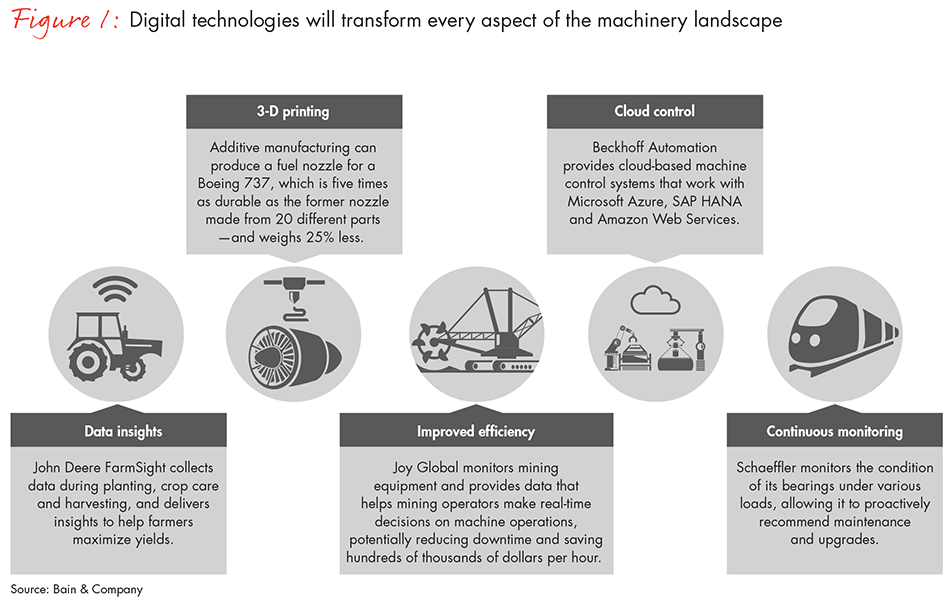
Some of the industry’s digital leaders see it differently. They recognize that digitalization will change nearly every aspect of industrial machinery, creating new value for customers and new lines of business for incumbent manufacturers and digital disruptors alike (see Figure 1).
Three ways that digital technology changes the machinery industry
To make the most of new opportunities, these digital leaders are focused on the three ways that digital technology is affecting their businesses: It is creating new opportunities for innovation, bringing end-to-end transformation and requiring organizational changes to support new technology.
Opportunities for innovation. Connectivity and analytics create a wide range of applications for industrial machinery. Take packaging equipment: Over the past 20 years, packaging systems have become increasingly sophisticated. Initially, these systems offered manufacturers the ability to monitor production and, later, the ability to control remotely through mobile applications or optimize the machine’s performance through updates. Increasingly, packaging systems are also taking on a more comprehensive role in quality assurance, notifying operators of worn parts needing replacement or, in some cases, even adjusting the packaging process, based on data analysis. Other examples of innovation include Caterpillar, which has added GPS and tracking sensors to its grading equipment to improve accuracy and increase productivity, and Maersk, which is exploring the idea of installing 3-D printers on ocean vessels to allow crews to print out spare parts on demand, potentially reducing nonproductive time for vessels and saving thousands in transport fees.
Value chain transformation. As products become more complex, evolving from a piece of machinery to a bundled offer, the profit pool will increasingly shift from hardware to software and services. These changes will affect every step in the value chain, from engineering to production, sales and after-sales field services. The more cross-functional connections that a manufacturer makes across the value chain, the more value it can derive from digital technology. For example, engineers could learn more about what happens to deployed equipment if they can access data and generate meaningful insights from it. Putting that information in a shared cloud could also increase transparency with suppliers and, in some cases, expand the potential for meaningful connections with customers.
Digital operating model. Companies that make industrial machinery are known for precision and high-quality work, and are staffed with dedicated engineers who continually strive for perfection to improve reliability and quality. Speed to market is not often the priority. But digital leaders are learning how to adjust their operating models to innovate and iterate more rapidly. They are adopting new ways of working, incorporating methodologies like Agile and Scrum and phasing out longer-cycle waterfall development methods.
Cross-functional collaboration becomes more important, as it enables customer insights to flow to the places where they can deliver the highest value. IT will need to expand its capabilities as it connects the organization to many thousands of pieces of machinery in the field and finds ways to deliver data and analytic insights at the customer and company levels—a huge challenge. Parts of the organization—such as the customer-facing systems, like portals, customer service and marketing—will move faster to incorporate digital technologies. The more mission-critical systems of record often will move at different paces, but they are all moving toward the same digital goals.

Forming a View of the Digital Landscape in Industrials
Explore the factors industrial companies should consider when selecting a digital vendor.
Key elements of a digital transformation
So how do industrial leaders decide where to begin? As we mentioned earlier, digital technology affects the entire value chain and challenges the ways companies engage their customers, define new products and services, and operate their businesses (see Figure 2).
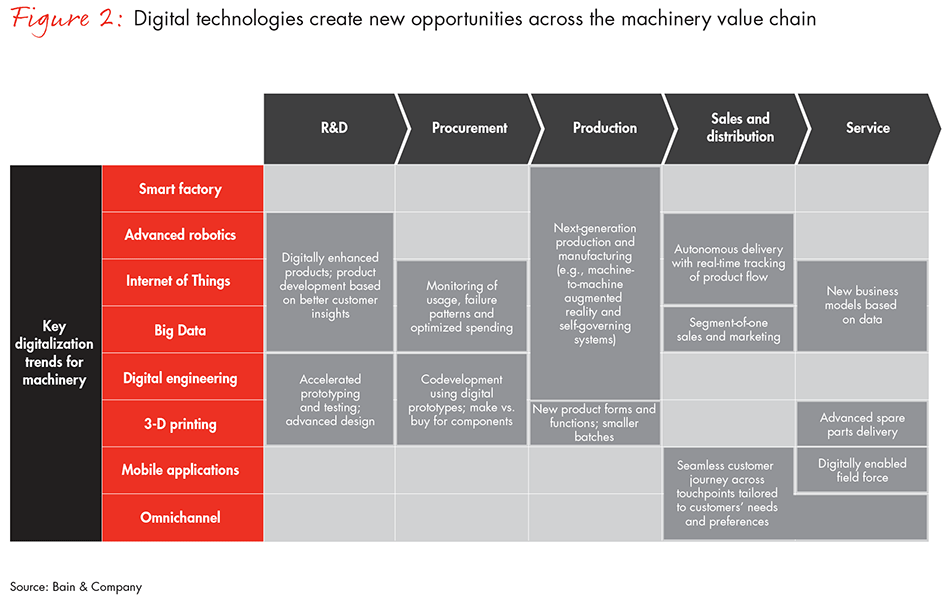
Digitalization will unlock significant value: Cost savings and opportunities for efficiency improvement range from 15% to 40%, depending on the possibilities at each step of the value chain. New business opportunities enabled by digital technologies and data analytics will also create innovative top-line opportunities. Even so, few management teams have defined a comprehensive vision for making the most of digitalization. In our work with executive teams at industrial equipment manufacturers and service suppliers, we find that the leaders take a pragmatic and systemic approach to the problem, which starts with assessing the industry and then moves toward adopting the most promising applications and uses of digital technology.
Understand how digital is disrupting your industry. Many companies start with a view that’s too narrow, focused on specific products or within the current business model. Now is the time to take an expansive view and explore holistic opportunities. Leading companies learn how digital technologies are changing customers’ operational and strategic priorities. Profit pools will shift as digitalization shapes how products are purchased, used, serviced and repaired. New business models will emerge: Instead of selling a piece of equipment, companies may sell by usage or performance levels. Digitalization of mechanical processes will recast the sources of competitive advantage, creating openings for new entrants. For example, in the printing and packaging industry, improvements in digital printing may allow more flexibility in how and where labels are printed, shifting the process from centralized printing centers to customer sites and creating possibilities for new entrants in small-batch segments. Leaders scan the landscape and consider all these elements as they plan.
Redefine the customer relationship. The old model—in which engineering develops a product, sales teams deliver it to customers and service teams keep it running—is giving way quickly to a digitally connected view that continually measures customer interactions. Customers increasingly expect to give feedback and input on product design, monitor the progress of orders and connect immediately with service teams when something is amiss. In some cases, customers now expect the manufacturer to identify and fix problems even before the customer is aware of them. Digital technology will also allow manufacturers to get a more comprehensive and integrated view of their customers, including how they shop, purchase, use and replace machinery. By monitoring machinery usage, manufacturers can often derive insights that allow them to help customers use equipment more effectively, often in real time.
Modify products and services to capture opportunities. Digital technology changes products and service in several important ways.
For products, new software features and control systems have substantially improved the quality, flexibility and productivity of equipment. This trend is likely to continue as more sensors and actuators make operational assets more intelligent every day. New production technologies, such as 3-D printing, make it possible to change design and material properties in ways that lead to entirely new value propositions. General Electric, for example, used 3-D printing to streamline the design and manufacture of a new, more durable jet fuel nozzle for its Leap aircraft engine. A single printed part replaces 20 manufactured pieces needing to be assembled. Seamlessly integrating new technologies and digitalized equipment into an existing operational landscape is an ongoing challenge that requires more support and new capabilities.
In service, machinery manufacturers have seen strong growth in recent years. Service will become more promising and more complex as original equipment manufacturers (OEMs) look to create better support through tighter integration with customers and suppliers. Bain’s Service Benchmark study found that digitalization will influence service profit pools in several ways, including enabling predictive maintenance, greater transparency on operations and data-driven services that monitor equipment and help improve performance. Retrofitting the existing installed base will be a challenge, but executives see new opportunities for advanced services that create value for machinery owners and operators. For example, as software becomes more important in machinery, machinery makers will need to develop business models that deliver value from the data captured.
Adopt digital to improve operations, production and service. Implementing digital technologies in product life-cycle management, automation, advanced control, computer-aided design and other systems can deliver quick wins. For example, digital technology allows OEMs to collate and access more information about production, engineering and applications of products, and to put that data in the hands of the people who can make the best use of it by systematically identifying and eliminating waste in operations.
However, to achieve the full potential of digital technologies, executives need to rethink their operations from end to end, to ensure they don’t create digital islands of limited value, such as a pure CRM system without project and product data or an engineering database that cannot be accessed by R&D or connected to actual performance in production. Data is the glue between all operational activities, creating transparency and insights and ultimately enabling decision making that improves performance.
Build capabilities to enable digital success. Finally, OEMs need to invest in new capabilities to tap the full potential of digitalization in their industry. Foremost among these is teaching employees new skills to prepare them for the digital transformation, including the shift in emphasis from hardware to software engineering. Machine manufacturers must learn to consider the digital and mobile aspects of everything they do. Companies must also learn how to derive meaningful insights that add value from ever-expanding flows of data. Top analytics talent is challenging to recruit and keep, especially if the talent feels the company is not committed to staying on the leading edge. For most companies, acquiring new analytic skills requires a combination of new hires and, for experienced staff, training and education. Finally, to support these new capabilities, machinery companies will need to revamp their IT organizations, enabling more nimble development in order to compete with all-digital innovators.
Digitalization is a multiyear transformation requiring significant investments and a test-and-learn mindset, with a significant upside of new value at stake. It’s easy to approach the task with either too much confidence (bold but unrealistic ambitions) or with too little confidence (protecting legacy businesses while waiting to see what competitors do). A more balanced approach takes a creative but realistic assessment of possibilities while focusing on resolving a few critical uncertainties and making a small portfolio of bets on new opportunities. A scenario-based approach that considers competitors’ moves and evolving technologies will provide executives with the insight and flexibility necessary to lead their companies through the uncertain changes ahead.
Klaus Neuhaus is a partner with Bain & Company in Düsseldorf, and Michael Schertler is a partner in Munich. Both work with Bain’s Industrial Goods & Services practice. Klaus leads the practice in Germany and Switzerland, and Michael leads the practice’s digital efforts in Europe, the Middle East and Africa.
The authors would like to acknowledge the contributions of Martin Nilvall, a practice area director in Stockholm, and Maike Grund, a manager in Munich. Both work with Bain’s Industrial Goods & Services practice.
First published in 10월 2016