Skip to Content
  • 오피스

    오피스

    미주
    • Atlanta
    • Austin
    • Bogota
    • Boston
    • Buenos Aires
    • Chicago
    • Dallas
    • Denver
    • Houston
    • Los Angeles
    • Mexico City
    • Minneapolis
    • Monterrey
    • Montreal
    • New York
    • Rio de Janeiro
    • San Francisco
    • Santiago
    • São Paulo
    • Seattle
    • Silicon Valley
    • Toronto
    • Washington, DC
    유럽, 중동, 아프리카
    • Amsterdam
    • Athens
    • Berlin
    • Brussels
    • Copenhagen
    • Doha
    • Dubai
    • Dusseldorf
    • Frankfurt
    • Helsinki
    • Istanbul
    • Johannesburg
    • Kyiv
    • Lisbon
    • London
    • Madrid
    • Milan
    • Munich
    • Oslo
    • Paris
    • Riyadh
    • Rome
    • Stockholm
    • Vienna
    • Warsaw
    • Zurich
    아시아, 호주
    • Bangkok
    • Beijing
    • Bengaluru
    • Brisbane
    • Ho Chi Minh City
    • Hong Kong
    • Jakarta
    • Kuala Lumpur
    • Manila
    • Melbourne
    • Mumbai
    • New Delhi
    • Perth
    • Seoul
    • Shanghai
    • Singapore
    • Sydney
    • Tokyo
    오피스 전체보기
  • 얼럼나이
  • 미디어 센터
  • 구독
  • 연락처
  • Korea | 한국어

    지역 및 언어 선택

    글로벌
    • Global (English)
    미주
    • Brazil (Português)
    • Argentina (Español)
    • Canada (Français)
    • Chile (Español)
    • Colombia (Español)
    유럽, 중동, 아프리카
    • France (Français)
    • DACH Region (Deutsch)
    • Italy (Italiano)
    • Spain (Español)
    • Greece (Elliniká)
    아시아, 호주
    • China (中文版)
    • Korea (한국어)
    • Japan (日本語)
  • Saved items (0)
    Saved items (0)

    You have no saved items.

    관심 있는 내용을 북마크하여 Red 폴더에 저장할 수 있습니다. Red 폴더 에서 저장된 내용을 읽거나 공유해보세요.

    Explore Bain Insights
  • 산업
    메인 메뉴

    산업

    • 우주항공, 방산 및 정부 서비스
    • 농업 관련 산업
    • 화학
    • 인프라, 건설 및 건축 자재
    • 소비재
    • 금융 서비스
    • 헬스케어
    • 산업용 기계 및 장비
    • 미디어 및 엔터테인먼트
    • 금속
    • 광업
    • 석유 및 가스
    • 제지 및 패키징 산업
    • 사모펀드
    • 사회 및 공공 부문
    • 유통
    • 기술
    • 텔레콤
    • 운송
    • 여행·여가
    • 유틸리티 및 재생가능 에너지
  • 컨설팅 서비스
    메인 메뉴

    컨설팅 서비스

    • Customer Experience
    • ESG
    • Innovation
    • M&A
    • 운영
    • 조직
    • 사모펀드
    • 고객 전략 및 마케팅
    • 전략
    • AI, 인사이트 및 솔루션
    • Technology
    • 변화 혁신
  • Digital
  • 인사이트
  • 베인 소개
    메인 메뉴

    베인 소개

    • 업무 소개
    • 베인의 신념
    • 구성원 및 리더십 소개
    • 고객 성과
    • 주요 수상 경력
    • 글로벌 파트너사
    Further: Our global responsibility
    • 다양성과 포용
    • 사회 공헌 활동
    • Sustainability
    • World Economic Forum
    Learn more about Further
  • Careers
    메인 메뉴

    Careers

    • Work with Us
      Careers
      Work with Us
      • Find Your Place
      • Our Work Areas
      • Integrated Teams
      • Students
      • Internships & Programs
      • Recruiting Events
    • Life at Bain
      Careers
      Life at Bain
      • Blog: Inside Bain
      • Career Stories
      • Our People
      • Where We Work
      • Supporting Your Growth
      • Affinity Groups
      • Benefits
    • Impact Stories
    • Hiring Process
      Careers
      Hiring Process
      • What to Expect
      • Interviewing
    FIND JOBS
  • 오피스
    메인 메뉴

    오피스

    • 미주
      오피스
      미주
      • Atlanta
      • Austin
      • Bogota
      • Boston
      • Buenos Aires
      • Chicago
      • Dallas
      • Denver
      • Houston
      • Los Angeles
      • Mexico City
      • Minneapolis
      • Monterrey
      • Montreal
      • New York
      • Rio de Janeiro
      • San Francisco
      • Santiago
      • São Paulo
      • Seattle
      • Silicon Valley
      • Toronto
      • Washington, DC
    • 유럽, 중동, 아프리카
      오피스
      유럽, 중동, 아프리카
      • Amsterdam
      • Athens
      • Berlin
      • Brussels
      • Copenhagen
      • Doha
      • Dubai
      • Dusseldorf
      • Frankfurt
      • Helsinki
      • Istanbul
      • Johannesburg
      • Kyiv
      • Lisbon
      • London
      • Madrid
      • Milan
      • Munich
      • Oslo
      • Paris
      • Riyadh
      • Rome
      • Stockholm
      • Vienna
      • Warsaw
      • Zurich
    • 아시아, 호주
      오피스
      아시아, 호주
      • Bangkok
      • Beijing
      • Bengaluru
      • Brisbane
      • Ho Chi Minh City
      • Hong Kong
      • Jakarta
      • Kuala Lumpur
      • Manila
      • Melbourne
      • Mumbai
      • New Delhi
      • Perth
      • Seoul
      • Shanghai
      • Singapore
      • Sydney
      • Tokyo
    오피스 전체보기
  • 얼럼나이
  • 미디어 센터
  • 구독
  • 연락처
  • Korea | 한국어
    메인 메뉴

    지역 및 언어 선택

    • 글로벌
      지역 및 언어 선택
      글로벌
      • Global (English)
    • 미주
      지역 및 언어 선택
      미주
      • Brazil (Português)
      • Argentina (Español)
      • Canada (Français)
      • Chile (Español)
      • Colombia (Español)
    • 유럽, 중동, 아프리카
      지역 및 언어 선택
      유럽, 중동, 아프리카
      • France (Français)
      • DACH Region (Deutsch)
      • Italy (Italiano)
      • Spain (Español)
      • Greece (Elliniká)
    • 아시아, 호주
      지역 및 언어 선택
      아시아, 호주
      • China (中文版)
      • Korea (한국어)
      • Japan (日本語)
  • Saved items  (0)
    메인 메뉴
    Saved items (0)

    You have no saved items.

    관심 있는 내용을 북마크하여 Red 폴더에 저장할 수 있습니다. Red 폴더 에서 저장된 내용을 읽거나 공유해보세요.

    Explore Bain Insights
  • 산업
    • 산업

      • 우주항공, 방산 및 정부 서비스
      • 농업 관련 산업
      • 화학
      • 인프라, 건설 및 건축 자재
      • 소비재
      • 금융 서비스
      • 헬스케어
      • 산업용 기계 및 장비
      • 미디어 및 엔터테인먼트
      • 금속
      • 광업
      • 석유 및 가스
      • 제지 및 패키징 산업
      • 사모펀드
      • 사회 및 공공 부문
      • 유통
      • 기술
      • 텔레콤
      • 운송
      • 여행·여가
      • 유틸리티 및 재생가능 에너지
  • 컨설팅 서비스
    • 컨설팅 서비스

      • Customer Experience
      • ESG
      • Innovation
      • M&A
      • 운영
      • 조직
      • 사모펀드
      • 고객 전략 및 마케팅
      • 전략
      • AI, 인사이트 및 솔루션
      • Technology
      • 변화 혁신
  • Digital
  • 인사이트
  • 베인 소개
    • 베인 소개

      • 업무 소개
      • 베인의 신념
      • 구성원 및 리더십 소개
      • 고객 성과
      • 주요 수상 경력
      • 글로벌 파트너사
      Further: Our global responsibility
      • 다양성과 포용
      • 사회 공헌 활동
      • Sustainability
      • World Economic Forum
      Learn more about Further
  • Careers
    최근 검색어
      최근 방문 페이지

      Content added to saved items

      Saved items (0)

      Removed from saved items

      Saved items (0)

      Report

      Engine 2: How to Grow a Sustainable New Business

      Engine 2: How to Grow a Sustainable New Business

      As pressure builds on energy and natural resources companies to change their businesses, they can tap their existing assets and skills to develop new ones.

      글 Sasha Duchnowski, Aleksander Lyngvi, and Brian Murphy

      • 읽기 소요시간
      }

      Report

      Engine 2: How to Grow a Sustainable New Business
      en
      한눈에 보기
      • The energy transition and the shift to a low-carbon economy are disrupting industries, but also creating new opportunities.
      • Energy and natural resources companies must develop a second engine of growth, an “Engine 2” that combines the assets of the core business with entrepreneurial energy.
      • Engine 2 also signals to investors and new talent that the company is looking forward and developing new businesses that can thrive through the energy transition.
      • Successful Engine 2s focus on the customer’s evolving needs and adopt an insurgent mentality, which allows them to compete against new competition.

      This article is part of Bain's 2021 Energy and Natural Resources Report.

      Explore the report

      Executives in some energy and natural resources (ENR) companies are looking out 5 or 10 years and wondering: Will my core business still be viable?

      It’s a reasonable question when the dynamics of sustainability and technology―low-carbon energy, electrification, and circular economics, for example―are disrupting industries that have been running on the same business model for years (see Figure 1).

      Figure 1
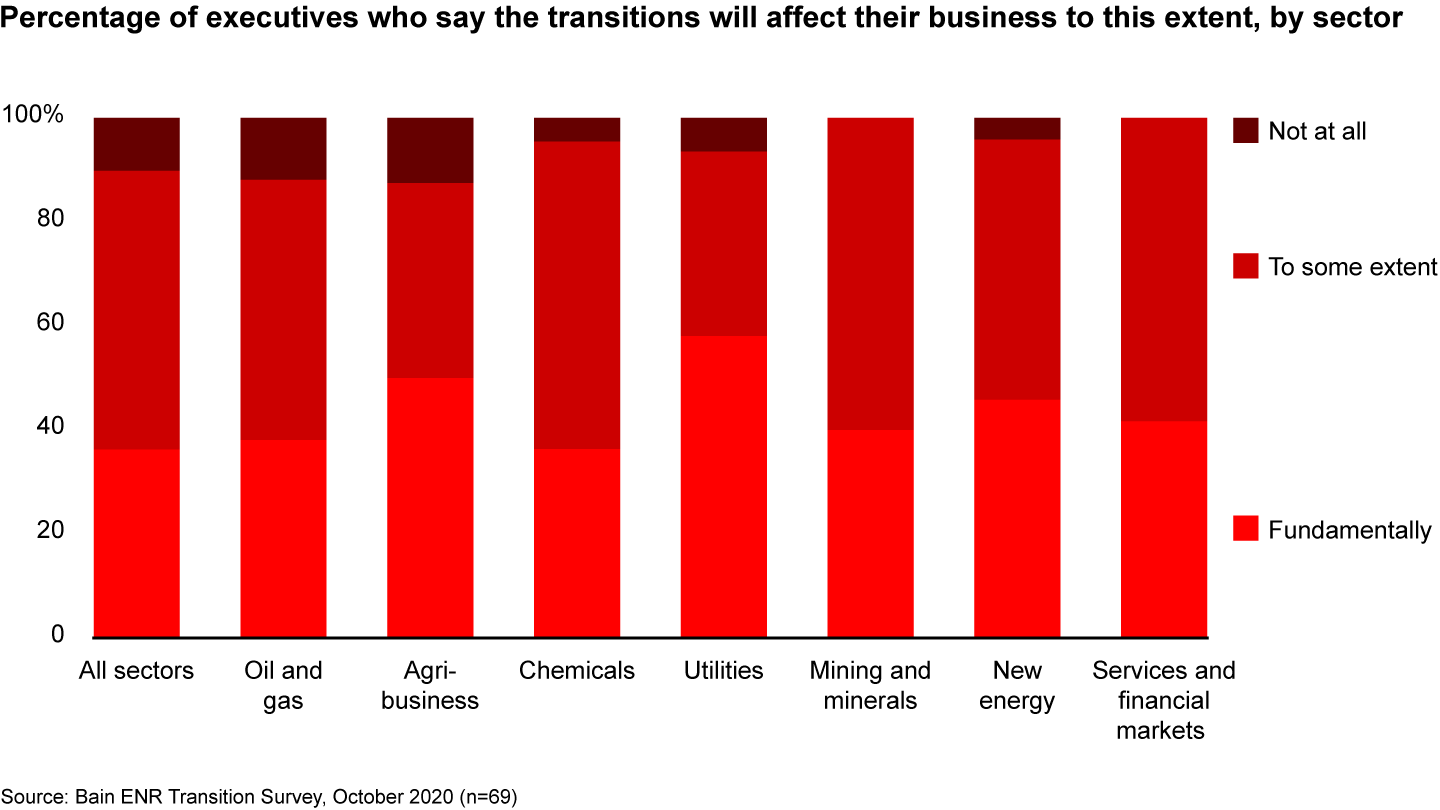
      Most executives say the energy and resource transition will change their company’s core business

      At the same time, they’re also creating new opportunities in related businesses, and this is where many of those executives already realize they need to focus. The technical, operational, and management capabilities that serve these companies well today are going to help them move into adjacent businesses like carbon capture and storage, green hydrogen, electrification and batteries, new minerals, energy as a service, sustainable packaging, and high-margin sustainable food.

      We call this Engine 2, the development of a second source of growth within the company that draws on the assets and capabilities of the core business, applying them in new ways. A successful Engine 2 taps the entrepreneurial energy of a start-up while taking advantage of the full benefits of scale of the entire organization.

      40%

      Amount of growth that executives believe will be needed from new models over the next 5 to 10 years

      66%

      Share of executives who predict that their main competitor 5 years from now will be different from one they worry about today

      In the energy and natural resources sector, two forces are coming together to create new growth opportunities: the demand for sustainability, and the new technologies that are making more sustainable businesses possible. While many of these technologies like solar and wind have been around for a while, they’ve only recently reached levels of maturity that make them cost effective and competitive with older technology. That’s opening the door for businesses that are as focused on the bottom line as on their sustainability goals. 

      In today’s environment of intense scrutiny, the benefits of an Engine 2 that emphasizes sustainability go beyond revenue generation. Engine 2 ventures can be an important signal to investors that leadership is keenly aware of pressures on the existing business and has its eye on the profit pools of the future. Although the initial revenues from Engine 2 will be small, they can boost confidence in the company's future, making investments more attractive. Engine 2 efforts are also vital in attracting top talent, particularly in industries that are often considered slow to move or resistant to new technology.

      What to look for in an Engine 2

      How should companies decide where to place bets that allow them to stand out from the crowd? Bain’s research has identified four factors common to successful Engine 2s. 

      • Rapidly growing profit pools, fueled by big trends. These future-fit profit pools include zero-carbon energy, carbon markets, green steel, sustainable fuels, high-margin sustainable food products, specialty chemicals, and commodities for batteries, like lithium, nickel, and cobalt.
      • New levers of competitive advantage, often because technology has blurred business boundaries. In energy, for example, upstream companies are starting to compete with renewable energy pure-plays, traditional utilities, storage providers, carbon offset providers, and start-ups.
      • Capabilities or skills from Engine 1 that power Engine 2. These could be resource access, project development or integration skills, technology, customers, partners, or access to capital, which all can provide advantages to Engine 2.
      • An entrepreneurial spirit inside the company. This may not come naturally to incumbents that have grown by developing resources with capex-intense, large assets. But it’s essential to nurture because one of the main reasons for Engine 2 failures is that incumbents underestimate the competitors that are already in the market. Remember, your Engine 2 is someone else’s Engine 1.

      Across energy and natural resources sectors, the same underlying triggers (sustainability and technology) are feeding these conditions for Engine 2 growth. As a result, many players within each industry are looking at the same list of Engine 2 themes (see Figure 2).

      Figure 2
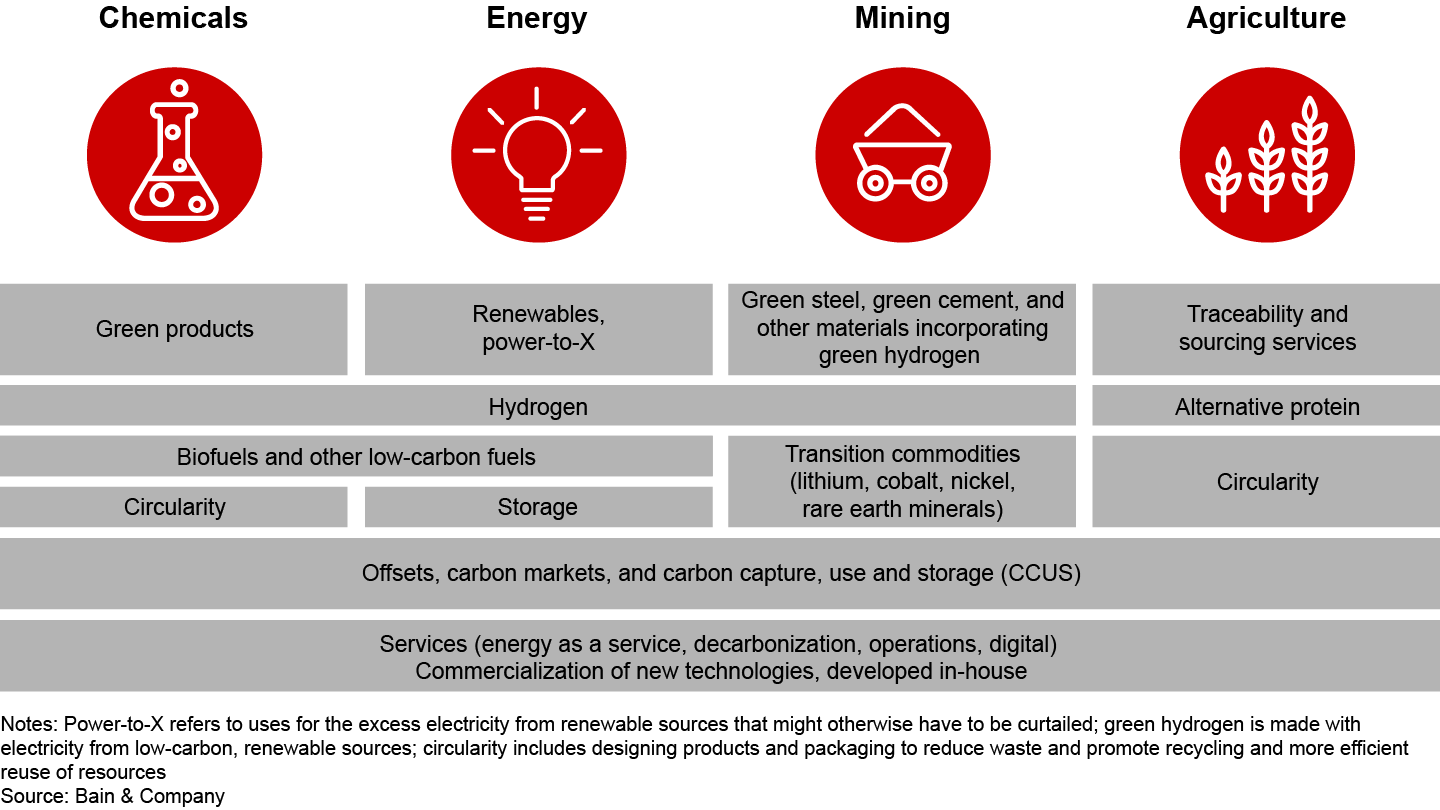
      Energy and natural resources companies are pursuing a common set of Engine 2 opportunities

      But if most players are looking at similar options, how do you avoid your Engine 2 becoming just another Engine 2? The real secret sauce for Engine 2 success is the “how.” 

      How to do Engine 2

      Treat the customer as the battleground. Many energy and resources businesses will have treated the resource, the cost curve, the asset, the underground reservoir, or the infrastructure as the Engine 1 battleground. Even for commodity business, the battleground in Engine 2 is much more the customer. Customers’ businesses are changing, and that creates the Engine 2 opportunities to frame new solutions based on needs that customers may not yet have fully articulated. Engine 2s will demand more attention across the full R&D, product development, sales, marketing and customer service life cycle. For example, a specialty chemicals company worked closely with a select group of customers to understand the full potential of a new biodegradable polymer in specialist packaging applications. It chose the customers not only for their willingness to explore the potential of the new material, but also because they were likely to become vocal advocates for the new material once they understood its value.

      Invest as if building a new business. The business case needs to be strong to invest in Engine 2, but no one should expect the economics to pay off like Engine 1―at least not at first. Not unlike venture capital, investment needs to meet the long-term goals of the company rather than the short-term needs of an investor market.

      New endeavors are less likely to be a single big investment, like a billion-dollar plant or new product development. They’re more likely to involve smaller and sequenced investments, triggered by testing and learning with customers―just like in a start-up. Because many Engine 2 opportunities are new businesses, it’s not certain how the profit pools will develop, so companies need to keep their options open.

      In fact, because Engine 2 options often involve unfamiliar experience curves (green hydrogen operates, for example, on different experience curves to traditional energy experience curves), speed of investment really matters to secure early-mover advantage with customers. It will take time to move down the experience curves, connect demand and supply, and develop the markets. 

      As with any new business, making the best use of partnerships for customers, capabilities, and capital is key. Sometimes the right first move isn’t as the owner but as a minority interest in something with existing momentum. Hedging this way can also be an important signal of continuity to investors who remain committed to Engine 1 revenues and business models.

      Adopt an insurgent growth model. Managing an Engine 2 within a large business requires a nuanced balance to take advantage of the parent’s capability, while moving with the speed and energy of an insurgent. The growth model is closer to building a new venture than expanding the core business, with a fair amount of test-and-learn on the go. In this type of pursuit, it’s usually better to get started on something than to wait for the perfect plan. After all, your competitors are already on the move.

      ENR companies, particularly those with an engineering heritage, may struggle with this. They built their success on engineering projects to perfection, including capex and risk-heavy assets that fueled growth for decades. That model won’t work as well in an environment where they’re competing against start-ups, and outcomes are less certain. But every organization has people who can make this leap, bringing some of the mature organization’s DNA into the fray for the next-generation marketplace.

      The energy transition and the shift to a lower-carbon economy present natural opportunities for Engine 2s among today’s ENR incumbents―and the field is likely to crowd around the most promising contenders. Moving assertively and treating Engine 2 like a new venture rather than simply a new product or technology will help leaders launch new growth opportunities best suited to their capabilities and market position. Approaching the opportunity with a customer orientation and an insurgent mindset will be key to gaining and maintaining a competitive edge in Engine 2.

      Read the Next Chapter

      Accelerating the Journey to Net Zero

      Read our 2021 Energy and Natural Resources Report

      Explore the full report Download the PDF

      More from the report

      • Two out of Three Won’t Do

      • Harnessing the Energy and Resource Transition

      • Net Zero: From Political Targets to Industry Action

      • Energy Is Only One Part of the Sustainability Transition

      • Redesigning Value Chains to Deliver More Sustainable Goods

      • Time for ESG Investors and Energy and Natural Resources Companies to Work Together

      • Business Opportunities in Low-Carbon Hydrogen

      • Raising Productivity in Energy and Natural Resources Capital Projects

      • Creating Resilience, Sustainability, and Accountability in Supply Chains

      • Engine 2: How to Grow a Sustainable New Business

      • Accelerating the Journey to Net Zero

      • Four Ways to Scale Digital in Energy and Natural Resources Companies

      저자
      • Headshot of Sasha Duchnowski
        Sasha Duchnowski
        파트너, Chicago
      • Headshot of Aleksander Lyngvi
        Aleksander Lyngvi
        파트너, Helsinki
      • Headshot of Brian Murphy
        Brian Murphy
        파트너, Perth
      문의하기
      관련 산업
      • 금속 및 광업
      • 농업 관련 산업
      • 석유 및 가스
      • 에너지와 천연자원
      • 유틸리티 및 재생가능 에너지
      • 화학
      관련 컨설팅 서비스
      • 지속 가능성 및 기업의 사회적 책임
      • Innovation & Business Building
      최적의 솔루션 찾기
      • Climate Change
      Energy and Natural Resources Report
      The Dual Challenge of the Energy Transition Is Urgent and Unprecedented

      Meeting the growing demand for energy while also reducing greenhouse gas emissions is the central challenge of the 21st century.

      자세히 보기
      Energy and Natural Resources Report
      The Energy Transition’s Other Big Puzzle: Making the Math Work

      Strong investment returns are within reach for companies that focus on the fundamentals and aren’t afraid to get creative.

      자세히 보기
      에너지와 천연자원
      Sustaining Capital: From Chaos to Discipline

      Fragmented budgets, poor visibility, and missed forecasts are fixable with the right approach.

      자세히 보기
      Climate Change
      Financing Climate Solutions in Brazil

      A study conducted by Bain, in partnership with BNDES, highlights both the challenges and the opportunities to accelerate the climate transition.

      자세히 보기
      지속 가능성 및 기업의 사회적 책임
      Venturing to Innovate: Five Strategic Insights for the C-Suite

      Five insights crucial for companies exploring the venture ecosystem.

      자세히 보기
      First published in 6월 2021
      태그
      • 금속 및 광업
      • 농업 관련 산업
      • 석유 및 가스
      • 에너지와 천연자원
      • 유틸리티 및 재생가능 에너지
      • 지속 가능성 및 기업의 사회적 책임
      • 화학
      • Climate Change
      • Energy and Natural Resources Report
      • Innovation & Business Building

      프로젝트 사례

      전략 New products propel profitability for metals manufacturer

      See more related case studies

      M&A An OFS captures post-merger growth synergies

      See more related case studies

      M&A Broader market plus tighter sales strategy equals big success for a portfolio company

      See more related case studies

      베인에 궁금하신 점이 있으신가요?

      베인은 주저 없이 변화를 마주할 줄 아는 용감한 리더들과 함께합니다. 그리고, 이들의 담대한 용기는 고객사의 성공으로 이어집니다.

      급변하는 비즈니스 환경에서 살아남기 위한 선도자의 시각. 월간 Bain Insights에서 글로벌 비즈니스의 핵심 이슈를 확인하십시오.

      *개인정보 정책을 읽었으며 그 내용에 동의합니다.

      Privacy Policy를 읽고 동의해주십시오.
      Bain & Company
      문의하기 환경정책 Accessibility 이용약관 개인정보 보호 쿠키 사용 정책 Sitemap Log In

      © 1996-2026 Bain & Company, Inc.

      문의하기

      무엇을 도와드릴까요?

      • 프로젝트 문의
      • 채용 정보
      • 언론
      • 제휴 문의
      • 연사 초청
      오피스 전체보기