
Skip to Content
  • 오피스

    오피스

    미주
    • Atlanta
    • Austin
    • Bogota
    • Boston
    • Buenos Aires
    • Chicago
    • Dallas
    • Denver
    • Houston
    • Los Angeles
    • Mexico City
    • Minneapolis
    • Monterrey
    • Montreal
    • New York
    • Rio de Janeiro
    • San Francisco
    • Santiago
    • São Paulo
    • Seattle
    • Silicon Valley
    • Toronto
    • Washington, DC
    유럽, 중동, 아프리카
    • Amsterdam
    • Athens
    • Berlin
    • Brussels
    • Copenhagen
    • Doha
    • Dubai
    • Dusseldorf
    • Frankfurt
    • Helsinki
    • Istanbul
    • Johannesburg
    • Kyiv
    • Lisbon
    • London
    • Madrid
    • Milan
    • Munich
    • Oslo
    • Paris
    • Riyadh
    • Rome
    • Stockholm
    • Vienna
    • Warsaw
    • Zurich
    아시아, 호주
    • Bangkok
    • Beijing
    • Bengaluru
    • Brisbane
    • Ho Chi Minh City
    • Hong Kong
    • Jakarta
    • Kuala Lumpur
    • Manila
    • Melbourne
    • Mumbai
    • New Delhi
    • Perth
    • Seoul
    • Shanghai
    • Singapore
    • Sydney
    • Tokyo
    오피스 전체보기
  • 얼럼나이
  • 미디어 센터
  • 구독
  • 연락처
  • Korea | 한국어

    지역 및 언어 선택

    글로벌
    • Global (English)
    미주
    • Brazil (Português)
    • Argentina (Español)
    • Canada (Français)
    • Chile (Español)
    • Colombia (Español)
    유럽, 중동, 아프리카
    • France (Français)
    • DACH Region (Deutsch)
    • Italy (Italiano)
    • Spain (Español)
    • Greece (Elliniká)
    아시아, 호주
    • China (中文版)
    • Korea (한국어)
    • Japan (日本語)
  • Saved items (0)
    Saved items (0)

    You have no saved items.

    관심 있는 내용을 북마크하여 Red 폴더에 저장할 수 있습니다. Red 폴더 에서 저장된 내용을 읽거나 공유해보세요.

    Explore Bain Insights
  • 산업
    메인 메뉴

    산업

    • 우주항공, 방산 및 정부 서비스
    • 농업 관련 산업
    • 화학
    • 인프라, 건설 및 건축 자재
    • 소비재
    • 금융 서비스
    • 헬스케어
    • 산업용 기계 및 장비
    • 미디어 및 엔터테인먼트
    • 금속
    • 광업
    • 석유 및 가스
    • 제지 및 패키징 산업
    • 사모펀드
    • 사회 및 공공 부문
    • 유통
    • 기술
    • 텔레콤
    • 운송
    • 여행·여가
    • 유틸리티 및 재생가능 에너지
  • 컨설팅 서비스
    메인 메뉴

    컨설팅 서비스

    • Customer Experience
    • ESG
    • Innovation
    • M&A
    • 운영
    • 조직
    • 사모펀드
    • 고객 전략 및 마케팅
    • 전략
    • AI, 인사이트 및 솔루션
    • Technology
    • 변화 혁신
  • Digital
  • 인사이트
  • 베인 소개
    메인 메뉴

    베인 소개

    • 업무 소개
    • 베인의 신념
    • 구성원 및 리더십 소개
    • 고객 성과
    • 주요 수상 경력
    • 글로벌 파트너사
    Further: Our global responsibility
    • 다양성과 포용
    • 사회 공헌 활동
    • Sustainability
    • World Economic Forum
    Learn more about Further
  • Careers
    메인 메뉴

    Careers

    • Work with Us
      Careers
      Work with Us
      • Find Your Place
      • Our Work Areas
      • Integrated Teams
      • Students
      • Internships & Programs
      • Recruiting Events
    • Life at Bain
      Careers
      Life at Bain
      • Blog: Inside Bain
      • Career Stories
      • Our People
      • Where We Work
      • Supporting Your Growth
      • Affinity Groups
      • Benefits
    • Impact Stories
    • Hiring Process
      Careers
      Hiring Process
      • What to Expect
      • Interviewing
    FIND JOBS
  • 오피스
    메인 메뉴

    오피스

    • 미주
      오피스
      미주
      • Atlanta
      • Austin
      • Bogota
      • Boston
      • Buenos Aires
      • Chicago
      • Dallas
      • Denver
      • Houston
      • Los Angeles
      • Mexico City
      • Minneapolis
      • Monterrey
      • Montreal
      • New York
      • Rio de Janeiro
      • San Francisco
      • Santiago
      • São Paulo
      • Seattle
      • Silicon Valley
      • Toronto
      • Washington, DC
    • 유럽, 중동, 아프리카
      오피스
      유럽, 중동, 아프리카
      • Amsterdam
      • Athens
      • Berlin
      • Brussels
      • Copenhagen
      • Doha
      • Dubai
      • Dusseldorf
      • Frankfurt
      • Helsinki
      • Istanbul
      • Johannesburg
      • Kyiv
      • Lisbon
      • London
      • Madrid
      • Milan
      • Munich
      • Oslo
      • Paris
      • Riyadh
      • Rome
      • Stockholm
      • Vienna
      • Warsaw
      • Zurich
    • 아시아, 호주
      오피스
      아시아, 호주
      • Bangkok
      • Beijing
      • Bengaluru
      • Brisbane
      • Ho Chi Minh City
      • Hong Kong
      • Jakarta
      • Kuala Lumpur
      • Manila
      • Melbourne
      • Mumbai
      • New Delhi
      • Perth
      • Seoul
      • Shanghai
      • Singapore
      • Sydney
      • Tokyo
    오피스 전체보기
  • 얼럼나이
  • 미디어 센터
  • 구독
  • 연락처
  • Korea | 한국어
    메인 메뉴

    지역 및 언어 선택

    • 글로벌
      지역 및 언어 선택
      글로벌
      • Global (English)
    • 미주
      지역 및 언어 선택
      미주
      • Brazil (Português)
      • Argentina (Español)
      • Canada (Français)
      • Chile (Español)
      • Colombia (Español)
    • 유럽, 중동, 아프리카
      지역 및 언어 선택
      유럽, 중동, 아프리카
      • France (Français)
      • DACH Region (Deutsch)
      • Italy (Italiano)
      • Spain (Español)
      • Greece (Elliniká)
    • 아시아, 호주
      지역 및 언어 선택
      아시아, 호주
      • China (中文版)
      • Korea (한국어)
      • Japan (日本語)
  • Saved items  (0)
    메인 메뉴
    Saved items (0)

    You have no saved items.

    관심 있는 내용을 북마크하여 Red 폴더에 저장할 수 있습니다. Red 폴더 에서 저장된 내용을 읽거나 공유해보세요.

    Explore Bain Insights
  • 산업
    • 산업

      • 우주항공, 방산 및 정부 서비스
      • 농업 관련 산업
      • 화학
      • 인프라, 건설 및 건축 자재
      • 소비재
      • 금융 서비스
      • 헬스케어
      • 산업용 기계 및 장비
      • 미디어 및 엔터테인먼트
      • 금속
      • 광업
      • 석유 및 가스
      • 제지 및 패키징 산업
      • 사모펀드
      • 사회 및 공공 부문
      • 유통
      • 기술
      • 텔레콤
      • 운송
      • 여행·여가
      • 유틸리티 및 재생가능 에너지
  • 컨설팅 서비스
    • 컨설팅 서비스

      • Customer Experience
      • ESG
      • Innovation
      • M&A
      • 운영
      • 조직
      • 사모펀드
      • 고객 전략 및 마케팅
      • 전략
      • AI, 인사이트 및 솔루션
      • Technology
      • 변화 혁신
  • Digital
  • 인사이트
  • 베인 소개
    • 베인 소개

      • 업무 소개
      • 베인의 신념
      • 구성원 및 리더십 소개
      • 고객 성과
      • 주요 수상 경력
      • 글로벌 파트너사
      Further: Our global responsibility
      • 다양성과 포용
      • 사회 공헌 활동
      • Sustainability
      • World Economic Forum
      Learn more about Further
  • Careers
    최근 검색어
      최근 방문 페이지

      Content added to saved items

      Saved items (0)

      Removed from saved items

      Saved items (0)

      Brief

      IT in M&A: Increasing the Odds of a Successful Integration

      IT in M&A: Increasing the Odds of a Successful Integration

      Leaders focus on making new opportunities happen, while planning for long-term savings.

      글 Sachin Shah, Marc Lino and Vishy Padmanabhan

      • 읽기 소요시간

      Brief

      IT in M&A: Increasing the Odds of a Successful Integration
      en

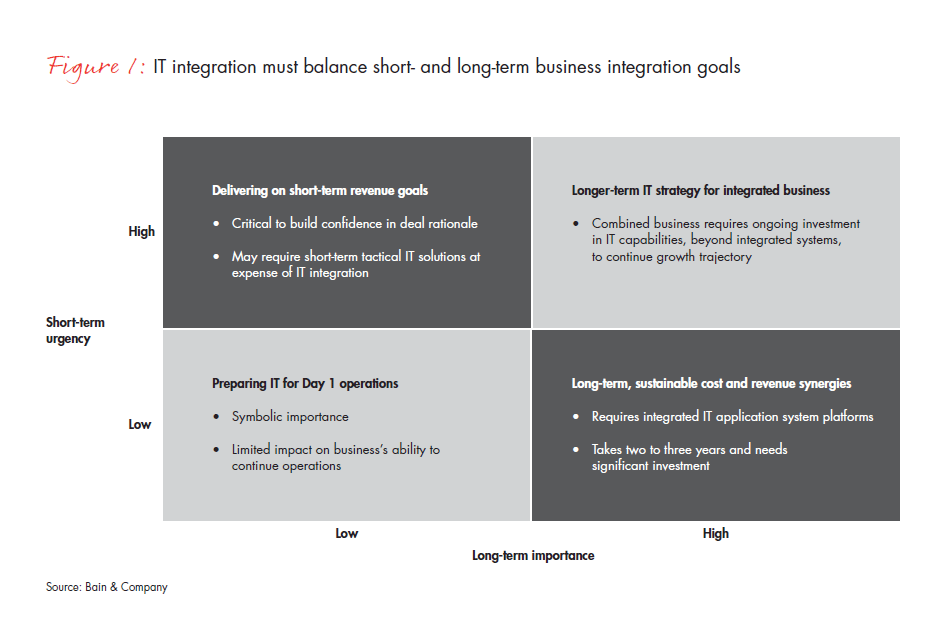
      In every merger or acquisition, companies integrating their IT systems face two conflicting needs. The business wants to start cross-selling the products and services of the newly combined organization as quickly as possible to increase revenues. IT, taking a longer-term view, wants to invest the time and effort to integrate the combined organization’s systems effectively. Both goals are critical to merger success—and the sooner they happen, the quicker IT can begin generating incremental value for the new business (see Figure 1).

      it-in-m-andd-a-increasing-the-odds-fig-01_embed

      But too often, executives lose valuable time in the early weeks and months after a deal completes by taking too long to decide on critical issues, such as which platforms the new organization will run on and the best approach to IT integration. Often they focus on the wrong issues, including lower-priority projects like merging email, intranets or other systems that could continue to run independently or with patched connections without slowing down the new business. 

      In successful IT integrations, executives work quickly to determine which decisions are most important, and how to make those decisions quickly. This reduces uncertainty about how the company will integrate its platforms and what the end state will look like. 

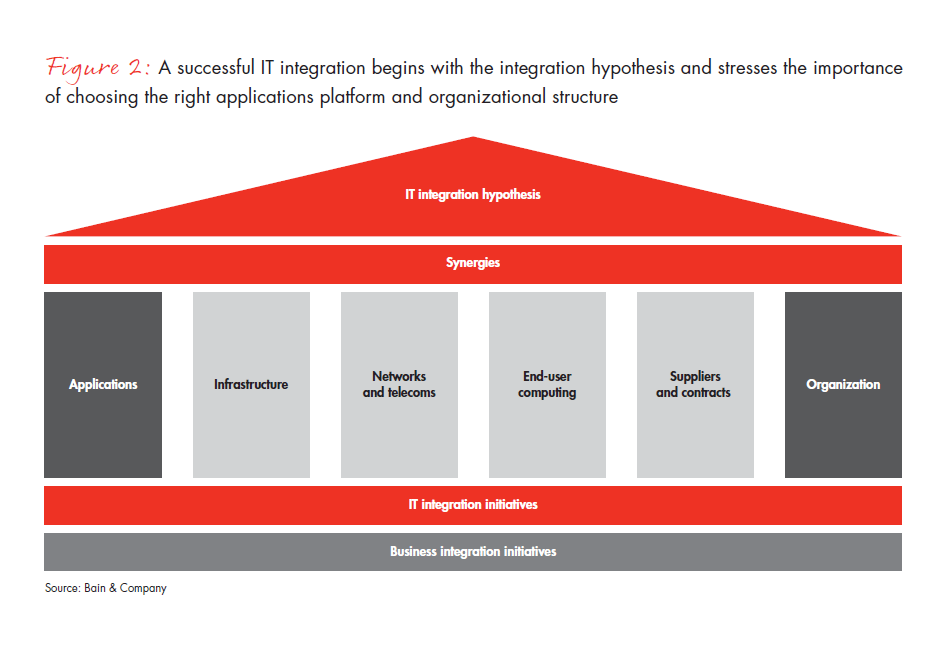
      • By the end of the first month, they should have a clear idea of the company’s IT integration goals and hypothesis (see Figure 2).
      • At the end of three months, they should know the shape and makeup of the future integrated application systems platforms, as well as how much they will need to invest and where they will get the resources. By this time, they should also know where integration is most important, which systems can continue to run independently and where interface connections are good enough for a while. They should also have defined the benefits they expect and how to manage the implementation risks.
      • After the first year, the integrated systems should be delivering at least half the value in cost and revenue synergies, as envisioned by the merger deal thesis. Full integration should be completed within two or three years.

      Getting this right is more important than ever, as low interest rates and abundant capital spur more M&A activity. The rewards are worth the effort: Bain’s research finds that companies that take part in M&A deliver higher total shareholder returns (4.8%) than those that stay on the sidelines (3.3%). (For more details, see the Bain Brief “The renaissance in mergers and acquisitions: The surprising lessons of the 2000s.”) Given IT’s critical role in determining whether mergers deliver their expected value, the key strategic decisions belong not only to IT executives but also to CEOs and other senior executives. Ideally, senior IT executives should make the recommendations and then work with the CEO and other senior managers to make decisions. The governance model of the post-merger organization will also help determine who makes those decisions. When one dominant partner is acquiring another, decision making tends to be easier (and quicker) than in a merger of equals.

      it-in-m-andd-a-increasing-the-odds-fig-02_embed

      Defining the goals of integration

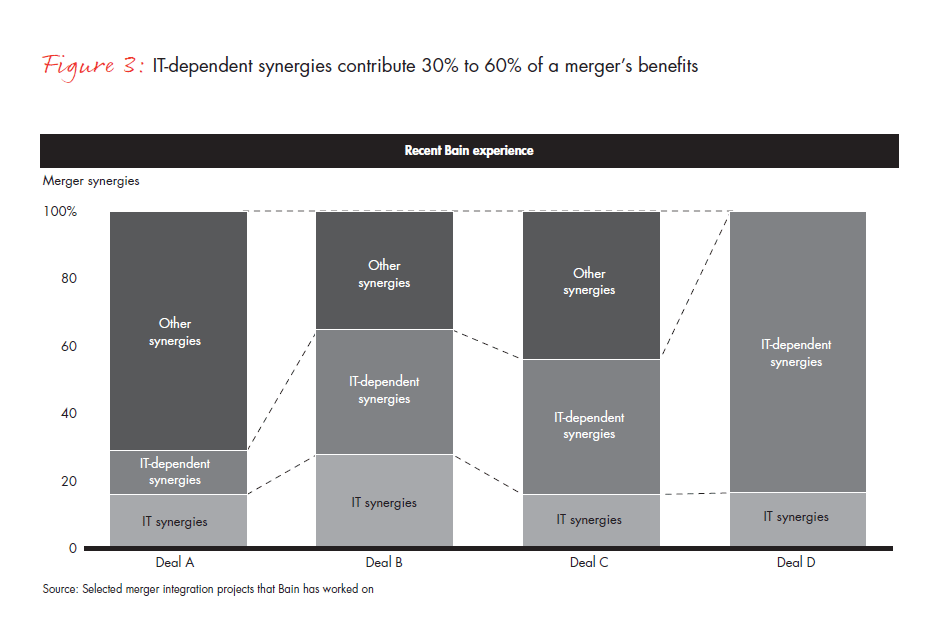
      The first step in a successful merger of IT organizations— one that is often overlooked—is to determine IT’s role in supporting the deal thesis. This important first decision clarifies the business value that IT will contribute to the merger (see Figure 3). Once the business integration principles are clear, they create a solid foundation on which to make other decisions.

      it-in-m-andd-a-increasing-the-odds-fig-03_embed

      With the business integration goals clear, the team can decide on the platform that best equips the company for future success—whether that’s using one company’s systems, employing a hybrid mix from both or continuing to run each company’s systems independently. With that decision made, others about infrastructure, organization, suppliers and outsourcing become easier to make.

      The merger of Kraft Foods and Cadbury in 2010 shows how answering the right questions promptly can help ensure a successful integration. One of the most compelling opportunities of the merger was the potential to cross-sell each company’s products through the other’s distribution channels. Kraft Foods was strong in food and snacks in North America and Europe, while Cadbury had a solid customer base for its confectionary products in Europe, India, Australia and other Commonwealth countries. To cross-sell, the company needed one platform. Kraft Foods had spent several years consolidating its systems and was heading toward a position of having three regional platforms—in North America, Europe and Asia-Pacific. Cadbury had a more distributed application platform footprint with 15 key platforms and a goal of consolidating down to nine. Executives decided to move all of Cadbury’s business to Kraft Food’s platforms because they were more modern and supported multiple operating models, and Kraft Foods was twice the size of Cadbury. Kraft Foods also had a good track record of consolidating and implementing its systems. Within a year, the combined company had achieved half of its intended integration synergies, and the entire IT integration was completed within three years.

      Sachin Shah, a partner in Bain's Information Technology practice, outlines four things an organization needs to get right for a successful IT integration project.

      Traits of successful integration

      In addition to starting with the right questions and adopting a clear understanding of the goals, successful mergers share several other pragmatic principles that help ensure a successful IT integration in the days and months after companies merge.

      • Focus on revenues. Many companies focus on cost savings right after a merger, but their first obligation should be to pursue new revenues, even if that means running two IT systems independently for a while. The upside of cross-selling combined products and services across both companies’ customer bases often far outstrips cost savings. In most airline mergers, for example, revenue synergies are a bigger target than cost savings. So it makes sense to quickly choose the reservation system that best suits customers’ needs and create value from selling each airline’s routes to both customer bases.
      • Act fast to support business goals. IT executives often want to pick and choose the best of breed from each organization’s application systems. But the costs of selecting and reconnecting these systems may outweigh the benefits to be gained. A more pragmatic strategy is to pick the best anchor system—reservations, for example, with an airline—and then consider living with the auxiliary systems that are tied to it. As integration continues, executives will want to weigh the value of changing those systems against the costs.
      • Prioritize ruthlessly. Align decisions with the business goals, and execute quickly and decisively. Leaders don’t shy away from cutting large projects that are no longer essential, even when it’s painful to project owners. When one beer company acquired another, it stopped a multimillion-dollar CRM project that was well under way, because it wasn’t needed in the combined company.
      • Hold on to talent. People experience a lot of uncertainty and anxiety during a merger, so it’s more important than ever for senior managers to actively communicate with top talent. Good people may leave during the integration if they think the deal could limit their futures. In one merger, IT executives in the company being acquired were actively looking for new job opportunities, since they thought they would be redundant in the new company. They didn’t realize that the acquirer was actually glad to have the chance to replace some of its own staff with new talent from the company being acquired. When the acquiring company learned what was happening, managers gave incentives to top talent so they would stay in the newly merged organization.

      Beyond the merger

      One of the risks inherent in mergers is that, with everyone focused on integration, the IT department can get derailed from its longer-term journey, which depends on developing technologies that support the company’s growth ambitions. It may be helpful to assign a team to look specifically at opportunities beyond the merger and to continue developing applications in line with the new company’s IT strategy, as well as to experiment with new technologies that may contribute to future growth, such as advanced data analytics or cloud computing.

      It is also important to set boundaries that signal an explicit transition from merger integration back to business. Change will no doubt continue, but at some point, the emphasis switches from integration to transformation, allowing the newly merged company to move forward as a single, integrated venture.

      Sachin Shah is a partner with Bain & Company in London. Marc Lino is a Bain partner in Amsterdam, and Vishy Padmanabhan is a partner in Bain’s Dallas office. All three partners work with Bain’s Global Information Technology practice.


      저자
      • Headshot of Sachin Shah
        Sachin Shah
        파트너, London
      • Headshot of Marc Lino
        Marc Lino
        파트너, Dubai
      • Vishy Padmanabhan
        Former Partner, New York
      문의하기
      관련 컨설팅 서비스
      • 정보기술(IT)
      • M&A
      • Post-Merger Integration
      M&A
      Integrating cultures after a merger

      Practical tools for measuring cultural differences—and for managing the challenge of combining two organizations.

      자세히 보기
      M&A
      The renaissance in mergers and acquisitions: What to do with all that cash?

      Several macro trends will combine to make M&A essential for profitable growth this decade.

      자세히 보기
      기술
      How to Keep Control of an IT System That's Outsourced to Multiple Suppliers

      To master increasingly complex IT, companies are turning to multiple suppliers. But that strategy creates another risk: loss of control over mission-critical functions.

      자세히 보기
      정보기술(IT)
      In M&A, Successful Acquirers Master Process and Systems Integration

      Bain Partner Laurent Hermoye outlines five core elements that can make or break deal value.

      자세히 보기
      M&A
      Media M&A

      AI and other tech tools can boost bidding confidence in this highly competitive environment.

      자세히 보기
      First published in 2월 2014
      태그
      • 정보기술(IT)
      • M&A
      • Post-Merger Integration

      프로젝트 사례

      성과 개선 Aggressively growing an IT service provider with a high-performance culture

      See more related case studies

      M&A An OFS captures post-merger growth synergies

      See more related case studies

      고객 전략 및 마케팅 Salesforce integration generates M&A success in healthcare

      See more related case studies

      베인에 궁금하신 점이 있으신가요?

      베인은 주저 없이 변화를 마주할 줄 아는 용감한 리더들과 함께합니다. 그리고, 이들의 담대한 용기는 고객사의 성공으로 이어집니다.

      급변하는 비즈니스 환경에서 살아남기 위한 선도자의 시각. 월간 Bain Insights에서 글로벌 비즈니스의 핵심 이슈를 확인하십시오.

      *개인정보 정책을 읽었으며 그 내용에 동의합니다.

      Privacy Policy를 읽고 동의해주십시오.
      Bain & Company
      문의하기 환경정책 Accessibility 이용약관 개인정보 보호 쿠키 사용 정책 Sitemap Log In

      © 1996-2026 Bain & Company, Inc.

      문의하기

      무엇을 도와드릴까요?

      • 프로젝트 문의
      • 채용 정보
      • 언론
      • 제휴 문의
      • 연사 초청
      오피스 전체보기