

Brief
Imagine that you have two promising candidates for promotion to vice president of product engineering. Both are bright and hardworking, with an impressive track record of results. They both get things done on time and on budget. But you notice a difference: Candidate A’s team members report they are satisfied with their jobs. Their scores on employee surveys are only slightly above average. A typical comment: “He technically gets the job done, but I don’t know if he really cares about me.” Candidate B’s team members, by contrast, are overwhelming in their enthusiasm for their jobs and their boss. “She is a true leader in every sense of the word,” says one. “Her impact on me personally has been tremendous.”
It’s obvious, isn’t it? Every company wants leaders who inspire and engage their colleagues. But surprisingly few build an explicit and robust inspirational component into their leadership development programs. Many assume that the ability to inspire is an innate characteristic—difficult to describe, hard to measure and impossible to cultivate in a corporate environment.
Our experience suggests otherwise. The ability to inspire isn’t innate. It can be developed. And in today’s fierce marketplace, a company that helps people learn and strengthen their inspirational skills will gain an edge on the competition. Doing so effectively, however, requires a fundamental reexamination of how companies go about developing their leaders, and of our assumptions about leadership itself.
Leadership in a new environment
Changes in recent years have upended much of the business world. They have redefined sources of value, reshaped how people do their jobs and transformed what we expect from the workplace. Most important, these changes have magnified the need for inspiration—not only among executives but also at every level of the organization. Three changes in particular have driven inspiration to the forefront.
First, there is a shift from product to customer experience as a major source of competitive advantage, even in product-focused companies. Successful companies have always gained an edge by delivering high-value goods or services. That’s still essential. But equally important is the ability to provide an experience that customers find not just satisfying but delightful. Frontline workers—the individuals who interact with customers every day—determine the quality of the customer’s experience. They thus hold the future of the business in their hands more than ever before. Companies that hope to succeed need line employees who feel inspired by their work and can inspire their customers in turn.
A second change lies in the nature of the work itself. Most 21st-century jobs involve a great deal of collaboration, much of it with little direct supervision. More and more people collaborate across functions and reporting lines, do their jobs remotely and work in self-managing teams. All of these employees are expected to come up with their own ideas and to take responsibility for getting the job done. But how can distributed teams function well unless their members feel motivated and involved, particularly with little supervision? Individuals must bring their own motivation to do their best work—and must share that passion with the others in their team and company.
This increasingly fluid organizational structure points the way to the third big change—this one led by the Millennial generation. Today’s workplace relies less on extrinsic than on intrinsic motivation. Employees want to work hard because they believe in their company’s mission and values, not just because they hope for a large salary or a fast promotion. For Millennials in particular, their sense of “what’s in it for me” is more likely to be defined by learning and engagement than by traditional motivators. Creating inspiration—whether through leaders or through investment in the employees themselves—is now essential for attraction and retention of the best talent.
Where leadership is concerned, all of these changes point in the same direction. Leaders can no longer rely only on traditional leadership skills to be effective. They can no longer simply issue directives. Nor can leaders rely heavily on the traditional tools of motivation—the classic carrot-and-stick approach.
Instead, they now must have the ability to energize the people around them, foster engagement and create a trusting atmosphere. They must inspire their teams—and that inspiration must extend all the way to the front line.
A different kind of leadership development
Are current leadership development programs up to the task of addressing these shifting needs? In a recent Bain & Company survey of 300 human resources executives around the world, fully half said that their leadership development programs were not very effective or didn’t provide much lasting benefit. When asked why, some respondents complained that the programs were too limited in scope. Others said they found it hard to evaluate the programs or to calculate the return on investment. Still others found it difficult to tie disparate leadership approaches back to the company’s core strategy.
While these are valid, our analysis suggests a more fundamental limitation, one that few executives have yet acknowledged.
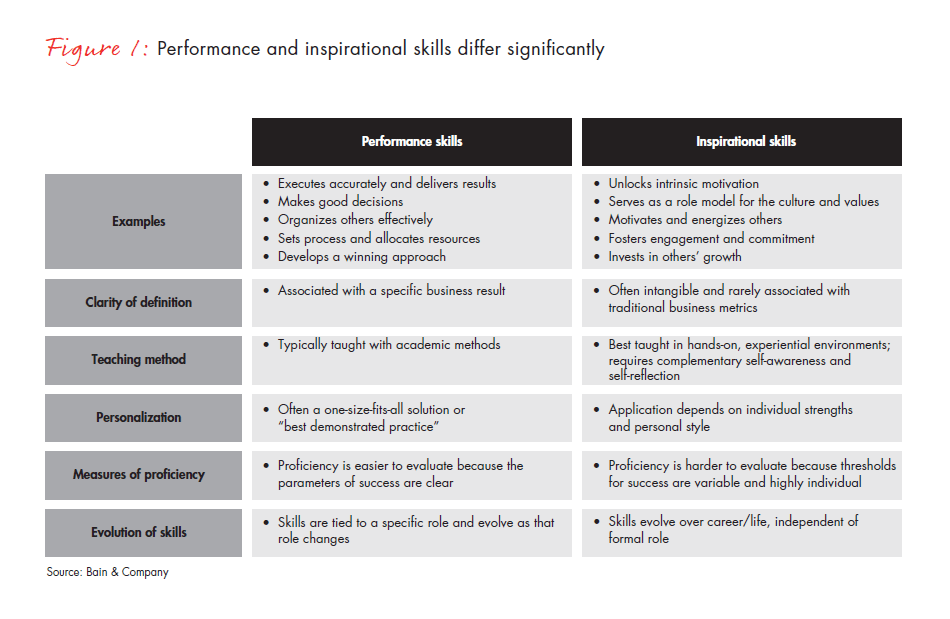
The biggest single weakness of today’s leadership development programs is that they combine performance skills and inspirational skills, or leave inspirational skills off the list altogether. Programs that do include inspiration lump together everything from strategic thinking and project management to listening and openness, and attempt to address them all the same way, with the same methods and expectations.
Yet the two sets of skills are radically different (see Figure 1). Performance skills are specific and tangible. They are oriented toward achieving a well-defined result. And whether you are creating a budget or staffing a project, there is typically a “right way” to do each of them. Inspirational skills, such as the ability to empathize or empower, are far less tangible. They are highly individual in their development and application. As a result, these skills require self-awareness, authenticity and courage. Most leadership development programs aren’t up to the job of working with individuals on capabilities that many feel are nebulous, overly personal or hard to assess. So that side of the leadership ledger gets short shrift—even though more inspirational skills are exactly what today’s environment requires.
Creating a better program
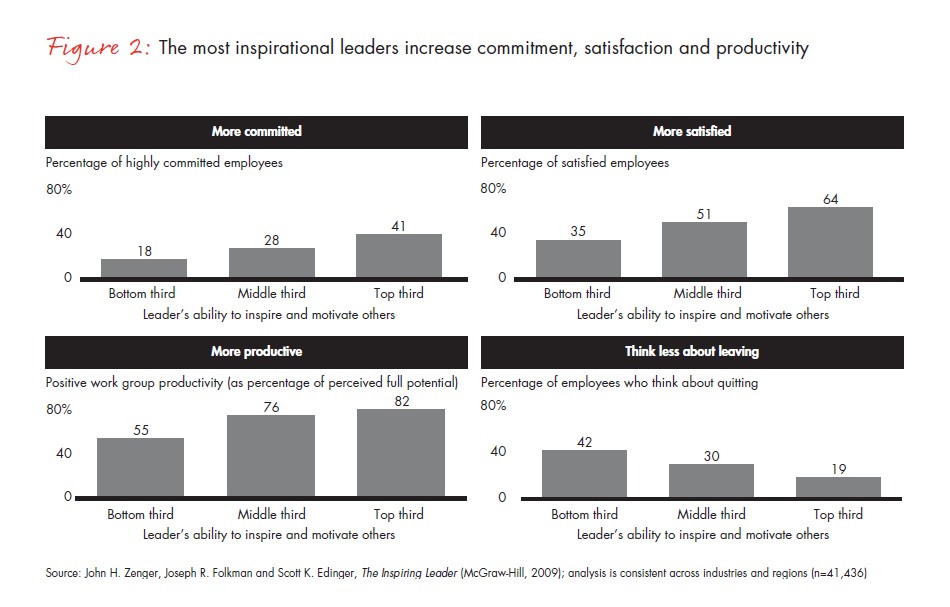
Many companies are familiar with data showing that inspiration delivers significant benefits. People who work for inspiring leaders are more committed, satisfied and productive, and they are less likely to leave their jobs (see Figure 2). Yet few companies want to rework their leadership models from scratch. The challenge is to keep current programs’ best elements while adding the inspirational component required today.
The elements to keep—or to establish if they are not present—start with tight links between the company’s strategy, the leadership model and the broader workplace culture. Leadership behaviors should be lived in the day-to-day workings of the company and supported by appropriate consequences. Further, the best leadership development programs are data-driven; they are supported by evidence and evaluated frequently. Finally, effective leadership programs generate insights that can guide key decisions about people.
But training for inspirational skills involves much more than conventional leadership development programs can offer. We often associate “inspiration” only with bold historic pioneers, such as Marie Curie or Nelson Mandela. Most of us, however, are more often inspired by everyday people—by our mentors and colleagues, by our family and friends—than we are by someone so distant from our own experience. And though few of us will ever win a Nobel Prize or lead the transformation of a nation, all of us can learn to be more inspirational to those around us, provided that we understand what inspirational skills are and how they can be learned.
When designing next-generation leadership models, companies should consider the key characteristics of inspirational leadership:
- Inspirational leadership is individual. Current leadership development programs are typically one-size-fits-all. While that may make sense for certain kinds of performance capabilities, there’s no one right way of inspiring or motivating someone. Everyone is inspired by a different combination of skills, and every individual has a different set of abilities. Learning to inspire begins with discovering and cultivating the latent strengths that each person already possesses.
- Inspirational leadership is strengths-based. When you are inspired by someone, it is almost always a particular set of skills that makes the person stand out from the crowd. An individual is inspirational because he is “the person who always listens” or because she “consistently empowers me to do more than I thought I could.” An inspirational leader is less likely to be someone who is consistently adequate than someone with a handful of traits that put her significantly ahead of her peers. An individual can multiply his inspirational leadership ability by excelling at just a handful of distinguishing strengths and neutralizing his weaknesses, rather than trying to be exceptional at everything.
- Inspirational leadership is learned experientially. Performance skills can be taught with traditional classroom or on-the-job methods. Inspirational skills are different. They have to be practiced, lived and felt, not just learned in a classroom. Developing an inspirational ability requires the motivation to increase self-awareness, embrace new ways of interacting, reflect upon their impact and revise your approach.
- Inspirational leadership can—and should—be developed by everyone. Many leadership programs target a limited number of people—the traditional constituencies of senior executives and high potentials. Those who are excluded, including most of the people on whom the company is depending, never get a chance to develop their inspirational skills. Yet companies need inspirational leaders throughout the organization, not just in the traditional chain of command.
- Inspirational leadership skills accumulate over time. Companies need people who start developing inspirational skills early in their careers, not just when they are senior enough to manage others. The sooner people get started, the stronger and more valuable those skills will be—as will the organization’s culture and leadership pipeline.
Right now, leading companies are beginning to develop programs based on these principles (see below, “Case study: A professional services firm”). They understand that their competitive edge depends on their ability to deliver a great customer experience. They know that the nature of work has changed, and that today’s employees are looking for more from their jobs than a paycheck and a pat on the back. They seek out and value their “Candidate Bs,” the leaders who truly inspire people—and they proactively develop those inspirational skills throughout their organization.
Conventional leadership development programs might have been sufficient in a 20th-century enterprise. But today’s world is different: It is more demanding and it moves faster, yet it can provide far more opportunity for everyone. Inspirational skills, properly supported and developed, are one key to a more productive future.
Case study: A professional services firm
Professional services firms are acutely aware of the changes affecting today’s workforce, because so many of their employees work offsite, interact directly with clients, participate in collaborative teams and identify as members of the Millennial generation. In response, one firm has developed an inspirational leadership system that incorporates the precepts outlined in this article. It has designed a series of trainings and interventions to help employees find the precise set of inspirational skills that combines their distinguishing strengths, underlying enthusiasm and authentic sense of self. Participants create a personal inspirational leadership development plan, informed by a 360-degree review and self-assessments. They then pursue a self-directed developmental path, supplemented by the company’s training programs and supported by the entire organization. They build inspirational skills over time and on the job through awareness, practice, reflection and experience. The firm believes that it is already seeing results in how people work together and feel about each other. Said one partner: “When we read anonymous comments like, ‘She is an inspirational leader’ or ‘He cares deeply about people on his teams,’ we know we are successfully reinforcing our core principles.”
Mark Horwitch is a partner at Bain & Company and directs Bain’s leadership programs. Meredith Whipple is senior manager in leadership. They are both based in San Francisco. The authors thank Jonas Golze, a senior Bain consultant in Sydney, and Alison Leibovitz, a Bain consultant in Atlanta, for their valuable contributions to this article.
First published in 6월 2014