

Report

한눈에 보기
- Most of the world’s major economies and many of the largest companies have set goals to reach net-zero carbon emissions over the next 30 to 40 years.
- While discussions about reaching those goals deals largely with abatement curves and net-zero studies, the actual steps to get there have more to do with raising capital and reducing risk.
- One model for public-private cooperation to reduce risk is Denmark’s climate partnerships, in which policymakers and companies share responsibility for moving toward net zero.
This article is part of Bain's 2021 Energy and Natural Resources Report.
Over the past few years, most of the world’s large economies have set targets of reaching net-zero carbon emissions over the next 30 to 40 years. To achieve these ambitious goals, investments in green technology are ramping up quickly and could surpass conventional energy investments in 5 to 10 years. It’s an impressive shift, but one that’s still too slow to meet the Paris Agreement’s goals of keeping the rise in temperature below 2.0°C in this century—unless the private and public sectors learn to work more collaboratively to encourage capital investment and reduce risk.
The roadmap to reach net-zero emissions is clear, and we can think of it in terms of four categories, each comprising a range of actions.
- Consume less energy. Reduce waste in buildings and industrial settings, and make appliances and the electricity grid more efficient.
- Decarbonize or electrify. Switch from internal combustion engines to cars and trucks that run on electricity or other low-carbon fuels. Electrify heating and industrial systems.
- Green the electricity supply. Build more renewable power generation and other zero-carbon sources of energy and capacity.
- Capture and store carbon. Build systems that capture CO₂ and other greenhouse gases during production and directly from the atmosphere. Preserve and enhance natural carbon sinks, such as forests.
To make this happen, electric grids need to be updated, gas and district heating systems will change, and energy consumers have to embrace new technologies. Electrification will play an important role, but it won’t be enough on its own. Fuels from low-carbon hydrogen need to be developed to meet some transportation and industrial needs (see “Business Opportunities in Low-Carbon Hydrogen.”) By some estimates, $50 trillion will be invested over the next 30 years in renewable energy, hydrogen, electrification, carbon capture and storage, biofuels, and infrastructure to support it all.

When Less Carbon Means More Growth
Winning companies play both offense and defense for a full-potential carbon transformation.
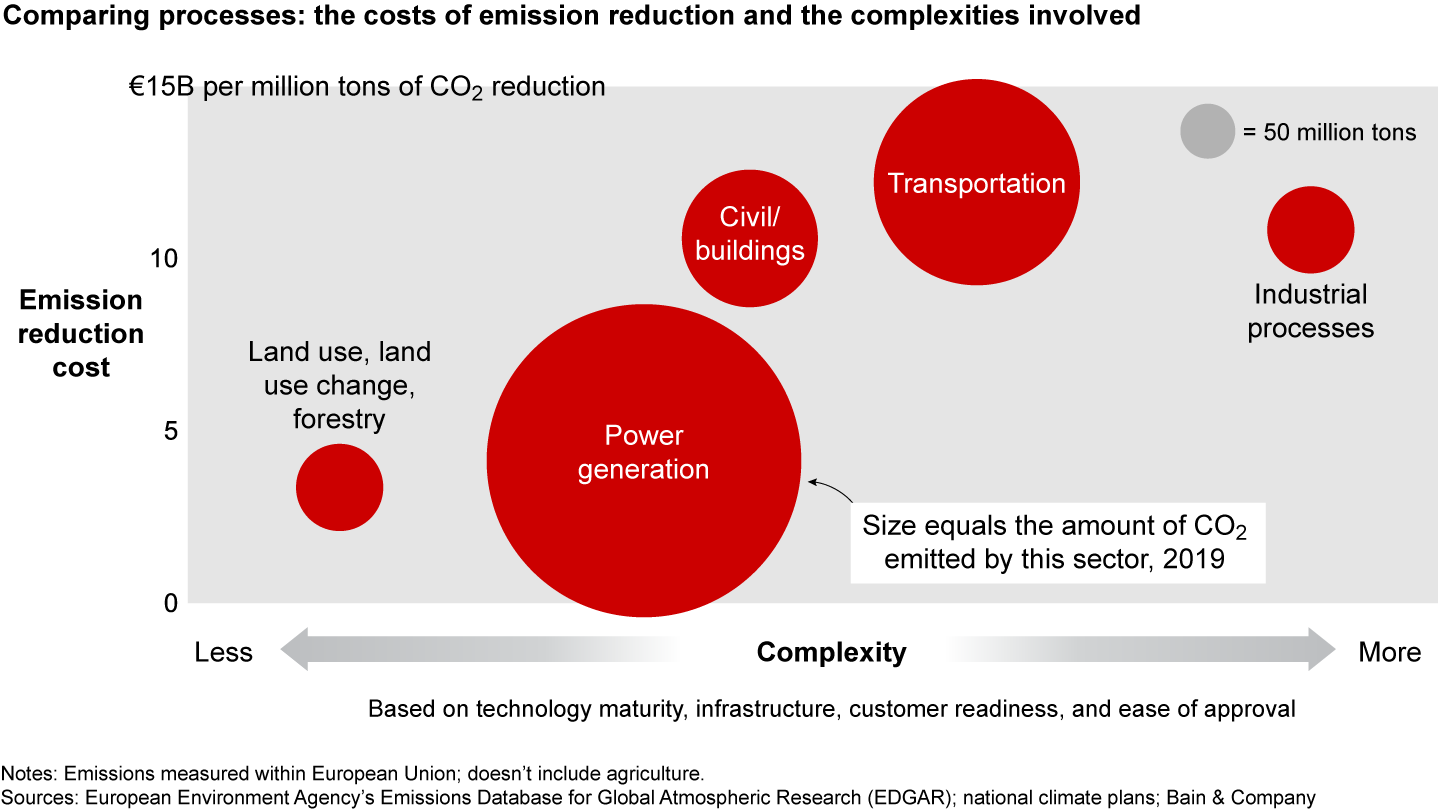
Much of the discussion on reducing emissions focuses on abatement curves and net-zero studies. While these help countries and industries think about where they have to go, getting there has more to do with encouraging capital and reducing risk. A look at nonagricultural emissions in the European Union through the lens of capital intensity and complexity shows where some of the big opportunities are, and where the private sector probably needs more support to reduce the risk of large investments (see Figure 1). In some sectors, such as power generation, the technology to reduce emissions is already well known, and the required capital investment is within reach for much of the private sector, given the right policy constructs and pricing mechanisms. However, in other sectors, where the complexity and costs remain high, such as transportation and industrial processes, managing risks will require public and private partnerships.
While the steps are clear, what’s missing is a unified approach among industry, policymakers, customers, and capital to move the world from lofty ambitions to real climate action.
Figure 1

Denmark’s national collaboration model
One model taking shape in Denmark shows how the government and the private sector can work together to promote capital formation, foster innovation, and share risks in order to move closer to that country’s goal of reducing emissions to 70% of 1990 levels by 2030, and net zero by 2050.
In the Danish government’s climate partnerships, policymakers provide the framework and conditions, while business contributes its expertise and the investment in new technology and infrastructure to meet the country’s climate ambitions.
The partnerships include energy companies in oil and gas and renewables (both utilities and original equipment manufacturers in wind, solar, biogas, and hydrogen), and companies along the grid, including transmission, distribution, and retail. The initial work has set ambitious goals for 2030, including reducing carbon emissions from the energy and utilities sector by at least 95%; cutting fossil fuel use in buildings, transportation, and industry by 50%; and developing a 10-year roadmap for hydrogen fuels.
In the partnerships’ work, risk sharing emerged as an important topic. Because energy companies invest heavily in infrastructure and generation, which often take decades to repay and are designed to last even longer, the private sector wants to ensure that the political will exists to create demand for greener energy and products. But altering consumption habits can be difficult. Prices of fossil fuels and other energy sources will help guide some changes, but for others, incentives, subsidies, and regulations may be necessary.
To reach Denmark’s target of reducing carbon emissions to 70% of 1990 levels by 2030, the country would need to generate twice as much electricity as it does today, which would require significant investments in renewable energy production and infrastructure, along with investments in new technology by industry. An analysis by Bain and the Danish Energy Association found that the country could completely phase out fossil fuels in electricity and heating, delivering clean energy to industry, agriculture, and transport.
The partnership provided a way for business and government to speed up progress toward net zero by combining strengths.
One of the partners is Danish energy company Ørsted, whose group CEO, Mads Nipper, highlighted the need for political and business collaboration. “Fixing climate change is not a technology problem,” he said. “We pretty much know the solutions to do it, and there is plenty of financial capital available. But we have a leadership problem, and it’s becoming increasingly important for business executives to take on the role as key influencers in shaping policies and national climate actions.”
The partnership provided a way for business and government to speed up progress toward net zero by combining strengths. In the initial phase, the government gave up some control to business executives, which created trust and ownership in the business community. “This work could never have been completed effectively by government alone, and would not have succeeded without the acknowledgment of all participants of their responsibility for the outcome,” said Lars Aagaard, CEO of the Danish Energy Association.
Denmark has taken important steps toward realizing its politically determined climate targets through actions that haven’t scared off the business community. Building on the work of the partnerships, the government approved laws aimed at bringing Denmark a third of the way to its 2030 targets. Executives have been able to create a productive alliance with government that looks at opportunities and threats to achieving the country’s climate goals in a balanced way, and with regulatory tools that support new business opportunities.
Unlocking the net-zero opportunity
For energy and natural resources companies, the key to this level of cooperation is improving the way they work with stakeholders and policymakers. Even small policy decisions can have multibillion-dollar effects on a large company’s energy transition. Policymakers, business leaders, and other stakeholders have to get better at resolving disputes, sharing risk, and clarifying the rules of the road—which all will be important in allowing companies to obtain the capital needed to invest in new technology.
These dialogues and perspectives need to make their way into and across energy and natural resources organizations. Adopting the stakeholder view can’t be left to the regulatory or legislative affairs teams; it must be a fundamental consideration that influences decisions about capital planning, operations, R&D, and product development. That’s the surest way to guard against company silos continuing to conduct business as usual while stakeholders and policy makers push the company in a different direction. Everyone should be aware that the stakeholder landscape is changing and understand their role in navigating it.
Collaborating closely with stakeholders is but one of the transformations required of executives at energy and natural resources companies. These executives can think about five imperatives to help capture new opportunities and move toward net zero.
- Make the shift to green technologies, whether from fossil to renewables, or from analog to digital.
- Shape the stakeholder landscape to create constructive policies and remove impediments to capital deployment.
- Engage actively with customers to capture their interest in green products, and to enlist their help in decarbonizing and reducing energy use.
- Prepare for new levels of capital deployment and scrutiny, from major capital projects to programmatic investments.
- Make sure corporate culture and processes are ready for the net-zero transition, including leadership and cultural norms, management systems, structure, accountabilities, talent strategy, and business processes.
Unlike in digital, where companies often set up use case factories to accelerate progress, this transformation must be deeply felt and embedded throughout the organization, with every employee―and the hard work of getting underway should start now.
Read our 2021 Energy and Natural Resources Report
More from the report
-
Two out of Three Won’t Do
-
Harnessing the Energy and Resource Transition
-
Net Zero: From Political Targets to Industry Action
-
Energy Is Only One Part of the Sustainability Transition
-
Redesigning Value Chains to Deliver More Sustainable Goods
-
Time for ESG Investors and Energy and Natural Resources Companies to Work Together
-
Business Opportunities in Low-Carbon Hydrogen
-
Raising Productivity in Energy and Natural Resources Capital Projects
-
Creating Resilience, Sustainability, and Accountability in Supply Chains
-
Engine 2: How to Grow a Sustainable New Business
-
Accelerating the Journey to Net Zero
-
Four Ways to Scale Digital in Energy and Natural Resources Companies
First published in 6월 2021