

Brief

한눈에 보기
- Tectonic shifts in retail are making supplier negotiations tougher. The situation requires consumer goods companies to overhaul their approach to key account management.
- For many branded players, achieving business objectives during any given year is more dependent on the quality of their relationships with key customers rather than any other, longer-term growth lever.
- The best companies build trustful and productive yearlong collaborations with their customers and create joint value plans aimed at helping both supplier and retailer economics.
- The path involves investing to understand retailer economics more thoroughly, differentiating plans based on each retailer’s needs, relying on cross-functional teams working in Agile fashion to prepare key customer touchpoints and using advanced tools to stay on top of the numbers.
Consumer goods companies are quickly discovering that winning with their key customers is becoming more critical than ever.
In some developed markets, large accounts might contribute 40% to 80% to revenue for a branded supplier. In fact, the revenue generated by big retail customers in critical geographies is often far larger than a consumer goods company’s entire business in many small countries. And the power of large accounts is mounting. In an attempt to gain scale, large retail chains in Europe are setting up alliances and buying groups with other retailers. We predict those alliances will represent close to 70% of overall grocery revenue by 2025, up from around 40% in 2013 (see Figure 1).
Figure 1


As modern trade takes root in developing markets, major accounts are gaining in importance there, too. We estimate that 30% to 60% of developing market growth will come from emerging retail leaders such as X5 in Russia, Shoprite in South Africa or Alibaba in China. The odds are that if you are not growing with these retailers, you are not growing at all.
Major retailers are also expanding and diversifying their business, moving into new channels (online), new business models (wholesalers) and different store formats (convenience). This diversification brings with it more sophisticated demands on suppliers. For example, new online players expect branded players to provide broader assortments, digital marketing solutions or 24-hour delivery on smaller orders.
These retailing changes have made the traditional key account management playbook obsolete.
Within key account management, the biggest challenge from large customers is the intensifying pressure on price negotiations. In many situations, it has become a zero-sum game, resulting in broken trust and mutual business disruption. To support their negotiations, the best-performing retailers not only leverage their size but also bring broader and deeper data to the table—for example, comparing a consumer goods company’s prices and on-shelf performance against alternatives at the SKU level within and across channels and countries.
For many branded players, achieving business objectives during any given year is more dependent on the quality of their relationships with key customers rather than any other, longer-term growth lever. So, it is no surprise that almost all consumer goods companies make customer centricity a critical pillar of their strategy. Yet, despite their repeated claims of doing just that, key account management is still highly underdeveloped at most companies.
The relationships those companies have with their customers are mostly transactional—often limited to annual negotiations and periodic review meetings between buyers and key account managers. The typical key account manager sits four levels below the CEO and is tasked with integrating myriad initiatives from every business function into a coherent annual plan. Everyone wants to see a pet project or key performance indicator (KPI) reflected, and there is little time or effort invested to understand what the customer might really want. The outcome is often a long, self-centric document that is meant more for internal consumption than for a real customer conversation, with only a few minutes to present the plan to a retailer who likely will only remember two or three ideas. Moreover, while retailers or other functions within the consumer products company may have benefited from big investments in new digital solutions or emerging data sources—for instance, advance pricing and promotional analysis solutions in trade marketing—the key account manager job continues to be performed very much over a simple spreadsheet, often missing even basic sell-out data.
Over the past five years, we have worked with consumer goods companies that are taking a far more proactive and thoughtful approach to key account management. Similar to many others, they have had their share of difficult negotiations. But they also have succeeded at building more trustful and productive yearlong collaborations with their clients and at creating joint value plans that are aimed at helping both supplier and retailer economics. We see them doing five things right (see Figure 2).
Figure 2

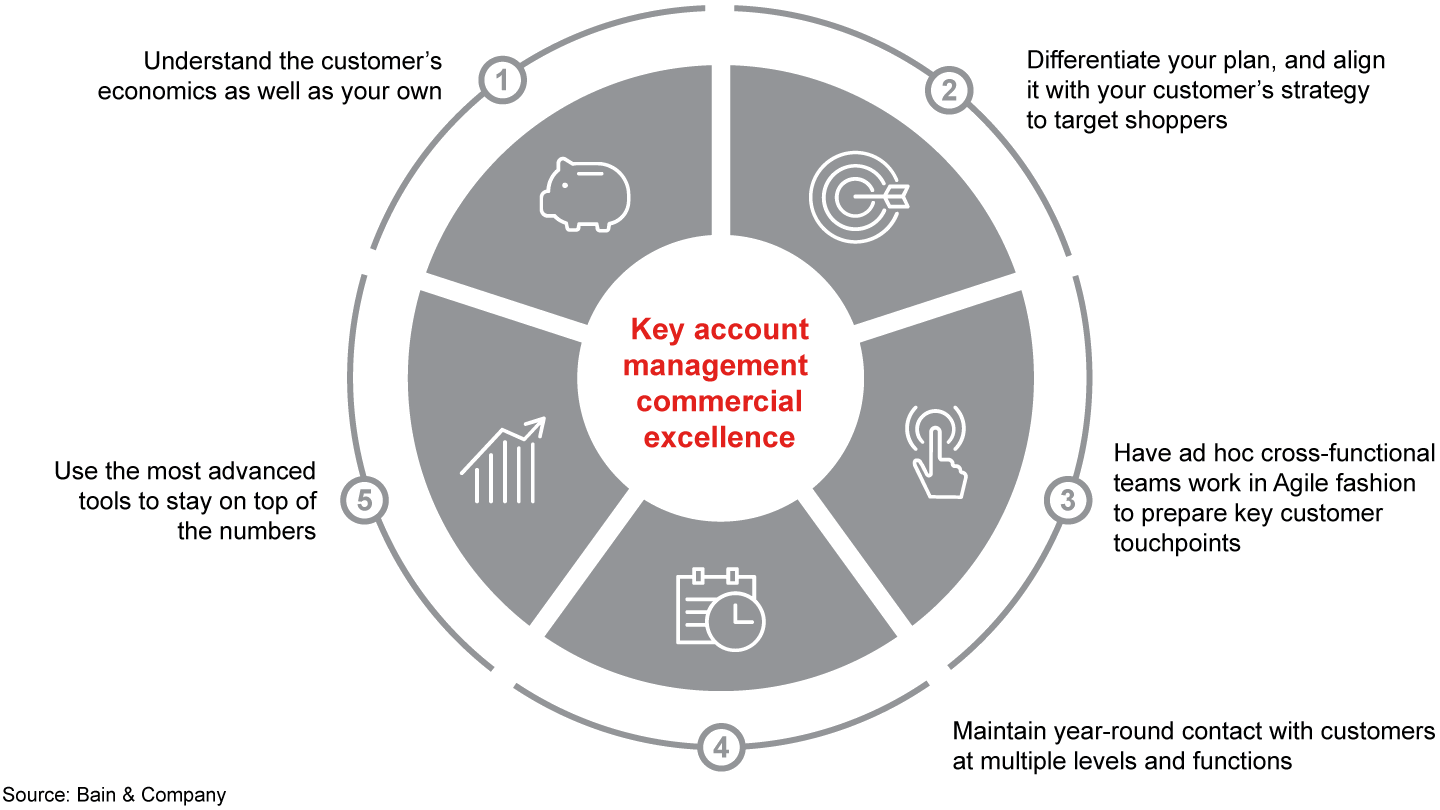
Understand the customer’s economics as well as you understand your own, and aim at improving both. The only way for a brand to thrive in this new world of retailing is to work with customers to develop long-term value for all parties involved.
The best companies never start out blind. They rigorously track how much they contribute to the revenue, profit and cash generation of their main customers. They know where and how those customers make or don’t make money on their portfolio—down to the SKU level or in-store activity. They are able to compare it with an estimate of the profit generated by their direct competitors—and even with an estimate of the profit generated by other categories competing for the same space in stores. They do not limit themselves to a static view but rather consider the evolution year over year to learn from past performances and root causes. They use this knowledge to assess the impact of new initiatives on customers’ economics, ensuring that their plans will help grow the joint profit pools.
At one beverage company, senior management will not approve a key customer plan unless it includes a clear understanding of the company’s contribution to the bottom line and cash generation of the key customer. The company tracks how a new product will be accretive and determines workaround solutions when it isn’t. Anchoring plans in customer economics helped the beverage brand shift from declining revenue to double-digit growth with its main retailer in a top-priority country.
Differentiate your plan, and align it with your customer’s strategy to target shoppers. It all boils down to having a compelling and actionable category story for the trade, win-win customer-specific plans and a tailored trade story—all of which are aimed at bringing sustainable value to the branded players, the retailer and the consumer.
To achieve this, the best consumer goods companies focus on understanding their customers’ strategies, needs and challenges. With full visibility into the KPIs their customers use to measure the performance of different categories and suppliers, branded players can generate banner or even store-specific insights. They get a clear picture of their customers’ internal timelines, and they can align their own processes with the customer’s deadlines. By knowing how a customer’s shoppers differ from the average shopper, a brand can craft a segmented and focused value proposition based on those specific needs. By understanding the customer’s business priorities, it can propose 360° initiatives beyond the traditional commercial levers—for example, improving end-to-end logistics. This is certainly more complex than the traditional targets of getting 100% distribution for all products in all stores or deploying one-size-fits-all promotional plans.
We have seen how the benefits of some differentiation can outweigh any additional costs generated by complexity. For instance, a frozen food company developed strong value-creation plans and exclusive product ranges for one of its key customers. The results were successful in making negotiations more collaborative and in getting better outcomes than previous years.
Rely on ad hoc cross-functional teams working in Agile fashion to prepare key customer touchpoints. Creating diversified, customer-centric 360° plans requires the active involvement of many functions within the organization (typically marketing, finance, supply chain, consumer and shopper insights, category management).
At the best consumer goods companies, key account managers act as general managers for their accounts, owning their profits and losses and orchestrating the work of their cross-functional team. And the way to get the most out of this group and ensure that all are working toward the same objective is to use an Agile approach. Agile is the best way to harness diversified teams’ input; it is also the best strategy for building strong and simplified customer plans (see the Bain Brief “Agile Innovation”). Agile ways of working help a company focus on what really matters for quicker decisions. By creating simple, integrated plans focused on a handful of big ideas instead of a long list of small and disconnected ones, Agile is also less likely to generate yield loss. Transitioning to Agile ways of working requires a certain choreography. During the kickoff, the cross-functional team defines priorities based on customer need. Afterward, the full team meets face to face once or twice a week for half-day working sessions. Intermediate versions of the plan are reviewed with management to steer the content and consistently reprioritize. The company continually stress tests ideas during regular contact with the customer, integrating feedback to improve the plans.
At one food company, Agile now is standard for all customer teams—regardless of the sales team organizational structure (which actually varies significantly by country), all concerned functions need to prepare key customer interactions using Agile.
Maintain year-round contact with customers at multiple levels and functions. The process doesn’t start nor end when supplier and retailer negotiate a jointly vested plan. The dialogue needs to continue beyond the negotiations, relying on one scorecard with jointly agreed metrics and a real-time tracking of results.
Successful consumer goods companies ensure regular meetings throughout the year between all critical levels at both the supplier and customer—for instance, the company’s general manager meets with the retailer’s general manager, the company’s supply chain team meets with the retailer’s supply chain team, and so forth. For each of these meetings, the Agile team mobilizes to prepare the specific content and ensure connections across functions. Ongoing dialogue to course correct in-year initiatives or develop initiatives for next year’s plan makes the actual negotiation a less formal milestone.
The most successful suppliers cocreate their plans (and even products) with some retailers. Regular interaction between the finance teams of a food company and a key retail customer helped both sides align their views on profit pools and economics—and facilitated initiatives aimed at improving both.
Use the most advanced tools to stay on top of the numbers. The joint value approach and Agile ways of working can only be embedded and rolled out if participants have the appropriate access to data and tools. Some consumer goods companies are derailed when different team members have access to different (at times even contradicting) data. Agile customer teams developing joint value plans need a single version of the truth. It helps them generate accurate, real-time estimates of the impact of various ideas on the joint profit pools. It also helps teams determine the best trade-offs, for both the proposed plans and negotiations—and it can facilitate tracking results.
Bain has developed a suite of advance simulation solutions to help cross-functional customer teams prepare their plans. Using Bain proprietary solutions, one beverage company used internal and external data to model different scenarios for joint value plans with some of its key customers. The company visualized the impact that each initiative would have on its customers’ top and bottom lines. It was also able to assess the potential effects of different negotiation moves and possible countermoves. Ultimately, it could agree on a plan that delivered double-digit growth in a year for both itself and its customers.
The relationship between retailers and consumer goods companies is not easy these days. There is no silver bullet solution for improving those relations, and the prevailing retail environment will not get better anytime soon. So, the only sustainable solution for suppliers is to find new ways to create value with and for most of their customers, not to fight them all.
Winning consumer goods companies will understand their retail customers’ economics as well as their own, differentiate plans based on a customer’s strategy and shoppers, rely on cross-functional teams and Agile ways of working to prepare customer touchpoints, maintain year-round contact at multiple levels and rely on advanced tools to bring data to the table for everybody’s well-being. That is what it really takes to become customer centric.
Eduardo Gimenez is a Bain & Company partner based in Madrid, Duilio Matrullo is a Bain partner in Milan and Laure Maddens is an expert vice president with Bain in Brussels. All are members with Bain’s Consumer Products practice.

Agile Innovation
Agile methods are poised to improve innovation in nearly every function of every business.
First published in 9월 2019