

Brief
“Every boxer has a plan until he gets punched in the face.” —Mike Tyson
Most chemical companies have been through this: Management develops a plan to improve commercial performance as a quick, low-capital means of boosting the bottom line. It prioritizes a short list of opportunities, forms a plan and rolls it out to the troops.
But soon, when the tools fail to produce the desired results, sales teams come back bruised and confused. Targets are missed, customers are lost, pricing discipline slips and teams become demoralized. Cynics become more vocal, asserting the industry has been commoditized and it’s now all about price.
Sales teams, whose preparations vaporized when the customer said no, are that much more skeptical about the next plan.
So what is the solution? Recognizing the benefits of best-in-class commercial practices, many management teams make thoughtful—and expensive—investments in sophisticated new tools and processes, thinking they will suffice. Too often the best tools are used inconsistently or are handicapped by inputs that don’t reflect the real economics of the business. Either way, a very limited set of benefits drops to the bottom line.
Successful commercial transformations manage these rollouts differently. In leading companies, managers expect a bumpy start and some degree of rejection. They plan for it, brace their sales teams for it and work with those teams to assess, improve and try again. This persistence is a theme we see among leaders, along with four keys to success that help these companies achieve growth and expand margins quarter after quarter and year after year.
- Identify sources of value. Before undertaking any effort to improve commercial performance, leaders invest the time and effort necessary to understand where they make money. Without a clear picture, it’s difficult to focus efforts in the right place.
- Deploy tools smartly. Leaders introduce new commercial tools in ways designed to win acceptance among the people who must use them. Sophisticated analytical and pricing tools are useless unless the front line embraces and integrates them into its daily work. This requires not only keen observations from the field but also a broad understanding of the company culture and ongoing positive reinforcement.
- Build lasting capabilities. As tools are deployed, leaders improve the organization’s capabilities to ensure that changes stick. Neither the executive team nor the front line can view this as a temporary sprint to deliver impressive quarterly results. It has to be seen and acted on as a permanent change in the way the company does business.
- Keep excellence on the agenda. Finally, to keep the program relevant and on a permanent path of improvement, leaders create feedback loops that allow managers to constantly revise and adjust sales tools and programs to maintain a competitive edge. The data generated in these feedback loops and the lessons learned can help keep commercial excellence on the management agenda.
Identify sources of value
Before investing in new tools, leading companies spend the time to identify hidden value within their organizations. Everyone talks about doing this, but we find very few companies that look deeply enough, to the level of detail and microsegmentation sufficient and necessary to find incremental value in processes, products, customers and channels.
Hidden value can be tough to locate, as it is obscured by several factors, including cost and product complexity, weak pricing discipline caused by poor understanding of market dynamics and customer needs, and persistent fragmentation of resources, which prevents companies from focusing their attention on the most attractive segments. Companies must address each of these challenges.
- Reduce complexity. Leaders assess the potential of complex products and the costs of lost business if the company were to stop producing them. Grades with long and complex production cycles, those that produce a lot of scrap or require more cleaning, and smaller-volume grades with higher fixed costs per unit are all candidates for reconsideration. And reducing complexity cannot be a one-time project. To make it stick, leaders embed into the organization concepts like cost-to-serve, and plan to manage complexity as they develop new products.
- Maintain pricing discipline. Great companies understand their products’ value to specific customers. They price accordingly to make products attractive enough to draw new customers while maximizing value from their existing customers. Many companies simply set cost-plus pricing floors as their main tool to enforce pricing discipline. While this minimizes downside and prevents rogue sales practices, it can also leave significant value on the table. It’s better to invest time to understand where to expand margins, whether by making the most of periodic short market conditions or by closely identifying the product and customer combinations that maximize companies’ distinct offers.
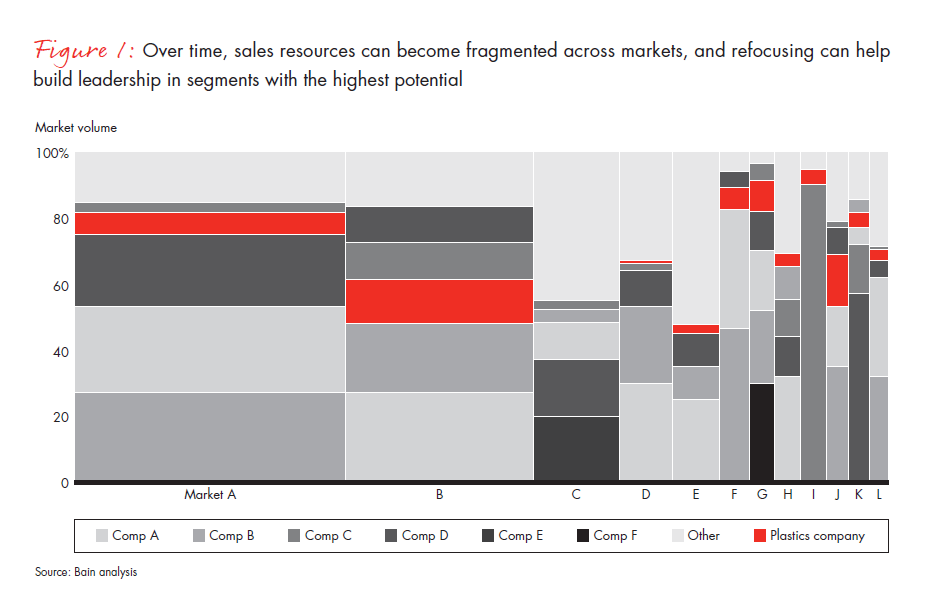
- Identify and focus on the most attractive segments. Diagnostic tools can help identify the most profitable products and customer segments, so companies can focus their commercial efforts on them. In chemicals we often see fragmentation of resources over time, as commercial teams look for additional outlets to fill their assets rather than focusing on customers who value the product the most (see Figure 1). In the short run, this goal of making and selling a plant’s maximum capacity seems reasonable, but over time those adjacent segments command more and more resources. Profitability declined for one European plastics manufacturer as it tried to serve more than 3,000 customers with a salesforce of about 100. A diagnostic revealed the opportunity to focus sales efforts on 25 key accounts with long-term potential. The shift to more profitable accounts and the discipline to walk away from less attractive business, combined with organizational changes that restructured the company around customer needs, helped boost profitability by more than 300% over a six-year period.
Deploy tools smartly
Any executive who has been through an unsuccessful transformation knows transformation is never easy, even with sophisticated tools in hand. Companies that successfully transform their businesses tend to put twice the effort into figuring out how to apply tools as they put into defining them. This requires a good deal of coaching from the organization’s most experienced and sophisticated users of the tools who must work with the front line to make sure they are comfortable with the new suite. These masters can help work out the bugs and make sure the tools are tailored to the real-life situations sales teams encounter, including market conditions and flexible pricing strategies that reflect the product line’s true value to customers.
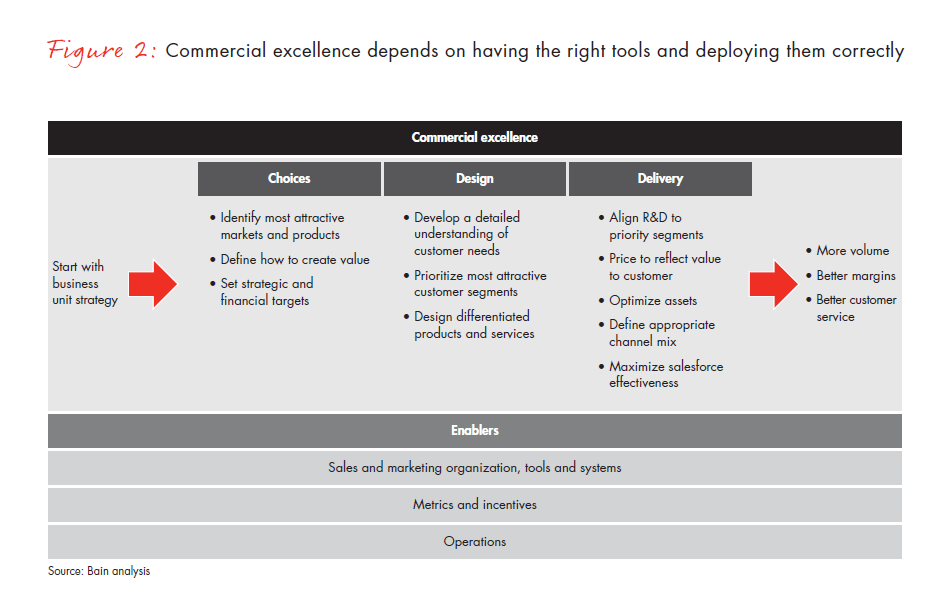
Managers should also be prepared to persist in the face of initial disappointments. In our experience, many commercial improvement efforts fail because executives don’t anticipate the struggles they will face when they roll out new tools. Too often, these tools aren’t tailored to the industry’s specifics, the company’s position or the point in the business cycle. Managers should set expectations so that if the first efforts fall flat, they will debrief, refine and reapply the tools. Most important, they need to make these changes with—not to—the sales organization. And they need to emphasize that they are making permanent changes to the way they sell—changes that will have a lasting effect on suppliers, customers and even competitors. In our conversations with executives, we talk about a “triple cycle” to emphasize that revisions and redeployment will likely be necessary before they see real progress (see Figure 2).
Companies that take this approach generally see a 10% to 20% increase in prices on key customers, but there are two important caveats. First, timing matters. For example, a plastic that works with faster molding speeds will be worth more to customers when capacity is tight than when demand slackens. Second, because companies cannot succeed everywhere, it’s critical to define which customers are most likely to become long-term, loyal customers and which are more opportunistic.
Build lasting capabilities
Like a boxer who must refocus attention in the face of unexpected adversity, leading companies refine programs as they learn how customers react. Successful transformations embed programs as they are developed, making clear that the company is beginning to permanently transition the way it does business. Leaders put in place training and accountability systems to ensure the company continues to progress.
As managers deploy these programs, they must take the organization along with them. Transformations are more successful when they happen with the workforce rather than to the workforce. And no company can improve its commercial efforts without the agreement of the sales and support teams, as well as the cooperation of other groups, including R&D, application development, marketing, customer service, tech service and operations. Many efforts fall short on the wreckage of sophisticated tools because executives didn’t understand how to apply them in context. Programs that do it right typically can boost earnings by 5% or more.
Throughout the process, senior executives should work with the transformation team to build changes into the way the company operates so processes and behaviors don’t slide back to business as usual after the initial focus fades. Executives must continue to sponsor efforts aimed at improving commercial capabilities, including through ongoing sponsorship of advisers and champions to coach sales teams. Most important, they need to align targets, incentives and rewards to encourage the right behaviors.
Transformations like these are never easy or brief, but rewards justify the effort. For example, one North American polymer manufacturer realized it was missing opportunities because its cost-plus pricing approach didn’t fully reflect customer demand or market dynamics. Management realized the company needed to target its most profitable customer segments and sell through its most profitable channels. Through a broad transformation, it identified a 45% improvement opportunity in earnings, with 60% coming from improved sales targeting—to more attractive market segments and channels—and about 40% coming from better pricing and more effective sales teams. Yet the journey to success lasted more than three years, requiring leadership’s close attention and the program’s fine-tuning over time.
Keep excellence on the agenda
Finally, winning companies don’t consider commercial excellence an artifact of good times, and they don’t cut back deeply when market conditions worsen or revert to price cuts as the primary selling tool. Those mistakes can lead to poor service or outsourced sales and the rapid attrition of commercial skills—which, once lost, are hard to rebuild when the market recovers. True commercial champions invest in their people, skills and commercial excellence programs for the long term, in good times and bad.
David Burns is a partner with Bain & Company in Chicago. Mark Porter is a Bain partner in London, where he leads the firm’s Chemicals practice in Europe, the Middle East and Africa.
The authors would like to acknowledge the contributions of Tom Shannon, a Bain partner in Chicago who leads the firm’s Chemicals practice in the Americas.
First published in 10월 2014