

Brief

한눈에 보기
- Current market conditions are challenging for renewable fuels producers, given the supply and demand imbalance and near-term policy uncertainty.
- By 2050, however, renewables could account for 10-15% of transport fuels, creating market tightness and new profit pools of $100 billion to $150 billion.
- Today’s technologies and production pathways won’t meet future demand; new feedstocks and technologies will be required.
- Leaders are looking ahead and creating optionality for growth by focusing on customers, embracing flexibility and partnerships, and innovating to mitigate risk.
Over a few short years, many executives considering the decision to invest in renewable fuels have gone from asking, “Should my company invest?” to asking, “When and how should my company invest?” This shift reflects the need to balance long-term upside with short-term risks and uncertainties.
The renewable fuels industry has made significant strides, particularly since the passage of the US Inflation Reduction Act (IRA) in 2022 and the EU’s revised Renewable Energy Directive (RED III and RED III.5) in 2023. Global production capacity more than doubled between 2021 and 2024 and could more than triple by 2028 in reasonable scenarios. Demand for drop-in renewable fuels will outpace traditional biofuels, and the need for renewable fuels that use waste-based feedstock (e.g., used cooking oil) and novel oil crops should grow significantly.
To put the opportunity in perspective, it’s plausible that by 2050, global demand for sustainable aviation fuel (SAF) and renewable diesel could be around double the size of today’s ethanol and biodiesel global markets. In a moderate scenario with conservative demand assumptions, we anticipate renewable fuels will account for 10% to 15% of total transportation fuels demand by 2050, with a profit pool between $100 billion and $150 billion. That’s about 4% to 6% the size of the global oil and gas market’s average net income over the past five years.
The renewable fuels profit pool could reach between $100 billion and $150 billion by 2050—4% to 6% the size of today’s oil and gas industry.
The pressure to enter this market has never been so intense. The first fuel-blending mandates in aviation and maritime will begin this year in the EU, the initial voluntary fuel decarbonization deadlines for many oil and aviation companies loom in 2030, and the debate is intensifying around the EU’s 2035 ban on sales of new vehicles with internal combustion engines.
From agribusinesses to oil and gas firms, executives across the fuels supply chain recognize the renewable fuels industry’s generational opportunity and growing pressure. But most companies are sitting on the sidelines because it’s a harsh environment in which to operate and make decisions, and many are struggling to generate returns. There’s significant near-term volatility due to regulatory uncertainties, oversupplied renewable diesel and biodiesel markets, difficulties securing feedstock and offtake agreements, and economic pressures that are increasing capital costs and squeezing project returns.
These headwinds produced mixed results in 2024. Some major oil and gas companies paused or scaled back renewable fuels investments, and some smaller renewable fuels companies faced bankruptcies and project cancellations. Meanwhile, other oil and gas companies continued advancing their low-carbon energy programs. They’re managing risks in their existing bets as well as seeking capital-light investments that provide flexibility and options for future growth, such as removing capacity bottlenecks or exploring disruptive technologies. In addition, large private equity funds have entered the market with sizable investments, including Mubadala Capital investing in a Brazil biorefining project and KKR acquiring a 25% stake in Eni’s renewable fuels company Enilive at a valuation of more than $12 billion.
It may be tempting to read too much into last year’s mixed results. The reality is that the renewable fuels sector was never going to progress in a straight line. The emerging leaders view today’s oversupplied renewable diesel and biodiesel markets, policy incongruencies, and shareholder sentiment favoring cash returns and capital discipline for what they are: noise.
The long-term signal, however, is clear. The world is moving toward a more decarbonized future. The question is at what pace, and what does that mean for how companies balance investments across their portfolio of existing assets, new opportunities in conventional energy areas, and renewable fuels?
Big market in any scenario
Regardless of energy transition scenario, demand for renewable fuels is expected to be two to four times higher than today’s level by 2050, according to our analysis (see Figure 1). Aviation fuel will be the fastest-growing renewable fuel because viable alternative carbon-abating solutions likely won’t exist for at least the next decade, and SAF will play a critical role in decarbonizing the industry. Similarly, renewable fuels produced from waste are well positioned to help decarbonize heavy-duty, long-haul, and public transport due to their drop-in compatibility with existing diesel infrastructure.
Figure 1
Note: Includes demand for biofuels based on first- and second-generation feedstock and electro-fuels, primarily electro-sustainable aviation fuel and electro-methanol
출처: Bain sustainable fuel integrated supply and demand modelHowever, constrained supply will likely be a feature of the landscape over the long term. Although supply exceeds demand today and is expected to keep pace with regulatory obligations in the coming years, the currently mature technologies and production pathways won’t be able to meet future demand (see Figure 2).
Figure 2
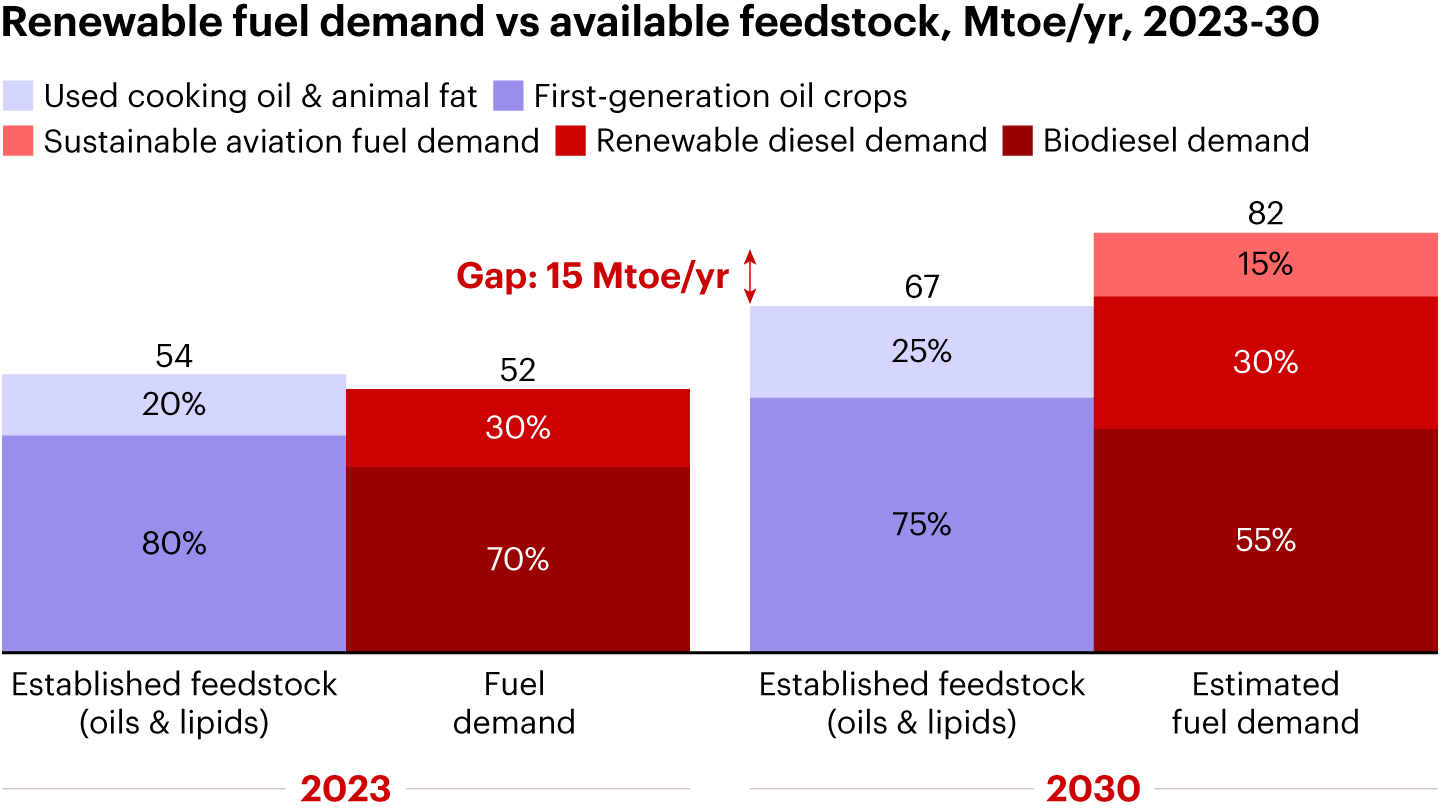

참고: Includes hydroprocessed esters and fatty acids (HEFA) and fatty acid methyl esters (FAME) feedstocks and fuel pathways; excludes ethanol, methanol, and emerging feedstocks and fuel pathways (e.g., alcohol-to-jet, gasification); available feedstock in 2023 refers to practically available, as not all available feedstock is turned into fuel due to lack of refineries or collection processes
출처: Bain sustainable fuel integrated supply and demand modelCompanies will likely pursue agricultural-based feedstocks and waste inputs first due to their availability and maturity. It will be complex for companies to develop and scale up additional options, such as novel oilseeds, but these sources will be key to overcoming supply constraints. Without these substantial catalysts for feedstock derived from hydroprocessed esters and fatty acids (HEFA), more expensive, alternative pathways such as synthetic fuels (e-fuels) and the gasification and Fischer-Tropsch process (GFT) will be needed.
Unique challenges and dynamics
Roadblocks specific to renewable fuels are making it challenging to scale up investments and develop this market.
Biofuels ecosystems are complex, with multiple players across the value chain that each serve a critical role. Cultivating new low-carbon refining feedstocks, for example, requires coordination between nontraditional partners. For refiners, accessing the extremely fragmented global supply of waste oils or novel crop growers is a new capability. Additional supply chains must also emerge, connecting new and disparate markets for feedstock with traditional centers of production and distribution.
Unlike conventional refining, renewable fuels will have multiple winning technology pathways, determined by regional characteristics and relative advantages. For example, the US may experience an ethanol overhang in the future as gasoline demand declines. This may incentivize investment in the alcohol-to-jet (ATJ) process as a critical pathway. Elsewhere, Europe is incentivizing development of advanced feedstocks, which could lead to broader availability long term.
Measuring a renewable fuel’s value proposition will continue to be arduous. Clean fuel policies are incongruent. The US continues to take a “carrot” approach (subsidies and credits) to incentivize adoption, while the EU uses a “stick” (mandates and taxes). Even within regions, approaches aren’t standardized. For example, California’s Low Carbon Fuel Standard policy uses a different methodology for measuring, reporting, and validating carbon intensity than the US government’s Renewable Fuel Standard and IRA programs. In voluntary markets, traded credits lack liquidity, and price signals are still being established. Those pricing signals will vary depending on the end customer, with each valuing a renewable credit differently based on their respective industry and carbon commitments.
Unlike traditional energy capital projects, renewable fuels investments have a different risk profile that requires a venture capital mindset. These projects are underwritten with greater uncertainty and typically a different time horizon for generating returns. It may take two years to build a traditional refining facility, with expectations for a four-to-six-year payback. By comparison, cultivating a novel crop feedstock may require 10 years of R&D and field testing before reaching scale. Similarly, investing in a new production technology such as ATJ may take years to climb down the cost curve and make economics attractive. This “option value” approach to capital allocation is a new capability for companies in traditionally mature industries.
Keys to winning
Navigating these roadblocks and mitigating project risks will determine the sector’s winners. Five levers are emerging as the most crucial to success in the renewable fuels industry.
1. Maximize returns on your existing assets. Renewable fuels industry margins grew for years before this recent downturn. Companies have been focused on growth and expanding capacity while demand intensified. With this perspective, there are lessons to be learned from the conventional fuels industry. Its best-in-class companies have used downswings in market cycles to shift focus to asset competitiveness, pulling all controllable levers to expand margins and cash flows.
For participants in renewable fuels value chains, this translates to a refocus on optimizing supply chains and input costs, dramatically reducing the cost of operations and sustaining capital, and maximizing throughput to improve unit economics. For many companies, after years of climbing a steep learning curve, this may be the first chance to step back and consider opportunities for improvement. Many companies are already starting to right-size their structures, improve processes, and increase their use of digital tools such as automated process controls and advanced analytics to extend reactor catalyst life.
2. Become more customer-focused than ever. With renewable fuels, companies aren’t selling a commodity, they’re selling carbon abatement and regulatory compliance. That’s a different value proposition that will require a much different approach to marketing and selling.
For one oil and gas refiner, breaking into renewable fuels required the company to more deeply understand its customer base so it could target the segments that value sustainability as a key purchasing criteria. Unlike with its oil and gas capital projects, the company has to secure offtake agreements with customers even before it makes a final investment decision to proceed with the project—a brand-new mindset. Developing customer-centric capabilities, such as understanding varying SAF demand and regulatory mandates across regions, has been crucial for activating early demand. (For more, read the Bain Brief “How to Master the Art of Selling Sustainability.”)
Buyers also have to adapt their procurement practices, which has important implications for sellers. Airlines, for example, are signing long-term contracts to secure SAF supply and lock in the price. That’s significantly different than timing the purchases of conventional jet fuel as a way to hedge against risk and higher costs.
3. Define a clear intent and embrace dynamic scenario planning. The early leaders are clear-eyed on both their strategic intent (and where and how they are playing offense vs. defense) and investment stance (bold bets vs. hedges). Unlike some sectors, the renewable fuels market has lots of combinations of feedstocks, technologies, and end-market focus areas that will likely prove to be good bets. While that provides business leaders with some margin for error in decision making, it makes it even more critical that they tailor the strategy to their company’s capabilities, assets, and local conditions. For instance, a company with a foothold in agriculture might have access to unique feedstock sources, while an oil and gas giant could exploit its logistics and refining expertise by converting existing refining capacity into SAF production.
The sheer number of potential combinations of feedstocks, technologies, and end markets a company could pursue also calls for a strategy that’s as flexible and nuanced as the sector itself. Robust scenario planning and monitoring signposts—like policy changes, economic shifts, or technological breakthroughs—will allow leaders to place hedging bets and pivot quickly when opportunities or risks evolve.
최적의 솔루션 찾기Strategic Planning
Rigid calendar-year planning cycles are obsolete. Our Living Strategy approach helps you conquer four pitfalls of strategic planning so you can join the elite ranks of companies that meet and exceed their strategic ambition.
4. Collaborate across the value chain. Partnerships are essential. Many companies entering the renewable fuels market will be doing things outside their core business, and very few will have the capabilities required to go it alone. Plus, there’s the chicken-and-egg challenge inherent to many nascent sectors: It’s risky for producers to put shovels in the ground without assured demand, but so is committing to purchases without assured supply. Partnering to develop supply and demand in tandem is less risky, enabling cost-sharing and faster market entry.
It’s no surprise, then, that early market entrants are leaning into joint ventures, mergers and acquisitions, and cross-sector alliances. Bunge and Chevron launched a renewable fuel feedstocks joint venture in 2022 that pairs the former’s oilseed processing capabilities and farmer relationships with the latter’s fuels manufacturing and marketing expertise. In November, BP and Corteva announced plans to form a joint venture to deliver crop-based feedstocks for SAF that would meet EU regulatory criteria and qualify for US policy incentives. M&A deals over the past couple of years include Chevron’s purchase of biofuels producer Renewable Energy Group and Neste’s acquisition of Crimson Renewable Energy Holdings’ used cooking oil collection and aggregation business, among other strategic moves.
5. Innovate to mitigate financial risk. Emerging leaders are reducing risk in creative ways, including seeking nontraditional funding sources and mechanisms. That will remain imperative for the next few years as executives face pressure to deliver shareholder value while the market scales up. Partnering with investors willing to share risks and rewards can help protect margins and ensure long-term viability. One oil and gas company is standing up a renewable fuels trading business before it even begins in-house production, partly as a way to generate revenue sooner, meet compliance obligations, and gain experience in this nascent sector.
Executing in a rapidly changing market
The opportunity is evident, but the renewable fuels market is moving fast. Companies are rushing to secure first-mover advantage, particularly with feedstocks. The winners will be those that act decisively to secure their position before the window of opportunity narrows. By investing early, building robust partnerships, and aligning strategies to their unique strengths, leaders can build competitive advantages in an industry poised to transform global energy.
First published in 2월 2025