

Brief

Six months into one of the most challenging years in business history, simple clarity has become our most precious resource.
Covid-19 is having a profound impact—we know that—but how it will play out remains deeply uncertain. While there’s no shortage of punditry and speculation, we’re still in the very early stages of understanding the pandemic’s full ramifications. And the noise can be deafening. Information about all that has changed and that will change has inundated leadership teams. The focus on protecting your people and getting back to work amid deep uncertainty has left little time to step back and consolidate, to explore as a team what new world is emerging and what that means for your company specifically.
What we do know is that the strategy you had in place in January is no longer relevant. Nobody planned for the demand spikes and supply shocks that have occurred already in 2020. The shifts we’re seeing among customers, competitors and markets will inevitably raise questions about your strategy’s core assumptions.

Macro Surveillance Platform
For more detail on the business implications of coronavirus from Bain’s Macro Trends Group, log on to the Macro Surveillance Platform. Learn more about the platform >
Your belief that you had three years to build out your digital channel? That no longer holds. Your once-easy reliance on global markets for both revenue and supply? That suddenly looks risky. There’s now no question that government intervention and new regulations around the world will reshape business boundaries. If you don’t move first to improve your market position, your competitors doubtless will.
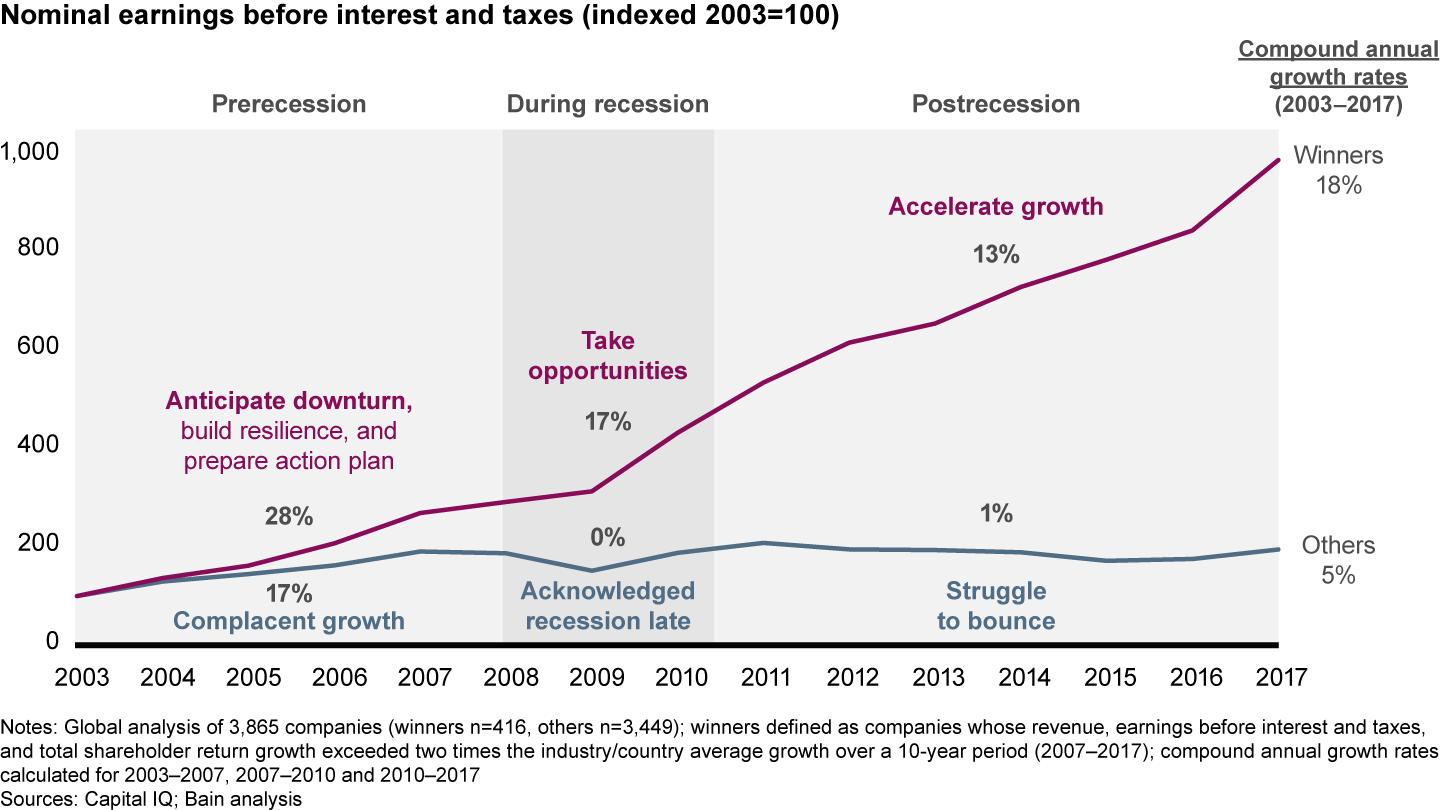
Taking a wait-and-see approach is a tempting response. Yet we also know that the time to act is now, both to lock in the changes already made and to accelerate your recovery. History is unambiguous in showing that winners and losers are forged in the crucible of turbulence. After the global financial crisis, for instance, the companies that had a clear plan for pursuing opportunities in the maelstrom rocketed away from the rest over the following decade (see Figure 1). Fate wasn’t kind to the laggards. Postcrisis, a full 40% of the companies in the S&P 500 dropped out as their performance withered. Given the current level of economic disruption, we wouldn’t be surprised if the dropout rate was greater than 50% this time around.
Figure 1

The new agenda
All of this is reshaping the agenda for business leaders. Most companies will need to retool their strategy, both to reflect what is knowable today and to prepare for a future defined by uncertainty. That will demand that your company raise its game across three vital aspects of strategy: adaptability, prediction and resilience (see Figure 2).
Figure 2
In planning strategy, most companies emphasize prediction at the expense of adaptability and resilience. But the current crisis reminds us that balance is essential—better prediction will never be sufficient on its own. Organizations need to be significantly more resilient against a broader set of shocks and much more adaptable to rapidly changing circumstances. If you could be perfect at any one of the three—adaptability, prediction or resilience—the other two would be unnecessary. But obviously, that’s not possible. What is achievable, and ultimately a powerful source of competitiveness, is to rebalance investment in these attributes so that they work together holistically. Better prediction, for instance, is itself a form of resilience, and strong resilience buys time to adapt.
Companies that are good at all three prepare for change with greater precision, absorb shocks more effectively, and move with agility to spot and take advantage of opportunities. They also never stop working on getting better. As CEOs and their boards lean into the challenge of retooling, they’ll need to focus the discussion on how to improve these key business characteristics and how to balance investment among them.
Adaptability
A truly adaptable organization can make up for a lot of shortcomings when it comes to prediction and resilience. The ability to spot signals of change and respond to them quickly is how the best companies stay relevant year after year, come what may. During the pandemic, we’ve seen that organizations under duress can react faster and more decisively than we ever thought possible. CEOs can capitalize on this in several ways.
Avoid snapback. Behaviors critical to adaptability include bottom-up experimentation; solving problems with small, Agile teams; clearing a path through the “rules, tools and fools” that slow things down; and devoting leadership time to focused learning and action. Not coincidentally, these were also critical to surviving the Covid-19 demand shocks. CEOs love that their organizations have been doing things in a matter of weeks that used to take months or even years. There’s more action and less planning, more willingness to slay sacred cows and less tolerance for endless deliberation. But heroics are also exhausting, and as the crisis drags on, it will be tempting to revert to the old comfort zone. CEOs can prevent this by committing explicitly to moving forward, not back, and to aligning the team around new behaviors to preserve and old ones to fend off. Now is the time to lock in learning, to ask what worked and what didn’t, and to focus on ways to sustain the speed and decisiveness the crisis inspired.
Commit to doing Agile right. Companies during this period have been learning Agile techniques on the fly. In the heat of the moment, they have identified their most pressing problems, and they have deployed cross-functional teams to gang tackle them. They’ve used prototyping and rapid feedback loops to find solutions to problems they’d never even envisioned. The opportunity now is to develop an Agile organization that outlasts the pandemic. That means embedding these techniques and behaviors systematically. The crisis spurred sporadic innovation. Now is the time to commit to additional Agile teams that are charged with generating innovation at a faster pace. Instead of attacking problems as they arise, spread Agile principles throughout the organization, team by team, step by step.
Create “Engine 2.” Winning the recovery will require doing what it takes to meet the needs of your most important customers. The challenge, of course, is that those needs will inevitably change in ways you can’t anticipate. Companies need to remain focused on flawlessly continuing to deliver on their current proposition, but they also need to learn how to build new businesses and capabilities. That starts with creating an “Engine 2” to challenge industry boundaries in ways that the current core business cannot. Engine 2 will innovate to serve existing customers better. It will find new customers by developing fresh channels, tapping into new profit pools and creating new business models. At the same time, it will help you build a stronger, more adaptable company with more options for success. It will both borrow from the core business and transfer learning back to the mother ship. Done correctly, it will liberate the organization, stimulate new ways of thinking and rapidly develop critical business-building capabilities.
Prediction
It’s easy to assume the net effect of the Covid-19 pandemic will boil down to accelerating existing trends, such as pulling forward new levels of e-commerce adoption or hastening the ubiquitous use of videoconferencing. That acceleration is very real and will have a major impact, but it would be a trap to believe the disruption will stop there. The subtext is that we already have the appropriate strategy: “Don’t worry. This is just moving faster, so we only have to execute harder.”
Companies that are good at prediction never assume that what they’re doing today will work in the future. They know that incremental change will get them only so far. Ironically, leadership teams that are great at prediction also assume that they don’t really know what the future will bring. Instead, they embrace scenario planning as a fundamental part of strategy, define and track the signposts that best signal change, and develop relevant playbooks that can be unlocked as the future begins to reveal itself. This is as much about offense as it is about defense. Anticipating change in your industry’s direction using six lenses can help uncover the biggest uncertainties and most consequential tipping points (see Figure 3).
Figure 3
It’s equally important, however, to tailor the inquiry to “what does it mean for my business?” Leadership teams can zero in on the best strategic options for this new era by breaking industry-level insights into a set of pragmatic steps to keep the company moving.
- Customers: Yes, the digital future has been pulled forward by two to three years, and if we hustle, we can deliver our next offering by year-end. But what’s the following wave of innovation we’ll need so that we can break new ground with our customers?
- Technology: Everybody’s increasing automation, but how can we deploy machines in ways that will actually differentiate us?
- Operations: What does the declining cost of distance really mean for our global footprint and our assumptions about everything from supply chain to talent acquisition?
- Boundaries and competition: Will new competitors emerge as supply chains become more local and reshape the industry cost structure?
- Macro: How can we be the first to access new growth opportunities as governments become more active in our sector?
- Social and sustainability: How will growing concerns around social change and a greener future alter what customers and employees demand from us?
As a practical matter, most companies focus scenario planning on events that are both highly impactful and highly likely. Yet Covid-19 has shown us the peril of ignoring those major events that seem too remote to worry about. What we’re learning is that effective planning doesn’t have to be about the specificity of the event itself; it is about anticipating what impact the event would have on your business and defining the playbooks you would need to react quickly and effectively, no matter what happens. Whether it’s a pandemic, a cyberattack, regime change or natural disaster, how do we take care of our people? How should we be thinking about supply chain disruption? What will happen to our sales channels? How will customers react? The goal isn’t to plan for each disaster scenario exhaustively but proactively to consider the likely impacts and which targeted investments would help us respond more effectively.
Resilience
If the Covid-19 crisis has demonstrated anything, it is that our intense focus on cost and efficiency over the past several decades has blinded us to a broad set of risks. We didn’t have plans and equipment to protect our people. We saw key parts of our global operations shut down overnight. Balance sheets were overextended, and companies are now bankrupt.
One important outcome of strong prediction is to help determine how we should redesign our business to be more resilient. Right now, broken supply chains are under the brightest spotlight because efforts to drive down costs and eliminate redundancy are coming home to roost. But it would be a mistake to isolate building resilience in one area of the enterprise from others just because that’s what failed this time. The most resilient companies are making strategic decisions today that will build resilience over time. It requires attention to five key aspects of the business.
Strategy and customer relevance: Absorbing and rebounding from shocks is a lot easier if you’re positioned well in the first place. Basic questions apply: Are you a leader in each of your businesses, and do they have strong growth prospects? Are you in a position of control within your industry value chain? Are you better at earning customer loyalty than your competitors?
Operations and supply chain: Supply chain management has been all about streamlining, but the pandemic exposed the risk of concentrating supply with one or two large sources and limiting buffer capacity. The cost of resilience is a distributed set of suppliers and operations as well as investment in technology that can give you a high degree of transparency past tier 1, all the way back to tiers 2, 3 and 4. Redundancy often seems expendable—until it isn’t.
Balance sheet and cost structure: A strong, flexible balance sheet and skilled working capital management are fundamental to resilience. And while we’ve seen the danger of trading efficiency for risk, maintaining a position as the lowest-cost competitor provides flexibility to absorb demand shocks, especially in down cycles.
Government and regulatory environment: Both governments and consumers are intently focused on issues such as public health, damaging environmental externalities, privacy and social impact. Resilience requires being on the right side of changes in these areas, anticipating their impact and accounting for them when developing strategy.
Talent and organization: Experience is an important part of resilience. It helps to have a crisis-tested leadership team, but it is also important to recognize that a rigid, siloed organization with low employee engagement is a vulnerable one. Building agility, adaptability and strong belief in the company’s nobler mission increasingly calls for developing a new deal for talent. These attributes often fall by the wayside as companies scale and become more complex. It takes strong leadership to nurture them.
Conclusion
It also takes strong leadership to define a new course. CEOs and boards need to carve out time to take stock of how the world is changing and prepare their companies to act. Given all the information coming at them on a daily basis, there’s real risk that each member of the leadership team is thinking differently about how to respond to a highly uncertain future. Getting past that dissonance is critical to moving forward as a unit. Teams need to step back now to evaluate which trends have accelerated, what new behaviors are emerging and how structural assumptions have changed.
But then the conversation has to conclude and conclude on a new action agenda. Don’t get hung up on consensus—you only need alignment on the questions, not the answers. Some things will be very clear and will point to clear action; others you will need to explore. The job is to identify and prioritize the most important questions and commit to seeking answers aggressively. What’s clear is the new strategic imperative: In a turbulent, disorienting time, it is essential to build strength by finding the appropriate balance of adaptability, prediction and resilience.

Coronavirus
The global Covid-19 pandemic has extracted a terrible human toll and spurred sweeping changes in the world economy. Across industries, executives have begun reassessing their strategies and repositioning their companies to thrive now and in the world beyond coronavirus.
First published in 7월 2020