

Brief

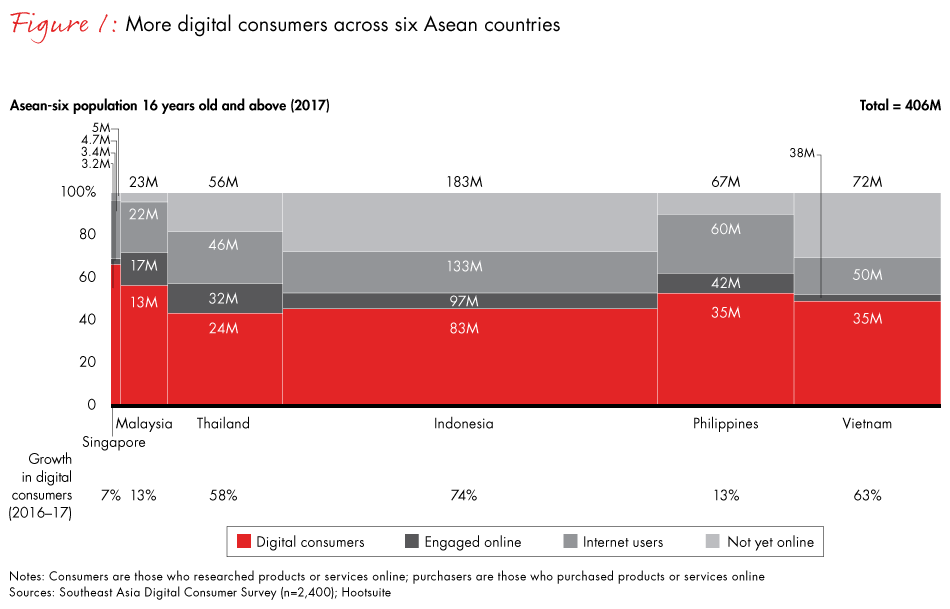
In the dynamic world of digital commerce, there’s no place as exciting as Southeast Asia, where the online consumer base grew by 50% last year and now totals 200 million individuals across Asean’s top six economies—and where every day brings with it news of hyperactivity (see Figure 1).
When Amazon opened for business in Singapore earlier this year, it made the first moves in a long-awaited showdown with Alibaba. Alibaba invested US$1 billion in local player Lazada this year, raising its stake from 51% to 83%. It also took steps that boosted Lazada’s ability to benefit from Alibaba’s vast and well-oiled ecosystem. For example, its affiliate Ant Financial merged with Lazada’s helloPay platform (since renamed Alipay) to strengthen payment processing. Alibaba also continues to invest in local player Tokopedia. These investments are building the muscles for a world-class clash of titans—with the big guys competing head to head and local players serving as proxies for the foreign giants.
The money keeps flowing in as players from around the world place their bets—for example, Tencent’s 40% investment in Garena Holdings (recently renamed Sea). Indeed, while the region is the first place on Earth to witness an East vs. West battle in which US behemoths such as Amazon and Google go up against China giants such as Alibaba and Baidu, there’s also a roster of strong local companies in the mix. China-based ride-hail player Didi Chuxing and SoftBank invested a combined US$2 billion in Grab, the dominant ride-hail start-up in Southeast Asia. Expedia invested US$350 million in Traveloka, which comes on top of the US$150 million that the region’s leading travel site raised from other investors. Shopee parent Garena Holdings raised US$884 million in an IPO to become Southeast Asia’s dominant mobile commerce player.
In addition to its scale and hyperactivity, what makes this region particularly compelling is that winning here can position companies for success in developing markets around the world. While victory is not a sure bet for any player, the most promising contenders are working to build the unique strengths that will give them an edge over their rivals, even as they work through the inevitable growing pains that accompany exponential growth. The best companies are carefully tracking players across industries for the lessons that can help them advance. They acknowledge that while e-commerce volumes across the region may be small—only about 3% of retail by some estimates—they’re preparing for the inevitable day when that penetration rises to 10%–15%, causing a significant effect on physical sales.
Florian Hoppe, who leads Bain’s Digital practice in Asia-Pacific, discusses digital shifts and how brands can win in Southeast Asia.
Know the territory
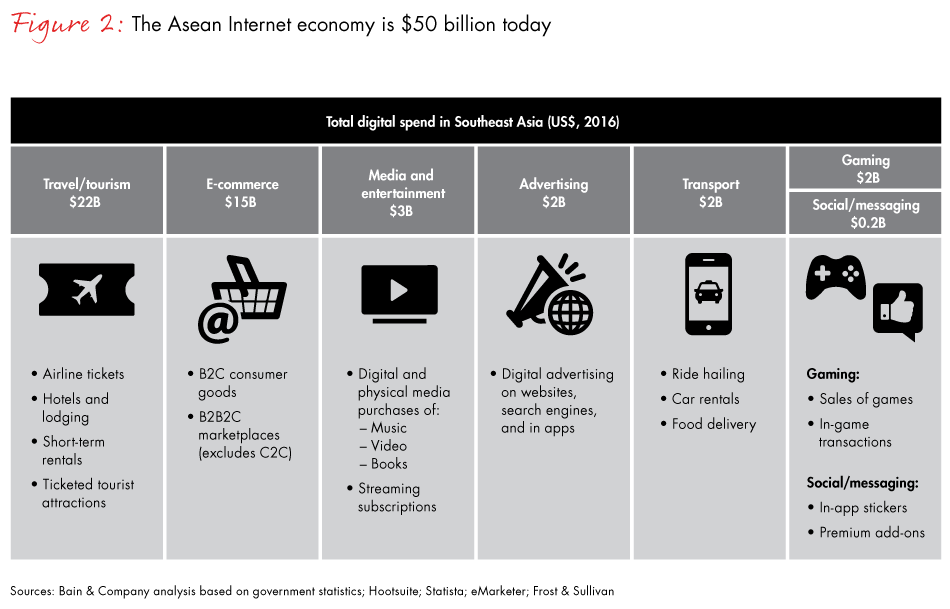
Competing here requires clearly understanding the unique characteristics of this booming region. The overwhelming majority of consumers in Southeast Asia use low-cost smartphones as their primary connection with the Internet. The biggest category of spending is for travel and tourism, followed by e-commerce and media and entertainment (see Figure 2). An increasing percentage of consumers use social media to purchase their goods or services. Most transactions are small.
Southeast Asia is also highly diverse. Consider the large variances in payment methods across countries. Credit cards are biggest in Singapore; Internet banking is the most common payment method in Malaysia; cash on delivery still rules in Vietnam, Indonesia, the Philippines and Thailand. In addition to a lack of uniformity in payment methods, there’s also significant market fragmentation. Southeast Asian consumers have multiple platforms to choose from for every daily need—be it to hail a ride or buy apparel—and the entrants are gaining in number. In fact, the region plays host to more than 7,000 start-ups, with new businesses being registered every day. And consumers take full advantage of these many platforms for digital purchases. For example, Indonesians use an average of 5.1 e-commerce platforms per year.
Amid this free-for-all, some leaders are emerging. Lazada has risen to become the leading e-commerce platform in four of the six markets. But the big, lingering question is if it will maintain that position as Amazon boosts its presence in the region. Foodpanda is the top food delivery site in four markets. But will ride-hailing leader Grab’s expansion into food delivery (Grabfood) threaten that status? Whether a company is a local or global player or a technology, consumer goods or financial services company, some fundamental rules will help distinguish the winners from the laggards.
Winners take an Agile approach to innovation. Southeast Asia’s e-commerce sector is a moving target. As such, success requires the ability to pivot quickly. Companies need to develop Agile capabilities for innovation not only in how they develop products or services but also in how they interact with consumers and new channels. Winners are fast to use test-and-learn approaches to get products out into the marketplace—and just as quickly pull the plug if necessary. Such speedy innovation has been a main ingredient of Amazon’s success for years. Back in 2005, Amazon Prime was conceived, developed and launched in about two months. The company has been equally swift when it comes to abandoning innovation efforts that don’t succeed, but it has a strong track record of gleaning lessons from those ended projects. Many retailers would consider these failures, but most of them contributed valuable learning toward eventual hits. For example, Amazon abandoned Auctions and zShops, yet both laid the groundwork for the enormous success of Amazon Marketplace.
In this spirit of rapid development, Southeast Asia has been a launching point for numerous innovations that are spurring the booming trend of social commerce. In Thailand, people on Facebook are spending more and more time communicating with friends, family, colleagues and increasingly businesses via messages. Because of this strong “conversational commerce” growth in which people directly communicate with businesses through messaging apps, Facebook has developed solutions to help small business owners leverage this trend.
One innovation rolled out across Southeast Asia is the revamped “shop” section for business pages on Facebook, an easy solution for businesses to attract customers and communicate with them. This has streamlined the purchasing journey for customers, making it simpler for them to discover products they want without having to visit multiple sites.

How to Win in Southeast Asia's Booming E-commerce Market
In the world's hottest online battleground, leading brands can follow three rules to win.
Winners transform their business to get ahead of the tectonic market shifts. Indeed, you’ll need agility in virtually every aspect of your business. You’ll not only be required to quickly adapt products and customer experiences to evolving consumer behavior and a rapidly changing market but you’ll also need agility for a full-scale transformation across a host of other areas—including the way you sell, the different platforms you try, your use of digital marketing and your interaction with the entire digital ecosystem. The best companies invest in tech-enabled transformations of the customer experience and business models.
Cosmetics retailer Sephora was a minor online player in Southeast Asia until it placed a major bet on the region in 2015 by buying Luxola. Sephora could spot a winner. It had taken Luxola only four years to become the leading cosmetics online pure play. Sephora renamed the company Sephora Digital SEA and laid a plan for integrating the two companies. The plan included building omnichannel capabilities that allow it to deliver the best of both digital and physical retailing to its customers; using data to generate consumer insights that help it better target products and services; and relying on image scanning, augmented reality and other technology innovations. The Luxola acquisition and subsequent transformation has produced one of the fastest-growing digital businesses in Southeast Asia.
Winners advance and reinvent their capabilities—and repeat as necessary. The internal capabilities that served you so well in the past will not help in this evolving market. That means continuously evaluating where you need to be best in class and how to get there. In talent, for example, multinationals will be required to cull from fast-growing local companies to help gain invaluable insights into this unique market while also deploying talent from other regions to transfer best practices. Local companies will need to broaden their skills by recruiting from multinationals.
Few companies have had as much success in creating new capabilities as the Development Bank of Singapore (DBS). Companies across industries are tracking its progress and taking lessons from the bank’s experience. In 2014, DBS announced aggressive plans to invest S$200 million to better harness digital technologies, finding partners to help in this pursuit. For example, a partnership with A*Star’s Institute for Infocomm Research established a joint lab to conduct new research in data analytics, mobile technology, social platforms and other leading-edge technologies. Meanwhile, DBS and Infocomm Media Development Authority partnered to launch a fintech training program under the government-led TechSkills Accelerator initiative.
DBS is investing S$20 million in the program, with the goal of providing training in Agile development, DevOps, information security and data analytics for the financial services sector. The bank also started the DBS Academy, a learning center in which employees are encouraged to embrace a digital mindset through experiential learning and experimentation.
These efforts to embed digital into its culture are paying off for DBS, which is setting the pace for developing digital capabilities and enhancing the customer experience. For example, DBS Home Connect, a mobile app launched in 2013, uses augmented reality to enable homebuyers to learn the valuation of a property just by pointing their mobile device at it. In 2014, the bank launched DBS PayLah!—an app that allows customers to transfer funds to other customers via their mobile phone with a few simple taps. Since its introduction, the app has more than 600,000 registered users.
As digital commerce spreads across Southeast Asia, companies in all industries that get ahead will adopt Agile approaches to innovation, and they will invest in the business transformations that will help them adapt to (and shape) the evolving digital landscape. Winners also will commit themselves to reinventing their capabilities as often as it takes to outpace rivals. Otherwise, there is no sense even competing in this fast-moving marketplace.
Florian Hoppe is a Bain & Company partner who coleads the firm’s Digital practice in Asia-Pacific, and Sebastien Lamy is a partner with Bain & Company’s Consumer Products and Retail practices who coleads the Digital practice in Southeast Asia. Both partners are based in the Singapore office.
First published in 12월 2017