
Skip to Content
  • 오피스

    오피스

    미주
    • Atlanta
    • Austin
    • Bogota
    • Boston
    • Buenos Aires
    • Chicago
    • Dallas
    • Denver
    • Houston
    • Los Angeles
    • Mexico City
    • Minneapolis
    • Monterrey
    • Montreal
    • New York
    • Rio de Janeiro
    • San Francisco
    • Santiago
    • São Paulo
    • Seattle
    • Silicon Valley
    • Toronto
    • Washington, DC
    유럽, 중동, 아프리카
    • Amsterdam
    • Athens
    • Berlin
    • Brussels
    • Copenhagen
    • Doha
    • Dubai
    • Dusseldorf
    • Frankfurt
    • Helsinki
    • Istanbul
    • Johannesburg
    • Kyiv
    • Lisbon
    • London
    • Madrid
    • Milan
    • Munich
    • Oslo
    • Paris
    • Riyadh
    • Rome
    • Stockholm
    • Vienna
    • Warsaw
    • Zurich
    아시아, 호주
    • Bangkok
    • Beijing
    • Bengaluru
    • Brisbane
    • Ho Chi Minh City
    • Hong Kong
    • Jakarta
    • Kuala Lumpur
    • Manila
    • Melbourne
    • Mumbai
    • New Delhi
    • Perth
    • Seoul
    • Shanghai
    • Singapore
    • Sydney
    • Tokyo
    오피스 전체보기
  • 얼럼나이
  • 미디어 센터
  • 구독
  • 연락처
  • Korea | 한국어

    지역 및 언어 선택

    글로벌
    • Global (English)
    미주
    • Brazil (Português)
    • Argentina (Español)
    • Canada (Français)
    • Chile (Español)
    • Colombia (Español)
    유럽, 중동, 아프리카
    • France (Français)
    • DACH Region (Deutsch)
    • Italy (Italiano)
    • Spain (Español)
    • Greece (Elliniká)
    아시아, 호주
    • China (中文版)
    • Korea (한국어)
    • Japan (日本語)
  • Saved items (0)
    Saved items (0)

    You have no saved items.

    관심 있는 내용을 북마크하여 Red 폴더에 저장할 수 있습니다. Red 폴더 에서 저장된 내용을 읽거나 공유해보세요.

    Explore Bain Insights
  • 산업
    메인 메뉴

    산업

    • 우주항공, 방산 및 정부 서비스
    • 농업 관련 산업
    • 화학
    • 인프라, 건설 및 건축 자재
    • 소비재
    • 금융 서비스
    • 헬스케어
    • 산업용 기계 및 장비
    • 미디어 및 엔터테인먼트
    • 금속
    • 광업
    • 석유 및 가스
    • 제지 및 패키징 산업
    • 사모펀드
    • 사회 및 공공 부문
    • 유통
    • 기술
    • 텔레콤
    • 운송
    • 여행·여가
    • 유틸리티 및 재생가능 에너지
  • 컨설팅 서비스
    메인 메뉴

    컨설팅 서비스

    • Customer Experience
    • ESG
    • Innovation
    • M&A
    • 운영
    • 조직
    • 사모펀드
    • 고객 전략 및 마케팅
    • 전략
    • AI, 인사이트 및 솔루션
    • Technology
    • 변화 혁신
  • Digital
  • 인사이트
  • 베인 소개
    메인 메뉴

    베인 소개

    • 업무 소개
    • 베인의 신념
    • 구성원 및 리더십 소개
    • 고객 성과
    • 주요 수상 경력
    • 글로벌 파트너사
    Further: Our global responsibility
    • 다양성과 포용
    • 사회 공헌 활동
    • Sustainability
    • World Economic Forum
    Learn more about Further
  • Careers
    메인 메뉴

    Careers

    • Work with Us
      Careers
      Work with Us
      • Find Your Place
      • Our Work Areas
      • Integrated Teams
      • Students
      • Internships & Programs
      • Recruiting Events
    • Life at Bain
      Careers
      Life at Bain
      • Blog: Inside Bain
      • Career Stories
      • Our People
      • Where We Work
      • Supporting Your Growth
      • Affinity Groups
      • Benefits
    • Impact Stories
    • Hiring Process
      Careers
      Hiring Process
      • What to Expect
      • Interviewing
    FIND JOBS
  • 오피스
    메인 메뉴

    오피스

    • 미주
      오피스
      미주
      • Atlanta
      • Austin
      • Bogota
      • Boston
      • Buenos Aires
      • Chicago
      • Dallas
      • Denver
      • Houston
      • Los Angeles
      • Mexico City
      • Minneapolis
      • Monterrey
      • Montreal
      • New York
      • Rio de Janeiro
      • San Francisco
      • Santiago
      • São Paulo
      • Seattle
      • Silicon Valley
      • Toronto
      • Washington, DC
    • 유럽, 중동, 아프리카
      오피스
      유럽, 중동, 아프리카
      • Amsterdam
      • Athens
      • Berlin
      • Brussels
      • Copenhagen
      • Doha
      • Dubai
      • Dusseldorf
      • Frankfurt
      • Helsinki
      • Istanbul
      • Johannesburg
      • Kyiv
      • Lisbon
      • London
      • Madrid
      • Milan
      • Munich
      • Oslo
      • Paris
      • Riyadh
      • Rome
      • Stockholm
      • Vienna
      • Warsaw
      • Zurich
    • 아시아, 호주
      오피스
      아시아, 호주
      • Bangkok
      • Beijing
      • Bengaluru
      • Brisbane
      • Ho Chi Minh City
      • Hong Kong
      • Jakarta
      • Kuala Lumpur
      • Manila
      • Melbourne
      • Mumbai
      • New Delhi
      • Perth
      • Seoul
      • Shanghai
      • Singapore
      • Sydney
      • Tokyo
    오피스 전체보기
  • 얼럼나이
  • 미디어 센터
  • 구독
  • 연락처
  • Korea | 한국어
    메인 메뉴

    지역 및 언어 선택

    • 글로벌
      지역 및 언어 선택
      글로벌
      • Global (English)
    • 미주
      지역 및 언어 선택
      미주
      • Brazil (Português)
      • Argentina (Español)
      • Canada (Français)
      • Chile (Español)
      • Colombia (Español)
    • 유럽, 중동, 아프리카
      지역 및 언어 선택
      유럽, 중동, 아프리카
      • France (Français)
      • DACH Region (Deutsch)
      • Italy (Italiano)
      • Spain (Español)
      • Greece (Elliniká)
    • 아시아, 호주
      지역 및 언어 선택
      아시아, 호주
      • China (中文版)
      • Korea (한국어)
      • Japan (日本語)
  • Saved items  (0)
    메인 메뉴
    Saved items (0)

    You have no saved items.

    관심 있는 내용을 북마크하여 Red 폴더에 저장할 수 있습니다. Red 폴더 에서 저장된 내용을 읽거나 공유해보세요.

    Explore Bain Insights
  • 산업
    • 산업

      • 우주항공, 방산 및 정부 서비스
      • 농업 관련 산업
      • 화학
      • 인프라, 건설 및 건축 자재
      • 소비재
      • 금융 서비스
      • 헬스케어
      • 산업용 기계 및 장비
      • 미디어 및 엔터테인먼트
      • 금속
      • 광업
      • 석유 및 가스
      • 제지 및 패키징 산업
      • 사모펀드
      • 사회 및 공공 부문
      • 유통
      • 기술
      • 텔레콤
      • 운송
      • 여행·여가
      • 유틸리티 및 재생가능 에너지
  • 컨설팅 서비스
    • 컨설팅 서비스

      • Customer Experience
      • ESG
      • Innovation
      • M&A
      • 운영
      • 조직
      • 사모펀드
      • 고객 전략 및 마케팅
      • 전략
      • AI, 인사이트 및 솔루션
      • Technology
      • 변화 혁신
  • Digital
  • 인사이트
  • 베인 소개
    • 베인 소개

      • 업무 소개
      • 베인의 신념
      • 구성원 및 리더십 소개
      • 고객 성과
      • 주요 수상 경력
      • 글로벌 파트너사
      Further: Our global responsibility
      • 다양성과 포용
      • 사회 공헌 활동
      • Sustainability
      • World Economic Forum
      Learn more about Further
  • Careers
    최근 검색어
      최근 방문 페이지

      Content added to saved items

      Saved items (0)

      Removed from saved items

      Saved items (0)

      M&A Report

      Technology M&A: How Hyper Acquirers Integrate New Capabilities

      Technology M&A: How Hyper Acquirers Integrate New Capabilities

      Big tech’s thirst for small deals means finding ways to realize a given deal’s value while also integrating a new deal that closes maybe two weeks later.

      글 Adam Haller and Chris Johnson

      • 읽기 소요시간
      }

      Report

      Technology M&A: How Hyper Acquirers Integrate New Capabilities
      en
      At a Glance
      • Major technology companies acquire dozens of small companies, with deals costing less than $500 million representing about 96% of all big tech M&A, requiring an efficient approach to integration.
      • The best acquirers do deep customer and product diligence during pre-signing to better understand the value available in a target and how it can add to the existing business. This allows them to create granular cost and revenue synergy plans pre-close that they can execute from day one.
      • More than 75% of the tech M&A practitioners we surveyed felt that talent retention is now more difficult than it was three years ago. The best tech acquirers go beyond retaining talent by finding ways to grow the target’s talent base even faster than it could on its own.
      • With some tech acquirers doing as many as 30 deals per year (or one every two weeks), the best tech acquirers build an integration chassis that will allow them to streamline the integration process and adapt the approach to focus on value creation in each unique deal.

      This article is part of Bain's 2022 M&A Report.

      Explore the report

      When Microsoft acquires Nuance Communications for $19.7 billion, it makes headlines. But what’s become far more common is when a tech giant such as Microsoft pays undisclosed amounts for significantly smaller companies such as TakeLessons or Clipchamp. Major tech companies buy dozens of small targets each year, usually with the goal of adding valuable capabilities that will improve their core business or seed new Engine 2 businesses. It’s to the point that deals costing less than $500 million now represent about 96% of all big tech M&A (see Figure 1).

      Figure 1
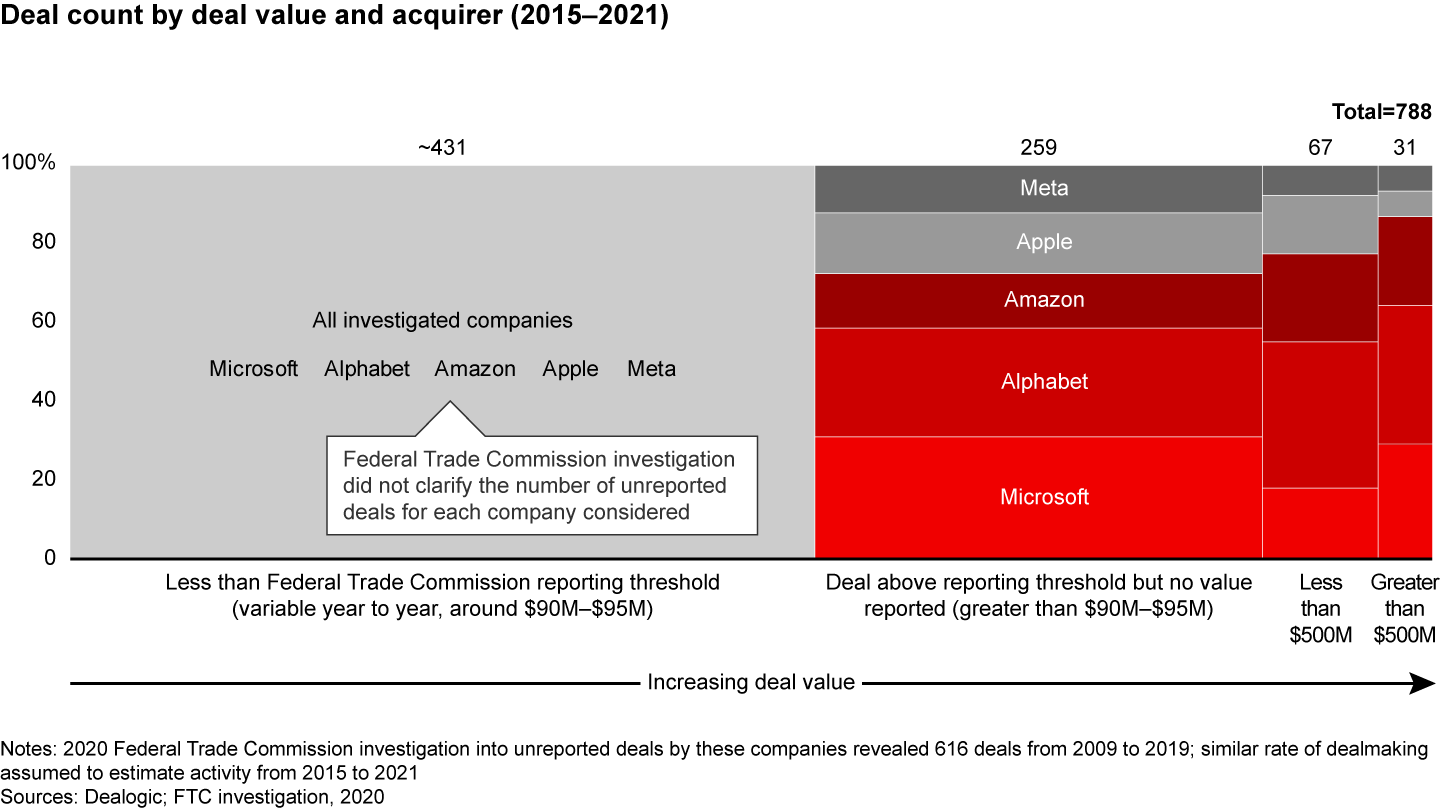
      Big tech companies have predicated their M&A strategy on large numbers of small deals
      Big tech companies have predicated their M&A strategy on large numbers of small deals
      Big tech companies have predicated their M&A strategy on large numbers of small deals

      While these deals come with the promise of access to the talent and cutting-edge innovation needed to help acquirers grow and lead the next wave of industry transitions, delivering on that promise isn’t always a sure thing, especially as some tech companies are acquiring more than 30 companies a year. Too often, the aggregate focus required to address this volume of deals causes great possibilities to give way to a distracted base business, cultural tensions, and talent attrition.

      Big tech companies now face the dual challenge of realizing the deal value in any given capability deal while also building a repeatable, high-velocity integration competency to manage the steady flow of deals coming in at a rate of one every two weeks. Some companies are surfacing as leaders in this high-stakes challenge of successfully integrating a steady flow of capability acquisitions.

      These companies are learning the factors that contribute to deal success. A clear deal thesis and integration thesis grounded in detailed customer and product diligence and aligned with the overall strategy, maniacal focus on retaining all critical talent (not just top leaders), and building a repeatable model with granular tracking of performance to both source and integrate capability deals stand out as priorities for companies ramping up this important type of organic growth.

      Deal thesis aligned to strategy and grounded in deep diligence

      At the most fundamental level, a company’s strategy for acquiring capability targets must be tightly linked to its overall strategy. Amid the industry’s relentless disruption, those strategies are constantly changing. So, M&A objectives and priorities need to shift accordingly, requiring frequent (often monthly) reviews of segment and target priorities.

      Deep customer diligence and product diligence then position acquirers to understand the value available and how it can add to the existing business. Customer diligence requires rigorous primary research, something that few companies do well. For product diligence, some companies become a customer of the target (and potentially its competitors) to work out the product glitches internally before completing a deal. Acquirers also clearly understand their parenting advantage for a particular capability deal. They entice a target by articulating the benefits of joining forces, such as access to the parent’s go-to-market capabilities or its technical talent.

      These deep insights from diligence then lend to another key requisite when integrating capability deals—namely, keeping a keen eye on revenue synergies. Tech acquirers articulate at a granular level where the synergies will come from and set aside funds to invest behind them. They focus on quick wins, often in areas in which the acquirer can help the target accelerate its growth ambitions, thus demonstrating why the combination is good for all (see “Bringing Science to the Art of Revenue Synergies”). These companies also keep a tight, highly agile connection between the acquired business and the strategy team to make sure that both are moving in tandem.

      Acquirers clearly understand their parenting advantage for a particular capability deal.

      Retaining and growing all critical talent

      The top priority in a capability deal is retaining the individuals and teams that underpin the desired competency. This is no easy feat, and more than 75% of the tech M&A practitioners we surveyed felt that retention is now more difficult than it was three years ago—and it was more commonly cited as difficult in tech than in other industries.

      The biggest retention risks mentioned by tech respondents include employees’ uncertainty about their role in the future organization and attractive alternatives in the labor market. As a result, it no longer suffices to focus on cash retention bonuses to ensure that critical talent stays. That’s why some acquirers structure capability deals differently than scale deals, with the goal of retaining the top people. For example, earn-outs, stock-for-stock acquisitions, or other methods to keep senior executives in place typically are more important for deals in tech than in other industries.

      It no longer suffices to focus on cash retention bonuses to ensure that critical talent stays.

      Another critical element for tech capability deal acquirers is that they invest heavily up front to define an operating model that strikes a balance, giving it autonomy to continue to innovate, grow the base business, and retain talent while also defining the required connection points to propagate the capability more broadly.

      Furthermore, the best tech acquirers don’t focus only on top leadership retention; they identify the frontline talent critical to creating the capability purchased, and they ensure that talent is appropriately motivated, rewarded, and ultimately retained. They go beyond simply retaining talent by also finding ways to grow the target’s own talent base. They allow the target to maintain its talent acquisition policies and processes in a way that would build out the talent pool even faster than it could on its own. Finally, they embrace the target’s start-up mentality. Its product cycles are likely to be faster and its tolerance for failure higher, so accepting the new culture is a way to avoid stifling innovation (see “Reimagining Talent in M&A”).

      Building a repeatable integration chassis

      When you manage this volume of acquisitions annually, there is no room for wasted energy, and tech hyper acquirers have learned to create a repeatable integration chassis that builds on lessons learned and drives continuous improvement. This starts with sourcing capability deals. The best companies keep a regular pulse on the market by comprehensively scanning relevant segments for emerging, venture-backed players; monitoring assets; and building a future acquisition pipeline.

      Their steady volume of deals also creates the need to act quickly and efficiently in each integration. The best integrators stay focused on the critical few decisions that truly unlock value, and they disproportionately invest in those areas. Again, talent retention is paramount. Some companies also define repeatable processes, systems connections, and talent models that allow them to efficiently adapt their integration approach for any given deal. They build integration bench strength in the form of a team of resources across functions (often residing within the functions) that are trained in integrating different types of deals.

      Finally, the tech acquirers that make the most of their small company acquisitions develop an effective feedback mechanism, with regular deal reviews aimed at understanding what’s working (and what’s not working) and transferring such learnings into subsequent acquisitions.

      The best integrators stay focused on the critical few decisions that truly unlock value, and they disproportionately invest in those areas. 

      Doing this well with an aim toward continuous improvement requires granular tracking and codification of synergies (targets and realized), implementation timelines, and investments to use as benchmarks for subsequent deals.

      Indeed, learning and continuously refining the integration approach should be the goal of any hyper acquirer hoping to fuel its growth and lead industry transitions. As in so many other areas, the tech industry is one lap ahead in this trend. That’s why many companies across industries are now tracking how the successful tech acquirers build muscles for high-velocity integration and learning from the best.

      Read the Next Chapter

      Telecommunications M&A: A Year of Resilience and Possibilities

      Read our 2022 M&A Report

      Download the PDF Explore the report
      저자
      • Headshot of Adam Haller
        Adam Haller
        파트너, San Francisco
      • Headshot of Chris Johnson
        Chris Johnson
        Alumni, San Francisco
      문의하기
      관련 산업
      • 기술
      관련 컨설팅 서비스
      • M&A
      M&A Report
      Software M&A

      The good news: Most deal best practices still apply to AI acquisitions.

      자세히 보기
      M&A Report
      Banking M&A

      As conditions shift, leading banks are fusing scale with scope to create future-ready organizations.

      자세히 보기
      M&A Report
      Consumer Products M&A

      In their quest for profitable growth, more companies are divesting brands or buying insurgents.

      자세히 보기
      M&A Report
      Media M&A

      AI and other tech tools can boost bidding confidence in this highly competitive environment.

      자세히 보기
      기술
      Exploring AI for Packaging Circularity

      AI is already creating value across the packaging lifecycle, from optimising design and reducing material use to improving sorting and traceability.

      자세히 보기

      Overview

      • Letter from the M&A Team: Beneath the M&A Headlines

      • State of the M&A Market

      • Bain’s Bedrock Beliefs on How to Create Value from M&A

      Hot Topics

      • Reimagining Talent in M&A

      • Bringing Science to the Art of Revenue Synergies

      • The ESG Imperative in M&A

      • Delivering Results in Joint Ventures and Alliances Requires a New Playbook

      • Harnessing the True Value of Corporate Venture Capital

      Industry Views

      • Aerospace and Defense M&A

      • Asset Management M&A

      • Automotive and Mobility M&A

      • Banking M&A

      • Consumer Products M&A

      • Diversified Industrials M&A

      • Energy and Natural Resources M&A

      • Healthcare M&A

      • Insurance M&A

      • Media M&A

      • Payments M&A

      • Retail M&A

      • Technology M&A

      • Telecommunications M&A

      • Wealth Management M&A

      Regional Perspectives

      • Brazil M&A

      • China M&A

      • India M&A

      • Japan M&A

      First published in 2월 2022
      태그
      • 기술
      • M&A
      • M&A Report

      프로젝트 사례

      Helping a Midsize ERP Player Compete against the Giants

      See more related case studies

      성과 개선 Aggressively growing an IT service provider with a high-performance culture

      See more related case studies

      고객 전략 및 마케팅 Electronics manufacturer increases value of CRM investment

      See more related case studies

      베인에 궁금하신 점이 있으신가요?

      베인은 주저 없이 변화를 마주할 줄 아는 용감한 리더들과 함께합니다. 그리고, 이들의 담대한 용기는 고객사의 성공으로 이어집니다.

      급변하는 비즈니스 환경에서 살아남기 위한 선도자의 시각. 월간 Bain Insights에서 글로벌 비즈니스의 핵심 이슈를 확인하십시오.

      *개인정보 정책을 읽었으며 그 내용에 동의합니다.

      Privacy Policy를 읽고 동의해주십시오.
      Bain & Company
      문의하기 환경정책 Accessibility 이용약관 개인정보 보호 쿠키 사용 정책 Sitemap Log In

      © 1996-2026 Bain & Company, Inc.

      문의하기

      무엇을 도와드릴까요?

      • 프로젝트 문의
      • 채용 정보
      • 언론
      • 제휴 문의
      • 연사 초청
      오피스 전체보기