

Brief

한눈에 보기
- As the selling environment has become more complex, sales leaders are requiring more functionality from their sales operations groups, yet finite budgets mean it’s important to know which investments yield the highest returns.
- Bain’s data set of 200 companies shows that these new teams with a broader mandate, now considered “commercial operations,” are built around 14 critical capabilities.
- The fastest-growing companies are four times more likely than laggards, on average, to have best-in-class performance on five foundational capabilities.
- Building on those five, leading sales organizations selectively invest in other capabilities that amplify their strategy, depending on their industry and go-to-market model.
In most companies, the sales operations function has failed to keep up with an increasingly complex selling environment. This group has traditionally focused on activities such as forecasting and incentive management, but with the proliferation of digital tools, digital engagement models and multichannel selling motions, sales operations must evolve. That’s why more business-to-business (B2B) companies have been transforming these operations. The reconfigured “commercial operations” function now performs new activities and has a broader, more strategic mandate.
In their search to define this new commercial operations function, sales executives often want to tinker with organizational design. But, in fact, success is less about where the capabilities reside and more about tightly linking the capabilities to the sales and marketing organizations.
Bain & Company and Dynata research on 200 B2B companies in the US, combined with our experience working with hundreds of sales organizations, find that 14 capabilities underpin the commercial operations group (see Figure 1).
Figure 1
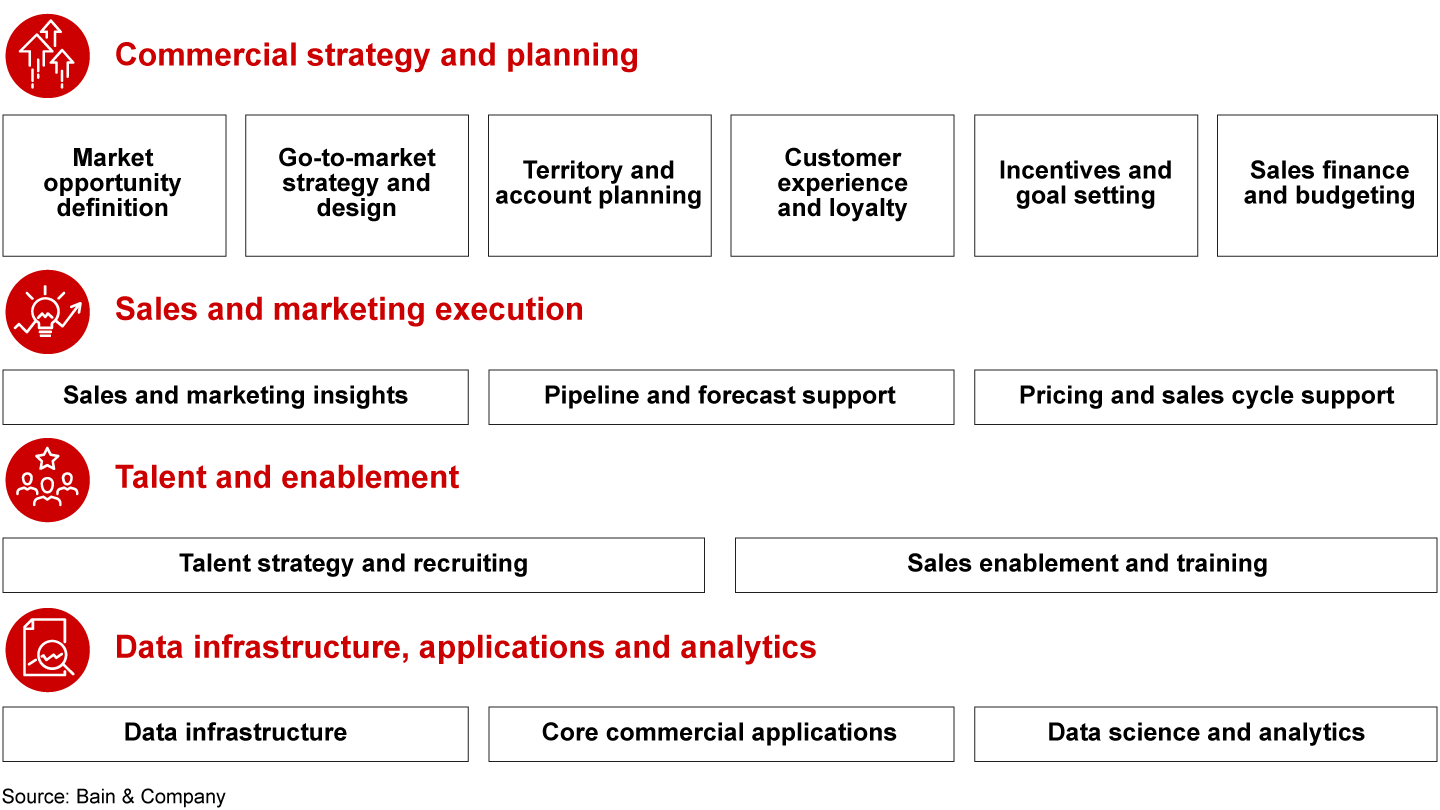

Sales operations groups have traditionally covered some of these capabilities, such as the three capabilities in the category of sales and marketing execution. Now, for the first time, commercial operations groups are taking up some of the other capabilities, such as those under the commercial strategy and planning category.
While investing in all capabilities might be ideal, sales leaders with finite budgets and tight time frames rarely have that luxury. They look instead for indicators about where they can get the highest return on investment (ROI). Our data analysis, again, reinforced by long experience working with sales organizations, identifies five capabilities that are fundamental table stakes for all B2B companies (see Figure 2):
- market opportunity definition;
- go-to-market strategy and design;
- incentives and goal setting;
- pipeline and forecast support; and
- sales enablement and training.
Figure 2
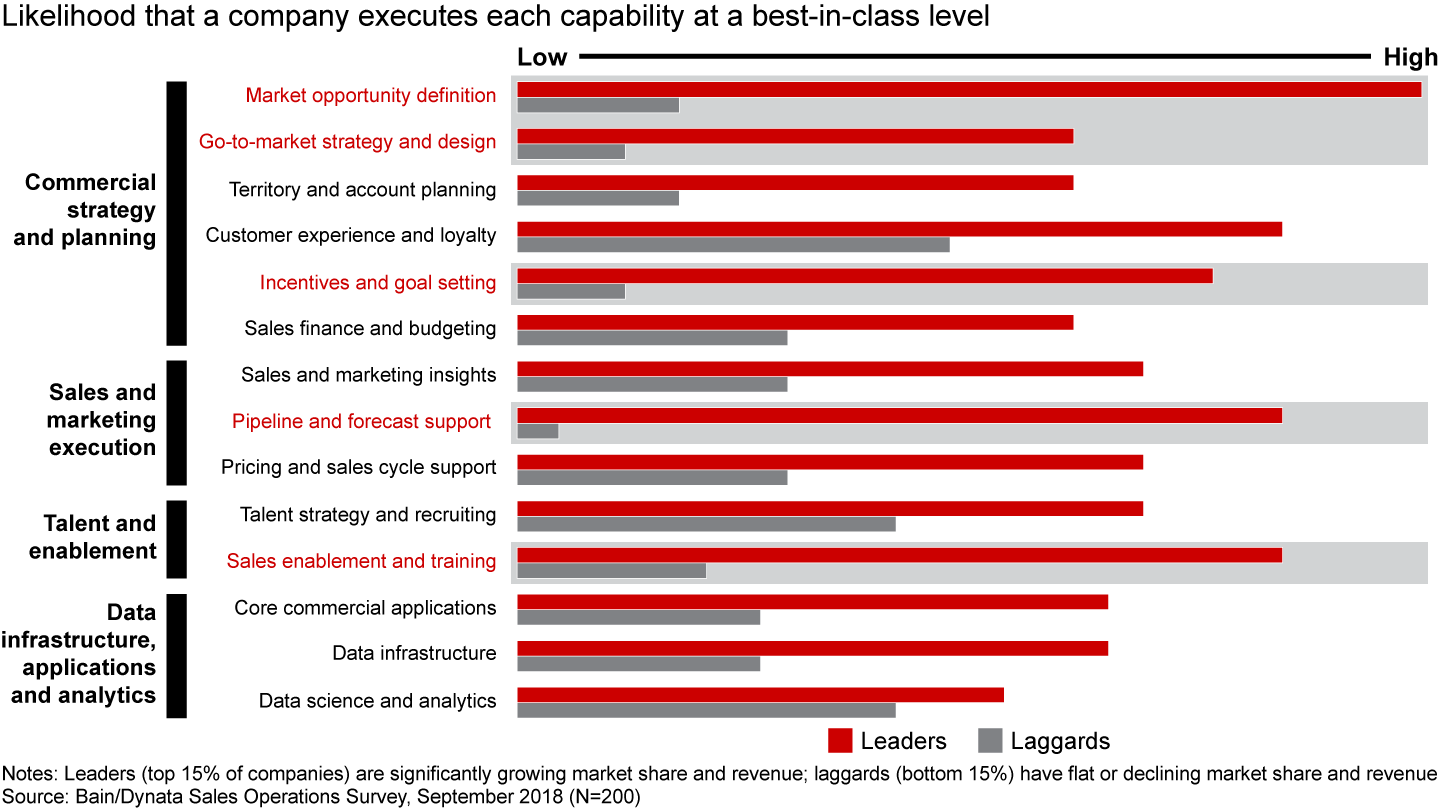

Our analysis finds that leading companies (defined as the top 15% in revenue and market share growth) are 50% more likely than laggards (defined as the bottom 15% in revenue and market share growth), on average, to have best-in-class capabilities. And the fastest-growing companies are four times more likely than laggards, on average, to have best-in-class performance on these five foundational capabilities. Let’s explore each in turn.
Five capabilities form the foundation
Market opportunity definition. Identifying target customers and their relative importance is easy. Digging deeper, though, few companies know the total spending or lifetime value of each customer. They should ask, Do we know the potential of each sales representative’s account portfolio? Is most of the value concentrated in a few representatives’ portfolios, where customers are not adequately served, or have we spread it out to ensure that each account gets the requisite amount of attention to maximize value?
Leading sales organizations do not leave opportunity definition to chance. They build a commercial operations group that owns the account and prospect database, composed of internal and external data, and keeps it up to date. Their algorithms and heuristics shape the data into an estimate of each customer’s total opportunity. A medical device company might rely on, among other things, procedural data, such as how many angiograms each hospital performs, to estimate potential demand and measure current share. An office supplies company could track demand catalysts, such as how many white-collar workers are employed at each location of a customer.
Go-to-market strategy and design. Sales capacity has a tendency to simply take last year’s model and make slight tweaks at the margin, thereby rusting in place. Leading commercial operations groups, by contrast, take an active approach to planning optimal coverage. After defining the best opportunities, they determine what type of coverage and capacity has the best chance of reaching target customers—in other words, what mix of channels, direct or indirect salesforces, and sales roles are required.
This discipline is especially important when significant changes occur, such as when a new product requires specialist sales reps, or when a European company expands into China, or when a supplier taking on more small business customers requires an upgraded e-commerce platform and more inside sales staff.
The commercial operations group identifies where and when these decisions need to be made, makes recommendations, and shepherds the executive team on the decisions. In a large, matrixed organization (with product owners, regional owners and global owners), the commercial operations group has the best position to take an enterprise-wide view and promote consistency.
Best-in-class teams often have revenue-planning tools that connect market opportunity data with coverage data and that link to the quota-setting process. This allows for a detailed analysis of where they should deploy sales resources. One incumbent software company that enjoys rapid growth uses this process to adjust its go-to-market model each year. As the company grew, it was able to shift the mix of new business reps in order to focus on markets with the biggest opportunities. At the same time, it staffed more mature markets with additional account managers to maintain the existing customer base. Over time, the commercial operations team guided the company to further diversify its coverage model to support a year-over-year growth rate in excess of 20%.
Incentives and goal setting. Top commercial operations groups make sure that compensation plans link to desired sales objectives and behaviors, such as selling a new solution or reaching a new set of customers. If a company has a major goal of acquiring new customers, for example, the compensation plan must be geared toward motivating reps to hunt. Best-in-class organizations standardize compensation plans across similar roles and limit the number of measurements to focus on only the most important objectives.
A big area of opportunity is the target-setting process. Many companies do this from the top down, defining their revenue target for the year and then dividing that among reps by adding some percentage to each rep’s target from the prior year. That tack fails to account for variations in rep tenure, ramp-up time or opportunities at the territory level. Instead, with its analysis and incentive design, a smart commercial operations group grounds target setting in reality by reconciling top-down financial targets with bottom-up estimates of market opportunity.
One broadcasting company undertook a detailed opportunity definition exercise and then defined the potential value of each rep’s portfolio. It decided that reps should go beyond their assigned product in each account and sell the entire portfolio. But the company would have to change its compensation plan, which emphasized assigned products and discouraged selling multiple products. The new plan set up individual targets with an expectation of growth and gave equal incentives to all products, which encouraged reps to sell solutions across the portfolio.
Pipeline and forecast support. The foundation for commercial operations involves managing and analyzing the pipeline review process, but the best groups excel through an industrialized set of processes that are more science than art. That is, they base pipeline probabilities on predictive analytics, not on reps’ estimates.
Commercial operations should not only maintain a rhythm of pipeline meetings and monthly forecast calls but should also serve as an intelligence engine, providing insights to support frontline sales managers, who do not always have time to assess every deal in the pipeline or play detective in reviewing each account with a rep. In addition, commercial operations helps sales leadership accurately “call the number” during each reporting period.
Technology-based advanced analytics and automation now underpin pipeline and forecast support, such as rollups of committed revenue estimates. In addition, analytics-based pipeline scoring applications can independently assess the probability that a deal will close based on modeling the attributes of comparable past deals won or lost. That gives managers solid data with which to direct their reps so that reps do not waste time chasing low-probability deals.
Sales enablement and training. Sales enablement and training might sound straightforward, but it can be tricky to execute well given how expansive the mandate is, ranging from new employee orientation to ongoing training to sales collateral development. Too often, training is product-centric, narrow and infrequent—eight hours crammed into a January offsite and forgotten by March.
To complicate matters, several teams, including human resources, marketing, product and others, own sales enablement. Many companies thus have disjointed and ineffective training, or they leave it to local leaders, which, in reality, means not having much enablement or training at all.
Leading commercial operations groups bring the same analytical rigor to enablement and training as they do to sales forecasting. They use digital tools, such as Microsoft Workplace Analytics, to track the online calendars and email traffic of reps, and they highlight what top performers do differently. Those behaviors serve as the basis of targeted training.
Further, they use multiple training methods, including microlearning via mobile devices or asking sales reps to submit videos of “elevator pitches,” that are scored by artificial intelligence models. They build a library of sales content, measure the utilization of each asset and develop recommendation engines that push specific content to reps based on the characteristics of the opportunity they are pursuing.
Standing out from the crowd
If leading companies excel on these five capabilities, do the other nine even matter? Choosing which of these nine to make substantial investments in will depend on a company’s starting point—namely, the strategic objectives, go-to-market model and industry dynamics.
For example, a company selling complex products to large groups of decision makers may choose to focus on developing strong account planning capabilities. One global manufacturer realized that its sales teams did not have a consistent approach to identifying growth opportunities for products and services at their accounts, which was causing the company to lose share to niche competitors. To remedy this, the commercial operations team redesigned the account planning process, installing a digital planning tool that integrated with the customer relationship management system and that allowed everyone on an account team to view the plan and provide updates. The team recommended a new cadence for reviewing account plans rather than treating them as an annual exercise. As a result of these changes, the manufacturer saw double-digit increases in pipeline activity across lagging product lines.
Questions to guide the investment
Our research and experience does not point to commercial operations assuming all capabilities or having a single leader. The group might own everything, or it could function as the integrator of information from multiple other groups in order to deliver a unified message to the field force and reduce the waste that occurs at the intersection of different groups. Its design should fit the environment in which it operates.
When considering where to invest first, start with a self-assessment to understand the commercial organization’s strengths and weaknesses as well as which capabilities are critical to the chosen strategy.
- What is our current state?
- Are the strategic priorities for the sales organization clear?
- Have those priorities translated into commercial operations capabilities?
- Based on spending and timing constraints, which capabilities will deliver the highest ROI?
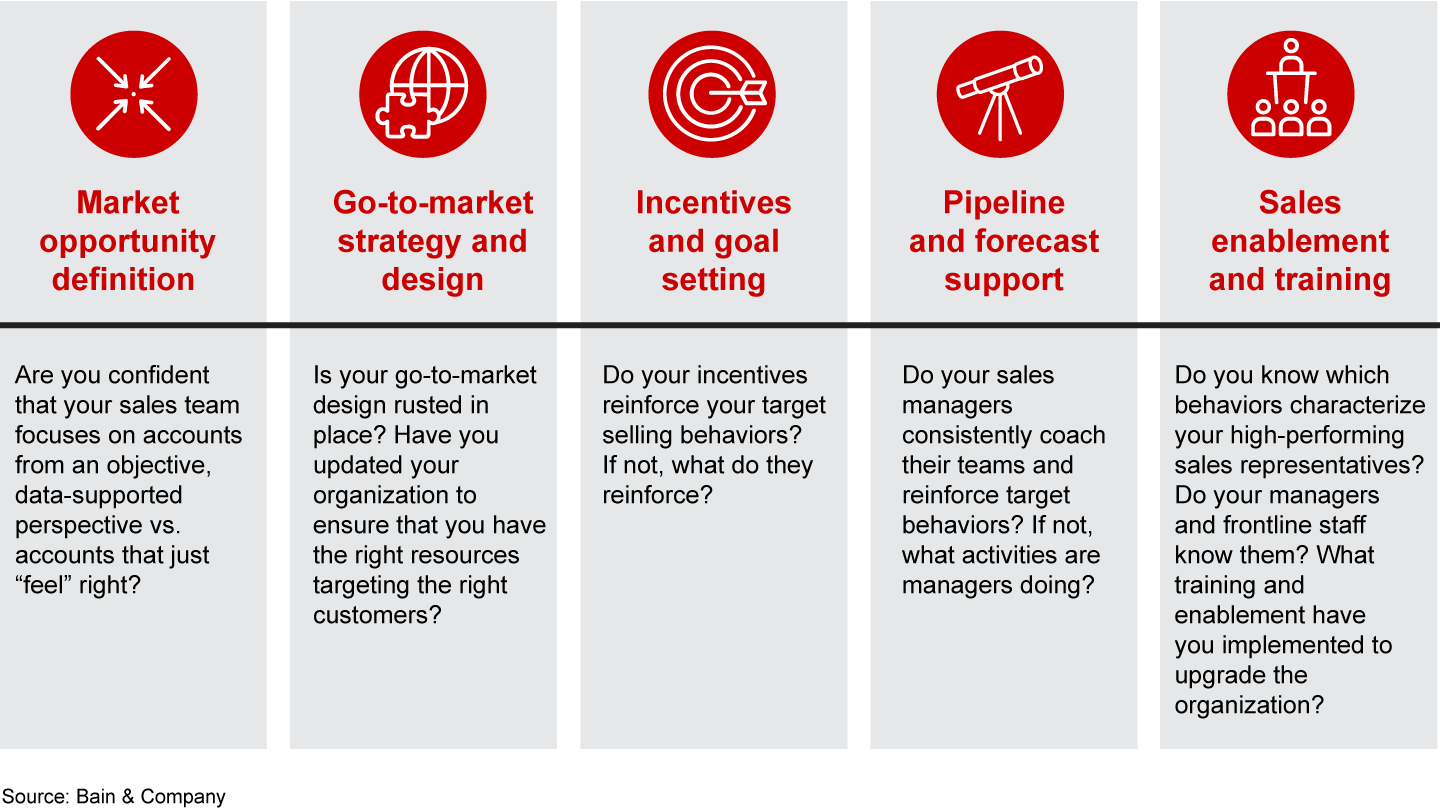
Answering these questions and others specific to the five foundational capabilities allows you to triage by weakness and alignment with the strategy (see Figure 3).
Figure 3

To demonstrate the value of commercial operations to the entire sales organization, a firm with solid revenue can afford to make limited initial investments in just one or two areas that will generate quick wins. One that’s struggling may not have the luxury of time and probably should move on several fronts right away so that it can uncover root causes of dysfunction and begin to correct them. In either case, though, shifting to a commercial operations group with a broader mandate will strengthen the entire sales organization.
Chris Dent is a principal and Greg Callahan and Thomas Whiteley are partners with Bain & Company’s Customer Strategy & Marketing practice. They are based, respectively, in Chicago, Boston and London.
First published in 11월 2019