
Skip to Content
  • 오피스

    오피스

    미주
    • Atlanta
    • Austin
    • Bogota
    • Boston
    • Buenos Aires
    • Chicago
    • Dallas
    • Denver
    • Houston
    • Los Angeles
    • Mexico City
    • Minneapolis
    • Monterrey
    • Montreal
    • New York
    • Rio de Janeiro
    • San Francisco
    • Santiago
    • São Paulo
    • Seattle
    • Silicon Valley
    • Toronto
    • Washington, DC
    유럽, 중동, 아프리카
    • Amsterdam
    • Athens
    • Berlin
    • Brussels
    • Copenhagen
    • Doha
    • Dubai
    • Dusseldorf
    • Frankfurt
    • Helsinki
    • Istanbul
    • Johannesburg
    • Kyiv
    • Lisbon
    • London
    • Madrid
    • Milan
    • Munich
    • Oslo
    • Paris
    • Riyadh
    • Rome
    • Stockholm
    • Vienna
    • Warsaw
    • Zurich
    아시아, 호주
    • Bangkok
    • Beijing
    • Bengaluru
    • Brisbane
    • Ho Chi Minh City
    • Hong Kong
    • Jakarta
    • Kuala Lumpur
    • Manila
    • Melbourne
    • Mumbai
    • New Delhi
    • Perth
    • Seoul
    • Shanghai
    • Singapore
    • Sydney
    • Tokyo
    오피스 전체보기
  • 얼럼나이
  • 미디어 센터
  • 구독
  • 연락처
  • Korea | 한국어

    지역 및 언어 선택

    글로벌
    • Global (English)
    미주
    • Brazil (Português)
    • Argentina (Español)
    • Canada (Français)
    • Chile (Español)
    • Colombia (Español)
    유럽, 중동, 아프리카
    • France (Français)
    • DACH Region (Deutsch)
    • Italy (Italiano)
    • Spain (Español)
    • Greece (Elliniká)
    아시아, 호주
    • China (中文版)
    • Korea (한국어)
    • Japan (日本語)
  • Saved items (0)
    Saved items (0)

    You have no saved items.

    관심 있는 내용을 북마크하여 Red 폴더에 저장할 수 있습니다. Red 폴더 에서 저장된 내용을 읽거나 공유해보세요.

    Explore Bain Insights
Bain.com 홈페이지
Founder's Mentality®
  • Overview
  • About
    Bain.com 홈페이지
    Founder's Mentality®

    About

    • About Founder's Mentality
    • About Micro-battles
  • Podcast
  • Book
  • Blog
  • 오피스
    메인 메뉴

    오피스

    • 미주
      오피스
      미주
      • Atlanta
      • Austin
      • Bogota
      • Boston
      • Buenos Aires
      • Chicago
      • Dallas
      • Denver
      • Houston
      • Los Angeles
      • Mexico City
      • Minneapolis
      • Monterrey
      • Montreal
      • New York
      • Rio de Janeiro
      • San Francisco
      • Santiago
      • São Paulo
      • Seattle
      • Silicon Valley
      • Toronto
      • Washington, DC
    • 유럽, 중동, 아프리카
      오피스
      유럽, 중동, 아프리카
      • Amsterdam
      • Athens
      • Berlin
      • Brussels
      • Copenhagen
      • Doha
      • Dubai
      • Dusseldorf
      • Frankfurt
      • Helsinki
      • Istanbul
      • Johannesburg
      • Kyiv
      • Lisbon
      • London
      • Madrid
      • Milan
      • Munich
      • Oslo
      • Paris
      • Riyadh
      • Rome
      • Stockholm
      • Vienna
      • Warsaw
      • Zurich
    • 아시아, 호주
      오피스
      아시아, 호주
      • Bangkok
      • Beijing
      • Bengaluru
      • Brisbane
      • Ho Chi Minh City
      • Hong Kong
      • Jakarta
      • Kuala Lumpur
      • Manila
      • Melbourne
      • Mumbai
      • New Delhi
      • Perth
      • Seoul
      • Shanghai
      • Singapore
      • Sydney
      • Tokyo
    오피스 전체보기
  • 얼럼나이
  • 미디어 센터
  • 구독
  • 연락처
  • Korea | 한국어
    메인 메뉴

    지역 및 언어 선택

    • 글로벌
      지역 및 언어 선택
      글로벌
      • Global (English)
    • 미주
      지역 및 언어 선택
      미주
      • Brazil (Português)
      • Argentina (Español)
      • Canada (Français)
      • Chile (Español)
      • Colombia (Español)
    • 유럽, 중동, 아프리카
      지역 및 언어 선택
      유럽, 중동, 아프리카
      • France (Français)
      • DACH Region (Deutsch)
      • Italy (Italiano)
      • Spain (Español)
      • Greece (Elliniká)
    • 아시아, 호주
      지역 및 언어 선택
      아시아, 호주
      • China (中文版)
      • Korea (한국어)
      • Japan (日本語)
  • Saved items  (0)
    메인 메뉴
    Saved items (0)

    You have no saved items.

    관심 있는 내용을 북마크하여 Red 폴더에 저장할 수 있습니다. Red 폴더 에서 저장된 내용을 읽거나 공유해보세요.

    Explore Bain Insights
Founder's Mentality®
  • 산업
    • 산업

      • 우주항공, 방산 및 정부 서비스
      • 농업 관련 산업
      • 화학
      • 인프라, 건설 및 건축 자재
      • 소비재
      • 금융 서비스
      • 헬스케어
      • 산업용 기계 및 장비
      • 미디어 및 엔터테인먼트
      • 금속
      • 광업
      • 석유 및 가스
      • 제지 및 패키징 산업
      • 사모펀드
      • 사회 및 공공 부문
      • 유통
      • 기술
      • 텔레콤
      • 운송
      • 여행·여가
      • 유틸리티 및 재생가능 에너지
  • 컨설팅 서비스
    • 컨설팅 서비스

      • Customer Experience
      • ESG
      • Innovation
      • M&A
      • 운영
      • 조직
      • 사모펀드
      • 고객 전략 및 마케팅
      • 전략
      • AI, 인사이트 및 솔루션
      • Technology
      • 변화 혁신
  • Digital
  • 인사이트
  • 베인 소개
    • 베인 소개

      • 업무 소개
      • 베인의 신념
      • 구성원 및 리더십 소개
      • 고객 성과
      • 주요 수상 경력
      • 글로벌 파트너사
      Further: Our global responsibility
      • 다양성과 포용
      • 사회 공헌 활동
      • Sustainability
      • World Economic Forum
      Learn more about Further
  • Careers
    최근 검색어
      최근 방문 페이지

      Content added to saved items

      Saved items (0)

      Removed from saved items

      Saved items (0)

      Founder's Mentality Blog

      The Second-generation Role: Maintain the Magic

      The Second-generation Role: Maintain the Magic

      Children of company founders need to carry on their parents' missions.

      글 James Allen

      • 읽기 소요시간

      Article

      The Second-generation Role: Maintain the Magic
      en

      I spent this past week in Mumbai, Delhi and Bangalore talking to founders—or as Indians tend to call them, “promoters.”

      A recurrent theme was the role of the second generation—the sons and daughters of the founder. It’s an issue that also came up during recent trips to China and South America.

      Here’s a typical situation I’ve encountered five times in three countries over the last three weeks:

      1. The company is a very successful business, founded by the father (and, in one case, the mother) who has recently moved to the chairman role.
      2. The founder has brought in a professional CEO who is working to bring in the right systems and processes to take the company to the next level.
      3. There are inevitable tensions at times between the founders and their new CEOs as the two seek to balance the benefits of maintaining the original founding culture and organization against the benefits of adapting the culture and organization to its new scale and the resulting need for greater professionalism.
      4. The son or daughter of the founder, having benefited from a first-class education and often a stint in a blue-chip company, has now re-entered the company, with the implicit understanding that they are being groomed to take over from the CEO.

      In my conversations, we talked about this as a classic triad—the Chairman-Founder, the Professional CEO and the Child of the Founder—and discussed the following questions:

      • What role should the “Child of the Founder” play—both immediately and over the medium-term?
      • Based on the answer, what is the best career path for the Child of the Founder?

      The common instinct of the Child of the Founder, as discussed by a son of the founder of a Chinese luxury business: “Managing the triad is difficult, and my instinct is to play to my strengths, helping the CEO professionalize the company. I have a good education and good work experience and this seems like the right first step. I’m currently helping my father and the CEO on M&A work.”

      The Child of the Founder, understandably, wants to help the CEO and their parent, the Chairman-Founder, to continue to professionalize the company. When it comes to the benefits of scale/scope versus the benefits of Founder’s MentalitySM, as shown on the Founder’s Mentality 2X2 graphic, the common instinct of the Child of the Founder is to help the company gain further benefits of scale and scope (see Figure 1).
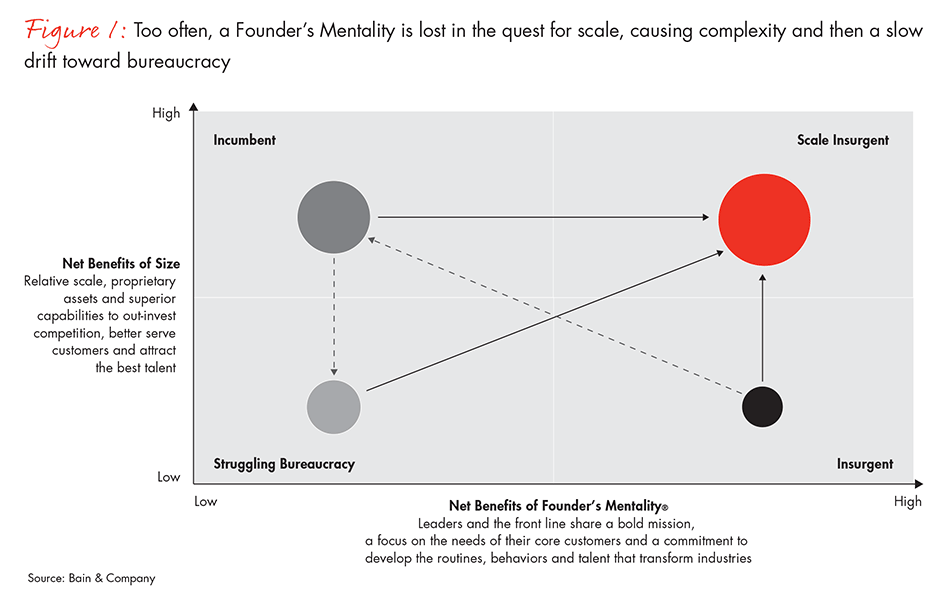

      While this instinct is understandable, it also is wrong in most cases if their goal (and the Founder’s goal) is for the Child of the Founder to take over the company. In this sort of a generational transfer of company leadership from Founder to Child, the most threatened aspect of the company is its Founder’s Mentality—the sense of insurgency, the owner mindset, and the obsession with customers and front line. The Professional CEO will handle the “Benefits of scale and scope” axis and bring in additional professional managers as needed to help with this mission.

      But who, if not the Child of the Founder, will take over the Founder’s Mentality?

      With newly minted professional education and experience, the children of founders instinctively want to bring that professionalism to their family business. But in most cases, what the company actually needs is for them to carry on their parents’ mission. Rather than become the group professional, this suggests strongly that they should become the voice of the front line and voice of the customer. It suggests that the best career path for them is to start at the front line of the business, not its center—to work with the “kings” of the organization (those responsible for delivering the company’s products and services every day), not the “court” (those responsible for supporting the kings with professional services). The Child of the Founder should be mission-driven—to continue the insurgency—and obsessed with culture—to maintain the owner mindset.

      Learn more

      About the Founder's Mentality

      The three elements of the Founder's Mentality help companies sustain performance while avoiding the inevitable crises of growth.

      This is often not a conclusion that the Child of the Founder or the Founder wants to hear, and these conversations aren’t always easy ones to have. The typical objections, from highly emotional to more dispassionate, are:

      • “I didn’t waste two years at business school and four years at an investment bank [or blue-chip company or top consulting firm] just to come back and work on a shop floor.” (Or, from the Founder: “I didn’t pay for an Ivy League education to train a job assistant!”)
      • “The firm desperately needs professionals that understand this business—why isn’t it right that I jump in and help here, rather than do something every first-year recruit could do?”
      • “To become the next CEO, I need to run a professionally run firm, not the personality-driven firm of my parent. Isn’t the whole point to move the company on from my parent’s time?”

      The answer to these questions, quite simply, is that Founder’s Mentality is magic dust. Growing to leadership in your industry and maintaining the sense of Founder’s Mentality is rare. Companies that do both, like AB InBev or Ikea, become industry leaders. What the Child of the Founder can do to truly differentiate the company is to provide insights on both scale and scope and Founder’s Mentality. Education and experience in blue-chip firms can help with the first dimension. But the Child of the Founder needs to round out that experience if they are to be the voice of the front line and customers, to be the culture carrier. Spending time on the front line is not a bad idea if you will someday be the champion of that front line.

      Of course, if the founder hasn’t brought in professional management and the Triad doesn’t exist, then the role of the Child of the Founder can be different. In that case, the company needs his or her newly acquired skills to support the transition to more professional management. Of course, in that case the Child of the Founder also has to work on maintaining the company’s Founder’s Mentality. This is a very tall order. In most cases, the correct action of the parent is to complete the TRIAD. Bringing in a Professional CEO will give the Child of the Founder the time and space they need to take over—not just from the Professional CEO but from the Founder-Chairman as well.

      Maintaining the magic dust of the Founder’s Mentality is often the most important mission of the Child of the Founder. They’ll need their education and blue-chip experience too. But let’s start on the shop floor.

      저자
      • Headshot of James Allen
        James Allen
        어드바이저 파트너, London
      문의하기
      관련 컨설팅 서비스
      • 전략
      Change Management
      Micro-battles and the Journey to Scale Insurgency

      Discrete, fast-moving initiatives bring focus to strategic choices and help companies rediscover the art of getting stuff done.

      자세히 보기
      전략
      The Founder's Mentality: How to Overcome the Predictable Crises of Growth

      The Founder's Mentality® can help businesses achieve lasting, profitable growth.

      자세히 보기
      전략
      Barriers and Pathways to Sustainable Growth: Harnessing the Power of the Founder's Mentality

      Some companies have been able to anticipate and address the internal obstacles to growth.

      자세히 보기
      창업자 정신
      The Magic of Founder-led Companies

      Companies with their founder present performed twice as well as their peers in the S&P 500 over the past decade.

      자세히 보기
      전략
      Six Threats Demand a New Playbook for Banks in Wealth and Asset Management

      AI, direct-to-consumer models, and the return of local priorities are redrawing industry lines.

      자세히 보기
      First published in 10월 2013
      태그
      • 전략
      • 창업자 정신

      프로젝트 사례

      전략 A Conglomerate Charts a New Global Strategy

      See more related case studies

      고객 전략 및 마케팅 Designing a Sales Compensation Plan Based on an Unusual Metric

      See more related case studies

      성과 개선 Transforming a telecommunications giant

      See more related case studies

      베인에 궁금하신 점이 있으신가요?

      베인은 주저 없이 변화를 마주할 줄 아는 용감한 리더들과 함께합니다. 그리고, 이들의 담대한 용기는 고객사의 성공으로 이어집니다.

      급변하는 비즈니스 환경에서 살아남기 위한 선도자의 시각. 월간 Bain Insights에서 글로벌 비즈니스의 핵심 이슈를 확인하십시오.

      *개인정보 정책을 읽었으며 그 내용에 동의합니다.

      Privacy Policy를 읽고 동의해주십시오.
      Bain & Company
      문의하기 환경정책 Accessibility 이용약관 개인정보 보호 쿠키 사용 정책 Sitemap Log In

      © 1996-2026 Bain & Company, Inc.

      문의하기

      무엇을 도와드릴까요?

      • 프로젝트 문의
      • 채용 정보
      • 언론
      • 제휴 문의
      • 연사 초청
      오피스 전체보기