

Brief

Retail healthcare companies are the new Starbucks. Dental clinics, physiotherapy chains and dermatology outlets are popping up in malls and retail strips and expanding across the US. Both private equity investors and healthcare operators are riveted by retail health's rapid rise—and the disruption it may bring.
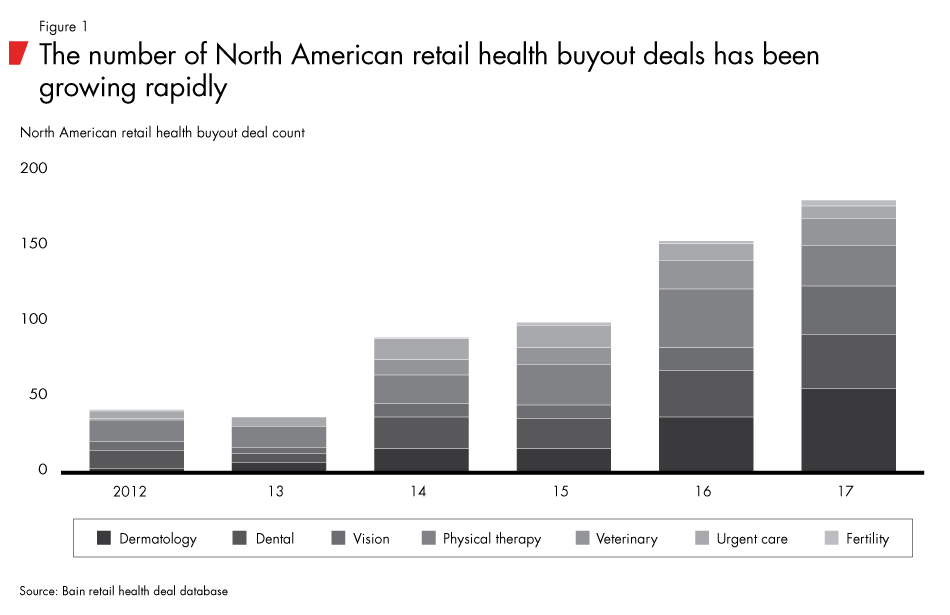
From 2012 to 2017, the number of deals involving retail health companies—those that operate freestanding health-related outlets like dental clinics or urgent care facilities—has soared, increasing at a compound annual rate of 34% in the North American market (see Figure 1).
Ample upside
Much of retail health's appeal is that it is a fragmented, high-margin sector with strong growth characteristics. In a sea of high prices, it still offers targets at reasonable multiples and many opportunities to unlock substantial value. The playing field includes a wide range of health services, from urgent care and dental to physical therapy and dermatology. What these companies have in common is a heavier reliance on consumer choice than many healthcare services, meaning some thrive less on insurance reimbursement and more on self-paying patients. They tend to be multisite businesses emphasizing proximity to customers, and many offer specialized care, which means their treatment protocols can be standardized and replicated across sites.
How dependent they are on consumer choice varies widely. A chain of veterinary clinics, for instance, will tend to rely heavily on direct payments from customers, while a dermatology outlet typically has a mix of revenue sources. Patients might pay for cosmetic procedures out of pocket, and their choice of provider might depend largely on social media reviews or recommendations. But patients with skin diseases or cancer tend to come from physician or network referrals, and payments are largely insurance based.
Whatever the mix, revenue growth—both current and potential—is central to retail health's appeal. The sector has been growing at a steady 3% to 4% annually, and it is clearly benefiting from trends in the healthcare industry that encourage cost management and greater patient choice. The rise of urgent care clinics, for instance, stems from the fact that these proliferating outlets provide a strong alternative to emergency rooms for both payers and patients. An aging population with growing health issues, higher incident rates and increased focus on wellness and prevention also supports long-term revenue growth. Moreover, that growth is likely to be recession-resistant. As with other health-related businesses, much of the sector's revenue comes from need-based services that remain steady despite fluctuations in economic activity.
While this level of secular growth is attractive, the opportunity to help retail health businesses perform substantially better also exists, through a combination of smart organic growth strategies, building new outlets and acquisitions. New outlets deliver a very high return on invested capital. Opening a site may trigger an investment of between $200,000 and $300,000, but operators can recoup that amount quickly, leaving a strong stream of future cash.
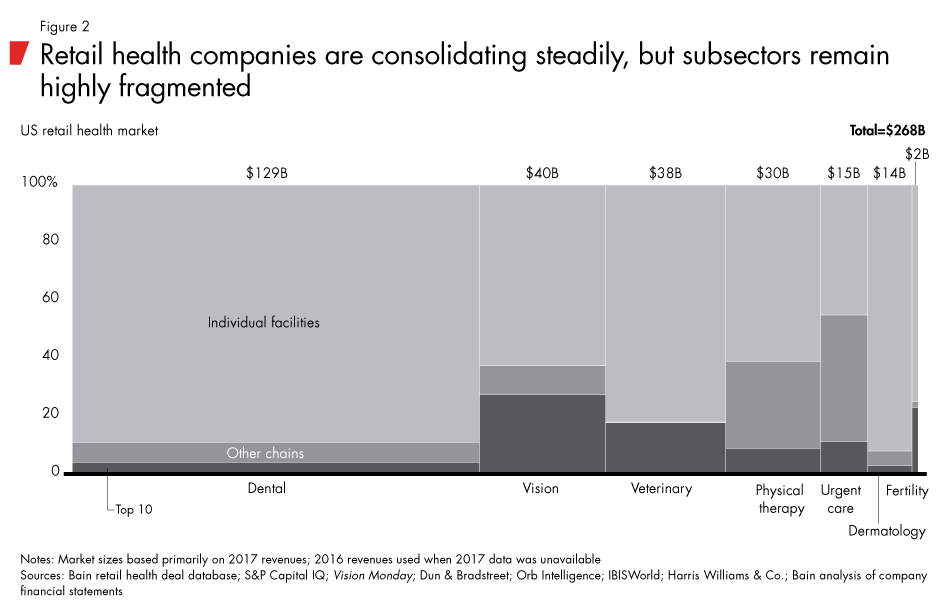
Similarly, a buy-and-build strategy gives PE investors the chance to arbitrage multiples that historically have expanded with a company's growing scale and clout. While retail health businesses with fewer than 10 outlets have been commanding multiples of around four to seven times earnings before interest, taxes, depreciation and amortization (EBITDA), those with 10 to 50 clinics are selling for seven to nine times, and companies with more than 50 clinics are trading in the low teens. The opportunity to magnify value through consolidation is huge. And with all areas of retail health still highly fragmented, there is no shortage of acquisition targets (see Figure 2).
Multiple paths to value
Top-line growth in the retail health sector also comes with potential for exceptionally high profitability. Before accounting for corporate overhead, individual retail health clinics typically enjoy EBITDA margins of around 25%, and those can spike as high as 45%. Even so, PE funds see significant upside potential in a sector that is still taking shape. Mature, ultracompetitive industries like traditional retail have been managed aggressively for years. Investors and management teams have already pulled many of the levers available to boost results—including supply chain optimization, procurement and category management—making it difficult to capture yet more value. In a typical retail buyout, the company might have to undertake a dozen initiatives in pursuit of less than 100 basis points of margin improvement. In retail health, firms are discovering that just a couple of key value-creation initiatives can demonstrably improve the company's economics.
The most successful strategies deploy a combination of retail and healthcare best practices. Retail investors bring expertise around real estate management, site selection, branding and marketing. They use a consumer mindset to identify target customers and best meet their needs. Healthcare specialists tend to attack the operations side of the business by improving clinical workflow, optimizing billing practices and improving negotiating power with payers and suppliers. The ability to run plays from both directions can be a meaningful advantage in assessing and realizing potential.
Whatever approach investors undertake post-acquisition, success hinges on clinician buy-in. Physicians and other clinicians play a major role in the management of these companies and add significant value. They are motivated by a range of factors, not just greater profitability. People who have devoted their careers to a practice need to know that an investment strategy isn't focused solely on financial performance, but also on delivering better outcomes for patients. This likely will include a plan for improving the patient experience and quality of care. It might involve strategies for bringing in new talent or increasing both professional and office staff to handle new volume.
Bain Partner Nirad Jain shares the underlining reasons why retail healthcare is a huge opportunity for PE funds looking to deploy capital.
Diligence matters
Investing in the retail health sector, of course, carries its own set of risks. Success at this intersection of retail and healthcare most often requires insights developed in both industries. The ability to create a clear and compelling deal thesis becomes especially important as asset prices in the sector increase. Successful PE firms and corporate investors focus closely on a number of key factors in their due diligence:
- Growth blueprint. Growth through consolidation and geographic expansion is a consistent investment theme in the retail health sector. But success depends on forging a specific strategy based on local circumstances. The most successful firms use the diligence phase to explore specific questions: Are there obvious acquisition candidates, and does the company have the ability to execute and integrate effectively and repeatedly? Are the dynamics in potential expansion markets similar to those where the company already operates? Is the company staffed with a competent business development team, or is that a barrier to expansion?
- Strong operating platform. Successful expansion also depends on the presence of an existing operating platform that is strong enough to meet the opportunities the market presents. The basics need to be there or installed—things like effective billing systems, financial and operational reporting procedures tied to the right metrics, and strong network contracting relationships. It's possible to shore up an operating platform, but that can take time and investors can't always afford to wait.
- Store economics. Like any retail-related business, these companies thrive on increasing traffic and same-store sales, not just site expansion. So potential investors need a deep understanding of what drives growth in same-store sales, what factors promote patient advocacy and what sort of operational economies turn more traffic into higher profitability.
- Customer segmentation. It is impossible to be all things to all people. Retail health companies have to be able to segment their customers and cater to the most valuable. This requires knowledge of patient needs, as well as insight into local market dynamics and an honest analysis of the company's competitive position. The importance of these factors varies by retail health concept. Direct competition, for instance, affects an urgent care outlet differently than it does a dermatology clinic. It can also vary by market or geography.
- Clinician retention and recruitment. As noted earlier, clinicians are critical to these businesses. Losing them is a major risk that investors have to consider when building a value-creation strategy. Even if a PE fund believes it can manage the issue of retention, recruitment can prove to be a challenge. Failing to hire the proper number of physicians to support organic growth and the addition of new outlets can lead to service bottlenecks.
- Reimbursement and regulatory risk. It's a standard concern for healthcare investors: How will future changes to the reimbursement or regulatory scheme affect margins or the size of the market? The risk varies depending on each company's balance of out-of-pocket and insurance payments. Understanding how these factors might affect future revenues is critical to assessing the return potential, especially given uncertainty about the future of the Affordable Care Act and the ongoing role of Medicare and Medicaid.
The next wave
As in any hot sector, stories of retail health success have drawn more activity, which inevitably put upward pressure on multiples. It's not surprising, then, that some investors have begun to search for opportunity in less obvious corners of the industry, including orthodontic centers, dental implant or denture practices, specialty pet hospitals and high-end concierge medical practices. A good example is Audax Private Equity's 2017 rollup of two women's health companies in Pennsylvania and New Jersey. The new company, branded Axia Women's Health, operates more than 50 clinics providing OB-GYN, mammography, fertility and general women's health services.
Retail health is even less mature in Europe and the Asia-Pacific region than it is in the US, and is evolving at different rates in different markets. The UK and Nordic markets have seen the greatest proliferation of retail health deals, but a slight relaxation of regulation in Germany should spur increased activity there. India and Australia are leading the way in Asia-Pacific, although China has also produced a number of buy-and-build scenarios. Activity in Asia-Pacific has trended toward ophthalmology, dental, primary care and "health checkup" clinics. In Europe, the emphasis is on dental practices, veterinary care and ophthalmology.
While it's natural for investors to look further afield as the market gets more crowded, we see ample opportunity in the retail health sector in North America. Even the most traditional retail health businesses are ripe for consolidation and value creation. Consider the market for dental service organizations. These groupings of dental offices, which contract with individual practitioners to provide a variety of business management and technology services, have signed up only around 11% of the total number of dentists in the US. Similarly, only about 10% of veterinary clinics are currently part of a chain, indicating that around 26,000 are still independent. Most segments remain highly fragmented, leaving plenty of room for further consolidation.
That sort of outlook is rare across the current investment landscape. At a time when PE funds and corporate investors are awash with capital but lacking attractive targets, a sector as vibrant as retail health is bound to attract an increasing amount of attention.
Nirad Jain and Kara Murphy are partners in Bain & Company's Healthcare and Private Equity practices and are based, respectively, in New York and Boston. Jeremy Martin is a Bain principal based in Atlanta.
First published in 5월 2018