Brief


|
At a Glance
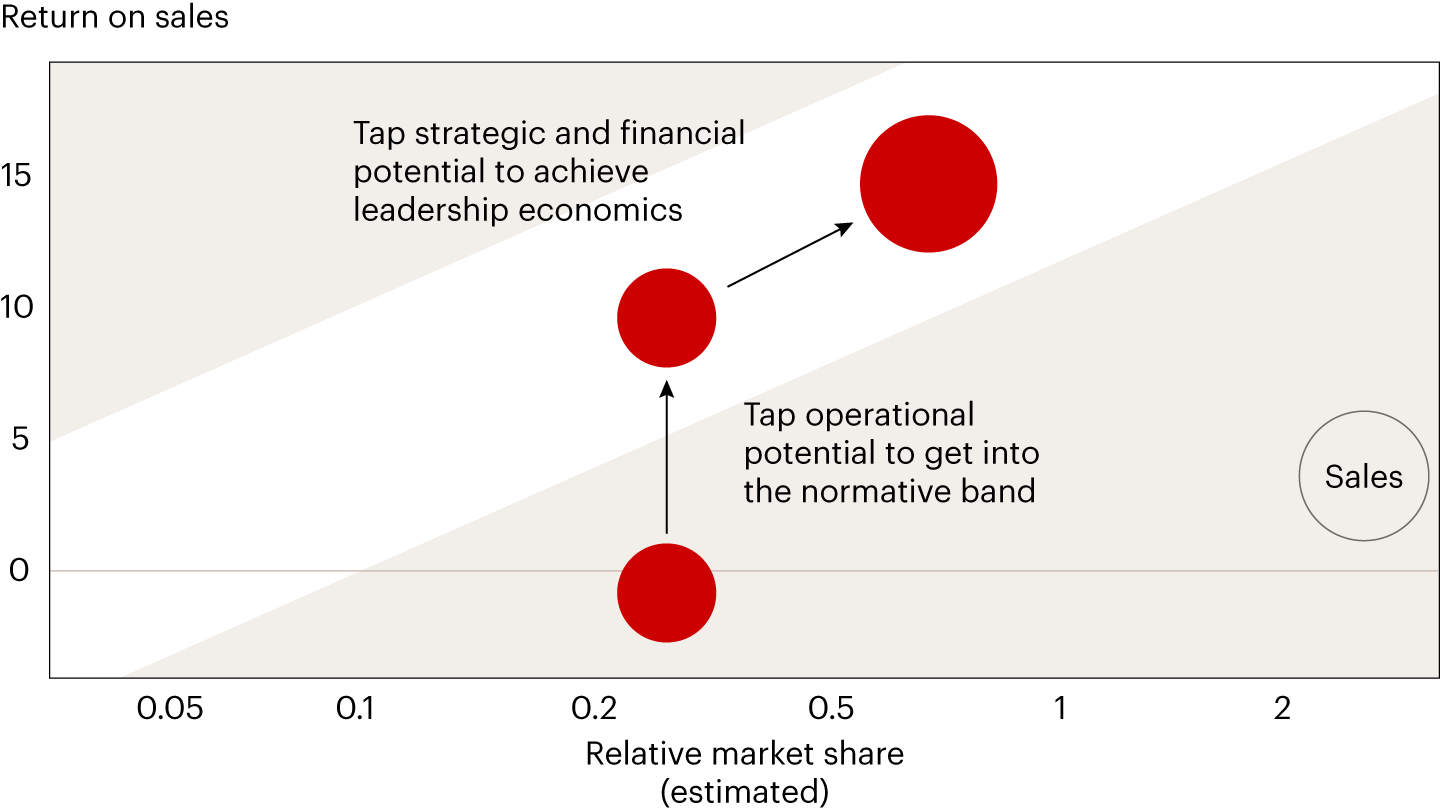
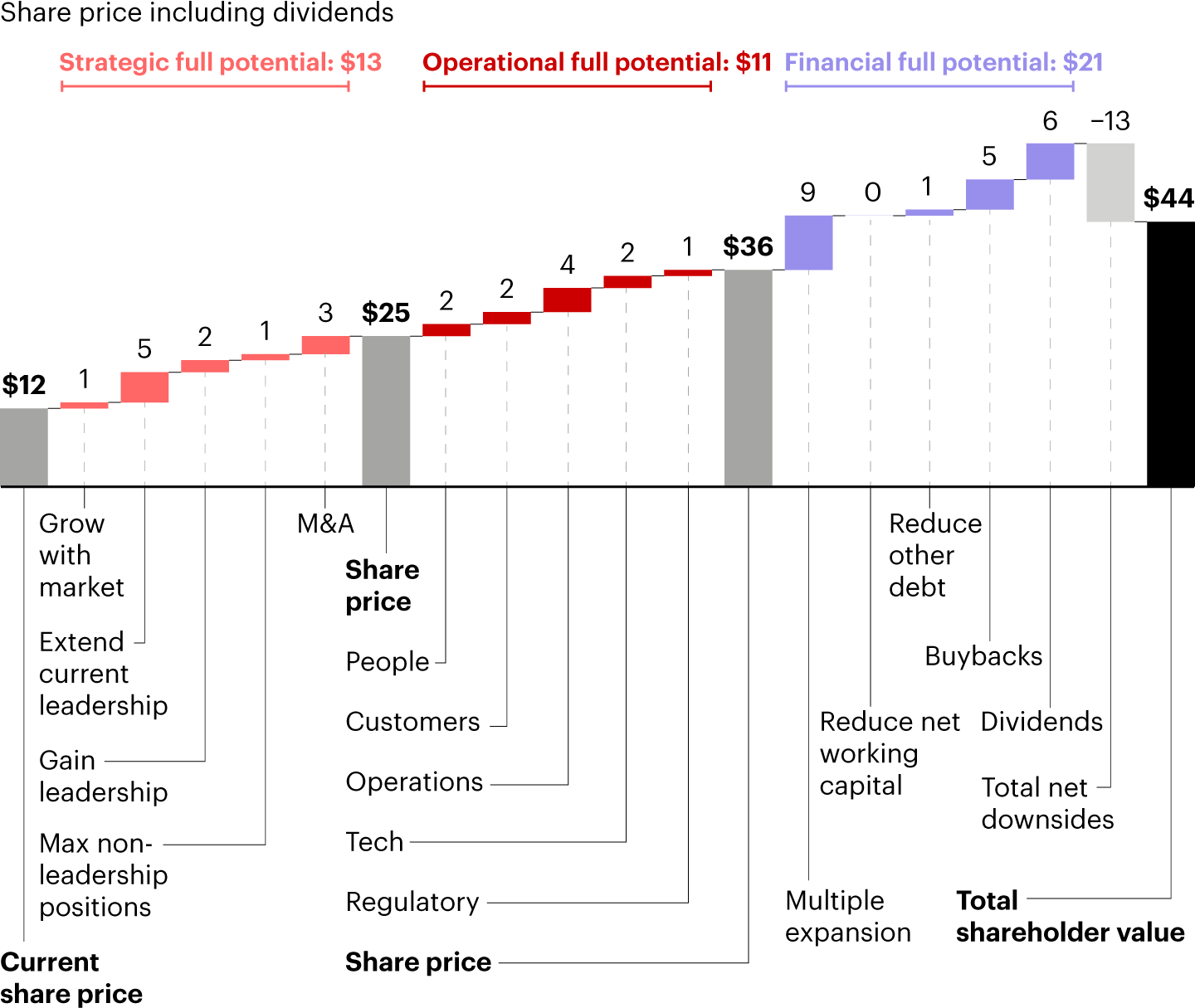
It has always been hard for companies to generate both economic profit and real top-line growth. Fewer than 20% are able to do this in any given year, and hardly any companies achieve both for 10 years in a row. And now, our research shows, it’s getting harder. Markets reward sustained value creation handsomely when they see it. But they’re also risk averse. Investors press CEOs for steady cash flows, not astonishing transformations; CEOs who aim high instead of hunkering down know markets will punish failure. For all the attention activist investors generate, they hold far fewer shares than index funds, which prize stability. And yet, most CEOs aspire to more. They report bold ambitions in our surveys. They have a vision. But they also say they lack the operational capabilities, talent, and AI-fluent organizations they need to deliver on it. Fewer than half say their company can read the market clearly enough to move with conviction when conditions change. Shrinking CEO tenures add another constraint. The CEOs who put their mark on industries often had a decade or more to do it; their ambitions were not bounded by a lurking expiration date. Yet even facing that time pressure, only 41% of CEOs say their calendar protects enough time for deep work on the topics that matter most. The illusion of “satisfactory” underperformanceThis is not the first time companies have sleepwalked into such malaise. In the 1970s—an era that rhymes unsettlingly with our own, with its oil shocks, geopolitical instability, and stubborn economic uncertainty—Bain founder Bill Bain called out American companies for “the illusion of ‘satisfactory’ underperformance.” A dangerous vacuum had opened between companies’ actual performance and their potential performance, and management had learned to live with it. Companies appeared to be doing fine. Compared to peers, many were. But that was the wrong benchmark. Global competitors saw that American firms were not sufficiently obsessed with quality, efficiency, and customers. Corporate raiders saw the diversified businesses of the era as unfocused, bloated, and under-leveraged. Both were right. Both extracted enormous value as a result. Bain challenged companies to renounce these operating and strategic failures and rise to their full potential—a concept that has shaped our view of strategic ambition ever since. The logic is captured in a simple picture: return on sales on one axis, relative market share on the other. Improving operating potential moves a company up, toward higher profitability. Improving strategic potential moves it to the right, building the scale that reinforces competitive leadership. Stronger profitability allows a company to invest more in scale; greater scale further strengthens profitability—a virtuous circle. But the logic also works in reverse. Underperformance can never be satisfactory because it carries a very real penalty: Leaders who fail to pursue full potential risk becoming followers. The virtuous circle becomes a vicious circle that is hard to escape. Today’s CEOs must go further still—not just pursuing operating and strategic full potential but also cutting through the noise to tell a distracted market a convincing story about financial potential. That means optimizing the balance sheet and providing investors with a clear, exciting, and believable ambition to earn the multiple that the company’s full potential deserves. Our data also shows the sustained value creators of today look markedly different than they did when we began studying them 25 years ago. Growth in a market buffeted by ever faster technological change requires a two-agenda discipline: running the current core business with relentless focus for as long as that makes sense while simultaneously building the next engine of value creation. The companies that have mastered this discipline have generated extraordinary returns. The question for any CEO today is the same one Bill Bain posed: Does your company have a genuine picture of its full potential? Not a target calibrated to analyst expectations, but a true vision of how much value your company can create—a vision grounded in economic reality, ambitious enough to be worth the effort, and concrete enough to act on. Let’s look at what that means. Full potential definedFull potential is an inspiring vision of how much value a company can create by making bold decisions and executing with relentless focus. It is grounded in economic reality, informed by breakthrough insights, and driven by a commitment to outperform. Setting a bold ambitionDefining what full potential means is easy enough. But the path toward achieving it starts with a deceptively hard question: How valuable could our company actually be? Your answer must be aggressive enough to inspire and grounded enough to believe. If it’s not aggressive enough, no one will be inspired. If it’s not realistic enough, no one will believe it. Be suitably ambitious, not stupidly ambitious. There are two ways to zero in on the right ambition: understanding what your strategic position permits and what investors demand. Both matter. What would it truly take to grab the attention and confidence of the capital markets? If your sector’s median TSR is running at 1%, and Treasury bonds are yielding 5% risk-free, what makes your equity worth owning? Try this thought experiment: What would it take to double your share price? That may sound arbitrary, but doubling share price over three to five years is strong performance in most industries and most eras. It is a benchmark worth taking seriously. Likewise, what your strategic position permits depends on where you hold leadership positions—or can seize them. Those positions are where outsized value creation is possible; you must be willing to fight to defend and extend them. Whether you’re working top-down from an investor-required return or bottom-up from your competitive position, the real work of ambition setting is asking: Where do I find the big chunks of value I need? Our work with lasting value creators shows that five building blocks of value—strategic, operating, and financial—separate them from the rest. 
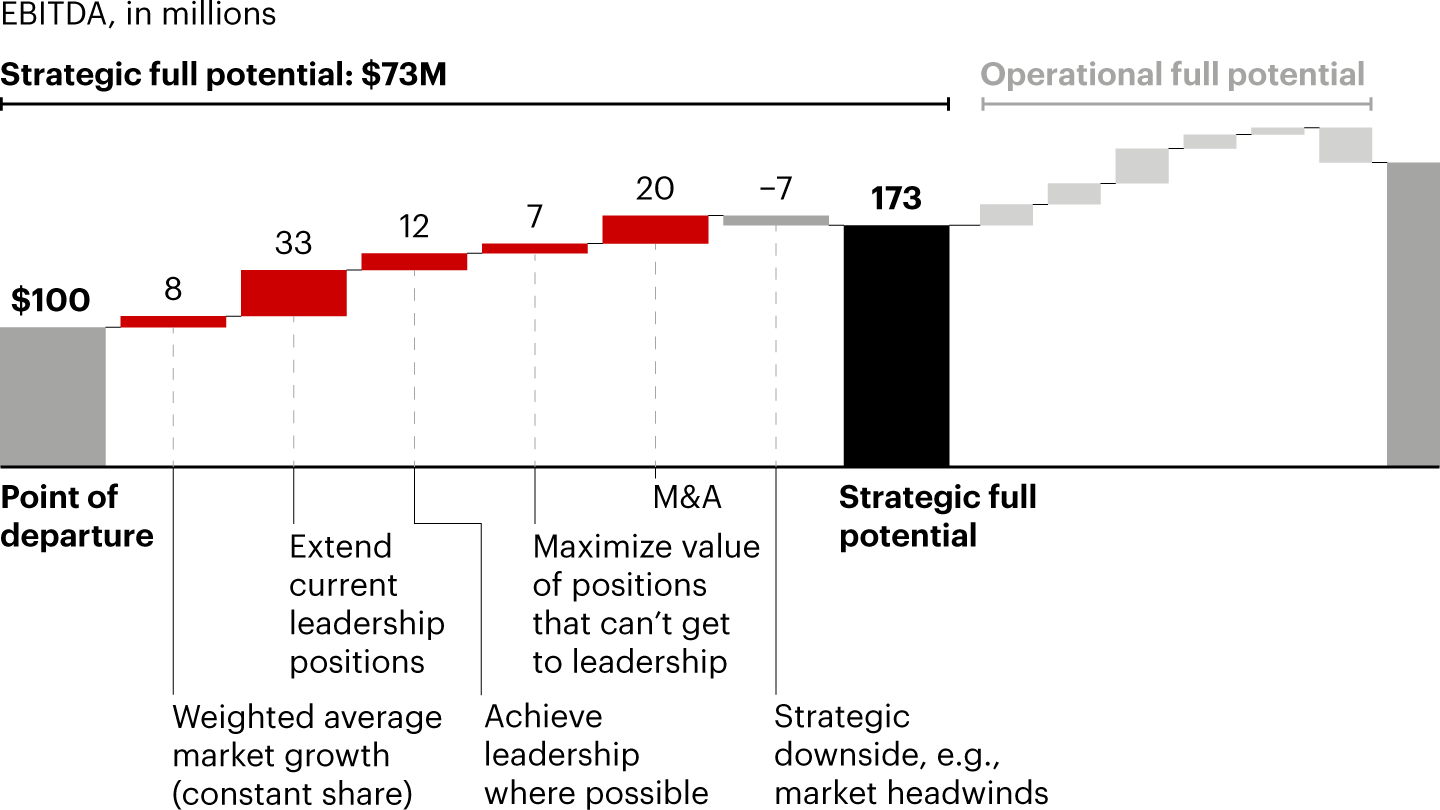
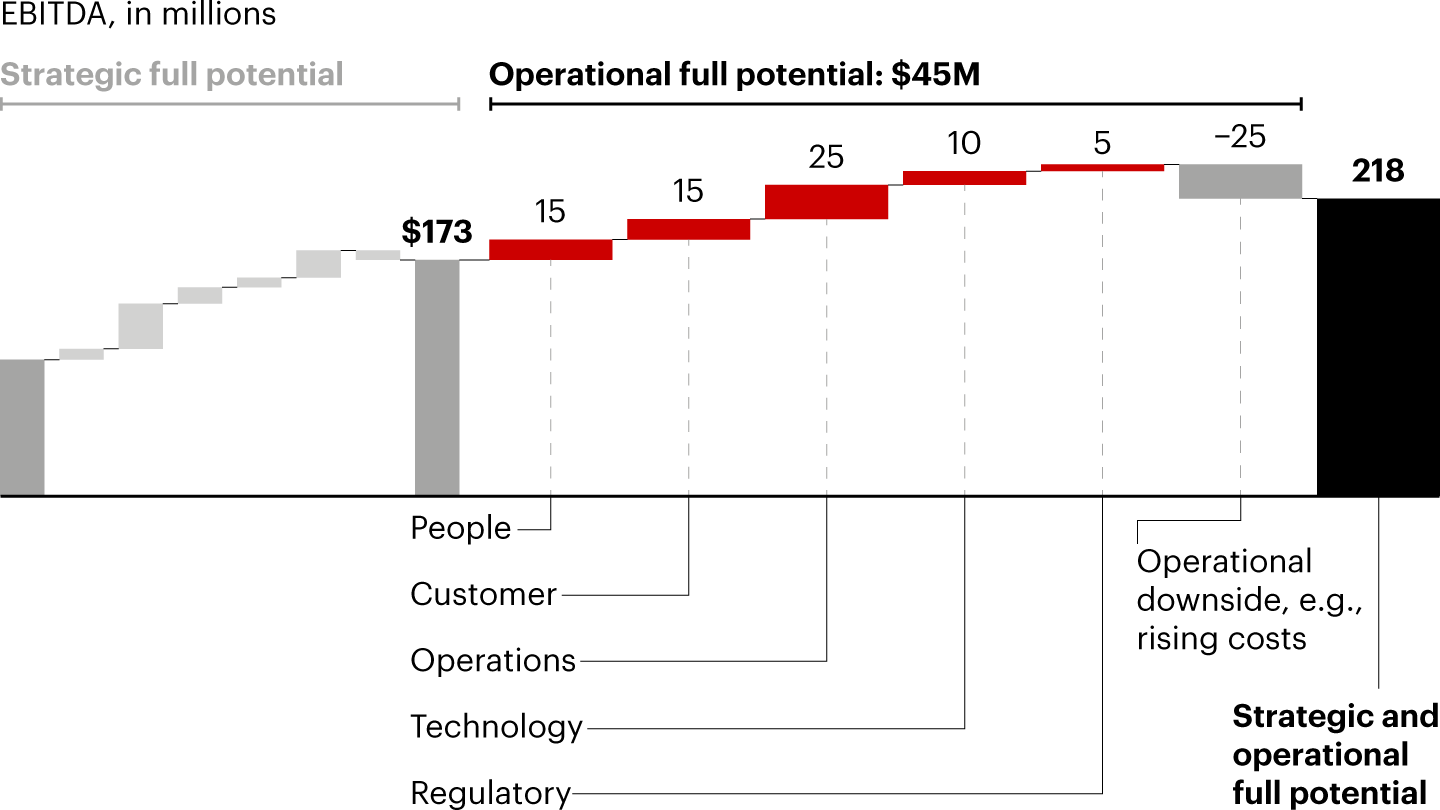
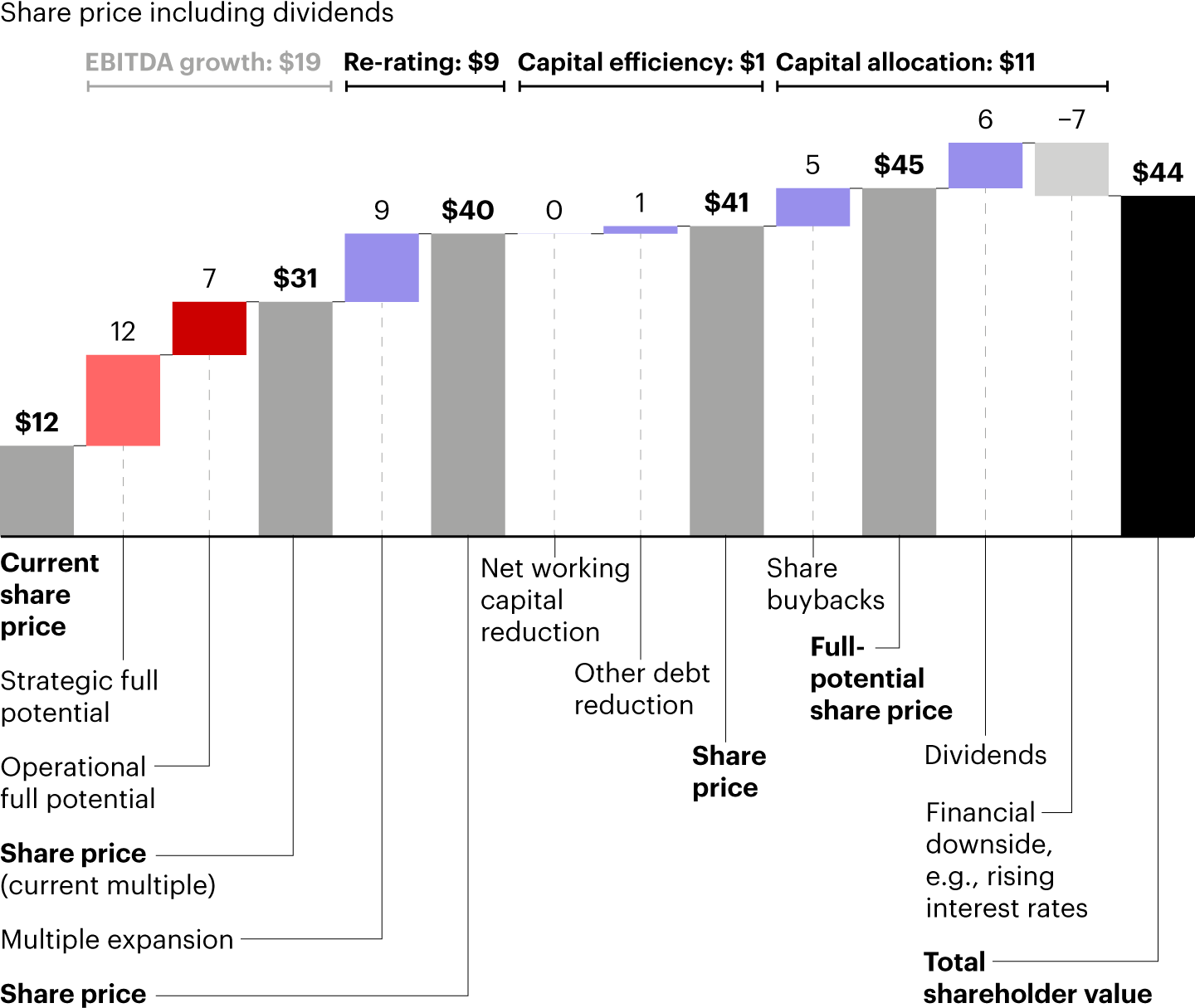
1. Optimal portfolio (strategic)A clear-eyed view of which businesses and positions are worth fighting for and the discipline to exit the rest. Your portfolio should consist of large, growing markets where you have—or can credibly build—leadership positions. 2. Distinctive assets (operating)The capabilities, relationships, data, or proprietary advantages that make you genuinely hard to compete with and give your company its right to win—whether they live in your people and organization, your technology, your customer relationships, your operations, or your regulatory positioning. 3. Genuine leadership positions (strategic)If you’re not one of the top three players in your market, you’re just going broke more slowly. Strategic full potential means extending where you already lead, fighting to gain leadership where you can, and being honest about what to do with the positions where leadership is out of reach: milk them for cash or exit. 4. Repeatable model (operating)The ability to take what works in one market, one product, one customer segment, and apply it systematically across your business. Companies that have cracked a repeatable model—in operations, in customer delivery, or in how they integrate acquisitions—generate value that compounds. 5. Winning financial strategy (financial)CEOs who can translate the portfolio, leadership positions, distinctive assets, and repeatable model into a credible value creation plan—one investors can understand, believe, and track—earn the market’s confidence. They must also work with their CFO to maximize the value creation potential of their capital structure and balance sheet. Multiple expansion is not a gift; it is earned, and it is earned by bringing investors along. That’s your story. Now put numbers on it. Quantifying full potentialPutting real numbers on your full potential transforms your inspiring vision into a plan that a leadership team can align on, a board can pressure-test, and a capital market can believe. Your picture of full potential builds in four steps: strategic full potential, operational full potential, financial full potential, and the full picture that converts them into a single share-price target. Step 1: Strategic full potentialStart with today’s EBITDA (or your sector’s standard profit metric). Add what the market gives you just by showing up—growth at constant share. Then the real work begins: In areas where your company holds leadership positions, how far can you extend them? Where you don’t yet lead, is there a credible path? Where leadership isn’t realistic, the choice is stark: milk it or exit. Then add in well-chosen M&A to round out your strategic view. Of course, you also must remember that markets don’t move in only one direction: A realistic picture also accounts for headwinds—disruption, share loss, portfolio drag. Put that together and you have your picture of strategic full potential. Step 2: Operational full potentialStrategy gets you part of the way there. Operations get you further. Five places to look: your people and organization, your customers and pricing, your operations, your technology, and your regulatory positioning. Many companies finds opportunity in all five; some find that one or two dwarf the rest. Step 3: Financial full potentialTranslating EBITDA improvement into share price is not mechanical. It depends on how the balance sheet is structured, how efficiently capital is deployed, and, critically, what multiple the market will award. That multiple is not a gift. CEOs earn it by bringing investors along with a clear, credible equity story, backed up by results delivered consistently. Step 4: The full pictureConsolidate the previous views into a single view: from today’s price to the full-potential share price. There is a spectrum of rigor here. There is a one-day answer—built on experience, a little data, and a rough back-of-the-envelope calculation—that every CEO should be able to articulate. There is a one-month answer that uses competitive analysis and diagnostic tools to sharpen the picture. And there is the answer that emerges once every option has been investigated, every assumption stress-tested, and the full-potential case is strong enough to withstand scrutiny from your board and the market. The figures above are illustrative—an example of how to calculate full potential—but the picture is not far-fetched. When you benchmark yourself against your full potential instead of against your competitors, the gap between your current share price and your full-potential share price is the cost of satisfactory underperformance made visible. Every CEO should have a picture like this. For most, the number will seem shockingly large, but it should also be inspiring: The value inside that gap is yours to claim. |