

Brief

Kodak is widely viewed as the classic case of an industry leader that failed to see the digital future coming.
In fact, Kodak developed a digital camera prototype in the 1970s and launched its first commercial digital product in 1991. Its strong brand and ample market power should have made it a force to be reckoned with. Instead, it walked into a set of traps common to large companies trying to come to grips with uncertainty: Its initial moves were small-scale and scattershot. It was unwilling to invest in a business that would cannibalize a highly profitable, but rapidly eroding core until it was too late. A last-gasp big bet was the wrong one—a failed joint venture with Hewlett-Packard to create photo-developing kiosks. Kodak knew which way the earth was shifting, but its strategy committed the company to a future that looked very much like the past.
At a time when uncertainty and turbulence have come to characterize most global markets, a growing number of companies are struggling to avoid their own Kodak moments (see Figure 1). That’s often because traditional approaches to strategy—analyzing trends, making forecasts and committing to only the “best” course of action—aren’t calibrated for the high degree of instability many companies face. There’s really only one thing we know about making projections: that they will be wrong. Companies using a traditional strategy process to cope with uncertainty may find themselves playing catch-up with more nimble competitors. Even worse, these linear processes can commit a company to a single course of action, and it may be the wrong one.
Envisioning a range of futures
In uncertainty, both the strategy process and the strategy itself need to change. The most effective leadership teams focus on the vital few uncertainties that matter, understand the possible scenarios that could develop and identify the critical trigger points that signal a swing to one scenario or another—we call these signposts. This leads to a clear and actionable portfolio of strategic actions that balance commitment with flexibility. And the process shifts from an exercise defined by conditions at a discrete point in time to a cycle of “execute, monitor and adapt,” redirecting the company toward the best opportunities over time.
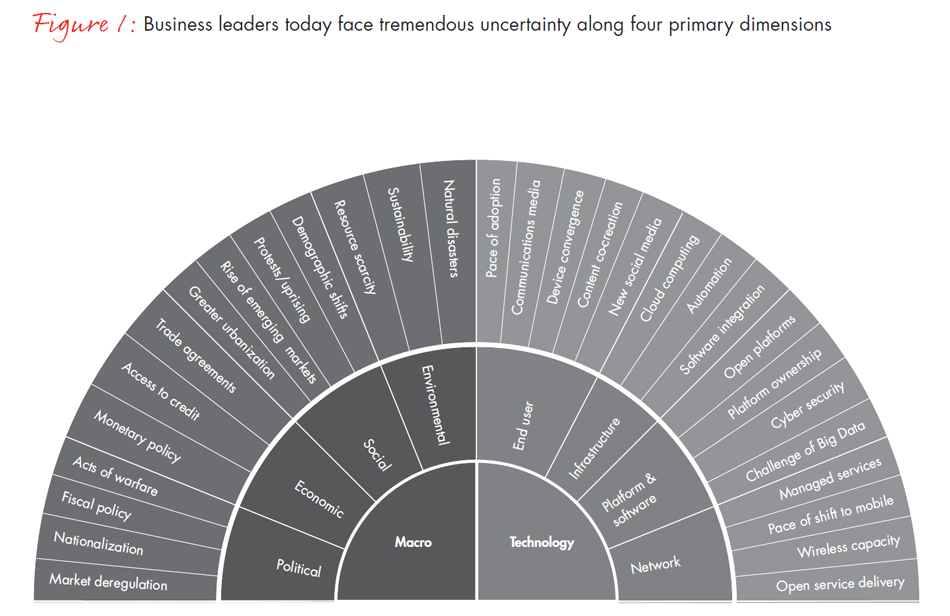
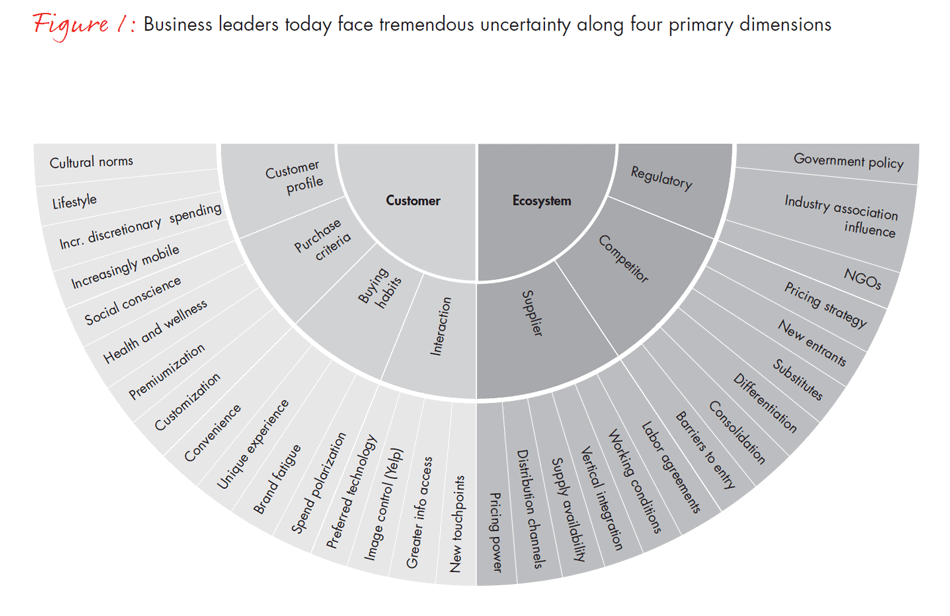
Companies that mobilize quickly around the right choices aren’t somehow better at predicting the future. It just seems that way. That’s because leadership has proactively prepared the company for a range of futures by:
- Defining which uncertainties the company faces and cutting through the noise by separating them into those that matter and those that don’t.
- Creating a set of probable scenarios for how the future might unfold and discussing the threats— and opportunities—that these scenarios present.
- Devising a specific set of strategic options that balance commitment to a course of action with the flexibility to adjust and thrive amid different future scenarios.
- Identifying a clear set of signposts that will signal important changes in the marketplace and trigger a set of actions already foreseen during the scenario-planning process.
This is very different from what many call “sensitivity analysis.” It’s about creating a coherent set of scenarios across all critical variables in an analytically rigorous fashion. That helps leadership teams address a number of key questions: What are the most likely possible scenarios to emerge from the major uncertainties the company faces and what should it look like to thrive in each one? How could the world evolve in a way that could either disrupt current strategy or create new opportunities? How can the company act quickly depending on which possible future unfolds?
The goal is to prod leadership to monitor change on a regular basis and move ahead of competitors as future states begin to take shape. Rather than adopting a wait-and-see approach to planning and investment, leadership is aligned and “pre-committed” to take specific action under different circumstances. If the world is evolving toward scenario X, the company has already laid plans to roll out strategy Y.
For one of the largest industrial companies in India, switching to a scenario-based planning process proved to be game changing in how leadership approached strategy development. Based largely on the experience of the recent past, the company had unconsciously pegged its strategy to “more of the same” assumptions across most key factors in the external environment. This guided most strategic choices—capacity additions, supply-chain decisions, capability investments, etc.—and the outcome would have been fine as long as external conditions didn’t change much.
But faced with increasing levels of uncertainty around ore-price inputs, economic growth and demand, the company reexamined its assumptions about the external environment and developed a set of scenarios that represented significant differences in demand levels and India’s supply context. That provided options that could be exercised depending on which scenario (or combination of scenarios) was emerging.
The new approach has produced significant benefits. It has led the company to develop solid business cases for multiple strategic options, which it would not have anticipated under the old, single-track process. Many of these moves require heavy capital investment and lengthy planning. By developing a clear set of plans before the scenarios come to pass, the company will shorten the decision-making cycle considerably, giving it a head start when the time is right.
Nikhil Prasad Ojha, a partner with Bain’s Strategy practice, reveals how the most effective leadership teams address uncertainty, as well as the three elements that the best strategies combine.
A strategy for uncertainty
One of the questions companies struggle with is how to balance the breadth of strategic choices that arise from the scenario process with the creation of a coherent strategy the organization can embrace.
Strategies that are robust in uncertainty are no less devoted to a bold, long-term ambition. But they do strive to balance commitment to this vision with an explicit set of investments that prepare the company to seize the future as it unfolds, rather than scramble reactively and allow rivals or the external environment to define the rules of competition. The best strategies blend three critical elements:
- No-regret moves. These are actions like ongoing cost management or increasing operational effectiveness that will benefit the company under any scenario.
- Options and hedges. These are strategic tactics aimed at specific scenarios. They might include a range of smaller-scale pilots or experiments that can be ramped up or scaled down quickly, joint ventures that provide lower-cost market entry or changes to projects that might add cost but provide additional flexibility.
- Big bets. These are large-scale commitments that are valuable in the prevailing scenario, but may have different payoffs depending on how uncertainties are resolved. Companies might not pull the trigger until there’s more clarity around which scenario is most likely to play out. But advance planning gives them the critical flexibility to move quickly.
Given its diverse portfolio of global businesses, General Electric was an early pioneer in using scenarios to cope with chronic uncertainty around the world. A recent decision to spend $200 million on a 67-acre “multimodal” factory in Pune, India, is a prime example of its determination to build flexibility into its strategic planning.
The company knew it would eventually need capacity in India for four different businesses. But it wasn’t exactly sure how demand would evolve for any of them. Building a new factory in anticipation of demand might generate significantly different returns under varying scenarios. But advanced manufacturing technology allowed GE to shift output depending on which one developed. The factory can use the same 1,500 employees and footprint to pivot cleanly from production of jet engine and locomotive technology to wind turbines and water treatment equipment as demand ebbs and flows. By building in options, GE was able to turn a significant investment into a no-regrets move.

Interactive: The circle of uncertainty
In some industries, uncertainty is a familiar theme. For others, it's not top of mind, but should be. Which uncertainties define your strategic choices in a complex world?
Knowing when to move
Moving faster than the competition as conditions change is critical to success in an uncertain world. And that means companies have to raise their headlights to identify the right signposts before competitors do, profiting from this heads-up interval—say 6 to 12 months.
Aurizon, Australia’s largest rail freight company, has created a permanent, cross-functional market-intelligence unit that monitors shifts in key markets for coal and other commodities. It maintains a dashboard of signposts that indicate the changing impact on EBITDA. The executive management team regularly reviews the dashboard for changes that might require shifts in emphasis among a predefined set of strategy playbooks. This, in turn, becomes part of the ongoing strategy dialogue during quarterly reviews with the company’s board.
The objective is to provide the kind of enhanced intelligence that can then trigger more informed decisions within the context of Aurizon’s ambition for total shareholder return. That makes it easier to allocate resources against the highest-probability outcomes. Action flows from rapid and closed feedback loops, resulting in faster, more informed adaptation than the competition. Instead of merely identifying a full potential vision and the means to execute it, strategy is always in motion as the company executes, monitors conditions and adapts to the best opportunities as they develop.
Macy’s: Acting to embrace the future
The object of strategy in uncertainty isn’t to stray far from the company’s core strengths or long-term vision. On the contrary, our experience suggests that those strengths and values provide the best compass for adapting to changing circumstances. Consider the case of Macy’s, which, like Kodak, faced a profound shift in technology and consumer preferences that threatened its core operations. With online retailing gaining altitude in the early 2000s, many of Macy’s bricks-and-mortar rivals had outsourced their digital showrooms to a more experienced online firm. In essence, these companies were creating options for the future without committing the heavy investment involved in building a world-class online platform.
But the leadership of Macy’s placed a different bet. They looked at a future world where the key uncertainty centered on “when,” not “if,” online retailing would be significant. And unlike Kodak’s leaders, they envisioned a flexible strategy to allow the company to win in that future world. Owning the customer experience, they reasoned, was (and is) a core element of the strategy, whether that experience takes place in a store or in cyberspace. Outsourcing might be less risky in the short term, but under all futures, Macy’s eventually had to learn how to bring its merchandising prowess online.
The company had no way of predicting what the online retailing revolution would bring. But building a platform of its own allowed Macy’s to both control the customer experience and learn from it in real time. Macy’s could adapt its online strategy intelligently and build a crucial capability that has become a direct extension of its core. The bet clearly paid off: Macy’s doesn’t break out online sales anymore but as of 2013, research firm L2 Think Tank reported that Web-based revenue was $3.1 billion, or 11% of the company’s total. It was growing at around 40%, according to company reports.
There was a time when turbulence and uncertainty were most prevalent in industries like technology or pharmaceuticals, where innovation and disruption present daily challenges. Or disruption was episodic—a temporary supply shock or a cyclical lull in the economy. But increasingly, finding a way to sustain profits and reach full potential amid a constantly shifting landscape is the central challenge in every market. The companies that make the future—not just take it as it comes—will be those that can embrace uncertainty and turn it to their advantage.
Martin Toner is a partner in Bain & Company’s New York office. Nikhil Ojha is a Bain partner in New Delhi. Piet de Paepe is a Bain partner in Brussels. Miguel Simoes de Melo is a Bain partner in the firm’s Sydney office. All are members of Bain’s Global Strategy practice.
First published in 8월 2015