

Brief

Many US banks are enjoying a period of strong profits and surging equity prices. They have demonstrated a level of financial resilience that on average is similar to their counterparts in Europe. However, there is a troubling issue with the stock prices of US banks: Less resilient, more financially vulnerable banks have attracted relatively high valuations. Investors are not making much distinction between the weaker and healthier banks, which creates haunting similarities to banking valuations in 2007, just prior to the global financial crisis.
These conclusions emerge from Bain & Company's health check of the US banking system, covering 601 banks in the US and 128 in Europe. Our health-check scoring model provides a uniquely integrated view, in contrast to looking only at a balance sheet or income statement (see the sidebar "How the scoring model works"). It derives a score from two dimensions:
- profitability and efficiency; and
- asset and liability health (here we give a relatively heavy weighting to asset quality as essential for future earnings).
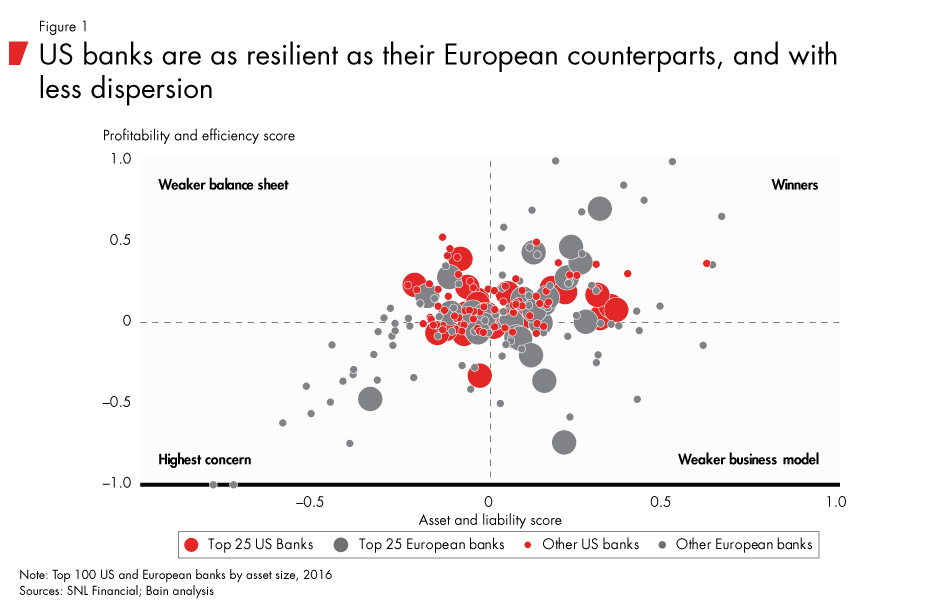
The scoring brings together publicly available data from financial information providers such as SNL Financial with banks' own financial statements. Based on the combination of information, we calculate a score for each bank and place it in one of four categories for year-end 2016, the latest period for which data is available (see Figure 1). These four categories, or quadrants, are as follows:
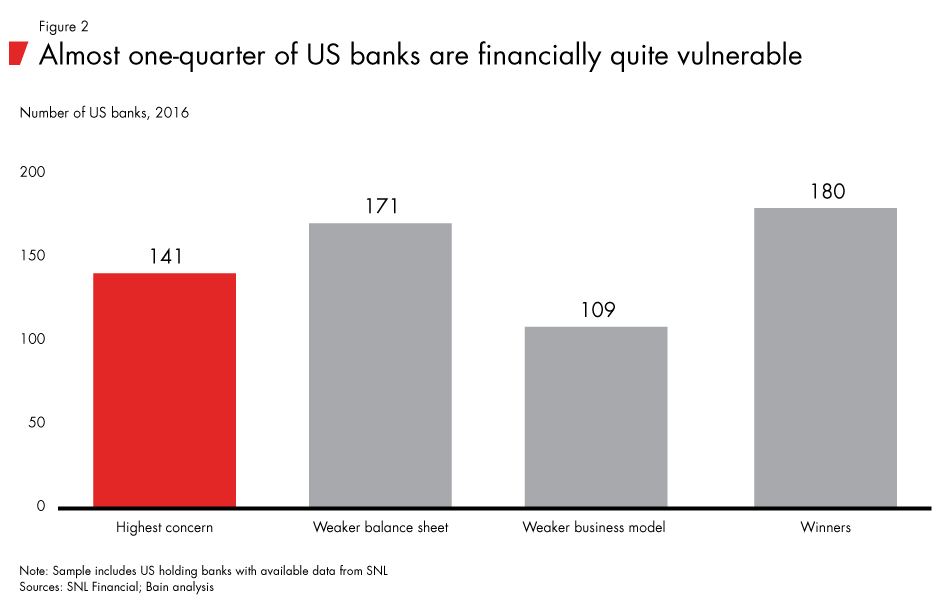
• Highest concern. Of the US banks analyzed, 23% fall into a high-risk category. Among the 25 largest banks in the analysis, which tend to draw the greatest scrutiny, five fall into this quadrant. Among banks for which financial statements are available, nearly every bank that failed in the past decade, as well as many banks that merged into other entities, fell into this quadrant prior to failure or merger. Of course, not all banks in this category fail; many endure.
• Weaker balance sheet. About 28% of banks analyzed have weaker balance sheets.
• Weaker business model. Banks in this category represent about 18% of the total. These institutions have healthier balance sheets, but less attractive financial performance.
• Winners. About 30% of the banks attain the strongest positioning, in a category with both robust financial and balance sheet health (see Figure 2).
US banks' financial position relative to Europe has changed over time (see Figure 3). When we analyze the 100 largest banks in the US and in Europe, in 2006, US banks had a higher average asset quality than European banks. In 2009, as investors already repriced valuations for US banks, they continued to overprice the European banks that had weaker balance sheets, ignoring resilience data because they perceived the financial crisis to be occurring mainly in other regions. By 2012, US banks had returned to higher asset quality and stronger profitability and efficiency. Since 2012, after six years of increasing resiliency, US banks on average appear to have slid backward somewhat, based on the financial and balance sheet dimensions. When coupled with robust valuations across the board, the picture that emerges in the US reveals similarities to 2006.
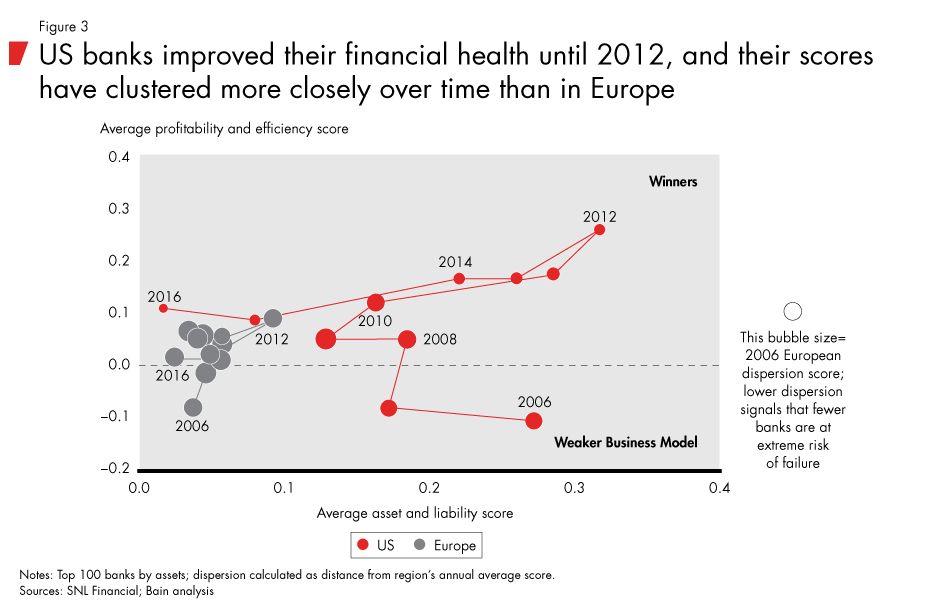
As of year-end 2016, there is far more dispersion along these financial measures among European banks, with a longer tail toward the quadrant of highest concern (see Figures 1 and 3). Simply put, more European banks are at risk of failure, in relative terms, than US banks. That may be because US banks have a stronger position on profitability and efficiency—a greater ability to turn a profit with assets on hand.
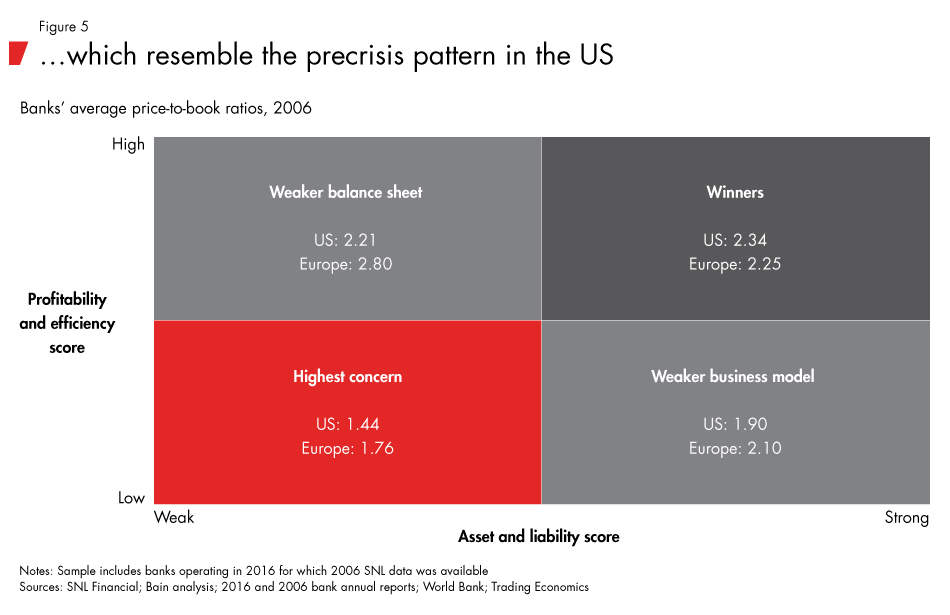
What stands out most prominently in the US, though, is the issue of equity-market perception mentioned earlier. The average price-to-book ratio is nearly 1.5 for the least resilient category of banks, in the highest-concern quadrant (see Figure 4); this valuation is higher than that of European winners. A full 92% of US banks in the sample have a price-to-book ratio above 1.
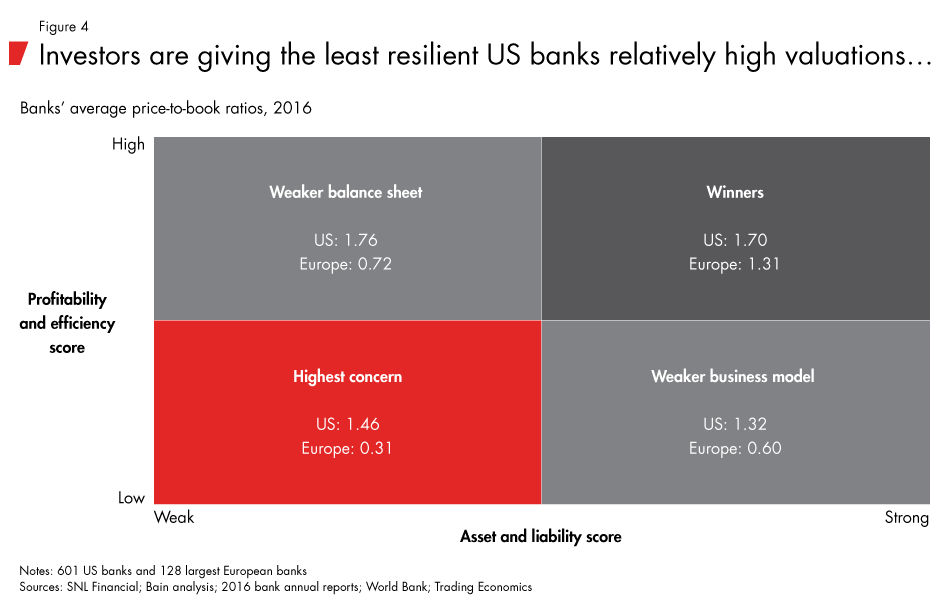
Investors today (unlike in 2009, after the crisis had bitten hard) make very little distinction for balance sheet stability in the US; unlike Europe, the price-to-book for banks with below-market median balance sheet performance is almost the same as for banks with above-market performance. By contrast, profitability and efficiency are strongly correlated with price-to-book in the US (see the sidebar "How two US banks stack up").
The current picture that emerges in the US market thus mirrors precrisis price-to-book ratios of 2006 (see Figure 5). It has been nine years since the last major market downturn, and while it is difficult to predict the exact nature and timing of the turn, one will come that could be more severe than the recent bout of volatility. Should it occur while valuations remain stretched for weaker institutions, there could be a domino effect in which the failure of one or more banks, even smaller entities, drags down others. Banks in the weaker category may quickly find themselves under pressure.
Weaker banks probably have a limited window of opportunity to improve their positions. Of the total 601 US banks with available data, 141 have poor profitability and weaker balance sheets that should be improved as soon as possible through adjustments to asset quality, liquidity and/or capital adequacy. Why the urgency? Consider that over 90% of banks that ultimately failed since 2008 were in the highest-concern quadrant the year before failure.
In addition, 109 banks with strong balance sheets but poor profitability should endeavor to increase profitability without sacrificing balance sheet health, through a blend of digital transformation and cost reduction.
Meanwhile, the 180 banks in the winners quadrant may be able to effectively grow via acquisition, as long as their managers undertake careful due diligence and set an appropriate period to digest the acquired entity. They should look to acquire banks with strong balance sheets and poor profitability, which are being undervalued by investors.
Ultimately, the health check helps banks analytically determine their relative position and gain clarity about a possible path to a stronger position. To that end, there is a proven trajectory for moving up, as previous experience illustrates. The journeys of two European banks that moved from "highest concern" to "winners" required painful choices, but ultimately paid off with much more robust, stable and profitable institutions (see Figure 6). What follows are actions that one of the banks took.
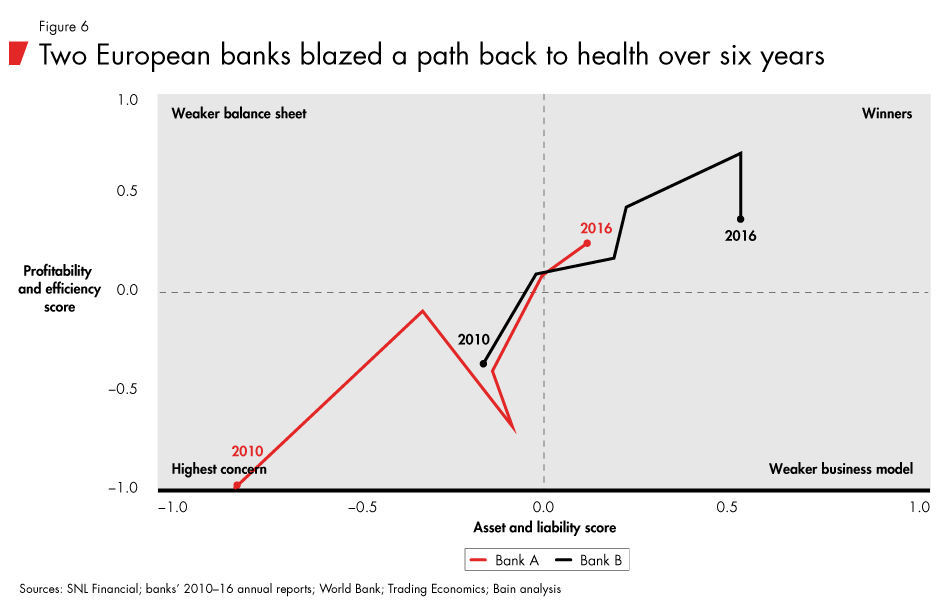
In 2010, Bank A was in dire straits, having been bailed out, seeing peers wink out of existence, and struggling with repeated changes in management that responded sluggishly to the financial crisis. Finally, the new leadership made four big moves.
First, they significantly shrank the balance sheet. Bank A reduced risk-weighted assets by about 50%, gross loan amounts by 25% to 30%, and problem loans by 70% to 75%. Restructuring troubled loans took a major commitment of time and effort, as the bank had to dispose of repossessed factories and other assets. But the bank persisted over three years, having realized that allowing nonperforming assets to sit on the balance sheet would require more capital every month and further impair the enterprise.
Second, the bank grew revenue by improving customer loyalty in the new digital world. Net interest margin as a percentage of risk-weighted assets more than doubled after the bank did an ambitious reassessment of its markets for retail and business segments. It discarded legacy businesses and created business models built around the customer's needs and priorities, rather than the bank's products.
These new models involved a systematic mapping of customer episodes in both personal and business banking. (An episode consists of customer interactions when they have a task to complete or a need to fulfill.) The bank redesigned episodes ranging from how it attracts credit card customers to how it could speed up onboarding of corporate customers. By adopting more digital tools and channels for customers to use, and improving various episodes, the bank earned an increase of 30 points over three years in its Net Promoter Score®, a key metric of loyalty.
Third, the bank adjusted its cost base to reinvest in new activities. Notably, the bank reduced costs through programs now known as zero-based redesign. This differs from traditional budgeting processes by examining all expenses for each new period, not just incremental expenditures in obvious areas. A zero-based approach puts the onus on managers to justify which costs should be kept—a subtle but powerful shift in perspective from what should be removed. As a result, the bank reduced its cost base by around 30%. Meanwhile, zero-basing freed up funds (up to one-third of the original savings) to reinvest in a more simple and digital business model featuring remote account management, straight-through processing and simpler product suites aimed at more carefully selected segments of customers.
The fourth major action involved changes to the mix of funding. Deposit levels rose by 20% to 25%, while the bank reduced wholesale funding by 70% to 80%. Reduced dependency on wholesale funding marked a sharp departure from the previous makeup of the balance sheet.
The experiences of this bank illustrates how persistence and creativity can pay off with a much healthier, more resilient position for even highly troubled banks. Strategy innovation has been more pronounced among European banks in recent years, and US banks could benefit by studying these playbooks.
Despite the capital-adequacy rules and stress tests devised in recent years, many US banks still have relatively weak positions. Yet investors do not appear to factor these weaknesses into their valuations. They could have multiple reasons for betting on a bull rather than a bear, including a belief in continued consolidation with acquirers paying a premium, forecasts of rising interest rates, or the hope that most banks will not succumb to the domino effect. Among bankers themselves, many believe the sector is healthier than before the crisis, so they view the valuations as rational and a confirmation of their strategies.
The data suggests to us that investors remain in a zone disconnected from the realities of banks' financial health, similar to their stance before the crisis. And regardless of the average state of health for US banking, the least resilient banks cannot afford to ignore the data that signals vulnerable points within their institutions. Taking an integrated view is essential for understanding how to return to robust health.
How the scoring model works
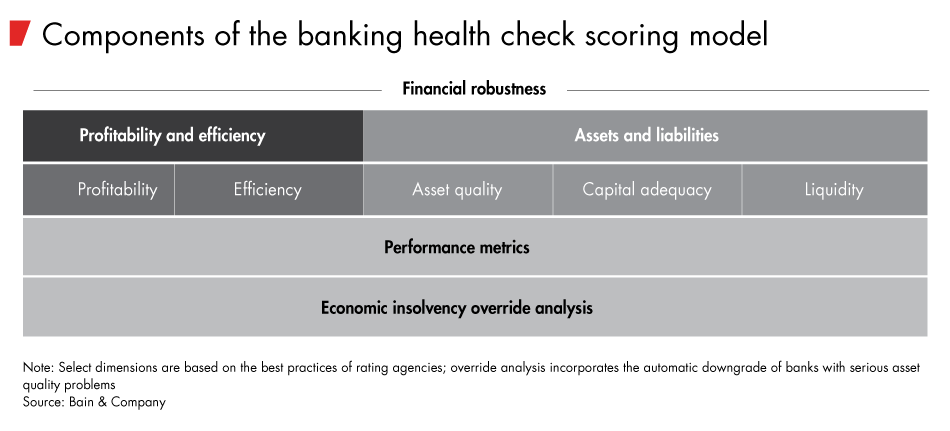
The scoring model in Bain's health check of the banking system gathers data in five areas, with the heaviest weighting on asset quality (see Figure).
Profitability: The key determinant of sustainable success or failure, it measures the ability to create economic value and to preserve or improve risk protection for creditors. Performance metrics include preprovision income as a percentage of risk-weighted assets and net income as a percentage of risk-weighted assets.
Efficiency: Cost containment is a strategic focal point; it allows banks to satisfy stakeholders' requirements without overly aggressive risk taking. Performance metrics include operating expenses as a percentage of net revenue.
Asset quality: A main factor in future earnings and capital generation or erosion, loan quality is a key to determining a bank's stability. Nonperforming loans predict future losses. Performance metrics as a percentage of gross loans include problem loans, loan-loss provisions and corporate loans.
Capital adequacy: Banks typically fail due to losses in the loan portfolio, poor business models or fraud—all of which lead to a decline in capital. In the case of low profitability, capital is the most important buffer for absorbing risk costs. Performance metrics include Tier 1 capital as a percentage of risk-weighted assets and tangible common equity as a percentage of average risk-weighted assets.
Liquidity: Illiquidity is often a proximate cause of failure as banks might not any longer be able to finance themselves under pressure. Access to market funding may not be based on long-term relationships but rather on creditworthiness. Performance metrics include gross loans as a percentage of total deposits and total debt—that is, liquid assets as a percentage of total assets.
How two US banks stack up
Two US banks with almost exactly the same level of assets and deposits have very different financial profiles, landing them in opposite ends of the health spectrum. Here's what they look like:
Winner
- Customer-centered institution, leaning toward more affluent consumers
- Diversified balance sheet yielding solid net income, even in a low-interest-rate environment, with room for growth if rates rise
- Ample deposit liquidity, with well over 10% CAGR in deposits over three years, making for a strongly capitalized institution
- Double-digit earnings growth across the board without taking undue credit risks
- A higher-touch labor model, yet with an average cost-to-income ratio
Highest concern
- Business- and product-focused institution
- Little pricing leverage with customers, and a heavy focus on variable-rate loans, which have led to poor net interest margins
- Slow revenue growth in the low-rate environment
- Anemic and declining earnings, with weakness in portfolio subsectors to which it was overexposed, causing above-average loss rates
- Deposits growing slower than assets, which drives up funding costs
- Heavy expense structure and a high cost-to-income ratio
- A restructuring program underway, but analysts cautioned that the inflated price-to-book ratio reflects investors' expectations of future success
Joe Fielding and João Soares are partners with Bain & Company's Financial Services practice, and Mike Baxter leads the practice in the Americas. They are based, respectively, in New York, London and New York.
Net Promoter Score®, Net Promoter System®, Net Promoter® and NPS® are registered trademarks of Bain & Company, Inc., Fred Reichheld and Satmetrix Systems, Inc.
Copyright© 2018 Bain & Company, Inc. All rights reserved.
First published in 3월 2018