

Brief

한눈에 보기
- Many retail banks have spent huge sums on digital initiatives without realizing the results they hoped for, particularly the migration of customers to lower-cost digital channels.
- Technology alone won’t solve the problem. Banks must mobilize customers through a sustained effort consisting of both voluntary and more forceful measures.
- Digital transformation also involves mobilizing—and enabling—frontline and back-office employees with the right digital tools, training and transition management.
- Done right, digitalization yields greater customer loyalty and better economics, as well as a sound defense against digital defection to competitors.
Explore Bain’s latest Customer Loyalty in Banking insights.
Many banks have invested up to half of their “change-the-bank” budgets in digital initiatives over the past few years. For most of them, results have been mixed at best. Our conversations with senior bankers worldwide confirm that these investments of up to hundreds of millions of dollars per year generally have not yet generated the expected improvements in finances or the customer experience.
Why is it so hard for retail banks to monetize their digital initiatives? The answer is clear: Investing in new technologies and processes alone will not do the job. Digitalization also requires radical behavioral change among both customers and employees, which banks consistently underestimate or underinvest in. With digital transformation, the discipline of managing change is more important than ever.
Digitalization done well yields big dividends. For example, digital banking tends to earn greater customer advocacy. Mobile-first customers in almost every country give higher loyalty scores to their primary bank than people with low digital behavior do—globally, almost 50% higher, according to Bain & Company’s latest consumer survey. Loyalty, in turn, drives growth and better economics. In the US, banks with a high Net Promoter Score® had net interest income growth of about 13% from 2014 through 2017, compared with 5% for loyalty laggards.
However, many banks are not reaping such benefits from their digital endeavors. In Europe, for example, we see many banks with only one-half or even one-third of their customer base registered for online banking, and then again only half of registrants actually using digital channels regularly. Traveling the full digital journey means investing in technology and processes, of course, but also undertaking a rigorous change management program. The place to start is mobilizing customers.

Moving Banking Customers to Digital
Banks can mobilize customers and employees to speed the transition toward digital tools.
Mobilize customers for the great migration
To be clear: Mobilizing customers in the digital world requires systematic dedication of financial and human resources over several years. Hitting the target will take effort, persistence and many different measures, which will vary depending on the type of customer. For example, older customers may be very familiar with their finances, but less so with digital tools, whereas millennials tend to be digitally fluent but need advice on how different bank products best meet their needs.
When designing these measures, banks typically want to start with voluntary migration, adopting soft measures, and later move on to more forceful, harder measures (see Figure 1).
Figure 1
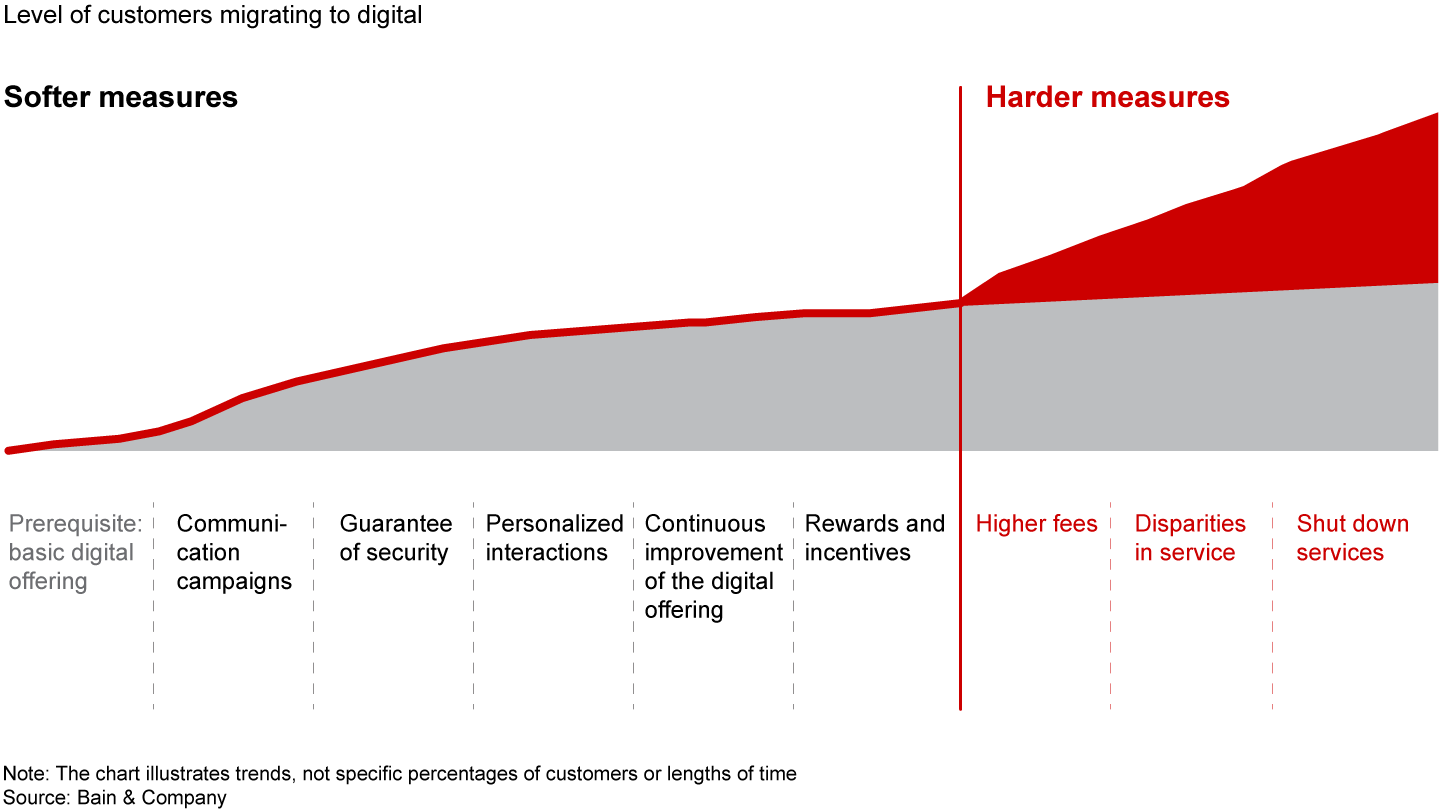

Softer measures for voluntary migration include:
- Communication campaigns. To actively market digital services, communication media usually includes classic television advertising and branch collateral, along with purely digital instruments such as videos, blogs and social media forums. The reason to keep using traditional instruments lies in the target audience, namely, people who have not yet gone digital.
- Guarantee of security. Bain research finds that security concerns count as an important barrier for offline customers. Banks will need to convince them otherwise through such tactics as offering a guarantee of security. For instance, if digital banking fraud occurs, the bank could cover the original loss. In some countries, measures like this can make a difference and prompt customer migration.
- Personalized interactions. Many customers may require the personal touch from trusted bank employees, which can take many forms. Bank staff could approach people to demonstrate the bank’s app at opportune moments, as when customers are being onboarded by a salesperson or have just finished a routine transaction with a teller. Digital ambassadors can roam the branch. Or the bank could host coffee sessions to bring in customers for digital demonstrations. Because of the time and expense involved, such measures should be weighed carefully against the expected benefit. Online tutorials can also work, though they presume a basic level of comfort with digital tools.
- Continuous improvement to the digital offering. With convenience and access being key attractions of digital channels, banks should look constantly for ways to make adopting and using the digital experience simpler and more convenient. For example, banks can add features such as video chat or voice chatbots (and market them).
- Rewards and incentives. Offer carrots first to reward customers for migration to digital, through financial or nonfinancial means. Common tactics include one-time payouts or fee reductions, gifts or event invitations. Banks can also offer incentives to, say, young digital customers for referring senior friends or relatives who are offline.
Harder measures for forced migration include:
- Pricing penalties. After carrots come sticks that make the digital offering financially more attractive. With general account bundles, banks can charge lower fees for the digital bundle than for offline, or offer the same fees for digital, but with additional services. Fees can be added for select offline services that are digitally available, such as paper copies of balances, money transfer orders or address changes. For all these pricing measures, employees in contact centers and branches must actually charge the fees, not waive them to avoid a difficult discussion with customers.
- Service-differentiation hurdles. To make the offline offering less appealing, banks can introduce hurdles such as longer wait/serve times for specific types of transactions in contact centers and branches, alerting customers to digital alternatives. These should apply only where convenient digital alternatives exist and the economics are justified.
- Shut down services. Finally, banks can switch off specific physical services. It is not unreasonable to eliminate paper copies of balance information, or to stop handling physical money transfers in certain branches. Again, digital alternatives must be available.
Note that all these measures require substantial resources, dedication and persistence. They cannot simply be put on executives’ “to do” list. The line organization should be supported with systematic planning and a programmatic organization.
Moreover, these measures do cost money, and some customers will be annoyed by the harder measures, so banks need to calculate the trade-offs. Yet if banks neglect to take these steps, their digital investments will fail to yield a payoff, and other banks and fintechs will siphon away more customers, extending their lead.
Mobilize employees to carry the digital torch
The heavy lifting of digital transformation involves mobilizing employees throughout the bank, not just at the front line. Employees must become ambassadors of digital change. At technology companies such as Google or Facebook, nearly all employees use their company’s products. Not so at many retail banks. On average, we estimate, fewer than half of bank employees regularly use their own bank’s mobile services. The ratios lag those of big tech firms, which now are competing in retail banking.
To mobilize employees for the digital journey, banks should calibrate the different stages of personal transition and organizational change according to a change curve: from awareness to understanding, acceptance, appropriation and anchoring (see Figure 2). Successful organizational change allows people to advance through all of these stages, with the right degree of support at each stage.
Figure 2
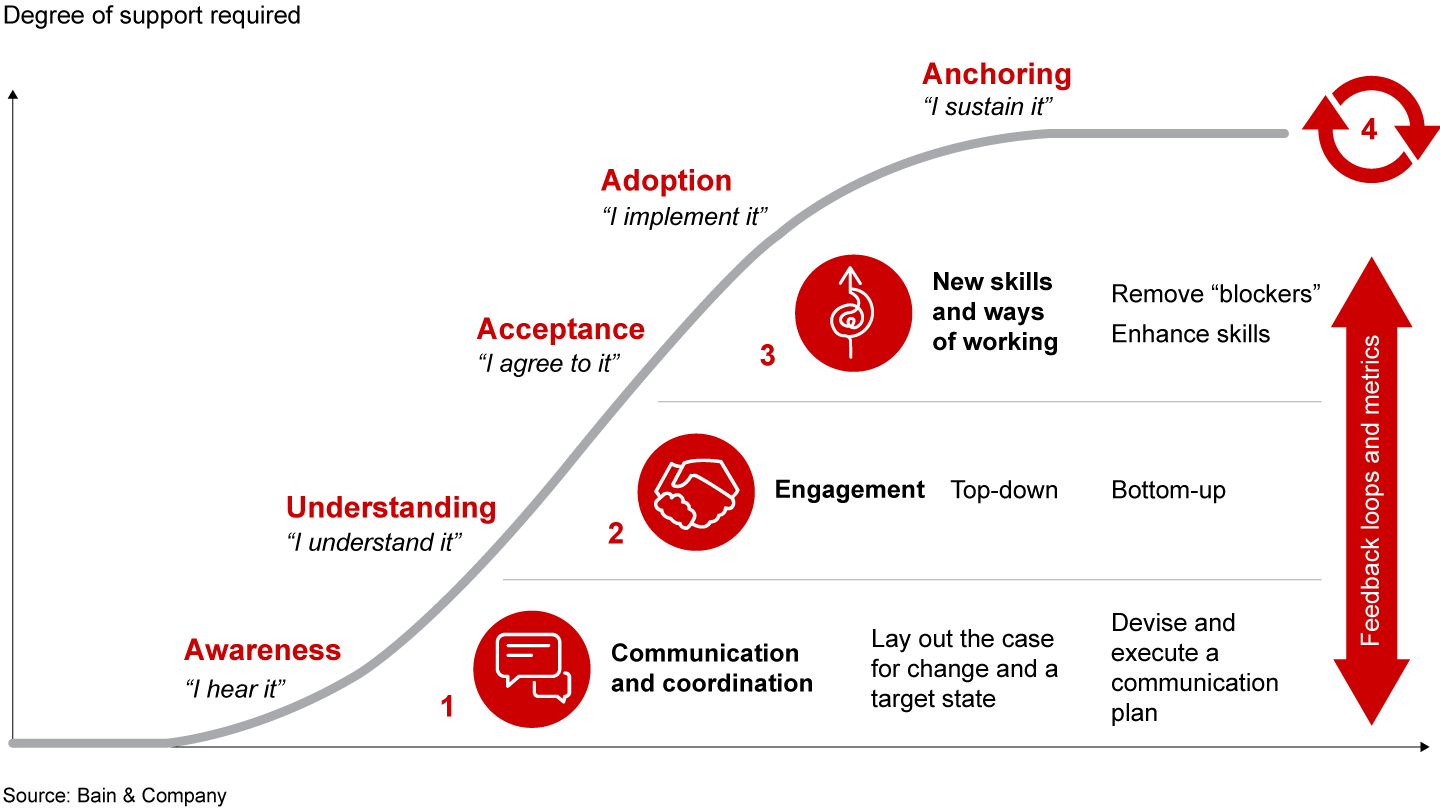

Step 1—Communication and coordination
To build awareness about the digital transformation, employees first need to hear about it. Organizations tend to underrate communication during periods of change, and do too little of it. Bank leaders should provide a clear case for change, a reason why the digital transformation matters. They can cite hard evidence such as declining revenues, or anticipated trends such as changing customer behaviors or disruptive competition.
Employees also want to know the target state of the transformation—“what we want to achieve.” This goal should be distinctive and easily understandable, but also emotional so that people want to embrace the journey. Senior management and the extended leadership team, moreover, should fully support and embody the end state. Using quantitative measures to express the target state, such as revenues or market share, will allow the organization to clarify and track progress. In addition, a distinctive slogan or logo can crystallize the target state.
Together with the case for change and the target state, other effective communication should be rigorously planned and executed. Tactics range from town hall events to videos, blogs and virtual collaboration tools such as Slack or Yammer. A communication plan will harmonize these various tactics and include dedicated metrics and details regarding content, timing, channels, presenters and audience.
Step 2—Engagement
Communicating a message does not automatically mean the message has been understood or agreed on. So banks have to engage with employees. While communication usually flows in one direction to reach larger groups, engagement provides the opportunity for each employee to participate in the digital endeavor through discussion and questioning. Communication generates attention and curiosity, but only engagement promotes understanding and acceptance.
Banks can travel in two directions to shape engagement. Top-down engagement starts with the executive board and then moves down the hierarchy along a defined sponsorship spine. Occasions for engagement include cocreation workshops and leadership walk-arounds. Bottom-up engagement uses a select group of employees who have a special affiliation with digital and a mandate to spread digital adoption. They can engage through a digital champions network, pulse checks, informal lunch discussions, an employee app and hackathons.
Step 3—New skills and ways of working
If communication and engagement have been effective, most employees will have accepted the change. But acceptance does not equal implementation; that is where dedicated measures come in. Enhancing employees’ skills, tools and methods can do the job. For a digital transformation, this often includes new, more flexible ways of working, as well as hard skills such as data tagging and data analysis.
Behavioral change also thrives in a favorable setting. Banks often have organizational blockers such as detached working spaces that make it difficult to collaborate, or restrictive mobile phone policies that undermine the proclaimed mobile-first approach. Banks will want to identify and remove such blockers.
Step 4—Feedback loops and metrics
Continuous feedback loops help to identify and address risks at an early stage. Regular “pulse checks” can gather employee feedback. Based on the feedback, senior leaders and change agents can understand the problems, involve employees in discussing potential solutions and arrive more quickly at resolutions. The feedback allows communication and transformation plans to be adapted accordingly.
High-velocity metrics also can help catalyze change. One Southeast Asian bank found that feeding the branch staff data on their success in driving digital adoption served as strong motivation by itself, and was reinforced by senior leaders’ recognition or rewards to the highest-performing branch.
Where do you stand in the digital journey?
For an individual bank, the next steps involve asking how far its workforce and customers have progressed in the digital journey.
- Does more than 90% of our workforce frequently use our digital offerings?
- Does more than 60% of our customer base frequently use them?
- Do we have dedicated initiatives in place to raise usage?
- Have we clearly defined the target end state for our digital proposition?
If your answer to any of these questions is “no,” you need to undertake a rapid, significant increase in digital migration efforts—or else your competitors will do so and take your customers with them.
Dirk Vater is a partner with Bain & Company’s Financial Services practice. Jens Engelhardt is a partner with Bain’s Customer Strategy & Marketing practice. Joe Fielding and Richard Hatherall are partners with Bain’s Financial Services practice. They are based, respectively, in Frankfurt, Zurich, New York and Hong Kong.
Net Promoter Score®, New Promoter System®, Net Promoter® and NPS® are registered trademarks of Bain & Company, Inc., Fred Reichheld and Satmetrix Systems, Inc.
First published in 5월 2019