

Brief

한눈에 보기
- Banks have a special role to help households, businesses and the broader economy cope with the coronavirus-induced downturn.
- They should first protect their employees and service providers through safety measures in branches and essential offices.
- For individual customers with stressed finances, banks should go the extra mile to address their immediate needs. For small business customers, they should offer payment extensions or other programs—but only so far as their balance sheets allow.
- To make the balance sheet more resilient, banks will have to better understand liquidity shifts day to day, review the loan portfolio and tailor measures for each loan category.
With the Covid-19 pandemic inflicting damage worldwide to people’s health and finances, and its duration highly uncertain, banks are one of the few industries considered essential to keeping economies lubricated. Besides playing a critical role for their customers and employees, banks help to stabilize systems of lending, payments, trade and liquidity.
Common-sense continuity plans and crisis-response checklists certainly have merit, but other actions particular to the dynamics of banking also apply. Banks should plan for a turbulent period lasting months at least, with actions spanning their entire footprint—physical and virtual—and touching all stakeholders. At the same time, banks should stress-test their capabilities and financial metrics, in order to identify long-term strategic implications and opportunities, and build a bridge from the present crisis to a postcrisis future.
Many customers, whether individuals, businesses or other organizations, face numerous urgent financial and operational decisions. Given the nature of the banking relationship, customers sorely need reassurance, security and safety. Likewise with employees. A bank’s actions and communications thus should signal consistency, stability and reasons to trust that services will continue during the crisis.
Our analysis of early actions by banks in China, Italy and South Korea, along with the first weeks of severe effects in other countries, suggest three immediate areas for focus.

Macro Surveillance Platform
For more detail on the business implications of coronavirus from Bain’s Macro Trends Group, log on to the Macro Surveillance Platform. Learn more about the platform >
Protect your employees
Now that most countries have urged or mandated sheltering in place, shifting from a central headquarters location to a distributed work-from-home operation is essential. Most banking processes can be managed with some adaptation—in our experience, with a success rate of over 90%. An exception at present is that some fraud, audit and back-office operations may still need to operate in the office, to ensure compliance with regulations.
Branches have remained at least partially open. Good health practices mandate a timely supply of hand sanitizers, cleaning equipment, masks, gloves, and plastic or glass screens. In addition, branches will need new protocols for traffic management, including selective closures, reduced opening hours, staggered access for customers, and by-appointment-only meetings.
Banks have taken different measures according to the severity and length of the coronavirus outbreak. In South Korea, Shinhan, Woori and KB Kookmin shortened their branch service hours in certain provinces. In Hong Kong, Bank of China, HSBC and Bank of East Asia closed one-fifth of branches in the network. In Italy, most banks reduced opening hours to the morning only. These measures obviously affected the volume of physical transactions, which sharply declined after the lockdowns.
Protective measures apply to a bank’s service providers as well. Software and other technology suppliers often work alongside banks’ own IT staff. Now these suppliers may be working at home, so banks must ensure they follow secure protocols and safety measures. Suppliers of essential services, such as janitorial, also must ensure safe practices to reduce the chance that the virus will circulate.
Go the extra mile for customers
The actions and tone you take with customers must reflect the nature of the relationship you have with them. Avoid assumptions about their emotional state. Frontline employees speaking with customers by phone or in person should listen with empathy and give them opportunities to explain their situation, thereby tuning communications and actions to the emotional state of these customers as much as possible. That helps reduce their anxiety and makes them feel that the bank is on their side.
The best, largest or most loyal customers will likely merit one-on-one, human outreach. Do not default to mass email or surveys for important relationships that need a personal touch, such as commercial or high-net-worth customers. Instead, plan a campaign consisting of human contact.
Other measures for retail customers include:
- Go the extra mile to help customers in a cash crunch, by temporarily suspending payments on loans and fees on transaction services. In Italy, Intesa Sanpaolo, UniCredit and other banks have suspended mortgage and loan repayments to directly affected families. Many banks across the globe have followed suit.
- Scale up call centers to manage a rise in inbound calls, and increase the role of digital, expanding the range of what can be done remotely.
- Attend to more affluent clients who have likely seen their investments pummeled. They are seeking both reassurance and sound advice.
Many small and medium-sized businesses are suffering the greatest economic hits due to regional lockdowns. While revenues collapse, their fixed real estate and labor costs often continue. Helpful measures include these:
- Suspend payments for those directly affected, particularly in vulnerable industries. In South Korea, Hana supported small businesses with a 12-month loan-payment suspension and interest-rate reductions of up to 1.3 percentage points. Bank of China has issued the equivalent of $645 million of “Covid-19 impact alleviation” bonds in Macau to support small businesses.
- Offer additional credit programs, in particular short-term credit extensions or new credit lines.
- Use digital technology to enable more remote operations and proof of authenticity, through such tools as remote biometric recognition of authorized signatories.
- Share useful, objective information about economic and political developments, along with best practices on how to weather the crisis.
Make the balance sheet more resilient
As consumption has collapsed, central banks and governments are moving quickly to address the transmission risks to the overall economy and to avoid contagion to banks. Still, not all banks will be immune, and they need to take action while there is time. Liquidity is a bank’s best friend right now. Best practices to minimize leaks include:
- Get a clear sense of liquidity needs under different scenarios, depending on your current source and maturity of liquidity, as well as realistic estimated new outflows and reduced inflows from nonperforming loans.
- Create a daily dashboard showing cash decreases or changes by segment, product, region and sector, as well as divestment of assets under management. This allows a bank to track liquidity from households and particularly corporate clients. In past financial crises, the flight to quality occurred rapidly, and you do not want to be caught flat-footed.
- Communicate regularly to customers about the bank’s soundness.
- Review marketing campaigns to ensure that your products are more appealing than those of competitors.
A bank’s capital will be tested when its lending book gets hit by a rising wave of defaults, for both longstanding and new loans. Companies struggling for cash will look for the bank’s support to remain viable. This surge will be compounded by new lending requirements across the globe.
In the UK, Funding Xchange estimates that demand for funding by small and medium-sized enterprises rose by 5 to 10 times in March, and banks have not kept up. Banks should accelerate their response in these ways:
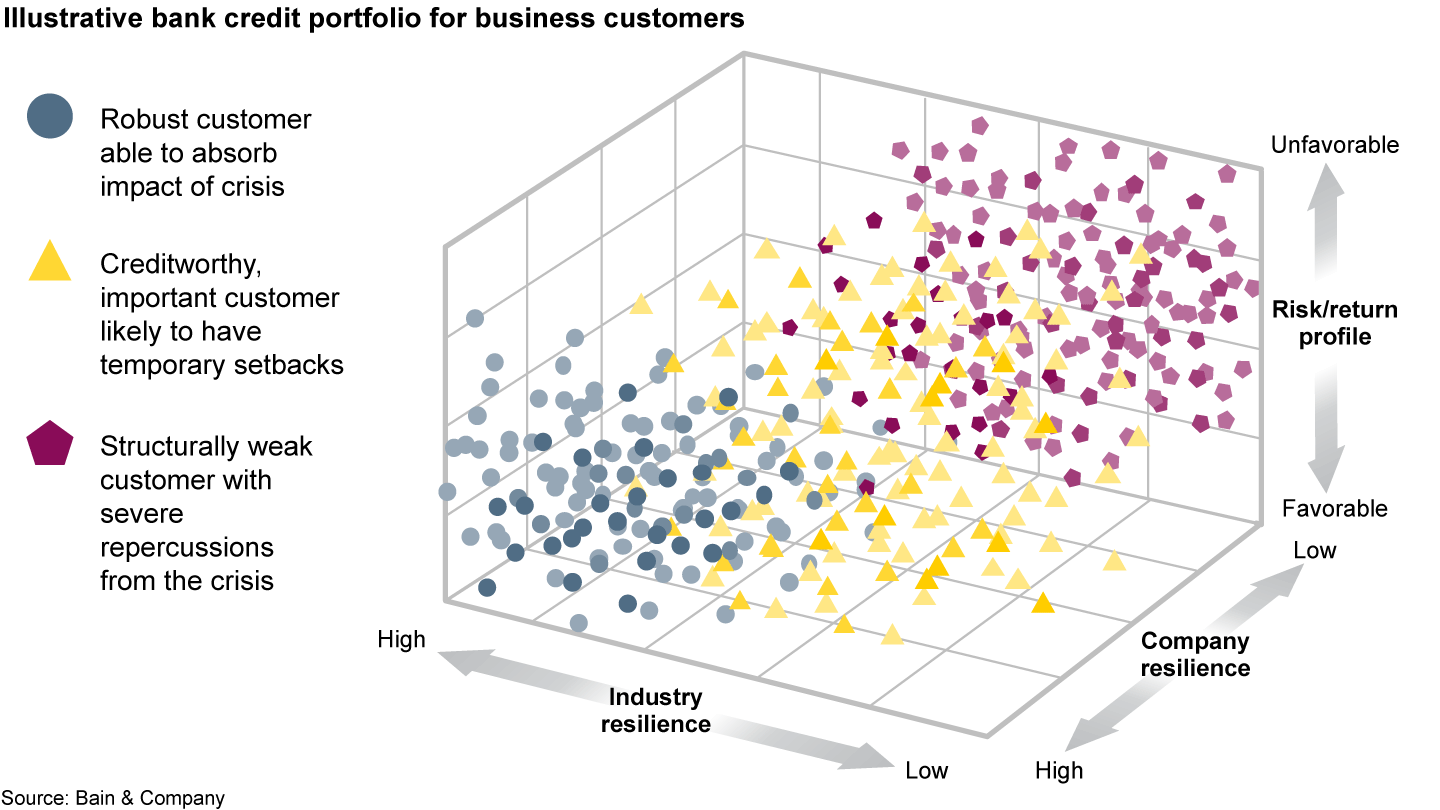
- Assess the credit portfolio to cluster customers by how much they have been hurt, the customer’s response, eligibility for state aid and other variables (see Figure 1).
- Design and launch a set of actions through the network, then monitor those actions continuously.
- Prepare the credit engine by estimating workloads, designing simplified decision trees and tailoring the credit-approval processes for each cluster.
Figure 1

To be sure, this involves a delicate balancing act. Citigroup CEO Mike Corbat recently noted that banks walk a “fine line” between supporting customers through the crisis and loading them with loans they will not be able to repay, which could threaten the solvency of a bank and the broader financial system.
Looking to the future
Beyond these urgent steps of protection, banks can design moves that will yield benefits in the longer term:
- Raise cash through tactical cost cuts. Reset the budget to reproritize 2020 expenses. Major cost components such as marketing, real estate and travel can be reviewed, cut selectively (not across the board) or deferred.
- Accelerate your digital readiness. Promote mobile and Internet banking among customer segments that have resisted so far. Deploy call-center agents and branch staff to educate customers about digital channels.
- Get serious about new ways of working. Working from home likely will endure even after the pandemic abates. This presents an opportunity to redefine smart practices for collaboration. Managers will need to be trained on how to keep physically separated teams coordinated and productive, emphasizing by objectives (not just tasks) and learning to keep remote teams engaged.
Addressing customers’ urgent needs now and meeting the longer-term issues head-on will allow banks to thrive in the months and years to come. During the last financial crisis, banks that took the right steps increased their resilience and improved their competitive position. The same thing will happen this time.

Coronavirus
The global Covid-19 pandemic has extracted a terrible human toll and spurred sweeping changes in the world economy. Across industries, executives have begun reassessing their strategies and repositioning their companies to thrive now and in the world beyond coronavirus.
Dirk Vater, Roberto Frazzitta, Giulio Naso and João Soares are partners with Bain & Company’s Financial Services practice, and Dirk leads the practice in Europe, the Middle East and Africa. They are based, respectively, in Frankfurt, Milan, Milan and London.
First published in 4월 2020