
Skip to Content
  • 오피스

    오피스

    미주
    • Atlanta
    • Austin
    • Bogota
    • Boston
    • Buenos Aires
    • Chicago
    • Dallas
    • Denver
    • Houston
    • Los Angeles
    • Mexico City
    • Minneapolis
    • Monterrey
    • Montreal
    • New York
    • Rio de Janeiro
    • San Francisco
    • Santiago
    • São Paulo
    • Seattle
    • Silicon Valley
    • Toronto
    • Washington, DC
    유럽, 중동, 아프리카
    • Amsterdam
    • Athens
    • Berlin
    • Brussels
    • Copenhagen
    • Doha
    • Dubai
    • Dusseldorf
    • Frankfurt
    • Helsinki
    • Istanbul
    • Johannesburg
    • Kyiv
    • Lisbon
    • London
    • Madrid
    • Milan
    • Munich
    • Oslo
    • Paris
    • Riyadh
    • Rome
    • Stockholm
    • Vienna
    • Warsaw
    • Zurich
    아시아, 호주
    • Bangkok
    • Beijing
    • Bengaluru
    • Brisbane
    • Ho Chi Minh City
    • Hong Kong
    • Jakarta
    • Kuala Lumpur
    • Manila
    • Melbourne
    • Mumbai
    • New Delhi
    • Perth
    • Seoul
    • Shanghai
    • Singapore
    • Sydney
    • Tokyo
    오피스 전체보기
  • 얼럼나이
  • 미디어 센터
  • 구독
  • 연락처
  • Korea | 한국어

    지역 및 언어 선택

    글로벌
    • Global (English)
    미주
    • Brazil (Português)
    • Argentina (Español)
    • Canada (Français)
    • Chile (Español)
    • Colombia (Español)
    유럽, 중동, 아프리카
    • France (Français)
    • DACH Region (Deutsch)
    • Italy (Italiano)
    • Spain (Español)
    • Greece (Elliniká)
    아시아, 호주
    • China (中文版)
    • Korea (한국어)
    • Japan (日本語)
  • Saved items (0)
    Saved items (0)

    You have no saved items.

    관심 있는 내용을 북마크하여 Red 폴더에 저장할 수 있습니다. Red 폴더 에서 저장된 내용을 읽거나 공유해보세요.

    Explore Bain Insights
  • 산업
    메인 메뉴

    산업

    • 우주항공, 방산 및 정부 서비스
    • 농업 관련 산업
    • 화학
    • 인프라, 건설 및 건축 자재
    • 소비재
    • 금융 서비스
    • 헬스케어
    • 산업용 기계 및 장비
    • 미디어 및 엔터테인먼트
    • 금속
    • 광업
    • 석유 및 가스
    • 제지 및 패키징 산업
    • 사모펀드
    • 사회 및 공공 부문
    • 유통
    • 기술
    • 텔레콤
    • 운송
    • 여행·여가
    • 유틸리티 및 재생가능 에너지
  • 컨설팅 서비스
    메인 메뉴

    컨설팅 서비스

    • Customer Experience
    • ESG
    • Innovation
    • M&A
    • 운영
    • 조직
    • 사모펀드
    • 고객 전략 및 마케팅
    • 전략
    • AI, 인사이트 및 솔루션
    • Technology
    • 변화 혁신
  • Digital
  • 인사이트
  • 베인 소개
    메인 메뉴

    베인 소개

    • 업무 소개
    • 베인의 신념
    • 구성원 및 리더십 소개
    • 고객 성과
    • 주요 수상 경력
    • 글로벌 파트너사
    Further: Our global responsibility
    • 다양성과 포용
    • 사회 공헌 활동
    • Sustainability
    • World Economic Forum
    Learn more about Further
  • Careers
    메인 메뉴

    Careers

    • Work with Us
      Careers
      Work with Us
      • Find Your Place
      • Our Work Areas
      • Integrated Teams
      • Students
      • Internships & Programs
      • Recruiting Events
    • Life at Bain
      Careers
      Life at Bain
      • Blog: Inside Bain
      • Career Stories
      • Our People
      • Where We Work
      • Supporting Your Growth
      • Affinity Groups
      • Benefits
    • Impact Stories
    • Hiring Process
      Careers
      Hiring Process
      • What to Expect
      • Interviewing
    FIND JOBS
  • 오피스
    메인 메뉴

    오피스

    • 미주
      오피스
      미주
      • Atlanta
      • Austin
      • Bogota
      • Boston
      • Buenos Aires
      • Chicago
      • Dallas
      • Denver
      • Houston
      • Los Angeles
      • Mexico City
      • Minneapolis
      • Monterrey
      • Montreal
      • New York
      • Rio de Janeiro
      • San Francisco
      • Santiago
      • São Paulo
      • Seattle
      • Silicon Valley
      • Toronto
      • Washington, DC
    • 유럽, 중동, 아프리카
      오피스
      유럽, 중동, 아프리카
      • Amsterdam
      • Athens
      • Berlin
      • Brussels
      • Copenhagen
      • Doha
      • Dubai
      • Dusseldorf
      • Frankfurt
      • Helsinki
      • Istanbul
      • Johannesburg
      • Kyiv
      • Lisbon
      • London
      • Madrid
      • Milan
      • Munich
      • Oslo
      • Paris
      • Riyadh
      • Rome
      • Stockholm
      • Vienna
      • Warsaw
      • Zurich
    • 아시아, 호주
      오피스
      아시아, 호주
      • Bangkok
      • Beijing
      • Bengaluru
      • Brisbane
      • Ho Chi Minh City
      • Hong Kong
      • Jakarta
      • Kuala Lumpur
      • Manila
      • Melbourne
      • Mumbai
      • New Delhi
      • Perth
      • Seoul
      • Shanghai
      • Singapore
      • Sydney
      • Tokyo
    오피스 전체보기
  • 얼럼나이
  • 미디어 센터
  • 구독
  • 연락처
  • Korea | 한국어
    메인 메뉴

    지역 및 언어 선택

    • 글로벌
      지역 및 언어 선택
      글로벌
      • Global (English)
    • 미주
      지역 및 언어 선택
      미주
      • Brazil (Português)
      • Argentina (Español)
      • Canada (Français)
      • Chile (Español)
      • Colombia (Español)
    • 유럽, 중동, 아프리카
      지역 및 언어 선택
      유럽, 중동, 아프리카
      • France (Français)
      • DACH Region (Deutsch)
      • Italy (Italiano)
      • Spain (Español)
      • Greece (Elliniká)
    • 아시아, 호주
      지역 및 언어 선택
      아시아, 호주
      • China (中文版)
      • Korea (한국어)
      • Japan (日本語)
  • Saved items  (0)
    메인 메뉴
    Saved items (0)

    You have no saved items.

    관심 있는 내용을 북마크하여 Red 폴더에 저장할 수 있습니다. Red 폴더 에서 저장된 내용을 읽거나 공유해보세요.

    Explore Bain Insights
  • 산업
    • 산업

      • 우주항공, 방산 및 정부 서비스
      • 농업 관련 산업
      • 화학
      • 인프라, 건설 및 건축 자재
      • 소비재
      • 금융 서비스
      • 헬스케어
      • 산업용 기계 및 장비
      • 미디어 및 엔터테인먼트
      • 금속
      • 광업
      • 석유 및 가스
      • 제지 및 패키징 산업
      • 사모펀드
      • 사회 및 공공 부문
      • 유통
      • 기술
      • 텔레콤
      • 운송
      • 여행·여가
      • 유틸리티 및 재생가능 에너지
  • 컨설팅 서비스
    • 컨설팅 서비스

      • Customer Experience
      • ESG
      • Innovation
      • M&A
      • 운영
      • 조직
      • 사모펀드
      • 고객 전략 및 마케팅
      • 전략
      • AI, 인사이트 및 솔루션
      • Technology
      • 변화 혁신
  • Digital
  • 인사이트
  • 베인 소개
    • 베인 소개

      • 업무 소개
      • 베인의 신념
      • 구성원 및 리더십 소개
      • 고객 성과
      • 주요 수상 경력
      • 글로벌 파트너사
      Further: Our global responsibility
      • 다양성과 포용
      • 사회 공헌 활동
      • Sustainability
      • World Economic Forum
      Learn more about Further
  • Careers
    최근 검색어
      최근 방문 페이지

      Content added to saved items

      Saved items (0)

      Removed from saved items

      Saved items (0)

      Technology Report

      When Will the Chip Shortage End?

      When Will the Chip Shortage End?

      Even with recent investments and signs of improvement, the recovery will be uneven and depend on such wild cards as general economic activity, geopolitical tensions, and shortages of “bleeding-edge” chipmaking equipment.

      글 Anne Hoecker, Peter Hanbury, Hans Joachim Heider, and Sophia Zou

      • 읽기 소요시간
      }

      Report

      When Will the Chip Shortage End?
      en
      한눈에 보기
      • The semiconductor shortage won’t end on a single date. Some companies are starting to see relief this year, while others may have to wait until 2024 or later.
      • Softening demand is the fastest route to relief, and it’s conceivable given the slowdown in the global economy.
      • Leading companies are designing their products to increase resilience, systematically assessing risks, investing in value chain innovations, and revamping their operating model.

      This article is part of Bain's 2022 Technology Report.

      Explore the report

      As the global semiconductor shortage drags on, every tech executive is asking the same question: When will it end? But the more salient question might be: When will my company get relief?

      The reality is the chip crunch probably won’t end on a single date. Many disruptive factors continue to dog semiconductor supply chains—acute events such as Covid-19 lockdowns and extreme weather that lead to short-term operational disruptions, as well as structural supply chain weaknesses that have caused shortages of “leading-edge” 12-inch wafers with transistors of 28 to 130 nanometers, “lagging-edge” 6- and 8-inch wafers, and advanced substrates for “bleeding-edge” chips with transistors of 5 to 14 nanometers. Each has its own timeline to resolution. As a result, some companies are starting to see relief this year, while others may have to wait until 2024 or later (see Figure 1). At the same time, several wild cards could cause more disruption, including the global economy, geopolitical tensions, and shortages of equipment for manufacturing bleeding-edge chips.

      Figure 1
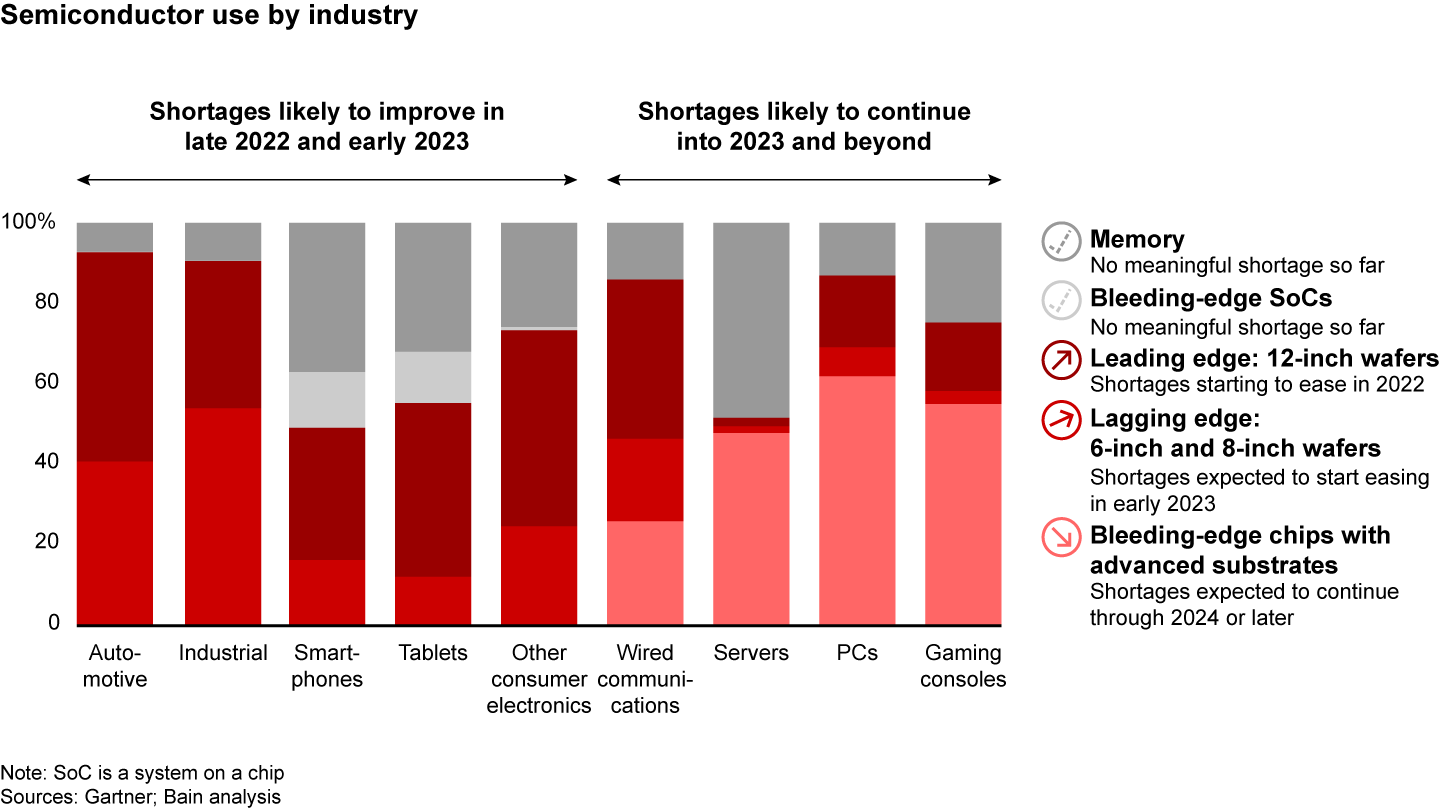
      Automotive and industrial companies are starting to see relief from chip shortages, but advanced computing products remain in a challenging period

      Many have followed how automotive companies cut back orders when Covid-19 hit, only to find themselves at the back of the line for wafers when they later needed them. But the larger impact has come from skyrocketing demand for technology products, and the long lead times required to build the fabrication plants that supply their chips has led to a chip shortage that has often played out unevenly but has affected nearly every end market in some way.

      Some chip types (and the industries that rely on them) have been hit harder and at different times. After shooting up in 2021, lead times for chip deliveries have flattened at elevated levels in recent months (see Figure 2).

      Figure 2
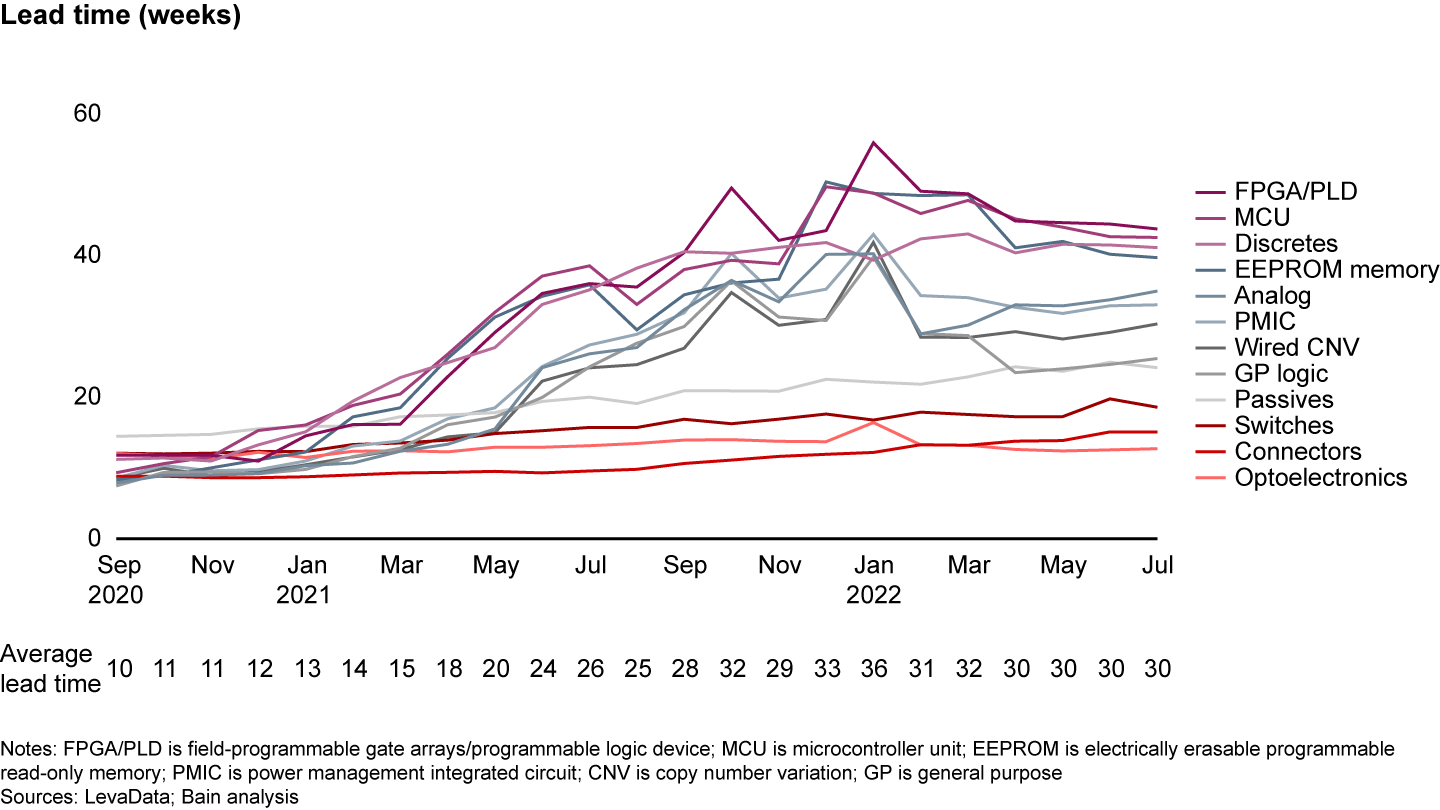
      After spiking in 2021, semiconductor delivery times flattened at elevated levels

      These shortages will improve faster for certain products and industries, depending on the types of chips they use, but more tech executives are recognizing that the next phase of the shortage will be like the arcade game Whac-A-Mole. As one shortage recedes, giving affected chip buyers all the computing components needed to produce a complete product, those buyers will start to consume chip supplies in another area, causing new shortages to pop up.

      Three wild cards will determine how the shortage plays out.

      • Demand pullback. Unfortunately, the fastest route to relief is softening demand. Inconceivable for the past 2 ½ years, this now seems a distinct possibility, given the economic outlook. There are already reports of tech companies temporarily pausing new component orders and asking suppliers to delay or shrink shipments amid inflation worries and growing inventories.
      • Shortages of extreme ultraviolet (EUV) lithography equipment. These $150-million-a-pop machines are necessary to build bleeding-edge fabrication plants, and there’s only one supplier, ASML. This bottleneck will likely grow over the next three years or so, potentially constraining capacity and limiting new plant openings at a time when semiconductor makers plan to spend well over $150 billion on new bleeding-edge production facilities (see Figure 3).
      • Geopolitical frictions. The semiconductor supply chain has become a major strategic asset in geopolitical maneuverings, and not just in China and the West. This year, Russia limited exports of noble gases, including neon, a crucial ingredient in chipmaking. That followed Japan’s 2019 restriction of exports to South Korea of high-purity hydrogen fluoride, an etching gas used in semiconductor manufacturing. Growing tensions between China and the US threaten to further bifurcate the global technology ecosystems. The US has already cut off China from receiving advanced tools, and domestic-first policies in China may make it difficult for Western firms to access lagging-edge chips from China, where there’s a concentration of lagging-edge wafer manufacturing hubs coming online. And these are just a few of the reasons that semiconductor consumers will need to increasingly consider geopolitical risks when sourcing their chips.
      Figure 3
      Bleeding-edge fabrication plants will receive the lion’s share of semiconductor capital investments in the next few years

      These wild cards are largely out of tech executives’ control, but companies can take several pragmatic steps to protect themselves against chip shortages and the myriad disruptions to electronics supply chains that are undoubtedly coming.

      Design products for flexible resilience. Leading companies constantly refine their products to increase resilience, ideally beginning early in product development and before a supply disruption hits. In our work with clients and analysis of the global landscape, we’ve found that certain things consistently succeed: reducing a product’s number of parts, reusing components, using standard design approaches and flexible product architecture wherever possible, and decoupling software from hardware. In a chip shortage, for example, the fewer “hooks” the product has into silicon, the better.

      Assess risks regularly. To help identify the next big supply crunch, leading companies proactively and continuously assess risks across their entire supply chain and all scenarios they can imagine. After chasing parts for 18 months, one global technology company recently stepped back to evaluate the potential magnitude and duration of a wide range of risks, including those related to specific suppliers, natural disasters, and geopolitical tensions. This helped highlight where investment was most critical to shoring up supply chain resilience. To reduce its reliance on a single supplier for key components, the company had to pay extra to keep multiple suppliers active and bring its procurement department into product development discussions earlier. As a result, the company should be able to fulfill more orders during the next major component shortage, potentially saving several hundred million dollars of revenue it would have otherwise lost.

      Get closer to the semiconductor supply chain. In this era of increasingly frequent and intense supply disruptions, traditional supply chain approaches won’t cut it. Many leading tech companies are developing closer relationships with their suppliers and the semiconductor ecosystem. Some are subsidizing suppliers’ production capacity in exchange for a guaranteed, agreed-upon volume of product. Foxconn has gotten even more hands-on, forming joint ventures to build chip fabs in India and Malaysia. Others are doing more semiconductor design in-house and developing new capabilities to do so.

      Revamp the operating model. To pull all of this off, leading companies are refreshing their operating model to improve collaboration among engineering, sales and marketing, and procurement—the teams critical to managing through and preparing for supply disruptions. For example, these companies create rapid feedback mechanisms to help the three departments communicate better and prioritize the most important customer requests and the highest-value product redesign opportunities. They further strengthen these operational muscles by emphasizing cross-functional collaboration in their training programs.

      After two years of chaos, some tech companies are finally starting to see some relief from the chip shortage. The recovery will be choppy, but leading companies are moving quickly to control what they can, investing in supply chain resilience so they’re ready for whatever comes next.

      Read the Next Chapter

      How Companies Can Build a Supply Chain for the Circular Economy

      Value Evolution

      • The Rise of Growth Equity Investors

      • A Multicloud World

      • Welcome to Web3

      • The US-China Decoupling

      Competitive Battlegrounds

      • Defending against Disruption

      • The Engine 2 Imperative

      • AI’s Next Frontier

      • The Industrial IoT

      Operational Advantage

      • Beyond the Rule of 40

      • Sales Productivity

      • Consumption-Based Pricing

      • Software R&D Efficiencies

      • The Chip Shortage

      • The Circular Economy

      Read our 2022 Technology Report

      Explore the report Download PDF
      저자
      • Headshot of Anne Hoecker
        Anne Hoecker
        파트너, Silicon Valley
      • Headshot of Peter Hanbury
        Peter Hanbury
        파트너, San Francisco
      • Headshot of Hans Joachim Heider
        Hans Joachim Heider
        파트너, Munich
      • Headshot of Sophia Zou
        Sophia Zou
        파트너, Shanghai
      문의하기
      관련 산업
      • 기술
      • Cloud Computing
      • Internet of Things
      • IT Services
      • Semiconductors
      • Software
      관련 컨설팅 서비스
      • Supply Chain
      Technology Report
      Product Management: The Key to Unlocking Return on Your Software R&D Investment

      Product management is instrumental to boosting returns on software development investments, but few companies do it well.

      자세히 보기
      Technology Report
      Quantum Computing Moves from Theoretical to Inevitable

      Quantum will likely become part of a mosaic, working with classical computing to solve big problems.

      자세히 보기
      CIO Insights
      Despite Tech Layoffs, Competition for Talent Remains Fierce

      Tech workers increasingly value career development opportunities and remote or hybrid work options, while compensation has soared.

      자세히 보기
      Supply Chain
      How AI Is Starting to Transform Circular Packaging

      There are 15 AI use cases companies across the value chain can use today to accelerate circularity.

      자세히 보기
      Technology Report
      How Can We Meet AI’s Insatiable Demand for Compute Power?

      Technological innovation, new revenue, and public support may be needed to fund and supply enough electricity.

      자세히 보기
      First published in 9월 2022
      태그
      • 기술
      • CIO Insights
      • Cloud Computing
      • Internet of Things
      • IT Services
      • Semiconductors
      • Software
      • Supply Chain
      • Technology Report

      프로젝트 사례

      Helping a Midsize ERP Player Compete against the Giants

      See more related case studies

      성과 개선 Aggressively growing an IT service provider with a high-performance culture

      See more related case studies

      고객 전략 및 마케팅 Sales blueprint puts IT Services Co.'s growth back on track

      See more related case studies

      베인에 궁금하신 점이 있으신가요?

      베인은 주저 없이 변화를 마주할 줄 아는 용감한 리더들과 함께합니다. 그리고, 이들의 담대한 용기는 고객사의 성공으로 이어집니다.

      급변하는 비즈니스 환경에서 살아남기 위한 선도자의 시각. 월간 Bain Insights에서 글로벌 비즈니스의 핵심 이슈를 확인하십시오.

      *개인정보 정책을 읽었으며 그 내용에 동의합니다.

      Privacy Policy를 읽고 동의해주십시오.
      Bain & Company
      문의하기 환경정책 Accessibility 이용약관 개인정보 보호 쿠키 사용 정책 Sitemap Log In

      © 1996-2026 Bain & Company, Inc.

      문의하기

      무엇을 도와드릴까요?

      • 프로젝트 문의
      • 채용 정보
      • 언론
      • 제휴 문의
      • 연사 초청
      오피스 전체보기