

Brief

한눈에 보기
- Cross-functional savings can double the savings from in-silo initiatives.
- Developing and analyzing data holistically across silos is key to identifying the opportunities.
- A “cost czar” and cross-functional teams ensure accountability for results.
Deflation has allowed companies to improve their margins in recent years without significantly cutting costs. But inflation is back, and rising supply chain costs are starting to erode earnings. In boardrooms around the world, executives now realize that they quickly need to take stronger measures to meet their productivity targets (see Figure 1).
Figure 1
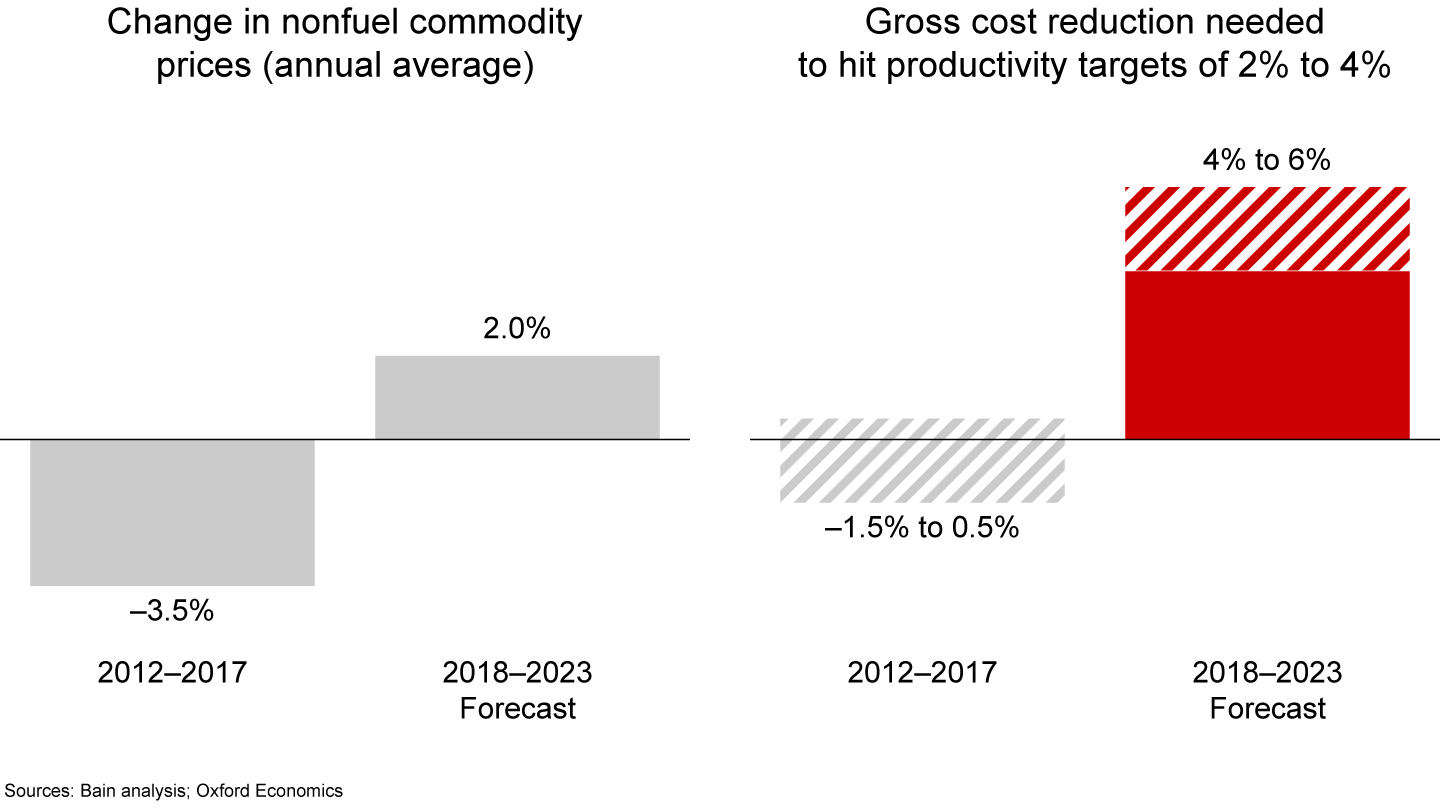

Take the case of a technology company with supply chain costs of about $400 million a year for personnel and freight. Between 2011 and 2017, the supply chain team carried out efficiency initiatives that, combined with deflation, especially in freight costs, helped managers cut supply chain costs in half. Now, with logistics and other input costs rising, the company is struggling just to keep costs flat.
Successful leadership teams combat inflation before it takes its toll. They’ve learned that bringing down costs as prices rise requires a more integrated approach to cost management. These leaders search across organizational boundaries for cost savings that hide in the seams between functions—the areas where responsibilities intersect.
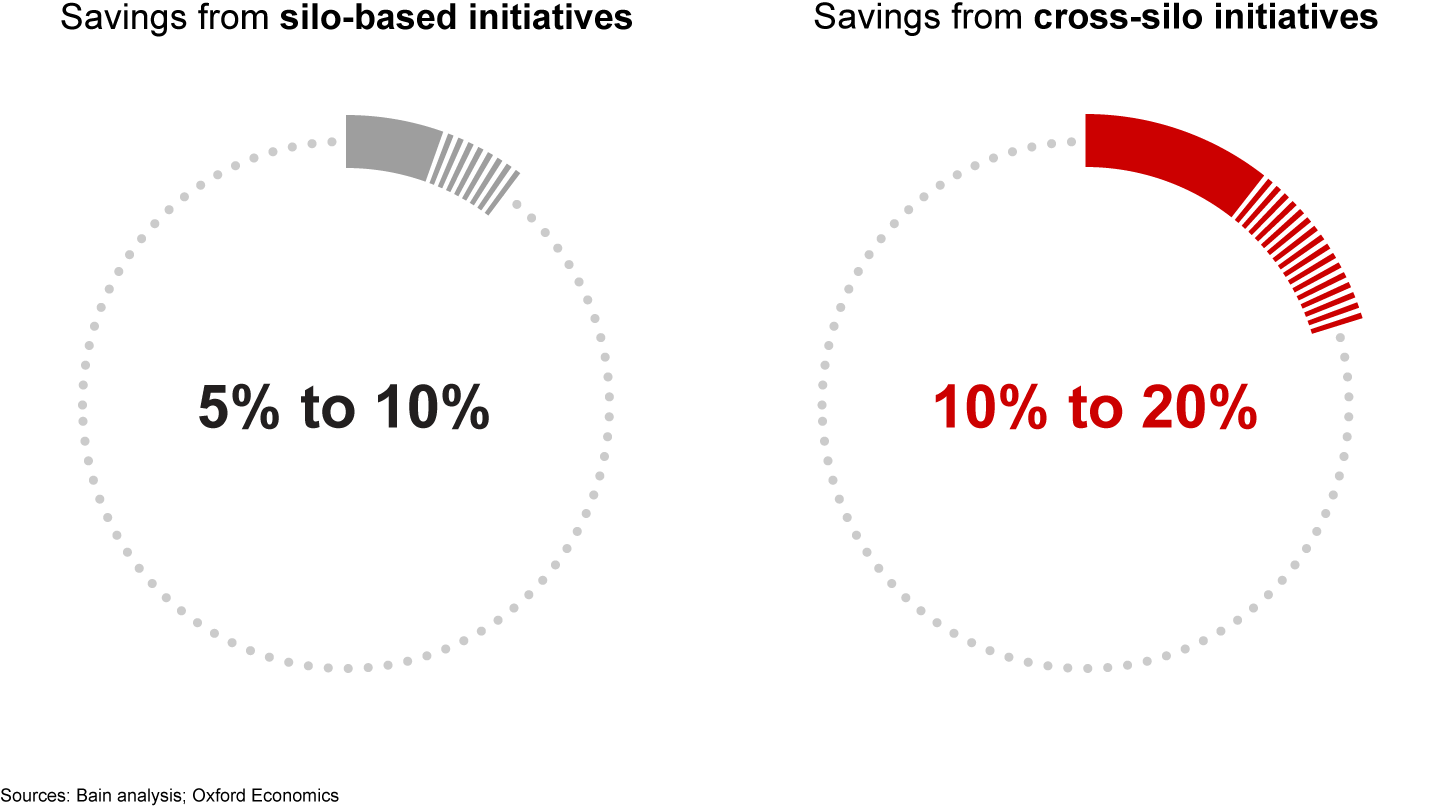
The prize is huge for those that get it right. Bain research shows companies that take an integrated approach to cost management can double the typical savings from silo-based initiatives, to 10% to 20% of total costs. Under normal conditions, those additional gains bolster the bottom line, but when costs are rising, they can provide a lifeline (see Figure 2).
Figure 2

As inflation and shifting trade relations begin to affect historically stable supply chains, an integrated approach to cost management can help companies build organizations that are more resilient while developing a significant competitive edge.
Cost reduction: Getting the basics right
As a first step, most companies typically brace for inflation by seeking savings in procurement, manufacturing, transportation and warehousing. These tactical actions are smart moves, regardless of whether costs are rising. In particular, less mature companies may produce significant improvements using this traditional approach.
Identifying savings within a given function is relatively easy because accountability and decision making are clear. Companies can prune unnecessary features in product design, renegotiate procurement contracts, limit expedited shipping and deploy automation to improve manufacturing efficiency.
The more companies reduce costs, however, the tougher it gets. Leadership teams that already have implemented cost initiatives year after year in each silo have to redouble their efforts to generate new productivity gains. It’s even harder to hit these efficiency targets in the face of rising inflation. In that situation, an integrated approach offers leadership teams a new and untapped source of savings.

How to Bring Down Supply Chain Costs as Prices Rise
After years of deflation, companies will need to take stronger measures to meet productivity targets.
The second wave: Finding savings beyond silos
Companies typically overlook the excess costs that span silos because no one is responsible for tracking them. A classic example is the cost generated by product model variations. Sales and marketing teams often propose products with slight variations to address a specific market niche. But increasing the number of product models can trigger exponential growth in purchasing, manufacturing and supply chain costs, offsetting the benefits of increased sales. Reducing model variations creates a stream of savings across all those functions. Shifting the location of finished goods manufacturing could also generate cross-functional savings by reducing inventory costs or decreasing freight.
Since many companies rely on silo-based organizational structures, seeking savings in the seams between individual business units or functions is not a natural process. Functional leaders tend to look only at data relevant to their function, and silos often hoard data. Taking an integrated approach to cost reduction involves changing people’s behavior. Leadership teams need to produce and analyze data holistically to understand how costs flow across different functions.
Three guidelines can help companies deliver savings beyond silos.
Establish clear ownership and accountability. A “cost czar” and cross-functional teams comprise the missing accountability for cost outcomes throughout the organization. The cost czar has the mandate to form cross-functional teams with managers from product design, procurement and manufacturing; develop a program; and weigh the trade-offs of cross-functional cost initiatives.
A global healthcare company that faced growing pressures to improve its cost base and margins has begun reaping big savings by using a cross-functional approach. After years of acquisitions, the company suffered from an inefficient manufacturing network. The leadership team set tough targets and empowered a cost czar and cross-functional teams to search for savings across silos, including procurement, manufacturing and distribution. The company is on track to deliver in-silo savings of $500 million over four years and $300 million in integrated savings—banking 60% more in gains than it would have through in-silo savings alone.
Often, cross-functional teams help identify costly practices and processes that erode competitiveness and otherwise wouldn’t come to executives’ attention. When an electronics company brought together engineering, supply chain, sourcing and commercial teams to review costs, it discovered that rivals were using more common components in their products. The company’s practice of using different versions of a component reduced scale benefits in sourcing, slowed product development, added to excess raw material inventory and increased manufacturing complexity. It’s a common problem since research and development (R&D) engineers rarely see the full impact on the supply chain of their decision to select a new component. The leadership team developed an integrated view of the total costs for components, balancing the costs and benefits of additional products. That approach reduced costs by $30 million, or 80% of total in-silo savings.
Create incentives to identify savings between silos and functions. Misaligned incentives can make it nearly impossible to take out costs that span different functions. If incentives for manufacturing employees reward quality, for example, the manufacturing leader will be reluctant to find ways to lower costs, even in areas in which customers do not value the level of quality provided.
Well-designed incentives may be financial or linked to broader company goals. One software company created a cost management program to free up capital to invest in priority growth sectors. Functional leaders supported efforts to generate cross-functional savings so that the company could invest in new growth areas.
Use data and advanced analytics to make the business case. Individual silos lack data and analytics showing how costs flow across the organization and where savings could lie. Developing and analyzing data holistically across silos is key to identifying the opportunities within individual functions and building an integrated cost initiative.
Take the example of the leadership team at a large technology company that was trying to reduce the costs and time required to build new manufacturing facilities. Rigorous cross-functional analysis showed that more than 50% of the opportunity to improve construction costs and time was outside of the construction function’s control and instead required close partnership with R&D.
Working with operations, the company deployed an automation system to transport materials to the massive production tools rather than relocating these tools. Similarly, the team worked with R&D to ensure that more of the tools were reusable with other products. In total, the construction team more than doubled cost savings, to more than $400 million, and cut construction time for new plants by six months.
Getting started
As mature companies redouble their efforts to deliver fresh gains from long-running cost programs, a shift in approach can transform results. A few key questions can help leadership teams identify new opportunities for savings.
- Do we know what input prices are rising and how they will affect costs across the entire organization?
- Are we looking for savings beyond silos—in the seams of the organization?
- Are we willing to seek the best overall cost solution instead of optimizing each individual function?
Many companies have already made significant progress reducing costs within silos, but inflation is eroding those gains and making it tougher than ever to improve net productivity. Taking an integrated approach to cost management gives leadership teams a new tool to battle rising costs and keep productivity gains on track.
Peter Hanbury is a partner with Bain & Company in the Performance Improvement practice and is based in the San Francisco office. David Schannon is a Bain partner in the firm’s Performance Improvement practice and is based in the Silicon Valley office. Caperton Flood is a Bain partner in the firm’s Performance Improvement practice and is based in the New York office.
First published in 11월 2018