
Skip to Content
  • 오피스

    오피스

    미주
    • Atlanta
    • Austin
    • Bogota
    • Boston
    • Buenos Aires
    • Chicago
    • Dallas
    • Denver
    • Houston
    • Los Angeles
    • Mexico City
    • Minneapolis
    • Monterrey
    • Montreal
    • New York
    • Rio de Janeiro
    • San Francisco
    • Santiago
    • São Paulo
    • Seattle
    • Silicon Valley
    • Toronto
    • Washington, DC
    유럽, 중동, 아프리카
    • Amsterdam
    • Athens
    • Berlin
    • Brussels
    • Copenhagen
    • Doha
    • Dubai
    • Dusseldorf
    • Frankfurt
    • Helsinki
    • Istanbul
    • Johannesburg
    • Kyiv
    • Lisbon
    • London
    • Madrid
    • Milan
    • Munich
    • Oslo
    • Paris
    • Riyadh
    • Rome
    • Stockholm
    • Vienna
    • Warsaw
    • Zurich
    아시아, 호주
    • Bangkok
    • Beijing
    • Bengaluru
    • Brisbane
    • Ho Chi Minh City
    • Hong Kong
    • Jakarta
    • Kuala Lumpur
    • Manila
    • Melbourne
    • Mumbai
    • New Delhi
    • Perth
    • Seoul
    • Shanghai
    • Singapore
    • Sydney
    • Tokyo
    오피스 전체보기
  • 얼럼나이
  • 미디어 센터
  • 구독
  • 연락처
  • Korea | 한국어

    지역 및 언어 선택

    글로벌
    • Global (English)
    미주
    • Brazil (Português)
    • Argentina (Español)
    • Canada (Français)
    • Chile (Español)
    • Colombia (Español)
    유럽, 중동, 아프리카
    • France (Français)
    • DACH Region (Deutsch)
    • Italy (Italiano)
    • Spain (Español)
    • Greece (Elliniká)
    아시아, 호주
    • China (中文版)
    • Korea (한국어)
    • Japan (日本語)
  • Saved items (0)
    Saved items (0)

    You have no saved items.

    관심 있는 내용을 북마크하여 Red 폴더에 저장할 수 있습니다. Red 폴더 에서 저장된 내용을 읽거나 공유해보세요.

    Explore Bain Insights
  • 산업
    메인 메뉴

    산업

    • 우주항공, 방산 및 정부 서비스
    • 농업 관련 산업
    • 화학
    • 인프라, 건설 및 건축 자재
    • 소비재
    • 금융 서비스
    • 헬스케어
    • 산업용 기계 및 장비
    • 미디어 및 엔터테인먼트
    • 금속
    • 광업
    • 석유 및 가스
    • 제지 및 패키징 산업
    • 사모펀드
    • 사회 및 공공 부문
    • 유통
    • 기술
    • 텔레콤
    • 운송
    • 여행·여가
    • 유틸리티 및 재생가능 에너지
  • 컨설팅 서비스
    메인 메뉴

    컨설팅 서비스

    • Customer Experience
    • ESG
    • Innovation
    • M&A
    • 운영
    • 조직
    • 사모펀드
    • 고객 전략 및 마케팅
    • 전략
    • AI, 인사이트 및 솔루션
    • Technology
    • 변화 혁신
  • Digital
  • 인사이트
  • 베인 소개
    메인 메뉴

    베인 소개

    • 업무 소개
    • 베인의 신념
    • 구성원 및 리더십 소개
    • 고객 성과
    • 주요 수상 경력
    • 글로벌 파트너사
    Further: Our global responsibility
    • 다양성과 포용
    • 사회 공헌 활동
    • Sustainability
    • World Economic Forum
    Learn more about Further
  • Careers
    메인 메뉴

    Careers

    • Work with Us
      Careers
      Work with Us
      • Find Your Place
      • Our Work Areas
      • Integrated Teams
      • Students
      • Internships & Programs
      • Recruiting Events
    • Life at Bain
      Careers
      Life at Bain
      • Blog: Inside Bain
      • Career Stories
      • Our People
      • Where We Work
      • Supporting Your Growth
      • Affinity Groups
      • Benefits
    • Impact Stories
    • Hiring Process
      Careers
      Hiring Process
      • What to Expect
      • Interviewing
    FIND JOBS
  • 오피스
    메인 메뉴

    오피스

    • 미주
      오피스
      미주
      • Atlanta
      • Austin
      • Bogota
      • Boston
      • Buenos Aires
      • Chicago
      • Dallas
      • Denver
      • Houston
      • Los Angeles
      • Mexico City
      • Minneapolis
      • Monterrey
      • Montreal
      • New York
      • Rio de Janeiro
      • San Francisco
      • Santiago
      • São Paulo
      • Seattle
      • Silicon Valley
      • Toronto
      • Washington, DC
    • 유럽, 중동, 아프리카
      오피스
      유럽, 중동, 아프리카
      • Amsterdam
      • Athens
      • Berlin
      • Brussels
      • Copenhagen
      • Doha
      • Dubai
      • Dusseldorf
      • Frankfurt
      • Helsinki
      • Istanbul
      • Johannesburg
      • Kyiv
      • Lisbon
      • London
      • Madrid
      • Milan
      • Munich
      • Oslo
      • Paris
      • Riyadh
      • Rome
      • Stockholm
      • Vienna
      • Warsaw
      • Zurich
    • 아시아, 호주
      오피스
      아시아, 호주
      • Bangkok
      • Beijing
      • Bengaluru
      • Brisbane
      • Ho Chi Minh City
      • Hong Kong
      • Jakarta
      • Kuala Lumpur
      • Manila
      • Melbourne
      • Mumbai
      • New Delhi
      • Perth
      • Seoul
      • Shanghai
      • Singapore
      • Sydney
      • Tokyo
    오피스 전체보기
  • 얼럼나이
  • 미디어 센터
  • 구독
  • 연락처
  • Korea | 한국어
    메인 메뉴

    지역 및 언어 선택

    • 글로벌
      지역 및 언어 선택
      글로벌
      • Global (English)
    • 미주
      지역 및 언어 선택
      미주
      • Brazil (Português)
      • Argentina (Español)
      • Canada (Français)
      • Chile (Español)
      • Colombia (Español)
    • 유럽, 중동, 아프리카
      지역 및 언어 선택
      유럽, 중동, 아프리카
      • France (Français)
      • DACH Region (Deutsch)
      • Italy (Italiano)
      • Spain (Español)
      • Greece (Elliniká)
    • 아시아, 호주
      지역 및 언어 선택
      아시아, 호주
      • China (中文版)
      • Korea (한국어)
      • Japan (日本語)
  • Saved items  (0)
    메인 메뉴
    Saved items (0)

    You have no saved items.

    관심 있는 내용을 북마크하여 Red 폴더에 저장할 수 있습니다. Red 폴더 에서 저장된 내용을 읽거나 공유해보세요.

    Explore Bain Insights
  • 산업
    • 산업

      • 우주항공, 방산 및 정부 서비스
      • 농업 관련 산업
      • 화학
      • 인프라, 건설 및 건축 자재
      • 소비재
      • 금융 서비스
      • 헬스케어
      • 산업용 기계 및 장비
      • 미디어 및 엔터테인먼트
      • 금속
      • 광업
      • 석유 및 가스
      • 제지 및 패키징 산업
      • 사모펀드
      • 사회 및 공공 부문
      • 유통
      • 기술
      • 텔레콤
      • 운송
      • 여행·여가
      • 유틸리티 및 재생가능 에너지
  • 컨설팅 서비스
    • 컨설팅 서비스

      • Customer Experience
      • ESG
      • Innovation
      • M&A
      • 운영
      • 조직
      • 사모펀드
      • 고객 전략 및 마케팅
      • 전략
      • AI, 인사이트 및 솔루션
      • Technology
      • 변화 혁신
  • Digital
  • 인사이트
  • 베인 소개
    • 베인 소개

      • 업무 소개
      • 베인의 신념
      • 구성원 및 리더십 소개
      • 고객 성과
      • 주요 수상 경력
      • 글로벌 파트너사
      Further: Our global responsibility
      • 다양성과 포용
      • 사회 공헌 활동
      • Sustainability
      • World Economic Forum
      Learn more about Further
  • Careers
    최근 검색어
      최근 방문 페이지

      Content added to saved items

      Saved items (0)

      Removed from saved items

      Saved items (0)

      Report

      Creating Resilience, Sustainability, and Accountability in Supply Chains

      Creating Resilience, Sustainability, and Accountability in Supply Chains

      Price and quality are still important, but now companies have more to consider.

      글 Peter Guarraia and Stephan Zech

      • 읽기 소요시간
      }

      Report

      Creating Resilience, Sustainability, and Accountability in Supply Chains
      en
      한눈에 보기
      • Supply chain goals are now about more than price, quality, and inventory levels.
      • Shortages during the Covid-19 pandemic underscored the importance of building resilience into supply chains.
      • As consumers and shareholders demand greater accountability and sustainability in their products, supply chains are also becoming more transparent and traceable.
      • New digital tools are helping companies reduce waste, improve accountability, and increase worker safety.

      This article is part of Bain's 2021 Energy and Natural Resources Report.

      Explore the report

      For most of their careers, supply chain and operations managers have had a clear mandate: source materials and deliver products at the right levels of quality, for the best available price. In energy and natural resources, that has meant delivering crude oil, natural gas or refined products, chemicals and plastics, mined materials, and agricultural products, all at the right levels of quality and at prices customers will pay.

      Suddenly, that formula has become much more complicated. Quality and price remain table stakes. But operations are now measured on a broader scorecard, which can include greenhouse gas emissions and other measures of sustainability, resilience to supply and operations disruption, and accountability for the social impacts of their business.

      Consider the events of just the past year or so. In oil and gas, demand dropped suddenly in the spring of 2020, leaving producers with a glut so large that West Texas Intermediate crude dipped into negative pricing for a day. In agriculture, as lockdowns kept consumers at home, product demand shifted away from food prepared and packaged for out-of-home dining to a new emphasis on products consumed at home. Agricultural companies had to continue to supply the world’s markets while retooling packaging operations and coping with a workforce affected by the virus.

      These sudden shifts came at almost the same moment that customers, shareholders, and governments were demanding more accountability for carbon emissions, plastic production, and other externalities, not only in a company’s own operations, but for its upstream supply chains and downstream customers.

      All this means that the days of business as usual are over. Supply chain and operations teams must develop new capabilities―and quickly. Playing to a more balanced scorecard will require a lot of changes: reducing the carbon footprint, building greater resilience in the supply chain, creating more transparency, and ensuring accountability.

      The pandemic sped up this change, and by mid-2020, supply chain executives were already reprioritizing their investments. Bain’s survey of operations executives found that their investments would focus less on cost reduction and speed, and more on resilience and flexibility (see Figure 1).

      Figure 1
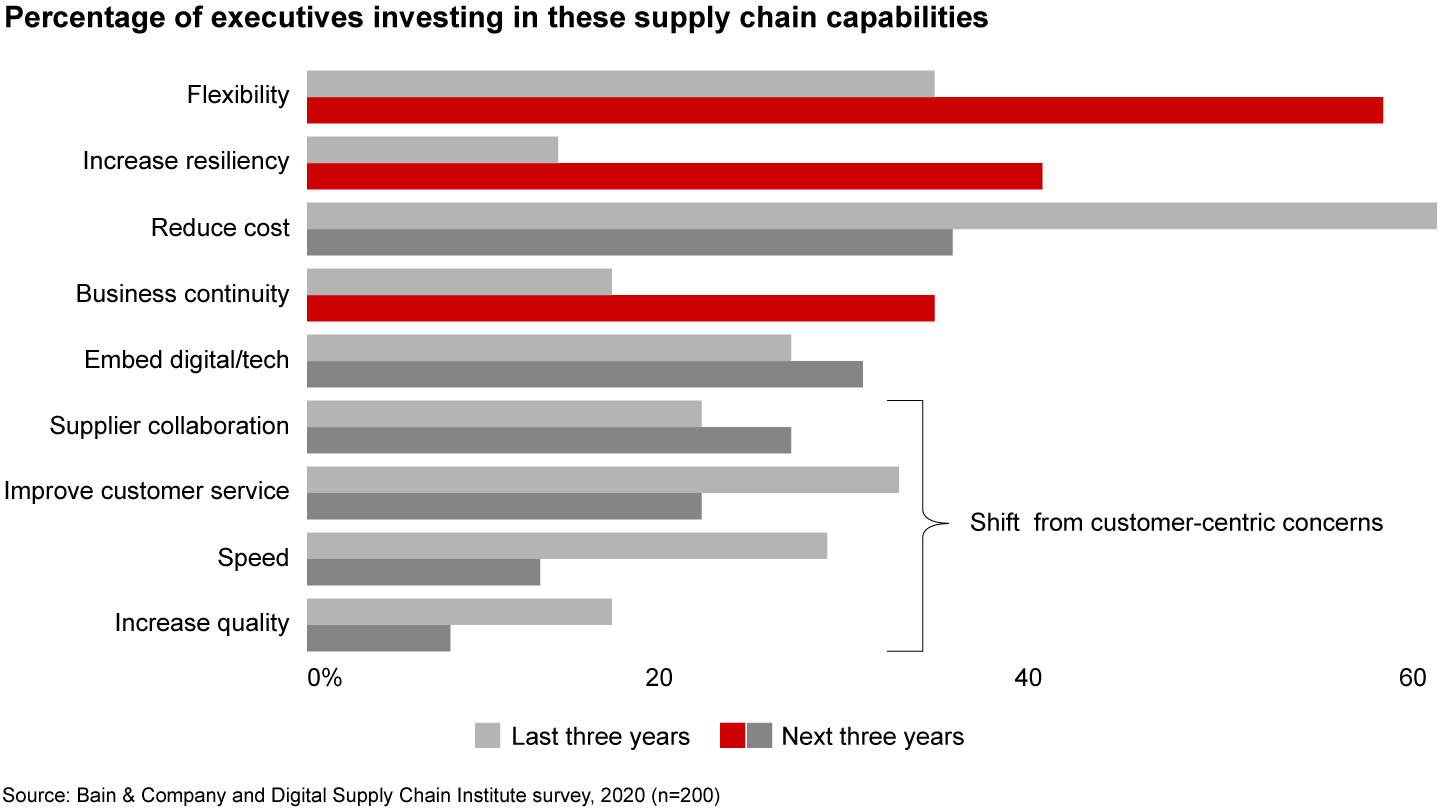
      In 2020, companies shifted supply chain investments toward resilience and flexibility, and away from reducing costs

      To help with all of these changes, most companies have been investing in digital improvements, including analytics and automation, drawn at first by the opportunities in cost savings and efficiency. Now they need these investments to deliver the other objectives on their scorecard.

      New digital capabilities

      The good news is that by building up the new muscles necessary to thrive in a period of greater scrutiny and more intense competition, companies can turn their operations into a true competitive weapon. An operating model that can balance efficiency with sustainability, transparency, accountability, and resilience is a model that can differentiate a company in its marketplace.

      Legacy enterprise management tools, while still essential, cannot meet all the needs of a rapidly evolving operations unit. Increasingly, companies will need to adopt and develop the next generation of digital tools that focus on very specific problems, such as transparency and accountability in a supply chain, network optimization, and inventory optimization. Bain research finds that 85% of the companies surveyed said they’re investing in big data and analytics. These tools have already proven themselves: advanced analytics can improve supply chain forecast accuracy by up to 60%. The next wave of capability building needs to close the loop, ensuring that the insights gleaned from analytics are put to work in operations to generate value.

      An updated digital operating model

      Applying digital technology to these four trends makes a big difference, not only for cost, but also in meeting other objectives of the balanced scorecard.

      • Smart automation. The first waves of industrial automation addressed large, repetitive tasks, usually in controlled, manufacturing environments. A new wave of smart automation employs artificial intelligence and Internet of Things systems to manage difficult, dangerous, or precise tasks more flexibly. The shift promises to enable much more automation in energy and natural resources industries, which are often in more open and variable environments.

        For example, one technique to efficiently mine potash has required a human observer to direct a boring machine at the most promising veins of salts among dirt and rock, deep underground. Smart automation puts sensors and intelligence on the process, making the same or better decisions about where to aim the borer―improving yields, reducing waste, and keeping the operator in a safer location. Drone monitoring is also promising. For example, utilities that rely on coal fuel can deploy drones to survey their stock of coal, make 3-D models, calculate the remaining supply, and report on the condition (dry or wet) of the coal.

      • End-to-end visibility. Companies are integrating their data sets, because that gives them a more comprehensive view of inventory levels and availability across the supply chain. But today, transparency is about more than just inventory. It helps companies see where products and components come from, and that helps them live up to their environmental and social commitments. Olam International, a commodity food company based in Singapore, developed the digital platform AtSource that traces food back through the supply chain, across processors, suppliers, and farmers. The platform provides a digital dashboard that also provides copious economic and contextual information gathered from the field, including premiums paid to farmers, emissions, land and water use, and social conditions of worker families.

      • Intelligent supply chain. Bain research found that more than half of executives in the energy and natural resources sector surveyed said they weren’t satisfied with the accuracy of their demand forecasting (see Figure 2). Advanced forecasting and more sophisticated demand models promote accurate planning, which can reduce waste, not only improving the return on investment, but also reducing the footprint of supply chain operations. In the Permian Basin, for example, one oilfield service company employs remote monitoring and algorithmic forecasting to know when a well needs more drilling fluid. This reduces waste by eliminating the need for the company or its customers to send out trucks on broad “milk runs” to check on drilling fluid.

        Predictive planning can go much further, aggregating all the relevant data from a range of sources, including inventory levels and consumption levels, constraints in the production process, and external factors that can affect demand―everything from business cycles to the weather. Intelligent systems can generate future scenarios based on observed patterns and real-time data and come up with probability scenarios and their effects on the supply chain.
      Figure 2
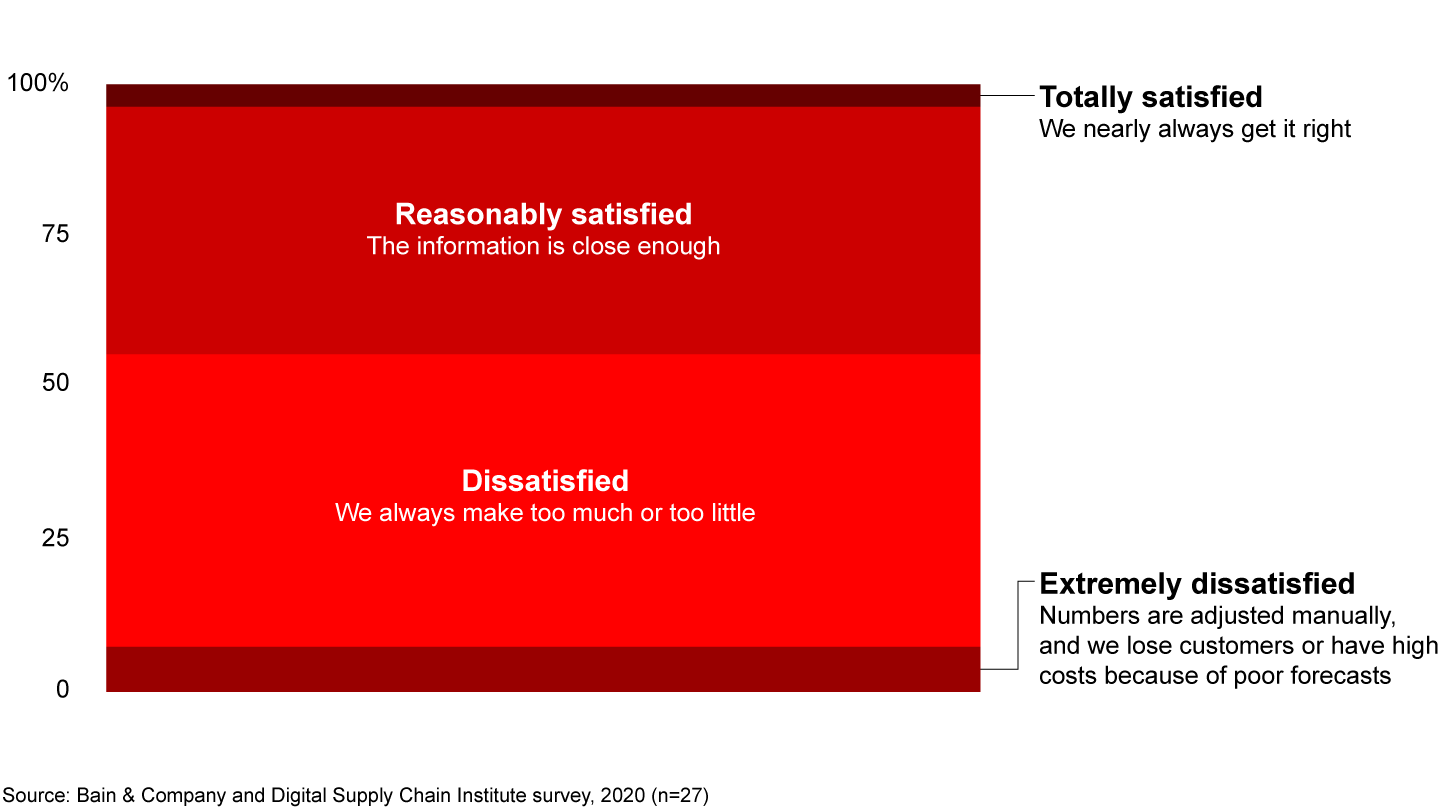
      More than half of executives in energy and natural resources say they aren’t satisfied with the accuracy of their demand forecasts
      • Next-generation talent. As in other industries, frontline workers in energy and natural resources are becoming more technically savvy, by necessity. As the systems they depend on become more sophisticated, workers are being retrained to understand and work with the digital systems that increasingly monitor and guide their activities.

        Technology is also supporting workers in their tasks and increasing their safety. Assisted-reality (AR) headsets are moving from experimental stages to scale deployment, putting visual guidance for an unlimited range of tasks literally at workers’ fingertips. One North American maritime contractor that was having difficulty finding enough skilled welders developed a system that combined artificial intelligence with AR, projecting instructions on a head-mounted display that guided welders through each task.

      Finally, because operations are increasingly measured against a broader set of requirements, executives need to reexamine their capital investment plans, asking, “What am I getting for this investment, beyond cost savings?” Capital investments also need to deliver efficiency, sustainability, resilience, and agility. (For a detailed look at capital investments, see “Raising Productivity in Energy and Natural Resources Capial Projects.”) If a company’s capital investment decisions are still based only on reducing costs, its investment thesis is failing to keep up with its strategic ambitions.

      Read the Next Chapter

      Engine 2: How to Grow a Sustainable New Business

      Read our 2021 Energy and Natural Resources Report

      Explore the full report Download the PDF

      More from the report

      • Two out of Three Won’t Do

      • Harnessing the Energy and Resource Transition

      • Net Zero: From Political Targets to Industry Action

      • Energy Is Only One Part of the Sustainability Transition

      • Redesigning Value Chains to Deliver More Sustainable Goods

      • Time for ESG Investors and Energy and Natural Resources Companies to Work Together

      • Business Opportunities in Low-Carbon Hydrogen

      • Raising Productivity in Energy and Natural Resources Capital Projects

      • Creating Resilience, Sustainability, and Accountability in Supply Chains

      • Engine 2: How to Grow a Sustainable New Business

      • Accelerating the Journey to Net Zero

      • Four Ways to Scale Digital in Energy and Natural Resources Companies

      저자
      • Headshot of Peter Guarraia
        Peter Guarraia
        Alumni, Houston
      • Headshot of Stephan Zech
        Stephan Zech
        파트너, Los Angeles
      문의하기
      관련 산업
      • 금속 및 광업
      • 농업 관련 산업
      • 석유 및 가스
      • 에너지와 천연자원
      • 유틸리티 및 재생가능 에너지
      • 화학
      관련 컨설팅 서비스
      • 지속 가능성 및 기업의 사회적 책임
      • Supply Chain
      에너지와 천연자원
      Building Resilience in Your Business Strategy: Four Imperatives for Leaders

      Traditional approaches to resilience don’t rise to today’s challenges.

      자세히 보기
      Energy and Natural Resources Report
      The Energy Transition’s Other Big Puzzle: Making the Math Work

      Strong investment returns are within reach for companies that focus on the fundamentals and aren’t afraid to get creative.

      자세히 보기
      에너지와 천연자원
      Sustaining Capital: From Chaos to Discipline

      Fragmented budgets, poor visibility, and missed forecasts are fixable with the right approach.

      자세히 보기
      지속 가능성 및 기업의 사회적 책임
      How AI Is Starting to Transform Circular Packaging

      There are 15 AI use cases companies across the value chain can use today to accelerate circularity.

      자세히 보기
      Energy and Natural Resources Report
      State of the Transition 2023: Global Energy and Natural Resource Executive Perspectives

      Bain’s third annual survey on the energy transition finds executives increasing investments in low-carbon businesses, but skeptical of consumers’ willingness to pay more.

      자세히 보기
      First published in 6월 2021
      태그
      • 금속 및 광업
      • 농업 관련 산업
      • 석유 및 가스
      • 에너지와 천연자원
      • 유틸리티 및 재생가능 에너지
      • 지속 가능성 및 기업의 사회적 책임
      • 화학
      • Energy and Natural Resources Report
      • Supply Chain

      프로젝트 사례

      An Environmental Services Company Captures Massive Savings from a Merger

      See more related case studies

      전략 New products propel profitability for metals manufacturer

      See more related case studies

      고객 전략 및 마케팅 Revitalizing a utility's market position with customer loyalty

      See more related case studies

      베인에 궁금하신 점이 있으신가요?

      베인은 주저 없이 변화를 마주할 줄 아는 용감한 리더들과 함께합니다. 그리고, 이들의 담대한 용기는 고객사의 성공으로 이어집니다.

      급변하는 비즈니스 환경에서 살아남기 위한 선도자의 시각. 월간 Bain Insights에서 글로벌 비즈니스의 핵심 이슈를 확인하십시오.

      *개인정보 정책을 읽었으며 그 내용에 동의합니다.

      Privacy Policy를 읽고 동의해주십시오.
      Bain & Company
      문의하기 환경정책 Accessibility 이용약관 개인정보 보호 쿠키 사용 정책 Sitemap Log In

      © 1996-2026 Bain & Company, Inc.

      문의하기

      무엇을 도와드릴까요?

      • 프로젝트 문의
      • 채용 정보
      • 언론
      • 제휴 문의
      • 연사 초청
      오피스 전체보기