

Brief
The year was 2010. The German healthcare company Merck KGaA had just acquired Millipore, an American biotech equipment supplier. Now executives from the two companies were facing the daunting challenge of marrying the organizations’ cultures—especially the way they went about making and executing decisions.
Merck, with an 8 billion euro global business, was known for its careful, methodical approach. “We revisit decisions, if needed, to ensure alignment with key stakeholders,” said one employee. Millipore was more entrepreneurial. As one executive put it, “If we decide on something, we do it.” The newly merged company would need to define and develop its own way of handling key decisions, one that captured the strengths of both organizations—and it would need to begin the process right away.
Nearly every organization has a characteristic style of making decisions. People may not be conscious of the dominant style, just as Molière’s Monsieur Jourdain was unaware that he had been speaking prose all his life. But a particular approach to decision making is nearly always a key ingredient of an organization’s culture. It’s one of the “soft” elements that research shows are most important in determining an organization’s decision effectiveness and thus its performance.
Sometimes, however, a company’s predominant decision style has to change. The trigger may be a merger, as with Merck and Millipore. It may be a shift in the competitive landscape, the adoption of a new strategy or the arrival of new leaders. Suddenly the customary way of doing things no longer fits the organization’s business objectives. People need to learn a new decision style, and they need to tackle the challenge head-on. This article will help you get started on the journey.
Four decision styles
From an analytic point of view, decision styles typically fall into one of the following four categories:
• Directive. One person has decision authority in any given situation. Once he or she makes a decision, the expectation is that everyone else will get on board.
• Participative. One person takes responsibility for each decision, but the decision maker gathers input from others with relevant knowledge or expertise. This style combines single-point accountability with a collaborative approach to the process.
• Democratic. Participants gather information, then vote on decisions. The majority rules, and the minority must abide by the vote.
• Consensus. All involved agree on the proposed plan of action before they finalize a decision.
Note that the categories aren’t hard and fast; they are more like markers on a continuum. And all of a company’s decisions don’t necessarily fall into the same category. Decisions relating to safety might be directive, for example, while decisions on which charities to support might be put to a vote.
But organizations get themselves into trouble when they fail to agree on and communicate a predominant decision style—a method that will be used for most decisions in most situations. For one thing, people in the organization don’t know what to expect. Individual executives adopt whatever style feels most comfortable to them. Employees, who often work across groups, wind up not knowing how to operate from one to the next. A new leader may confuse things still further. A major UK retail chain, for instance, relied for decades on a CEO whose style was wholly directive. When a new, more participative CEO took the reins, the organization could barely function. People weren’t sure how to participate, and they hadn’t learned to make decisions on their own.
Then, too, the organization may find it has adopted a particular style by default, and that the style is inappropriate to its business challenges. Several years ago, Boeing Commercial Airplanes revisited how it handled pricing. At the time, only a handful of executives at the top of the organization knew how the company priced its airplanes and how much money it made on each one. This directive style on pricing decisions excluded information from lower-level executives, which might have led to better choices.
The advantages of the participative style
Though any of the four styles can work in some situations, we find compelling evidence from both research and experience in favor of the participative style. More than half of the top performers in a recent survey said that they tend to rely on such a style. Employee engagement is also significantly higher in companies with a participative style. Employees of participative companies are three times as likely as others to recommend their organization as a place to work.
Changing to a participative style often improves both the speed and the quality of decisions. Boeing’s shift to a participative style under Alan Mulally helped the company make better pricing and other commercial decisions and turn around performance.
Changing behavior
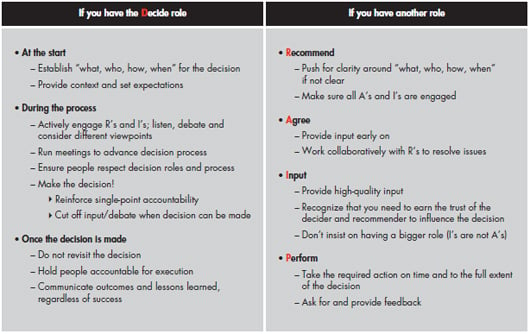
At root, “decision style” is simply a convenient shorthand for a set of specific behaviors. If an organization aspires to change its style, individuals in the organization must learn to behave differently—not always an easy task. Leaders who are guiding this process typically rely on four critical steps.
1. Explain the rationale
The first step is to answer the obvious question: Why do we need to change? People need to see a clear link between a new decision style and business objectives if they are to buy in to the program. When MetLife shifted to the participative style, CEO Rob Henrikson was crystal clear about the rationale. In an internal video, he said, “The participative style fits well with our desired culture, emphasizing both accountability and collaboration.” In the case of Merck and Millipore, executives from both sides could see that smooth decision making was key to achieving the hoped-for synergies.
2. Determine the biggest gaps between today’s behaviors and those that will be required in the future
Companies that adjust their decision style typically ask employees to assess their current ways of acting—their point of departure, so to speak. What are the behaviors that obstruct effective decision making? What are the behaviors that help it? In the case of a merger, which behaviors are at odds? The organization can then define the point of arrival, the behaviors that will support the new style. In the Merck-Millipore merger, the teams from Merck identified a sizable gap between their current speed of decision making and the speed they wanted in the future. Millipore’s group wanted future decisions to focus less on short-term results than they had in the past.
3. Identify the behaviors that need to change
Millipore executives were accustomed to a fast-moving style, which didn’t always allow for debate. The move to a participative style required decision makers to learn to listen to others, and it required the others to begin offering input in a timely fashion. Merck executives, for their part, had traditionally operated more by consensus, without explicit roles and processes. Adopting the participative style helped them move faster and get things done more effectively.
For example, Merck Chemical chief executive Bernd Reckmann had the “D”— decision rights—on the priority agenda for 2011. In keeping with the new style, Reckmann consulted with others at every step and led a spirited debate on the criteria for choice before coming to his decision.

Decide & Deliver
Learn more about the five steps that leading organizations use to make great decisions quickly and execute them effectively.
A useful approach is to home in on the two or three behavior shifts that are hardest when going from one style to another. If an organization is shifting from directive to participative, decision makers may find it difficult to solicit input, welcome open and constructive debate and change their minds when warranted. One executive addressed that issue by asking for every staff member’s views before declaring his own, just to be sure he got everyone’s perspectives. People who don’t have decision responsibility but are involved in decisions must prepare the input that they want to offer— and understand that they must earn the trust of the decision maker if they expect to influence the decision.
Moving from consensus to participative can be even harder. Decision makers must actually be decisive and bring the discussion to a close, even in the face of conflicting views. When they choose a course of action, they should help others understand their thinking, so that people don’t suddenly feel they’re being told what to do with no explanation. Participants must all learn to commit to the decision even if they don’t agree, and not to take it personally if they are no longer involved in certain decisions.
4. Embed the new behaviors
Companies changing their decision style invariably find that they must reinforce the message in several different ways, including:
• Role modeling and communication by leaders. One big motivator for many people is seeing leaders act in new ways. When MetLife was consolidating its US businesses into a single organizational unit, the new unit president, Bill Mullaney, decided to move one part of the organization to another. Rather than simply announcing the change, he sent an email to every manager explaining how he and his team had made the decision using the participative style. He recounted how he had used some of the new decision practices he was trying to reinforce, such as considering alternatives and evaluating the options with the right facts. The message was crystal clear: This is the new way of doing things, and here’s how it works.
• Reinforcement. Of course, little is as powerful as rewards for adopting new practices. Reinforcement needs to be positive, immediate and consistent. It can come from the boss, such as a simple “well done” after a meeting using the new decision style. Even more powerful is reinforcement from a peer group. When the newly merged Merck and Millipore made its decision about priorities for 2011, executives went through a process of preparation, spirited discussion and revision. But they wound up making this complex decision on time and on budget, without undue effort. The experience left people feeling good about the entire process and ready to use the new disciplines again in other critical decisions. The positive feedback from peers created its own reinforcement for participants.
• Feedback and coaching. Regular feedback on progress toward behavior change is critical for groups as well as individuals. Merck established a checkpoint for the change process, asking each leader how things were working and then summarizing the feedback for senior management discussions. If an individual is struggling with certain behaviors, outside coaching can often help that person make progress toward the goal.
These behavior changes may feel uncomfortable. People accustomed to working by consensus, for example, may find the participative style too abrupt. Those accustomed to a directive style may find that decisions take longer than they used to. The key to getting people past their discomfort to actual behavior change is persistence. The journey takes time: The initiative will fail if behavior change is no longer a priority six months later. But long-term commitment will reap long-term rewards.
Conclusion
The teams from Merck and Millipore concluded a remarkably successful merger. It closed on time and on budget. The new company began to execute its business plan and turned in excellent operational results in the period immediately following the merger. Many factors contributed to the success, of course, but a central factor was the introduction and gradual implementation of a new decision style—a style that allowed people from both companies to make good decisions, make them quickly and see them implemented effectively.
So it can be with any major change in a company’s organizational life. Identifying your predominant decision style, selecting a new one if necessary and launching the process of changing behaviors so that the new style comes to life can create a path to better decisions and thus better performance.
Marcia W. Blenko is a partner with Bain & Company and leads the firm’s Global Organization practice. Paul Rogers is the managing partner of Bain’s London office. Patrick Litre is a partner with Bain & Company in Atlanta.
First published in 5월 2011