

Brief
Many companies begin—and many continue—without a clear sense of their target customer. Some resist clarifying the target; they want to appeal to as many buyers as possible, and defining a target implies excluding some customers. Others are unable to describe in more than a cursory way who does or will buy their offerings. We have to serve the entire market, runs one common belief. Or sometimes: We can’t afford to focus.
In practice, of course, product and service designers always make trade-offs. They sacrifice one feature or another so that they can achieve something else, such as a competitive price. But without a specific design target in mind, they may make these trade-offs without a good rationale. Asking customers what they want, with no constraints, doesn’t always help: Customers typically respond that they want “more” and “better.” Sometimes that leads companies to conclude that more is the same as better.
This kind of unconstrained thinking was one factor behind Ford Motor Company’s mediocre performance before the arrival of Alan Mulally in 2006.
Here’s how it played out. The smart, experienced designers and engineers on Ford’s product-development teams naturally wanted to create world-class cars. They benchmarked between 40 and 50 vehicle attributes, identifying best-in-class standards for each one.
Ford then asked customers if they wanted those best-in-class attributes, and the customers said yes. The company’s cost targets, however, always forced compromises, and the development teams spread those compromises over all of the vehicle’s features. Unfortunately, that led to products that weren’t best-in-class in anything and weren’t well differentiated from competitors’ vehicles. Customers were disappointed, and Ford’s market share in cars and light trucks plunged by more than one-fourth between 1995 and 2005.
The approach we describe in this article can help you escape that kind of dead end. As you’ll see, though, building true customer focus can have hard-to-accept implications for your product line and your organization. For instance, it means that if you want to truly delight your customers—if you want to be world class at what they value most—your performance will most likely have to be only average or worse on everything else.
Pursuing the design target
Suppose that, instead of trying to serve everybody, you identify a specific set of customers you can serve better than anyone else—with better products, better service, lower cost, or some combination of all three. This is your design target.
Companies that take this route set out to learn all they can about these target customers, starting with who is buying, why they are buying and where the potential buyers are. They seek both qualitative and quantitative insights, and not just from one-off research projects but from a constant stream of feedback. They investigate the customers’ needs, their spending habits, their passions, their unmet wants. They figure out where competitors are missing the boat, and they determine which customer needs best match their own capabilities. All of these steps lay the foundation for loyalty and enthusiasm among those customers (see Figure 1).
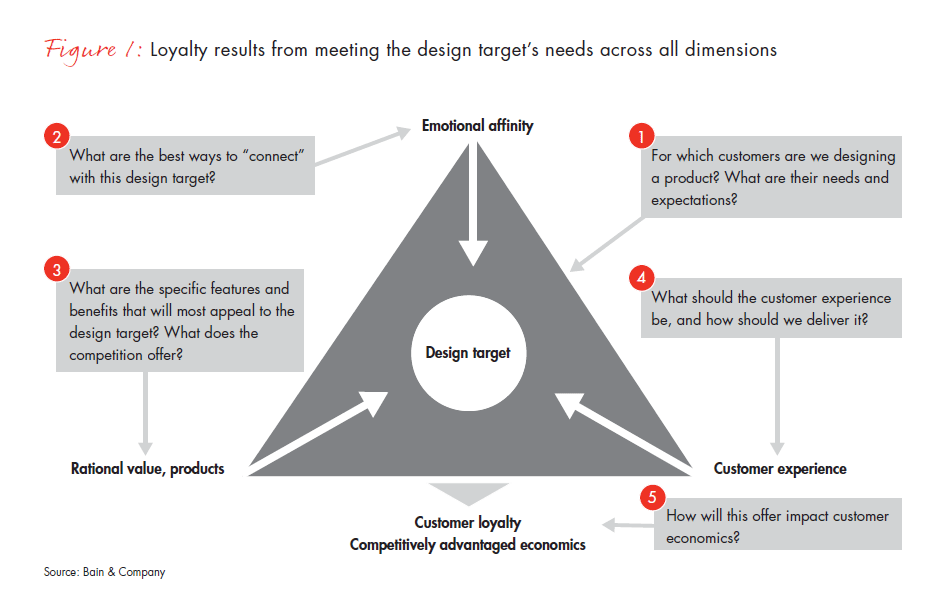
Some fundamental facts about companies and their customers inform this approach.
- First, management teams tend to overestimate the degree to which they are really better than the competition. In a well-known Bain study of 362 companies, 80% of management teams felt they delivered a better customer experience than rivals—but only 8% of customers agreed. Companies need to make sure they aren’t exaggerating what makes them special in the eyes of their customers.
- Second, when a customer makes a purchase, he or she can’t use that money for anything else. So a product has to rise above the competition and above whatever other options the customer might have. Frito-Lay, for instance, views its products not just from the salty snack perspective but also from the “share of stomach” perspective. It constantly strives to figure out how its products can displace not only other salty snacks but other calories a customer might consume. To achieve that goal, something about each of Frito-Lay’s products has to stand out above the rest. Not everything, but something.
- Third, customers themselves are always making trade-offs, and understanding those trade-offs allows you to offer exceptional performance in some areas while ignoring others. Hamburgini, a new quick-service restaurant in Riyadh, sells nothing but burgers, fries and drinks. It bakes the buns in its store, using locally sourced ingredients and a proprietary recipe. It buys its beef fresh from a nearby farm and prepares the patties minutes before grilling them. Since the restaurant doesn’t offer much in the way of seating or ambience, most of the orders are takeout. Yet there is often a line two blocks long outside the door. The reason? The meat and buns are as fresh as you can get anywhere, and the burgers are cooked to perfection. For that, people are willing to trade speed, atmosphere, comfortable surroundings and menu choice. The restaurant, in other words, is terrible at everything except creating great burgers.
Established companies often need to refocus themselves by re-identifying their design target and rediscovering the trade-offs those customers are willing to make. In the late 1990s, for instance, the pet-supplies chain PetSmart was facing a challenge. Though its category-killer format had brought early success, more and more superstores around the US had begun selling pet supplies. PetSmart was also experiencing strategic and operational difficulties—its warehouse-style stores were no longer appealing to consumers, for example—and its stock price had declined more than 75%.
So the company looked closely at its most profitable and enthusiastic customers. The very best, it learned, were people who were completely devoted to their pets, treating them almost like children. These “pet parents” had distinct needs at each stage of their pet’s life cycle. They weren’t interested only in products; they also wanted services such as training, boarding and grooming. PetSmart realized that there was no one-stop shop that offered everything pet parents needed at competitive prices in convenient locations.
Armed with such knowledge, a company can design offerings that become a priority for its core customers. It can test, learn and adapt as necessary, and then it can scale up. That’s what PetSmart did. Rather than trying to capture every casual pet owner looking for the cheapest price on two cases of pet food, it redesigned its stores to appeal to pet parents. It changed its décor for a more upscale look. It arranged its aisles by animal type and realigned its buying organization to match. It now offered a wide variety of services, including dog day care, grooming and in-store veterinary services. It also created fast-feedback mechanisms to allow for continuous adaptation and improvement. Soon the company’s sales and stock price were on the way up, with shares rising from below $10 in the early 2000s to about $60 in mid-2014.
Implications for a focused company
This kind of customer focus has implications for every aspect of simplification: strategy, products, processes, IT and organization. Here we’ll look at just two of those elements: products and organization.
Products. Many companies favor a broad product line: They want to have something for everybody, so that no potential customer goes away disappointed. That leads to the kind of product proliferation we described in an earlier article. The resulting complexity almost always raises costs, compromises quality and leads to stock-outs. Sales people find it hard to be knowledgeable about all the different SKUs. Customers are often baffled.
Focusing on the target customer enables a company to cut through product complexity. If you know exactly what your primary customers most want—if you know what their sweet spot is—you can concentrate on giving them exactly that. Navistar, the truck manufacturer, used to offer seemingly endless numbers of options on most of its vehicles. The company believed that the ability to customize a truck was the most important criterion for customers—a key ingredient of truck-buying culture.
Then, in the mid-1990s, the company introduced its Diamond SPEC™ program, allowing buyers of a certain class of truck to choose from just 16 pre-engineered modules rather than from more than a thousand individual components. The modules met truckers’ functional needs (long haul, short haul and so on) but eliminated most of the optional bells and whistles. The simplification enabled Navistar to identify significant manufacturing savings and operational improvements and thus to offer customers a 5% discount. The lower price, shorter ordering process (hours instead of days), and improvements in quality and performance led customers in the pilot program to place more than twice as many orders as forecast. Not long after its launch, Diamond SPEC accounted for 80% of dealer orders for that class of truck. As it turned out, the desire for customization was secondary or even tertiary to more basic needs—or as one Navistar executive wryly put it, “customers definitely care about having all the choices in the world unless it’s a nickel cheaper not to have them.”
By focusing on their core customers, both PetSmart and Navistar were following a time-honored principle: Delight the few to attract the many. Offerings that are exactly what your core customers want are likely to appeal to large numbers of other customers. However, any company that follows this route has to make some hard decisions. Since nobody can be all things to all people, a company that invests in delighting its core customers will necessarily disappoint others.
Hal Sperlich, the automotive legend who helped create both the original Ford Mustang and Chrysler’s first minivan, often spoke of the “Killer ABCs”—the three most important attributes—that define a product in the eyes of the customer. The Mustang’s Killer ABCs were performance, design and price. The minivans were carrying capacity, convenience and value. But note the compromises. A minivan buyer looking for great fuel economy or a peppy engine would have found Chrysler’s product merely competitive, not exceptional. Remember Hamburgini: Offerings that are great in some respects can be average or even below average in others. The leaders of a focused company accept that, because they know exactly where it pays to be great.
Organization. A focus on the customer also gives you a knife for slicing through the organizational complexity that tends to build up over time in any large company. Does a given activity, function or business unit add value to what you are offering your core customers? If the answer is “no” or “we’re not sure,” that part of your organization is a good candidate for trimming or even elimination. Do you know which decisions and capabilities are central to delighting your target customer? If not, you are probably not making those decisions or cultivating those capabilities as well as you should. Do you have a truly customer-centric culture? If not, people who make product or service decisions may slight the customer in favor of other priorities. And they may not hear feedback from the frontline employees who are actually dealing with customers.
Charles Schwab illustrates this kind of organizational focus. When founder Charles R. “Chuck” Schwab returned to the company he founded as CEO in 2004, its costs were rising. It had expanded into businesses where it had little competitive advantage, and it had lost focus on its core business of serving individual investors. “We’d built up our overhead and our bureaucracies,” Chuck Schwab later told an interviewer, “and our business activities were sort of far flung.” He was most distressed with how the company was treating its clients. Nuisance and penalty fees, for example, had swollen to the point where they accounted for 25% of revenues. And no wonder costs were high: The company had seven retail presidents, each with an entire administrative staff and a separate call center.
Chuck Schwab first focused on eliminating many of the company’s expensive bureaucracies, eventually reducing costs by some $600 million. That enabled him to eliminate the bad profits generated by nuisance and penalty fees and get prices back in line with those of low-cost competitors. Instead of reducing services, however, the company further realigned its organization to give its target customers more of what they wanted. For example, “Clients were clearly asking for more investment help and guidance from Schwab than we had traditionally provided,” as one executive put it. So Schwab increased the percentage of clients eligible to work with dedicated representatives; created a concierge service in which local branch managers called new clients (and those who had added a significant new product or services) to offer personal help; and created an outreach program to ensure that even investors who didn’t have relationships with local Schwab financial consultants would still have opportunities to talk with somebody at the company. All of these moves helped build advocacy and loyalty by showing that Schwab was really listening to customers and tailoring its organizational priorities to their needs.
PetSmart, Navistar and Schwab faced hard choices. They had grown mostly by offering more and more options to a poorly defined array of customers. But that course was unsustainable, and the complexity it created was killing them. To return to profitable growth, the companies had to figure out exactly who their target customers were, learn more about those customers, tailor their offerings precisely to match the customers’ wants and needs, and earn customer loyalty. Like the owners of Hamburgini, they also had to forget about the less important matters.
Mark Gottfredson, a partner based in Dallas, is a leader in Bain & Company’s Performance Improvement practice and coauthor of The Breakthrough Imperative: How the Best Managers Get Outstanding Results (HarperCollins, 2008). Rob Markey, a Bain partner based in New York, leads the firm’s Global Customer Strategy & Marketing practice; he is coauthor of The Ultimate Question 2.0: How Net Promoter Companies Thrive in a Customer-Driven World (Harvard Business Review Press, 2011).
First published in 8월 2014