

Brief

Grocers, mass merchants, fast-food restaurant chains and other retailers that sell to consumers are increasingly implementing third-party pricing software. Vendors such as Clear Demand, DemandTec (an IBM company) and Revionics provide tools that can be highly effective, particularly in high-SKU and high-volume operations. Companies use these software programs to establish price points that fit their strategy, maintain pricing accuracy as the competitive landscape and vendors change, and make their pricing processes more efficient and effective. Companies can also use pricing tools to assess consumer elasticity and thereby optimize prices. The benefits that accrue range from 1% to 3% of gross margin dollar improvement (see the sidebar, “The three standard benefits of pricing tools”).
Yet the extent of the benefits depends on how carefully companies select, adopt and use the tools. Many different outcomes are possible, and there are major risks in adopting pricing tools without anticipating the organizational changes that need to occur. In fact, underinvesting in the time and resources required for setting up a new system can cause companies to deviate from their pricing strategy. Ultimately, that could lead to a loss in market share and profits—all after the costs of buying and installing the software. Software vendors typically emphasize gross margin improvements because they need to show a return on investment in order to make the sale; however, other benefits, such as price accuracy and more efficient price management, matter just as much, if not more.
This type of software system will not replace the expert judgment and experience required to develop and maintain pricing strategy; rather, its purpose is to augment judgment. Selling one $100 box of cereal clearly is an unrealistic strategy compared with selling 25 $4 boxes, but even a $7 box might be unrealistic given the competitive realities. All too often, companies do not spend enough time determining how to translate their pricing strategy—including its implication for competitors, consumer perceptions and cost position—into the right guardrails for the software tool. There is much more to using pricing software than switching it on and getting gross margin benefit from optimization.
Based on our experience supporting the implementation of pricing tools, we have distilled a set of best practices that will raise the odds of gleaning the full potential from these tools.
Considerations before the launch
Adopting software without thoroughly thinking through the organizational and technical implications tends to severely limit its benefits and can even torpedo an entire project. Therefore, it’s well worth keeping the following practices in mind.
-
Vet before you buy. Each pricing tool has features and strengths that are more or less suited to different industries and business models, so it’s important to make sure that the chosen software adequately meets the organization’s particular needs. For example, a grocery store needs a tool that will react quickly to frequent competitor price changes and the seasonality of items, whereas a department store may want a tool that recommends different pricing for in-store and online products, and that manages the markdown sequence.
Senior leaders will want to confirm how the tool supports the overall company strategy. Pricing leaders and analysts must ensure that the system can execute the specifics of the existing pricing strategy. In addition, it’s important that IT leaders research how well the tool will work with existing company systems.
- Align all the relevant senior leaders before pricing strategy gets hardwired in the tool. Companies often neglect to fully align the leadership prior to implementation on overall pricing strategy as well as how the tool will be used. Company pricing strategy should determine the configurations and direction for the tool. Given the extensive changes involved during and after implementation, lack of alignment usually results in limiting the tool’s usefulness. Similarly, changing the pricing strategy during or after a rollout limits an organization’s ability to take advantage of the software’s full functionality and may cause project costs to spike.
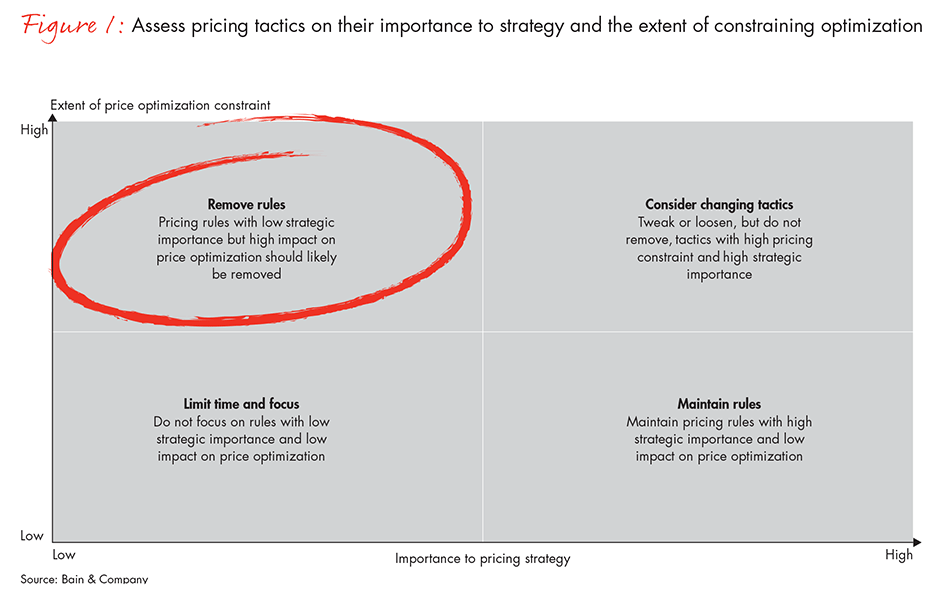
- Depart from current pricing tactics where appropriate. Much of the software’s value lies in optimizing price points based on consumer elasticity. Existing tactics used mainly to make manual pricing easier thus should not be incorporated into the tool as they will needlessly constrain prices from reaching optimization, leaving profits on the table. For example, if a grocer previously set certain products at the same price point in order to limit the extent of manual pricing (with no consumer or strategic benefit), that rule no longer makes sense with software. Each item can be set at its unique optimal point to yield the greatest benefit.
- Vet your own data inputs. The quality of the software’s output depends on data input. Historical price change data should be both complete and accurate, with all items’ costs accurately reflected in the software and, if relevant, complete competitor price-check information. A tool will recommend widely different prices for a product if its cost information is faulty or it lacks sufficient historical data to use in the elasticity calculation. Each of these shortcomings will reduce the benefit of using the tool to price those items. It may take longer than anticipated to collect and check the required data, so it pays to start this process well ahead of every launch.
- Set clear standards and guardrails. Software often entails new processes that don’t exist with manual pricing, such as accepting or rejecting price recommendations; on the other hand, some existing processes can be eliminated. Training in the revised processes will help the pricing organization make the transition. Also, leaders should lay down guardrails for pricing analysts about which decisions the analysts can make on their own vs. which require leadership approval—say, a price change of more than 10%. Clear processes, standards and guardrails will give analysts the right level of flexibility and accountability.
- Bring other stakeholders on board. Resistance to changing the way pricing works is natural, and skeptics of the software may try to continue pricing certain products manually, which will undermine the tool’s potential benefits. The core team must communicate both the rationale and the implications of the project with anyone who interacts with the pricing organization and, subsequently, solicit their feedback.
- Restrain the urge to customize. Minor customizing of software may be warranted to fit price points into the pricing strategy. Beyond that, though, most customization prevents prices from reaching optimal levels, and increases cost and complexity. It is best to limit customization to essential strategic reasons, and to make sure that everyone involved thoroughly understands and accepts the trade-offs.
- Choose products carefully. Software does not produce reliable elasticity for some products. Items with low turnover, for instance, don’t have enough historical price change data for software to accurately estimate elasticity. Items with volatile costs, such as commodities, may also be difficult to place in the software environment, due to the frequency with which cost input data must be refreshed and price changes made. Higher margins result from pricing as many revenue dollars as possible through the tool, so it’s essential to build a strong case for continuing to manually price certain products.
Accelerating after the launch
Launching the software is just the start. Only by using the tool correctly will a company accrue additional margin and other benefits. Several principles can inform continuous improvements to the pricing endeavor.
- Keep your eye on the strategy ball. The need to regularly evaluate one’s pricing strategy does not disappear by setting the software on autopilot. Companies should have realistic expectations of a tool’s functionality and benefits. Managers will have to maintain many other pricing elements outside the tool. Apart from the software, price perception tactics, such as product placement in a store, signage and advertising, still play an important role. Loyalty programs may or may not affect price points, yet they still serve to increase profitable sales. And with the software eliminating much of the manual pricing activities, the pricing organization will be able to dedicate more time to such strategic elements.
- Raise the bar on analytics. With many of the manual tasks eliminated, pricing analysts can take on more strategic activities, such as evaluating whether a new price point should be implemented, or catching data errors. In order to excel at these activities, the analysts will need technical or business training to give them a deep understanding of why the tool makes particular recommendations. A company may also need to hire new analysts who are more skilled in strategy than execution.
- Where it does not affect pricing strategy, set elasticity free. As a rule, companies should use consumer elasticity and behavior data to optimize prices wherever possible—as long as it does not conflict with the goal of enacting or protecting pricing strategy. Constraints on optimization can be built into the tool, though they should be regularly evaluated and, for those not clearly aligned with strategy, considered for removal (see Figure 1).
- Keep an expert on site to coach the pricing team. Few analysts will know how all of the software configurations and settings operate. Companies may consider employing a pricing tool expert to ensure that they use the tool in smart ways, don’t restrict prices unnecessarily and feed data inputs into the tool correctly. The expert can also work with analysts to try new configurations and tool functionalities that will yield additional benefits.
- Use value measurement reporting to inform course adjustments. Tracking key metrics such as units, sales and gross margin (both rate and dollars) allows the pricing organization to see whether the tool’s recommendations will actually lead to the forecast benefits. If particular categories fall short, analysts can alter the configurations accordingly. Value measurement can assess whether the program is on track to reach the company’s goals, and it can also influence future price changes and configuration settings.
- Test and learn. The pricing organization team and the other departments with whom they interact must be willing to try new price points in order to gather additional data and refine consumer elasticity estimations. New strategies also can be tested through the software to see the forecast effect of changing particular configurations. As analysts gain more understanding of and comfort with the tool, they will be able to determine which price recommendations to implement, which configurations to alter and so forth to reach the optimal pricing mix.
When used effectively, pricing software can unlock significant value for companies in business-to-consumer markets. Conversely, choosing a tool that is not well suited to the company or forging ahead to use it without careful preparation and monitoring can cause considerable harm. It will have a direct effect on shelf prices, consumer choices and perceptions, which will flow through to a greater market share and profitability. By giving software the right role and weight in the pricing strategy context, a company can realize multiple benefits—including improved processes, greater accuracy and higher gross margin dollars—while remaining true to its brand.
The three standard benefits of pricing tools
Most companies can expect to garner three types of benefits from successfully implementing pricing software.
- Price accuracy. Pricing software can significantly reduce the need for manually entering prices, which lowers the risk of printing incorrect tags for items on the shelf. The tool also makes it easier to adhere to the chosen pricing strategies and tactics because they’re entered into the software as assumptions. For example, if one element of the strategy calls for all private-label items to have at least a 10% shielding from their national brand equivalents, the software ensures this rule applies systematically, and it can flag where the rule is being broken.
- Process efficiency. Software can more quickly and efficiently change prices by eliminating manual steps and simultaneously using multiple spreadsheets. Saving time on manual tasks frees up pricing analysts to concentrate on strategic analysis and questions for experimentation. The software also allows for easy estimation of the effect of various strategies in a simulated testing environment.
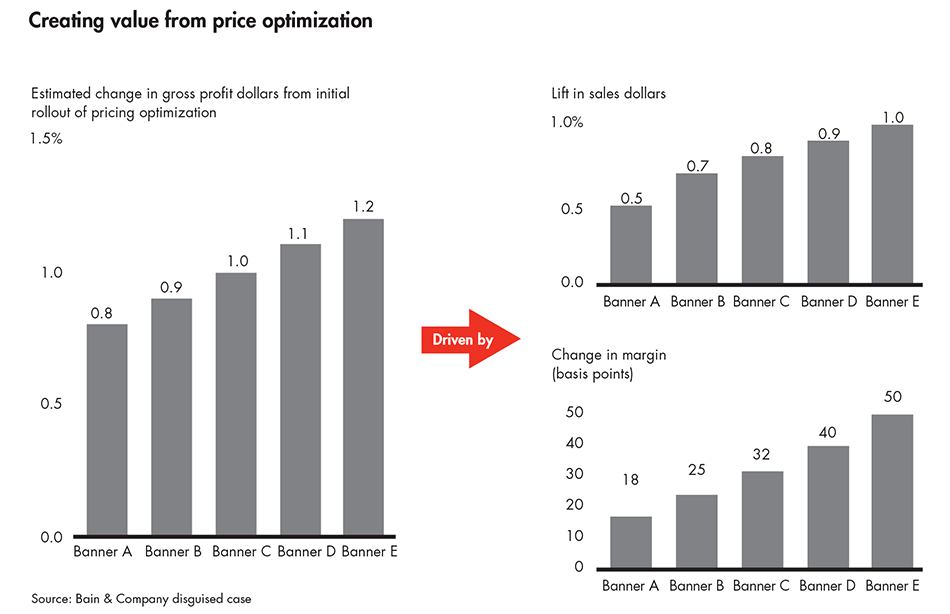
- Price optimization. Software tools calculate consumer elasticities for individual products using previous price and volume data, which in turn serves as an input on setting future price points. Because it’s difficult to properly use consumer behavior data to set price points without software-aided analytics, the majority of measurable gross margin benefit derives from this functionality. Typically, the software accumulates data over time and alters elasticities and price points based on the new information. This continually improves the price position and adds gross margin (see Figure).
Sandeep Heda, Stephen Mewborn and Stephen Caine are partners in Bain & Company’s Customer Strategy & Marketing practice. Heda is based in the Atlanta office, and Mewborn and Caine are based in Chicago.
First published in 4월 2016