

Brief

Many manufacturing firms leave enormous value on the table because of their approach to sales and operations planning (S&OP). They tend to use rough rules of thumb rather than rigorous mathematics, and they lack close coordination among different departments.
Consider how this dynamic played out at two firms. A global specialty pharmaceutical company struggled with high variability for products with long lead times. Each plant tried to optimize its total output, not necessarily what was needed by the commercial teams. The commercial business leaders, though, routinely faced supply shortfalls, causing them to lose faith in the reliability of the plants. They would send false demand signals in order to secure enough product. With so many decisions being made independently, no one in the company had a complete view of the situation, and no one realized that service levels actually reached only 85% product availability when the customer ordered it, not the 95% that was widely assumed.
A different type of demand–supply mismatch plagued a computer hardware maker. It relied on ocean shipping for units made in China because that was $15–$20 per unit cheaper than air freight. But while the units sailed across the ocean, the commercial team frequently changed their forecast for the mix of units that would sell over the next few weeks. The company routinely had to scramble at the last minute to ship via air (at great expense) in order to match the right supply to changes in demand forecasts.
Thomas Kwasniok, a partner in Bain's Performance Improvement practice, outlines four steps to create a high-performance sales and operations planning (S&OP) that will be the central nervous system of your operations.
Do these problems sound familiar? Some manufacturing firms experience a flurry of stock-outs or surging inventory with no clear explanation. Others see a large variability in production from one factory to another. Even service firms, such as IT consultancies, often struggle to get the right people to the right client at the right time. In these situations, the heads of the supply chain and a business unit each wonder what the other is thinking—or worse, blame each other for the problem.
Companies that are not realizing value from the S&OP process should look for the following indicators of dysfunction.
- Functions or business units make decisions in isolation: When each function is working under different operating assumptions or competing incentives, each acts without understanding the implications for other functions.
- People lack clear governance or decision rights over planning processes.
- Multiple versions of the truth abound: Different departments within a manufacturing firm, for instance, often have different data on how many units shipped last quarter.
- Planning algorithms often have a high degree of false precision, and planners want to frequently adjust the plan to account for each change. The result is significant downstream noise and activity rather than a more accurate plan.
- Teams attack the symptoms of demand–supply mismatches rather than figuring out the source of controllable variability, thus putting them in a perpetual reactive mode.
Building the pillars of success
Fixing these problems and optimizing the supply chain require a more tightly integrated approach to S&OP. Successful S&OP hinges on close synchronization among the relevant functions and departments, combined with analytical rigor that goes well beyond standard root cause analysis. An effective process builds in the following characteristics (see Figure 1).
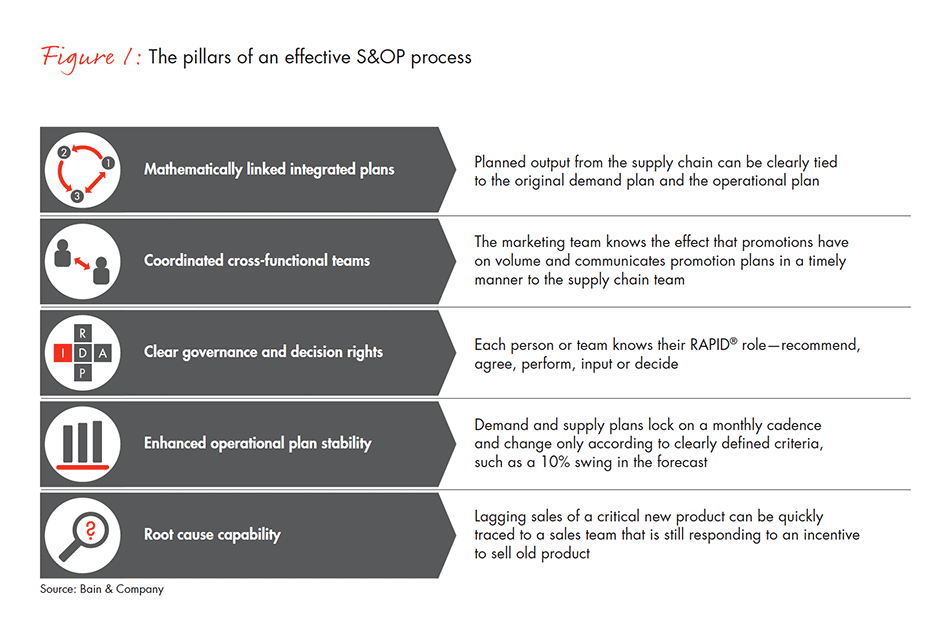
- Mathematically linked integrated plans: The planned output from the supply chain can be clearly tied to both the original demand plan and the operational plan.
- Coordinated cross-functional teams: Teams have aligned on specific operating assumptions, incentives and targets. The marketing team, for instance, knows the volume effect of promotions and communicates its promotion plans in a timely manner to the supply chain team.
- Clear governance and decision rights: The company has clarified responsibilities for each major decision, using a method such as RAPID®. This assigns owners to the five key roles in any decision—namely, who should recommend a course of action on a key decision, who must agree to a recommendation before it can move forward, who will perform the actions needed to implement the decision, whose input is needed to determine the proposal’s feasibility and who decides.
- Enhanced operational plan stability: Demand and supply plans lock on a monthly cadence and change only according to clearly defined criteria, such as a 10% swing in the forecast.
- Root cause capability: Lagging sales of a critical new product, for instance, can be quickly attributed to the salesforce having incentives to sell the old product.
Running merely good S&OP may no longer be acceptable, because customers have higher expectations for product availability and fast delivery. The spread of new digital channels, on top of existing physical channels, has made it more complicated to know where inventory sits and what it will cost to deliver to customers. Also, the supply chain has grown more complex as suppliers operate a more far-flung network of suppliers, third-party logistics providers and inventory partners. Coordinating all that activity can be a stiff challenge.
Yet we have seen companies raise their performance by putting S&OP at the center of the entire planning process—from weekly to annual planning sessions and from the overall budget to daily behaviors on the front line. These companies have seen improvements on the order of 20% to 50% more accurate forecasts, a 10% to 30% reduction in inventory, a 5% to 15% reduction in manufacturing downtime and a 5% to 10% increase in on-time delivery.
Best practices for running the machine
High-performance planning aligns strategic and operational goals through five practices (see Figure 2).
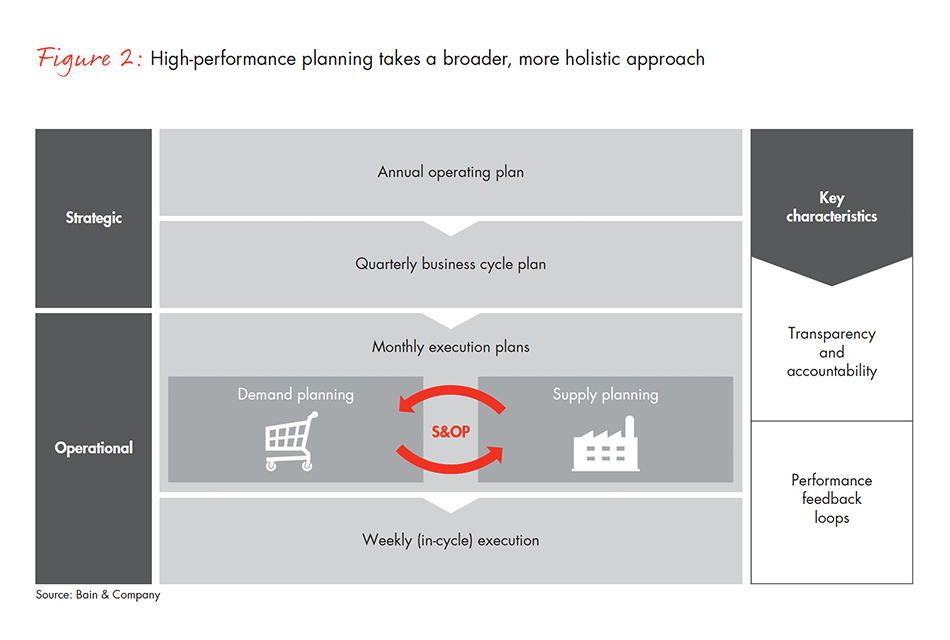
- Linking annual operational plans to broader supply chain strategy and specific operating parameters.
- Aligning and integrating demand and supply plans on a monthly basis.
- Instilling discipline and structure to make effective, rapid in-cycle changes.
- Elevating and celebrating that data rules.
- Using closed-feedback loops to make continuous improvements and eliminate controllable variability.
Below, we look at each of these practices in turn.
Linking operational plans to a broader supply chain strategy
Companies often jump from their budget right to monthly execution. But moving immediately to the monthly cycle almost guarantees poor decisions as people rush to translate the plan to specific operating parameters. Instead, it is worth first looking out 6 to 12 months with a tactical plan that lays out the specific operating assumptions, priorities and trade-offs regarding topics such as inventory, product roadmap and promotions. This plan unites all the functions or departments around a common language, and it discourages gaming the system. For example, if the priorities include ensuring that the supply of products goes to Tier 1 and Tier 2 countries first, with Tier 3 countries optional, no one can wink and try to divert supply to Tier 3 countries anymore.
Issues to discuss in this plan would include what service levels should apply to different customer segments, what the appropriate inventory strategy should be, where to hold inventory and what stock-out rate to target. Gathering all the functions and departments together allows the planning team to have an enterprise-wide view that takes into account the interdependencies among, say, inventory levels, service levels and forecast accuracy. Those interdependencies can be mathematically linked so that everyone works with a common set of assumptions and trade-offs.
Over time, incentives for one function (optimizing yield for the manufacturing group) that conflict with incentives for another function (low inventory for the supply chain group) will become evident. A strong S&OP process lays bare competing incentives and forces discussion of how to reconcile them. One large retailer in Africa, for instance, focused on a metric of supply chain cost per box. It would hold trailers at the distribution facility until they were full in order to optimize logistics costs. However, that led to long delays and stock-outs in stores because the retailer did not take an end-to-end view of costs and trade-offs.
Aligning and integrating demand and supply plans on a monthly basis
High-performing companies translate the macro plan to detailed operating plans through a monthly forum. Sales, marketing, finance, manufacturing, logistics and inventory teams all participate in building bottom-up demand plans by geography and product. These plans get mathematically linked to supply plans so that if demand slows, the supply chain group quickly understands the implications for inventory and can make adjustments. Marketing, in turn, might help by rolling out a short-term promotion.
Negotiating the adjustments can be difficult as each function’s planners may be skeptical of other functions’ accuracy and could try to hedge to their own advantage. That second-guessing undermines the plan, so it is critical to publicly air disagreements. A senior executive team needs to understand all the upstream and downstream implications so that it can make the final decision.
Robust monthly meetings allow a large beer company in Thailand to review the demand–supply plan, investigate and agree on the root causes of any deviations from the plan, and lock in the new plan within three days after the executive review. In the event of a last-minute disagreement, senior executives huddle to resolve the issue.
Instilling discipline and structure to make effective, rapid in-cycle changes
An effective weekly S&OP process focuses disproportionately on gaps between the plan and the company’s actual performance. It addresses urgent problems that result from unanticipated events, such as a factory suddenly going offline, and makes adjustments to address demand–supply imbalances.
Such adjustments depend on people being willing to revisit assumptions behind prior decisions. This does not mean constant debate about whether a certain metric is correct or about who has responsibility for an activity. In fact, the organization should agree on one view regarding the metrics and planning process in order to focus on action rather than debate the numbers.
An effective run-the-business team typically consists of operators, planners and commercial staff. They all work from a common set of data and are positioned to spot the actions needed—such as using short-term sales incentives for a product launch or moving excess inventory from a particular country—and they have the authority to execute the changes. They also act as the control point to ensure that each function executes on what it said it would do. If manufacturing said it would build in 10 days of inventory for a product launch, did that actually happen? If not, the accuracy of the plan will diminish.
Elevating and celebrating that data rules
Many planners run off tribal knowledge, often because they have a limited mathematical understanding of the financial and operational trade-offs. That is a mistake. A more rigorous business management review, run by an analytically savvy team that can package the analysis in the right format for senior executives, allows companies to respond to emerging trends with effective, root cause solutions.
At one pet food company, inventory had doubled within a year. Initially, the company hypothesized that the increase stemmed from extra testing put in place after an incident of salmonella poisoning. While the extra testing did contribute, rigorous analysis traced the source to a planning mandate to never run out of product, which led inventory planners to keep raising their inventory targets until there were no stock-outs. The lesson: Embrace the data that reflects the reality, and put data-driven reports at the center of the process.
Using closed-feedback loops to make continuous improvements and eliminate controllable variability
A company’s S&OP can only improve if people are able to learn from it. Feedback loops allow each function or department to sense and explain how changes to the plan are affecting their operation. Based on the feedback, the coordinated planning team can better control variability across the entire system.
This involves teasing out harmful variability from acceptable variability, then making appropriate changes to stop the bad variability. One event services company noticed that its manufacturing throughput kept declining, and fingers pointed to the supply chain group. A closer analysis, though, revealed that rush orders to the plants had steadily increased, disrupting the normal production schedules, with no repercussions to the sales teams. In response, the company bifurcated the production lines and changed incentives for the sales teams to work with a separate job shop process for their rush orders.
Building and sustaining a high-performance planning process is not easy for some organizations. It requires much closer collaboration among functions, greater analytical capabilities and the willingness to force explicit choices.
Organizations that persist with these changes, though, find that high-performance S&OP serves as the central nervous system of their execution. No significant event happens in one corner of the organization without other corners learning about it, discussing it and fine-tuning it accordingly. That creates a huge advantage in fast-moving, dynamic markets.
Joshua Hinkel, Oliver Merkel and Thomas Kwasniok are partners with Bain & Company’s Performance Improvement practice. They are based, respectively, in Dallas, Johannesburg and London.
First published in 4월 2016