
Skip to Content
  • 오피스

    오피스

    미주
    • Atlanta
    • Austin
    • Bogota
    • Boston
    • Buenos Aires
    • Chicago
    • Dallas
    • Denver
    • Houston
    • Los Angeles
    • Mexico City
    • Minneapolis
    • Monterrey
    • Montreal
    • New York
    • Rio de Janeiro
    • San Francisco
    • Santiago
    • São Paulo
    • Seattle
    • Silicon Valley
    • Toronto
    • Washington, DC
    유럽, 중동, 아프리카
    • Amsterdam
    • Athens
    • Berlin
    • Brussels
    • Copenhagen
    • Doha
    • Dubai
    • Dusseldorf
    • Frankfurt
    • Helsinki
    • Istanbul
    • Johannesburg
    • Kyiv
    • Lisbon
    • London
    • Madrid
    • Milan
    • Munich
    • Oslo
    • Paris
    • Riyadh
    • Rome
    • Stockholm
    • Vienna
    • Warsaw
    • Zurich
    아시아, 호주
    • Bangkok
    • Beijing
    • Bengaluru
    • Brisbane
    • Ho Chi Minh City
    • Hong Kong
    • Jakarta
    • Kuala Lumpur
    • Manila
    • Melbourne
    • Mumbai
    • New Delhi
    • Perth
    • Seoul
    • Shanghai
    • Singapore
    • Sydney
    • Tokyo
    오피스 전체보기
  • 얼럼나이
  • 미디어 센터
  • 구독
  • 연락처
  • Korea | 한국어

    지역 및 언어 선택

    글로벌
    • Global (English)
    미주
    • Brazil (Português)
    • Argentina (Español)
    • Canada (Français)
    • Chile (Español)
    • Colombia (Español)
    유럽, 중동, 아프리카
    • France (Français)
    • DACH Region (Deutsch)
    • Italy (Italiano)
    • Spain (Español)
    • Greece (Elliniká)
    아시아, 호주
    • China (中文版)
    • Korea (한국어)
    • Japan (日本語)
  • Saved items (0)
    Saved items (0)

    You have no saved items.

    관심 있는 내용을 북마크하여 Red 폴더에 저장할 수 있습니다. Red 폴더 에서 저장된 내용을 읽거나 공유해보세요.

    Explore Bain Insights
  • 산업
    메인 메뉴

    산업

    • 우주항공, 방산 및 정부 서비스
    • 농업 관련 산업
    • 화학
    • 인프라, 건설 및 건축 자재
    • 소비재
    • 금융 서비스
    • 헬스케어
    • 산업용 기계 및 장비
    • 미디어 및 엔터테인먼트
    • 금속
    • 광업
    • 석유 및 가스
    • 제지 및 패키징 산업
    • 사모펀드
    • 사회 및 공공 부문
    • 유통
    • 기술
    • 텔레콤
    • 운송
    • 여행·여가
    • 유틸리티 및 재생가능 에너지
  • 컨설팅 서비스
    메인 메뉴

    컨설팅 서비스

    • Customer Experience
    • ESG
    • Innovation
    • M&A
    • 운영
    • 조직
    • 사모펀드
    • 고객 전략 및 마케팅
    • 전략
    • AI, 인사이트 및 솔루션
    • Technology
    • 변화 혁신
  • Digital
  • 인사이트
  • 베인 소개
    메인 메뉴

    베인 소개

    • 업무 소개
    • 베인의 신념
    • 구성원 및 리더십 소개
    • 고객 성과
    • 주요 수상 경력
    • 글로벌 파트너사
    Further: Our global responsibility
    • 다양성과 포용
    • 사회 공헌 활동
    • Sustainability
    • World Economic Forum
    Learn more about Further
  • Careers
    메인 메뉴

    Careers

    • Work with Us
      Careers
      Work with Us
      • Find Your Place
      • Our Work Areas
      • Integrated Teams
      • Students
      • Internships & Programs
      • Recruiting Events
    • Life at Bain
      Careers
      Life at Bain
      • Blog: Inside Bain
      • Career Stories
      • Our People
      • Where We Work
      • Supporting Your Growth
      • Affinity Groups
      • Benefits
    • Impact Stories
    • Hiring Process
      Careers
      Hiring Process
      • What to Expect
      • Interviewing
    FIND JOBS
  • 오피스
    메인 메뉴

    오피스

    • 미주
      오피스
      미주
      • Atlanta
      • Austin
      • Bogota
      • Boston
      • Buenos Aires
      • Chicago
      • Dallas
      • Denver
      • Houston
      • Los Angeles
      • Mexico City
      • Minneapolis
      • Monterrey
      • Montreal
      • New York
      • Rio de Janeiro
      • San Francisco
      • Santiago
      • São Paulo
      • Seattle
      • Silicon Valley
      • Toronto
      • Washington, DC
    • 유럽, 중동, 아프리카
      오피스
      유럽, 중동, 아프리카
      • Amsterdam
      • Athens
      • Berlin
      • Brussels
      • Copenhagen
      • Doha
      • Dubai
      • Dusseldorf
      • Frankfurt
      • Helsinki
      • Istanbul
      • Johannesburg
      • Kyiv
      • Lisbon
      • London
      • Madrid
      • Milan
      • Munich
      • Oslo
      • Paris
      • Riyadh
      • Rome
      • Stockholm
      • Vienna
      • Warsaw
      • Zurich
    • 아시아, 호주
      오피스
      아시아, 호주
      • Bangkok
      • Beijing
      • Bengaluru
      • Brisbane
      • Ho Chi Minh City
      • Hong Kong
      • Jakarta
      • Kuala Lumpur
      • Manila
      • Melbourne
      • Mumbai
      • New Delhi
      • Perth
      • Seoul
      • Shanghai
      • Singapore
      • Sydney
      • Tokyo
    오피스 전체보기
  • 얼럼나이
  • 미디어 센터
  • 구독
  • 연락처
  • Korea | 한국어
    메인 메뉴

    지역 및 언어 선택

    • 글로벌
      지역 및 언어 선택
      글로벌
      • Global (English)
    • 미주
      지역 및 언어 선택
      미주
      • Brazil (Português)
      • Argentina (Español)
      • Canada (Français)
      • Chile (Español)
      • Colombia (Español)
    • 유럽, 중동, 아프리카
      지역 및 언어 선택
      유럽, 중동, 아프리카
      • France (Français)
      • DACH Region (Deutsch)
      • Italy (Italiano)
      • Spain (Español)
      • Greece (Elliniká)
    • 아시아, 호주
      지역 및 언어 선택
      아시아, 호주
      • China (中文版)
      • Korea (한국어)
      • Japan (日本語)
  • Saved items  (0)
    메인 메뉴
    Saved items (0)

    You have no saved items.

    관심 있는 내용을 북마크하여 Red 폴더에 저장할 수 있습니다. Red 폴더 에서 저장된 내용을 읽거나 공유해보세요.

    Explore Bain Insights
  • 산업
    • 산업

      • 우주항공, 방산 및 정부 서비스
      • 농업 관련 산업
      • 화학
      • 인프라, 건설 및 건축 자재
      • 소비재
      • 금융 서비스
      • 헬스케어
      • 산업용 기계 및 장비
      • 미디어 및 엔터테인먼트
      • 금속
      • 광업
      • 석유 및 가스
      • 제지 및 패키징 산업
      • 사모펀드
      • 사회 및 공공 부문
      • 유통
      • 기술
      • 텔레콤
      • 운송
      • 여행·여가
      • 유틸리티 및 재생가능 에너지
  • 컨설팅 서비스
    • 컨설팅 서비스

      • Customer Experience
      • ESG
      • Innovation
      • M&A
      • 운영
      • 조직
      • 사모펀드
      • 고객 전략 및 마케팅
      • 전략
      • AI, 인사이트 및 솔루션
      • Technology
      • 변화 혁신
  • Digital
  • 인사이트
  • 베인 소개
    • 베인 소개

      • 업무 소개
      • 베인의 신념
      • 구성원 및 리더십 소개
      • 고객 성과
      • 주요 수상 경력
      • 글로벌 파트너사
      Further: Our global responsibility
      • 다양성과 포용
      • 사회 공헌 활동
      • Sustainability
      • World Economic Forum
      Learn more about Further
  • Careers
    최근 검색어
      최근 방문 페이지

      Content added to saved items

      Saved items (0)

      Removed from saved items

      Saved items (0)

      Technology Report

      How AI Is Recoding the Software Business Model

      How AI Is Recoding the Software Business Model

      New features could accelerate growth, but changes in customer processes and job roles could disrupt established use cases and pricing models.

      글 Simon Heap, Christopher Schorling, and Ted Shelton

      • 읽기 소요시간
      }

      Report

      How AI Is Recoding the Software Business Model
      en
      한눈에 보기
      • Easy access to large language models has unleashed a torrent of experimentation in the software industry: Nearly 9 out of 10 developers are already using artificial intelligence (AI) in their products.
      • Software vendors expect a step change in functionality, and those that move too slowly could lose competitive advantage.
      • The rise of AI also poses some risks for software companies—for instance, AI tools could make it easier for customers to develop their own software instead of buying it.
      • If AI reduces the number of roles in some job categories, software vendors that price on a per-seat basis may need to adjust their business models.

      This article is part of Bain's 2023 Technology Report.

      Explore the report

      Over the past six months, nearly every software company has announced plans to apply generative artificial intelligence (AI) within their business. The ease of access to large language model (LLM) application programming interfaces (APIs) has made it relatively easy to demonstrate new AI-powered products. Bain’s recent survey found that 89% of software companies are building AI into their products to differentiate them—15 percentage points higher than other sectors.

      Innovation is happening quickly, and we’re still in early days. Three out of four software companies surveyed believe that early movers will have a sustained advantage that will not level off. Software leaders expect the technology to generate significant opportunities to increase top-line growth and customer retention (see Figure 1). All that can be certain is those that fail to start the journey will be left behind.

      Figure 1
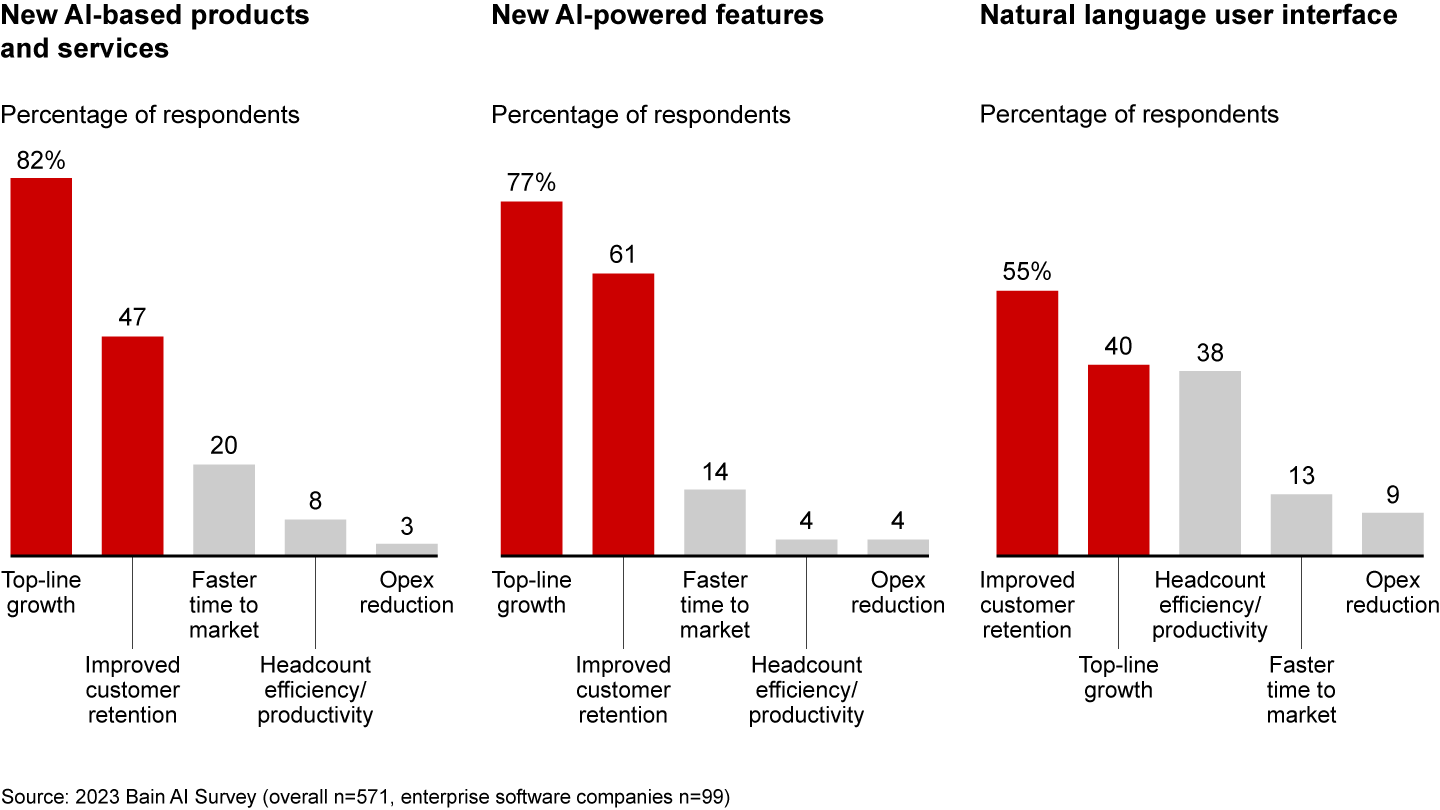
      Software companies see benefits from new artificial intelligence products, features, and interfaces
      Software companies see benefits from new artificial intelligence products, features, and interfaces
      Software companies see benefits from new artificial intelligence products, features, and interfaces

      Opportunities and risks

      Software companies also need to address how the adoption of generative AI by their customers and competitors can threaten their core business. Some software categories may face an existential threat as AI fundamentally changes the capabilities and economics of what can be done in areas such as low- or no-code application development and customer experience management. Most application categories will experience a step change in functionality and user experience, so vendors should prioritize their AI roadmaps to deliver their own capabilities where they will count the most.

      As customers introduce AI into their own processes, job roles will change. This could lead to a dramatic fall in the number of end users, which would hurt segments that rely on seat-based pricing, such as service desks, engineering development, marketing and project management, and others (see Figure 2). Seat-license software companies can respond by ensuring that the product still adds value as customers reengineer their processes; they can also adopt an alternative, consumption-based pricing model (for more, read the Bain Brief “Is Consumption-Based Pricing Right for Your Software?”).

      Figure 2
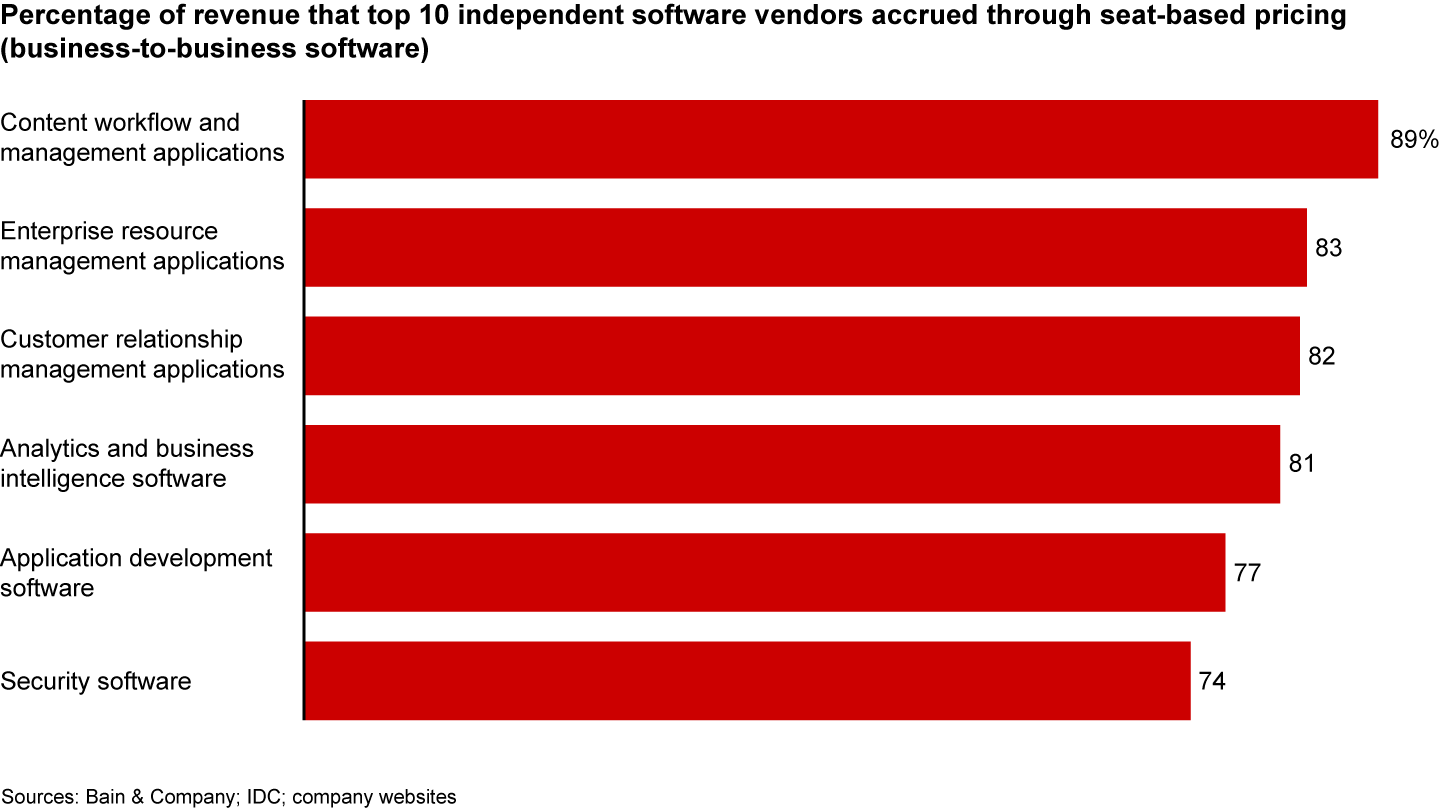
      Generative artificial intelligence will have a greater effect on software categories that rely on seat-based pricing models
      Generative artificial intelligence will have a greater effect on software categories that rely on seat-based pricing models
      Generative artificial intelligence will have a greater effect on software categories that rely on seat-based pricing models

      Developing an understanding of how customers are adopting AI and reengineering their processes can help identify other risks and opportunities. Nearly 40% of the companies we surveyed said that they are either evaluating or adopting foundation models or generative AI into their work. Most activity is in software development, knowledge work, and content creation aimed at helping companies synthesize data, create content, or assist in reasoning and planning. Rather than simply automating discrete roles (for example, an AI-powered chatbot), we’re seeing a complete reimagining of workflows and job roles. For example, AI could help a product manager create marketing content, thereby reducing the need for some downstream roles in product marketing and content authoring.

      In the past, vertical software vendors focused on particular industries and relied on process expertise to maintain a competitive advantage. That edge could become harder to maintain as horizontal software vendors are able to use LLMs to interpret industry knowledge and develop industry features at low cost, using their scale and scope to beat niche players.

      AI and product strategy

      As software companies think about how AI will change their business, they should consider several important questions.

      • How will generative AI change the customers’ businesses, and what does that mean for the software product and business model? Automating process steps is simple, but how will customers radically reimagine their workflows?
      • Will our AI-powered solutions be differentiated by a proprietary LLM? Or will we differentiate through the integration with other systems and data?
      • How will improvements in R&D productivity affect the speed of innovation?
      • Will LLMs and generative AI enable a new level of customization for users, reversing the trend toward standardization? Will users still interact with our application, or will it be intermediated by a new chat-based user interface?

      These choices will help identify where differentiation will matter most, how to construct the user interface, and how to package and price products. LLM investment barriers to entry are dropping rapidly, and the open-source community continues to innovate in kind. Options to partner or build are expanding, and some customers might have preferences for or against models hosted by particular cloud service providers.

      Some use cases are better served with narrower models rather than general foundation models such as GPT4. For example, Intuit is rolling out a generative AI operating system on which its next generation of applications will be built. The OS would be based on a narrow LLM targeting tax, accounting, cash, and personal finance tasks.

      Although companies such as Salesforce and ServiceNow use LLMs from third-party vendors, they are also building their own LLMs. As expected, propensity to build and train an LLM increases with company size (see Figure 3).

      Figure 3
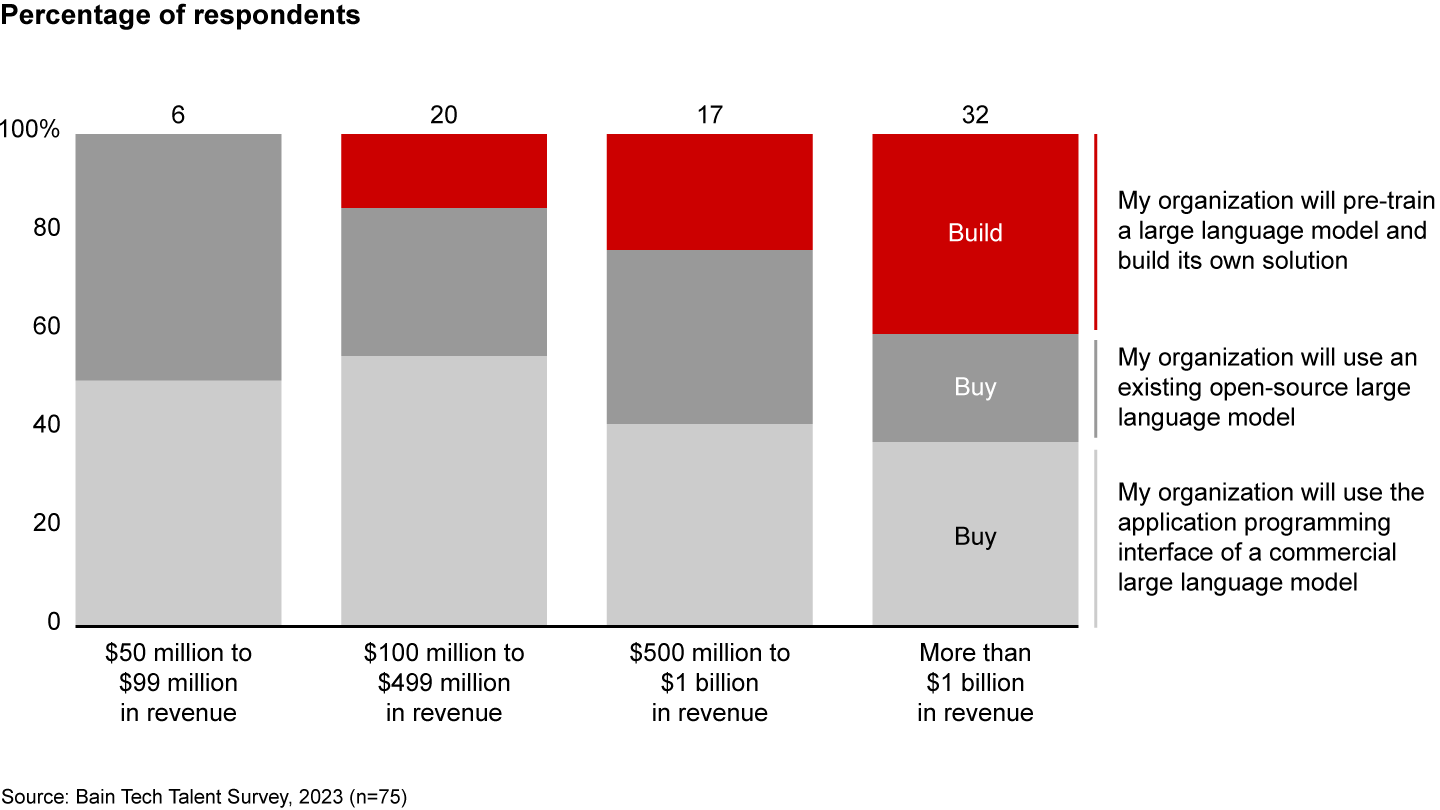
      Larger companies are more likely than smaller ones to build their own large language models, but even they are more likely to buy
      Larger companies are more likely than smaller ones to build their own large language models, but even they are more likely to buy
      Larger companies are more likely than smaller ones to build their own large language models, but even they are more likely to buy

      Many customer concerns around data protection and access, personally identifiable information, audit trails, prompt grounding with proprietary data, and integration with other machine learning and automation technologies are served in platform layers, beyond the LLM. It’s here that many software companies can differentiate themselves, leveraging established positions in customer architectures. For example, Salesforce is investing in its LLM Gateway architecture while accessing GPT4 and other LLMs through APIs, where they also have MuleSoft API management capabilities.

      Generative AI will transform the way users interact with software. They no longer will have to interact through traditional user interfaces, and they can now do so with natural language via a chatbot. Software makers’ decisions about whether this is a simpler user interface for existing applications, a new user portal for all process interactions, or an established general purpose text interface (such as Slack or Teams) can shift to where the control point sits.

      Software makers also have to decide how to package and price new AI functionality. Whether it’s a separate product, an add-on, or just embedded as an enhancement of the existing product, independent software vendors could monetize it with a price increase, or they might choose to treat this as continued innovation that pays for itself by retaining customers. But beware the gross margin impact of running computing-intensive features.

      Generative AI is already having a huge impact on the software industry, offering both opportunities and threats to the established order. Software vendors must embrace the opportunities and not shy away from reinventing themselves to remain relevant and capitalize on this new technological development. Doing so requires understanding how customers will reengineer themselves around existing applications, and that will help software makers decide how to architect and differentiate new AI solutions.

      Read the Next Chapter

      Generative AI and Cybersecurity: Strengthening Both Defenses and Threats

      Read our 2023 Technology Report

      Download the PDF Explore the report
      저자
      • Headshot of Simon Heap
        Simon Heap
        어드바이저 파트너, Silicon Valley
      • Headshot of Christopher Schorling
        Christopher Schorling
        Alumni, Frankfurt
      • Headshot of Ted Shelton
        Ted Shelton
        Alumni, Silicon Valley
      문의하기
      관련 산업
      • 기술
      • Software
      관련 컨설팅 서비스
      • 어드밴스드 애널리틱스
      최적의 솔루션 찾기
      • Artificial Intelligence
      CIO Insights
      Will Agentic AI Disrupt SaaS?

      Disruption is mandatory. Obsolescence is optional.

      자세히 보기
      CIO Insights
      Quantum Computing Moves from Theoretical to Inevitable

      Quantum will likely become part of a mosaic, working with classical computing to solve big problems.

      자세히 보기
      기술
      Software M&A

      The good news: Most deal best practices still apply to AI acquisitions.

      자세히 보기
      CIO Insights
      What Business Leaders Need to Know About AI Sovereignty

      Aligning business strategy with national AI priorities is necessary to compete and scale.

      자세히 보기
      어드밴스드 애널리틱스
      How AI Is Starting to Transform Circular Packaging

      There are 15 AI use cases companies across the value chain can use today to accelerate circularity.

      자세히 보기

      Value Evolution

      • Creating Value in Tech Throughout the Life Cycle

      • Preparing for Exit: A Buyer’s Market Is Coming for Tech Assets

      • AI Investors: Act Fast, Act Wisely

      • Technology Enters Its Post-Globalization Era

      Strategic Battlegrounds

      • You’re Out of Time to Wait and See on AI

      • How AI Is Recoding the Software Business Model

      • Generative AI and Cybersecurity: Strengthening Both Defenses and Threats

      • Taking the Hyperbole Out of the Metaverse

      • The Untapped Value at the Intelligent Edge

      • After the Chip Shortage, Fears of a Capacity Glut Are Overblown

      Operational Transformations

      • Digital Innovation: Getting the Architecture Foundations Right

      • The Talent Implications of Generative AI

      • How Enterprise Sales Can Supercharge Product-Led Growth

      • How Your Revenue Can Grow Faster Than Your Salesforce

      • Decarbonizing Technology Supply Chains

      First published in 9월 2023
      태그
      • 기술
      • 어드밴스드 애널리틱스
      • Artificial Intelligence
      • CIO Insights
      • Software
      • Technology Report

      프로젝트 사례

      Helping a Midsize ERP Player Compete against the Giants

      See more related case studies

      고객 전략 및 마케팅 Video: A Marketing Transformation Puts a Software Leader Back on Top

      See more related case studies

      성과 개선 Aggressively growing an IT service provider with a high-performance culture

      See more related case studies

      베인에 궁금하신 점이 있으신가요?

      베인은 주저 없이 변화를 마주할 줄 아는 용감한 리더들과 함께합니다. 그리고, 이들의 담대한 용기는 고객사의 성공으로 이어집니다.

      급변하는 비즈니스 환경에서 살아남기 위한 선도자의 시각. 월간 Bain Insights에서 글로벌 비즈니스의 핵심 이슈를 확인하십시오.

      *개인정보 정책을 읽었으며 그 내용에 동의합니다.

      Privacy Policy를 읽고 동의해주십시오.
      Bain & Company
      문의하기 환경정책 Accessibility 이용약관 개인정보 보호 쿠키 사용 정책 Sitemap Log In

      © 1996-2026 Bain & Company, Inc.

      문의하기

      무엇을 도와드릴까요?

      • 프로젝트 문의
      • 채용 정보
      • 언론
      • 제휴 문의
      • 연사 초청
      오피스 전체보기