
Skip to Content
  • 오피스

    오피스

    미주
    • Atlanta
    • Austin
    • Bogota
    • Boston
    • Buenos Aires
    • Chicago
    • Dallas
    • Denver
    • Houston
    • Los Angeles
    • Mexico City
    • Minneapolis
    • Monterrey
    • Montreal
    • New York
    • Rio de Janeiro
    • San Francisco
    • Santiago
    • São Paulo
    • Seattle
    • Silicon Valley
    • Toronto
    • Washington, DC
    유럽, 중동, 아프리카
    • Amsterdam
    • Athens
    • Berlin
    • Brussels
    • Copenhagen
    • Doha
    • Dubai
    • Dusseldorf
    • Frankfurt
    • Helsinki
    • Istanbul
    • Johannesburg
    • Kyiv
    • Lisbon
    • London
    • Madrid
    • Milan
    • Munich
    • Oslo
    • Paris
    • Riyadh
    • Rome
    • Stockholm
    • Vienna
    • Warsaw
    • Zurich
    아시아, 호주
    • Bangkok
    • Beijing
    • Bengaluru
    • Brisbane
    • Ho Chi Minh City
    • Hong Kong
    • Jakarta
    • Kuala Lumpur
    • Manila
    • Melbourne
    • Mumbai
    • New Delhi
    • Perth
    • Seoul
    • Shanghai
    • Singapore
    • Sydney
    • Tokyo
    오피스 전체보기
  • 얼럼나이
  • 미디어 센터
  • 구독
  • 연락처
  • Korea | 한국어

    지역 및 언어 선택

    글로벌
    • Global (English)
    미주
    • Brazil (Português)
    • Argentina (Español)
    • Canada (Français)
    • Chile (Español)
    • Colombia (Español)
    유럽, 중동, 아프리카
    • France (Français)
    • DACH Region (Deutsch)
    • Italy (Italiano)
    • Spain (Español)
    • Greece (Elliniká)
    아시아, 호주
    • China (中文版)
    • Korea (한국어)
    • Japan (日本語)
  • Saved items (0)
    Saved items (0)

    You have no saved items.

    관심 있는 내용을 북마크하여 Red 폴더에 저장할 수 있습니다. Red 폴더 에서 저장된 내용을 읽거나 공유해보세요.

    Explore Bain Insights
  • 산업
    메인 메뉴

    산업

    • 우주항공, 방산 및 정부 서비스
    • 농업 관련 산업
    • 화학
    • 인프라, 건설 및 건축 자재
    • 소비재
    • 금융 서비스
    • 헬스케어
    • 산업용 기계 및 장비
    • 미디어 및 엔터테인먼트
    • 금속
    • 광업
    • 석유 및 가스
    • 제지 및 패키징 산업
    • 사모펀드
    • 사회 및 공공 부문
    • 유통
    • 기술
    • 텔레콤
    • 운송
    • 여행·여가
    • 유틸리티 및 재생가능 에너지
  • 컨설팅 서비스
    메인 메뉴

    컨설팅 서비스

    • Customer Experience
    • ESG
    • Innovation
    • M&A
    • 운영
    • 조직
    • 사모펀드
    • 고객 전략 및 마케팅
    • 전략
    • AI, 인사이트 및 솔루션
    • Technology
    • 변화 혁신
  • Digital
  • 인사이트
  • 베인 소개
    메인 메뉴

    베인 소개

    • 업무 소개
    • 베인의 신념
    • 구성원 및 리더십 소개
    • 고객 성과
    • 주요 수상 경력
    • 글로벌 파트너사
    Further: Our global responsibility
    • 다양성과 포용
    • 사회 공헌 활동
    • Sustainability
    • World Economic Forum
    Learn more about Further
  • Careers
    메인 메뉴

    Careers

    • Work with Us
      Careers
      Work with Us
      • Find Your Place
      • Our Work Areas
      • Integrated Teams
      • Students
      • Internships & Programs
      • Recruiting Events
    • Life at Bain
      Careers
      Life at Bain
      • Blog: Inside Bain
      • Career Stories
      • Our People
      • Where We Work
      • Supporting Your Growth
      • Affinity Groups
      • Benefits
    • Impact Stories
    • Hiring Process
      Careers
      Hiring Process
      • What to Expect
      • Interviewing
    FIND JOBS
  • 오피스
    메인 메뉴

    오피스

    • 미주
      오피스
      미주
      • Atlanta
      • Austin
      • Bogota
      • Boston
      • Buenos Aires
      • Chicago
      • Dallas
      • Denver
      • Houston
      • Los Angeles
      • Mexico City
      • Minneapolis
      • Monterrey
      • Montreal
      • New York
      • Rio de Janeiro
      • San Francisco
      • Santiago
      • São Paulo
      • Seattle
      • Silicon Valley
      • Toronto
      • Washington, DC
    • 유럽, 중동, 아프리카
      오피스
      유럽, 중동, 아프리카
      • Amsterdam
      • Athens
      • Berlin
      • Brussels
      • Copenhagen
      • Doha
      • Dubai
      • Dusseldorf
      • Frankfurt
      • Helsinki
      • Istanbul
      • Johannesburg
      • Kyiv
      • Lisbon
      • London
      • Madrid
      • Milan
      • Munich
      • Oslo
      • Paris
      • Riyadh
      • Rome
      • Stockholm
      • Vienna
      • Warsaw
      • Zurich
    • 아시아, 호주
      오피스
      아시아, 호주
      • Bangkok
      • Beijing
      • Bengaluru
      • Brisbane
      • Ho Chi Minh City
      • Hong Kong
      • Jakarta
      • Kuala Lumpur
      • Manila
      • Melbourne
      • Mumbai
      • New Delhi
      • Perth
      • Seoul
      • Shanghai
      • Singapore
      • Sydney
      • Tokyo
    오피스 전체보기
  • 얼럼나이
  • 미디어 센터
  • 구독
  • 연락처
  • Korea | 한국어
    메인 메뉴

    지역 및 언어 선택

    • 글로벌
      지역 및 언어 선택
      글로벌
      • Global (English)
    • 미주
      지역 및 언어 선택
      미주
      • Brazil (Português)
      • Argentina (Español)
      • Canada (Français)
      • Chile (Español)
      • Colombia (Español)
    • 유럽, 중동, 아프리카
      지역 및 언어 선택
      유럽, 중동, 아프리카
      • France (Français)
      • DACH Region (Deutsch)
      • Italy (Italiano)
      • Spain (Español)
      • Greece (Elliniká)
    • 아시아, 호주
      지역 및 언어 선택
      아시아, 호주
      • China (中文版)
      • Korea (한국어)
      • Japan (日本語)
  • Saved items  (0)
    메인 메뉴
    Saved items (0)

    You have no saved items.

    관심 있는 내용을 북마크하여 Red 폴더에 저장할 수 있습니다. Red 폴더 에서 저장된 내용을 읽거나 공유해보세요.

    Explore Bain Insights
  • 산업
    • 산업

      • 우주항공, 방산 및 정부 서비스
      • 농업 관련 산업
      • 화학
      • 인프라, 건설 및 건축 자재
      • 소비재
      • 금융 서비스
      • 헬스케어
      • 산업용 기계 및 장비
      • 미디어 및 엔터테인먼트
      • 금속
      • 광업
      • 석유 및 가스
      • 제지 및 패키징 산업
      • 사모펀드
      • 사회 및 공공 부문
      • 유통
      • 기술
      • 텔레콤
      • 운송
      • 여행·여가
      • 유틸리티 및 재생가능 에너지
  • 컨설팅 서비스
    • 컨설팅 서비스

      • Customer Experience
      • ESG
      • Innovation
      • M&A
      • 운영
      • 조직
      • 사모펀드
      • 고객 전략 및 마케팅
      • 전략
      • AI, 인사이트 및 솔루션
      • Technology
      • 변화 혁신
  • Digital
  • 인사이트
  • 베인 소개
    • 베인 소개

      • 업무 소개
      • 베인의 신념
      • 구성원 및 리더십 소개
      • 고객 성과
      • 주요 수상 경력
      • 글로벌 파트너사
      Further: Our global responsibility
      • 다양성과 포용
      • 사회 공헌 활동
      • Sustainability
      • World Economic Forum
      Learn more about Further
  • Careers
    최근 검색어
      최근 방문 페이지

      Content added to saved items

      Saved items (0)

      Removed from saved items

      Saved items (0)

      Technology Report

      How to Compete and Win in the Multicloud World

      How to Compete and Win in the Multicloud World

      After a crash in valuations, multicloud infrastructure software vendors (ISVs) and “hyperscaler” cloud service providers battle for the cloud software market, each bringing unique strengths.

      글 Matthew Crupi, Mark Brinda, Morgan Maxwell, and Bill Radzevych

      • 읽기 소요시간
      }

      Report

      How to Compete and Win in the Multicloud World
      en
      한눈에 보기
      • The multicloud software market has grown tremendously in recent years, but not all companies can survive.
      • Three factors will determine an ISV’s likelihood to succeed in a given market: whether customers will pay for premium functionality, whether they want to avoid locking into walled gardens, and whether hyperscalers’ benefits of scale provide a unique advantage.

      This article is part of Bain's 2022 Technology Report.

      Explore the report

      After the valuations of multicloud infrastructure software vendors shot into the stratosphere over the past three years only to start crashing down to earth in late 2021, investors and enterprise customers are left wondering, who will survive and thrive?

      It’s one of the most consequential questions in technology right now, because it has significant bearing on who will win the cloud software market: multicloud infrastructure software vendors (ISVs), hyperscaler cloud service providers, or on-premise originators (see definitions of these three groups in “Cloud Software Competitors” below).

      Multicloud ISVs’ rapid growth in value indicated an expectation of transformative market penetration and massive revenue growth over the next few years. Indeed, revenue growth of top multicloud ISVs has exceeded that of both hyperscalers and on-premise originators, increasing by a median of 44% from 2019 to 2020 and 50% from 2020 to 2021 (see Figure 1). Their market valuations increased by a median of 157% from 2019 to 2020 and 25% from 2020 to 2021. Some ISVs enjoyed valuations 50 times higher than their annual revenue, more than triple the average software multiple.

      Figure 1
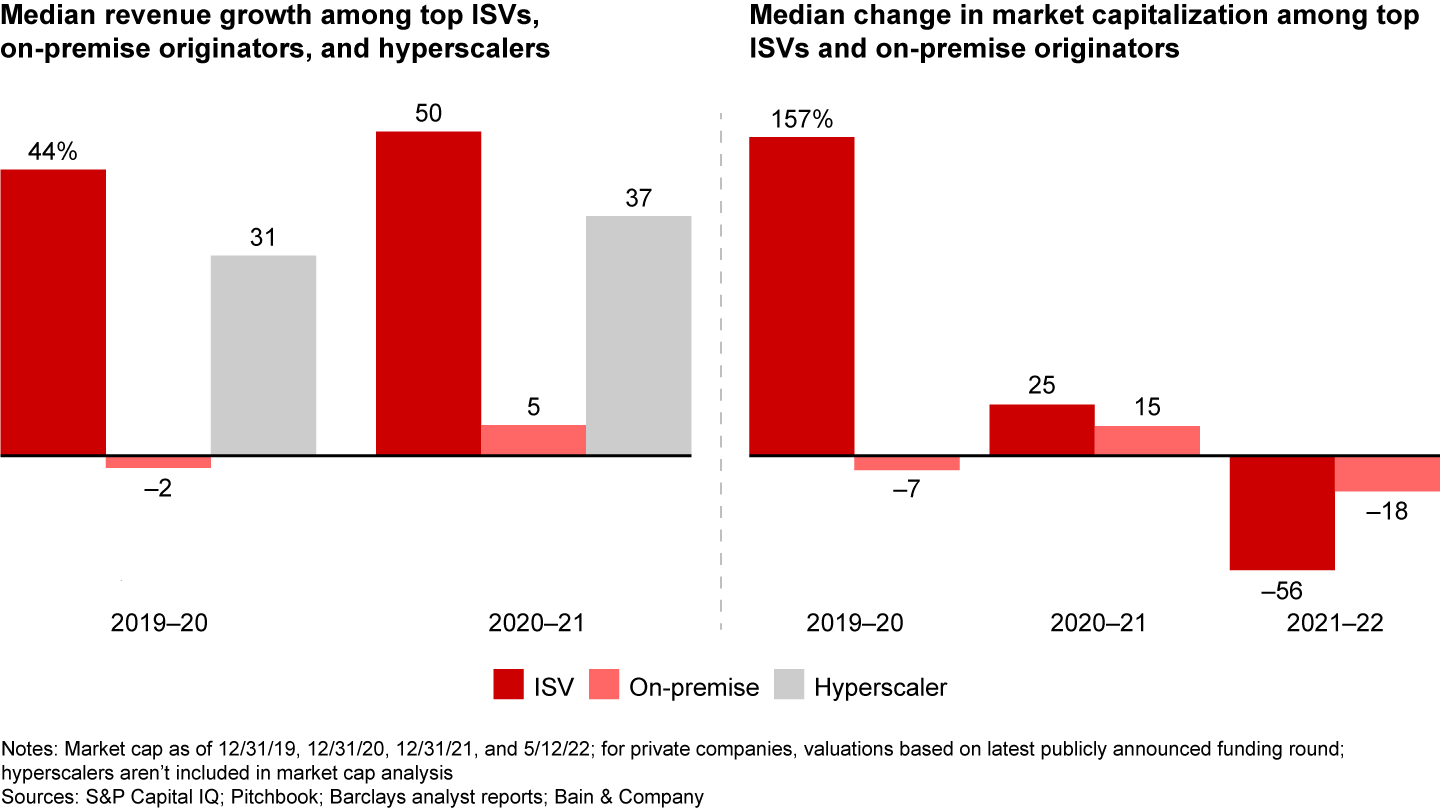
      Infrastructure software vendors grew quickly and were highly valued through 2021, but they’ve been hit hard this year
      • Cloud Software Competitors

        Three major categories of organizations are building out the cloud’s infrastructure, middleware, and management software markets.

        • On-premise originators. Companies providing infrastructure and analytics, including hardware, software, and middleware layers of the technology stack. Examples with on-premise roots include VMware, a virtualization company that has moved from on-premise to multicloud, and Teradata, which now offers software subscriptions in the cloud in place of an on-premise, hardware-centric product portfolio. 
        • Multicloud infrastructure software vendors (ISVs). Cloud-native, hybrid-native (combining on-premise systems with cloud), or open-source software-as-a-service (SaaS) companies offering solutions that integrate with the hyperscalers’ cloud infrastructure. Examples include Datadog, Snowflake, and Twilio.
        • Hyperscalers. The largest cloud service providers that have built a growing portfolio of services running on top of their own platforms. Examples include Amazon Web Services, Microsoft Azure, and Google Cloud. These services either compete with or complement solutions from the multicloud ISVs.

      It wasn’t sustainable. As macroeconomic challenges dragged down the stock market overall, multicloud ISV valuations declined even more steeply, even as their revenue growth often exceeded expectations. In time, it will become clear whether this is an overcorrection or a reset that better reflects intrinsic value. However that plays out, it’s increasingly clear that the competition between multicloud ISVs and hyperscalers will determine the future of the cloud software market. As investors and enterprises evaluate their cloud strategies, here’s our guide to what will determine the winners.

      Three swing factors

      The strength of a multicloud ISV’s advantage in a segment hinges on three characteristics.

      • Customers’ willingness to pay a premium for best-of-breed solutions. Multicloud ISVs have an opening to differentiate themselves in parts of the cloud stack located further from hyperscalers’ core offerings. Customers already choose ISVs when they need best-in-class technology, and for certain key purchase criteria (see Figure 2).
      • Strong customer preference for cloud infrastructure flexibility. Multicloud ISV solutions that work consistently across computing environments are well suited to buyers that want to avoid vendor lock-in and simplify their multicloud or hybrid environments.
      • Relatively limited benefit from scale. ISVs are more likely to succeed when this key advantage of hyperscalers’ platforms isn’t critical.
      Figure 2
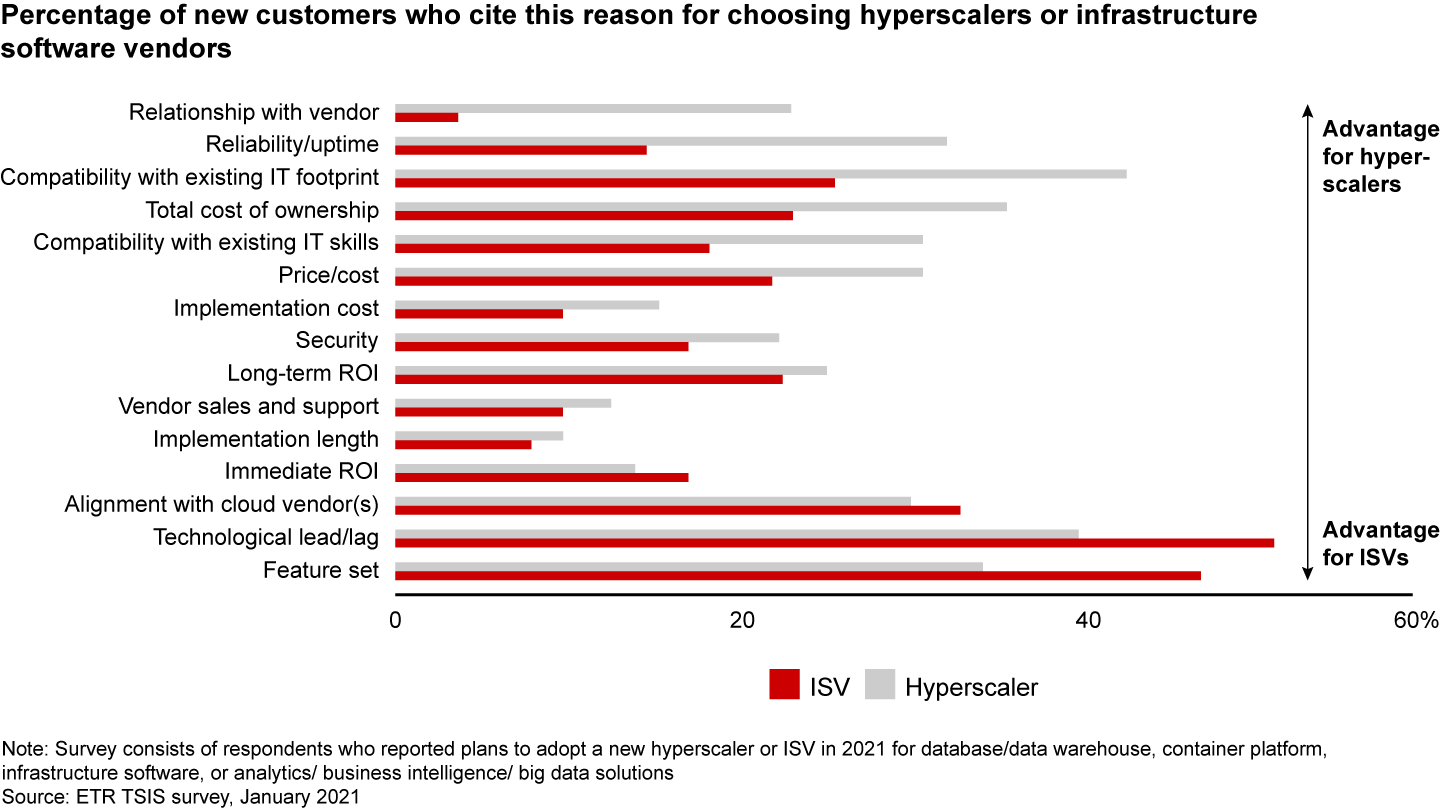
      Customers choose cloud-native infrastructure software vendors for high-quality technology, and hyperscalers for reliability, integration with existing IT, and cost

      The future of ISVs

      These three swing factors help clarify when ISVs are better positioned to win, when they’ll face fierce competition from hyperscalers, and when hyperscalers have the advantage.

      • ISVs are in a good position to win when best-in-class technology and cloud infrastructure flexibility are paramount. Examples include cybersecurity and app monitoring. In cybersecurity, despite hyperscalers’ moves to bolster their offerings (such as Google Cloud Platform’s $5.4 billion Mandiant acquisition), multicloud ISVs will be formidable competition, well positioned on all three swing factors. Cloudflare, for example, has upped the game for web performance and security with its differentiated software architecture and innovation. The combination has powered the company beyond investor analysts’ revenue growth expectations, more than tripling its total addressable market estimate from $32 billion in 2018 just before its 2019 IPO to over $100 billion.
      • ISVs and hyperscalers will engage in fierce competition when best-in-breed technology may be beneficial but not necessary. Examples include data warehousing and database management. In data warehousing, we believe multicloud ISVs can continue carving out leading positions in the market, but doing so will require overcoming strong hyperscaler presence and investment, as well as managing the complex relationship between ISVs and hyperscalers in those market segments where they both compete and partner. Snowflake has enjoyed a spectacular rise, including the largest software IPO at that point in history. Similarly, Databricks has demonstrated exceptional strength, reaching $800 million in annual recurring revenue in 2021, 80% more than in 2020.
      • Hyperscalers could capture the majority of profit pools when they have a distinct technological edge, a significant lead in the market, or an overwhelming advantage from scale. This may include areas within artificial intelligence (AI) and machine learning (ML), such as AI developer frameworks or vision and natural language processing. Hyperscalers get differentiated benefit of scale from training AI/ML solutions on large data sets and across multiple tools. In this segment, customers are already voting with their dollars, spending around 60% of their AI/ML budgets on hyperscalers’ tools, compared with 25% on multicloud ISV solutions, according to a 2022 Bain survey. We still expect to see ISVs winning in areas of AI further from the hyperscaler core, however, including cases involving proprietary data or domain-specific functionality. 

      Implications for ISVs, hyperscalers, and on-premise originators

      As the cloud services industry matures, multicloud ISVs should play a larger role in the market, but hyperscalers will maintain a strong competitive position, and on-premise originators have an opportunity to carve out their own valuable niche.

      On-premise originators have two important strengths to draw upon: a large installed base of customers and well-known brand names. Rather than trying to beat hyperscalers, we expect more on-premise originators to form partnerships and invest in making their leading software offerings work seamlessly on top of hyperscalers’ platforms.

      Critical questions for on-premise originators to consider as they crystallize their strategies:

      • What’s the source of our competitive differentiation from hyperscalers and multicloud ISVs today? What will it be in the future?
      • How can we partner with hyperscalers to keep customers from seeking a new solution?

      Successful multicloud ISVs will disproportionately invest in products located further from the hyperscaler core that have hybrid or multicloud requirements and limited benefits from scale. By maintaining a focus on customer needs and delivering best-in-class solutions, they can continue to win. One wild card to watch is regulation. If regulators require more standardization and interoperability, that’s likely to benefit multicloud ISVs.

      Critical questions for multicloud ISV leadership teams:

      • Do hyperscalers view our markets as must-win battlegrounds or as distant adjacency bets?
      • In markets with attractive swing factors, how can we create maximum value?

      The most effective hyperscalers will assess their portfolio of services to determine where their scale delivers a needle-moving competitive advantage and where best-of-breed players have the edge. As their service offerings expand from hundreds today to potentially thousands in the future, hyperscalers will need to effectively manage that complexity while remaining an easy-to-use one-stop shop for customers.

      Critical questions for hyperscalers:

      • Which priority areas of our core business should we invest in to ensure we stay ahead of the competition?
      • In which limited number of critical adjacent software markets should we invest? How will these further differentiate us from other hyperscalers?

      Read the Next Chapter

      Web3 Could Rewrite the Rules on User Identity

      Value Evolution

      • The Rise of Growth Equity Investors

      • A Multicloud World

      • Welcome to Web3

      • The US-China Decoupling

      Competitive Battlegrounds

      • Defending against Disruption

      • The Engine 2 Imperative

      • AI’s Next Frontier

      • The Industrial IoT

      Operational Advantage

      • Beyond the Rule of 40

      • Sales Productivity

      • Consumption-Based Pricing

      • Software R&D Efficiencies

      • The Chip Shortage

      • The Circular Economy

      Read our 2022 Technology Report

      Explore the report Download PDF
      저자
      • Headshot of Matthew Crupi
        Matthew Crupi
        파트너, Dallas
      • Headshot of Mark Brinda
        Mark Brinda
        파트너, New York
      • Headshot of Morgan Maxwell
        Morgan Maxwell
        파트너, Dallas
      • Headshot of Bill Radzevych
        Bill Radzevych
        파트너, Seattle
      문의하기
      관련 산업
      • 기술
      • Cloud Computing
      • Hardware
      • Internet of Things
      • IT Services
      • Semiconductors
      • Software
      Technology Report
      Four Ways Tech Companies Can Boost Sales Productivity, Even in a Downturn

      To grow revenue faster than sales and marketing expense, leading companies systematically improve their coverage models and invest in their sales reps’ productivity.

      자세히 보기
      Technology Report
      Quantum Computing Moves from Theoretical to Inevitable

      Quantum will likely become part of a mosaic, working with classical computing to solve big problems.

      자세히 보기
      CIO Insights
      Despite Tech Layoffs, Competition for Talent Remains Fierce

      Tech workers increasingly value career development opportunities and remote or hybrid work options, while compensation has soared.

      자세히 보기
      Technology Report
      How Can We Meet AI’s Insatiable Demand for Compute Power?

      Technological innovation, new revenue, and public support may be needed to fund and supply enough electricity.

      자세히 보기
      기술
      Using Hardware to Scale the Industrial Internet of Things

      Bain partners discuss the opportunity for hardware vendors to help companies develop their IoT pilots.

      자세히 보기
      First published in 9월 2022
      태그
      • 기술
      • CIO Insights
      • Cloud Computing
      • Hardware
      • Internet of Things
      • IT Services
      • Semiconductors
      • Software
      • Technology Report

      프로젝트 사례

      Helping a Midsize ERP Player Compete against the Giants

      See more related case studies

      성과 개선 Aggressively growing an IT service provider with a high-performance culture

      See more related case studies

      고객 전략 및 마케팅 Sales blueprint puts IT Services Co.'s growth back on track

      See more related case studies

      베인에 궁금하신 점이 있으신가요?

      베인은 주저 없이 변화를 마주할 줄 아는 용감한 리더들과 함께합니다. 그리고, 이들의 담대한 용기는 고객사의 성공으로 이어집니다.

      급변하는 비즈니스 환경에서 살아남기 위한 선도자의 시각. 월간 Bain Insights에서 글로벌 비즈니스의 핵심 이슈를 확인하십시오.

      *개인정보 정책을 읽었으며 그 내용에 동의합니다.

      Privacy Policy를 읽고 동의해주십시오.
      Bain & Company
      문의하기 환경정책 Accessibility 이용약관 개인정보 보호 쿠키 사용 정책 Sitemap Log In

      © 1996-2026 Bain & Company, Inc.

      문의하기

      무엇을 도와드릴까요?

      • 프로젝트 문의
      • 채용 정보
      • 언론
      • 제휴 문의
      • 연사 초청
      오피스 전체보기