
Skip to Content
  • 오피스

    오피스

    미주
    • Atlanta
    • Austin
    • Bogota
    • Boston
    • Buenos Aires
    • Chicago
    • Dallas
    • Denver
    • Houston
    • Los Angeles
    • Mexico City
    • Minneapolis
    • Monterrey
    • Montreal
    • New York
    • Rio de Janeiro
    • San Francisco
    • Santiago
    • São Paulo
    • Seattle
    • Silicon Valley
    • Toronto
    • Washington, DC
    유럽, 중동, 아프리카
    • Amsterdam
    • Athens
    • Berlin
    • Brussels
    • Copenhagen
    • Doha
    • Dubai
    • Dusseldorf
    • Frankfurt
    • Helsinki
    • Istanbul
    • Johannesburg
    • Kyiv
    • Lisbon
    • London
    • Madrid
    • Milan
    • Munich
    • Oslo
    • Paris
    • Riyadh
    • Rome
    • Stockholm
    • Vienna
    • Warsaw
    • Zurich
    아시아, 호주
    • Bangkok
    • Beijing
    • Bengaluru
    • Brisbane
    • Ho Chi Minh City
    • Hong Kong
    • Jakarta
    • Kuala Lumpur
    • Manila
    • Melbourne
    • Mumbai
    • New Delhi
    • Perth
    • Seoul
    • Shanghai
    • Singapore
    • Sydney
    • Tokyo
    오피스 전체보기
  • 얼럼나이
  • 미디어 센터
  • 구독
  • 연락처
  • Korea | 한국어

    지역 및 언어 선택

    글로벌
    • Global (English)
    미주
    • Brazil (Português)
    • Argentina (Español)
    • Canada (Français)
    • Chile (Español)
    • Colombia (Español)
    유럽, 중동, 아프리카
    • France (Français)
    • DACH Region (Deutsch)
    • Italy (Italiano)
    • Spain (Español)
    • Greece (Elliniká)
    아시아, 호주
    • China (中文版)
    • Korea (한국어)
    • Japan (日本語)
  • Saved items (0)
    Saved items (0)

    You have no saved items.

    관심 있는 내용을 북마크하여 Red 폴더에 저장할 수 있습니다. Red 폴더 에서 저장된 내용을 읽거나 공유해보세요.

    Explore Bain Insights
  • 산업
    메인 메뉴

    산업

    • 우주항공, 방산 및 정부 서비스
    • 농업 관련 산업
    • 화학
    • 인프라, 건설 및 건축 자재
    • 소비재
    • 금융 서비스
    • 헬스케어
    • 산업용 기계 및 장비
    • 미디어 및 엔터테인먼트
    • 금속
    • 광업
    • 석유 및 가스
    • 제지 및 패키징 산업
    • 사모펀드
    • 사회 및 공공 부문
    • 유통
    • 기술
    • 텔레콤
    • 운송
    • 여행·여가
    • 유틸리티 및 재생가능 에너지
  • 컨설팅 서비스
    메인 메뉴

    컨설팅 서비스

    • Customer Experience
    • ESG
    • Innovation
    • M&A
    • 운영
    • 조직
    • 사모펀드
    • 고객 전략 및 마케팅
    • 전략
    • AI, 인사이트 및 솔루션
    • Technology
    • 변화 혁신
  • Digital
  • 인사이트
  • 베인 소개
    메인 메뉴

    베인 소개

    • 업무 소개
    • 베인의 신념
    • 구성원 및 리더십 소개
    • 고객 성과
    • 주요 수상 경력
    • 글로벌 파트너사
    Further: Our global responsibility
    • 다양성과 포용
    • 사회 공헌 활동
    • Sustainability
    • World Economic Forum
    Learn more about Further
  • Careers
    메인 메뉴

    Careers

    • Work with Us
      Careers
      Work with Us
      • Find Your Place
      • Our Work Areas
      • Integrated Teams
      • Students
      • Internships & Programs
      • Recruiting Events
    • Life at Bain
      Careers
      Life at Bain
      • Blog: Inside Bain
      • Career Stories
      • Our People
      • Where We Work
      • Supporting Your Growth
      • Affinity Groups
      • Benefits
    • Impact Stories
    • Hiring Process
      Careers
      Hiring Process
      • What to Expect
      • Interviewing
    FIND JOBS
  • 오피스
    메인 메뉴

    오피스

    • 미주
      오피스
      미주
      • Atlanta
      • Austin
      • Bogota
      • Boston
      • Buenos Aires
      • Chicago
      • Dallas
      • Denver
      • Houston
      • Los Angeles
      • Mexico City
      • Minneapolis
      • Monterrey
      • Montreal
      • New York
      • Rio de Janeiro
      • San Francisco
      • Santiago
      • São Paulo
      • Seattle
      • Silicon Valley
      • Toronto
      • Washington, DC
    • 유럽, 중동, 아프리카
      오피스
      유럽, 중동, 아프리카
      • Amsterdam
      • Athens
      • Berlin
      • Brussels
      • Copenhagen
      • Doha
      • Dubai
      • Dusseldorf
      • Frankfurt
      • Helsinki
      • Istanbul
      • Johannesburg
      • Kyiv
      • Lisbon
      • London
      • Madrid
      • Milan
      • Munich
      • Oslo
      • Paris
      • Riyadh
      • Rome
      • Stockholm
      • Vienna
      • Warsaw
      • Zurich
    • 아시아, 호주
      오피스
      아시아, 호주
      • Bangkok
      • Beijing
      • Bengaluru
      • Brisbane
      • Ho Chi Minh City
      • Hong Kong
      • Jakarta
      • Kuala Lumpur
      • Manila
      • Melbourne
      • Mumbai
      • New Delhi
      • Perth
      • Seoul
      • Shanghai
      • Singapore
      • Sydney
      • Tokyo
    오피스 전체보기
  • 얼럼나이
  • 미디어 센터
  • 구독
  • 연락처
  • Korea | 한국어
    메인 메뉴

    지역 및 언어 선택

    • 글로벌
      지역 및 언어 선택
      글로벌
      • Global (English)
    • 미주
      지역 및 언어 선택
      미주
      • Brazil (Português)
      • Argentina (Español)
      • Canada (Français)
      • Chile (Español)
      • Colombia (Español)
    • 유럽, 중동, 아프리카
      지역 및 언어 선택
      유럽, 중동, 아프리카
      • France (Français)
      • DACH Region (Deutsch)
      • Italy (Italiano)
      • Spain (Español)
      • Greece (Elliniká)
    • 아시아, 호주
      지역 및 언어 선택
      아시아, 호주
      • China (中文版)
      • Korea (한국어)
      • Japan (日本語)
  • Saved items  (0)
    메인 메뉴
    Saved items (0)

    You have no saved items.

    관심 있는 내용을 북마크하여 Red 폴더에 저장할 수 있습니다. Red 폴더 에서 저장된 내용을 읽거나 공유해보세요.

    Explore Bain Insights
  • 산업
    • 산업

      • 우주항공, 방산 및 정부 서비스
      • 농업 관련 산업
      • 화학
      • 인프라, 건설 및 건축 자재
      • 소비재
      • 금융 서비스
      • 헬스케어
      • 산업용 기계 및 장비
      • 미디어 및 엔터테인먼트
      • 금속
      • 광업
      • 석유 및 가스
      • 제지 및 패키징 산업
      • 사모펀드
      • 사회 및 공공 부문
      • 유통
      • 기술
      • 텔레콤
      • 운송
      • 여행·여가
      • 유틸리티 및 재생가능 에너지
  • 컨설팅 서비스
    • 컨설팅 서비스

      • Customer Experience
      • ESG
      • Innovation
      • M&A
      • 운영
      • 조직
      • 사모펀드
      • 고객 전략 및 마케팅
      • 전략
      • AI, 인사이트 및 솔루션
      • Technology
      • 변화 혁신
  • Digital
  • 인사이트
  • 베인 소개
    • 베인 소개

      • 업무 소개
      • 베인의 신념
      • 구성원 및 리더십 소개
      • 고객 성과
      • 주요 수상 경력
      • 글로벌 파트너사
      Further: Our global responsibility
      • 다양성과 포용
      • 사회 공헌 활동
      • Sustainability
      • World Economic Forum
      Learn more about Further
  • Careers
    최근 검색어
      최근 방문 페이지

      Content added to saved items

      Saved items (0)

      Removed from saved items

      Saved items (0)

      Article

      How to Make the Most of Executive Team Meetings

      How to Make the Most of Executive Team Meetings

      Well-structured C-suite meetings help executives better manage day-to-day operations, and also innovate and grow.

      글 Joost Spits and Marcia Blenko

      • 읽기 소요시간
      }

      Article

      How to Make the Most of Executive Team Meetings
      en
      한눈에 보기
      • Improving executive meetings starts with thinking through their purpose and intent.
      • Executive priorities fall into two categories—running the business (operations) and changing the business (innovation)—and each calls for a distinct type of meeting.
      • Using this framework, executives can design meetings that encourage the right conversations and support good decision making.

      The first law of thermodynamics states that energy can’t be destroyed, yet most executives can point to meetings on their calendars that would seem to refute that rule. Meetings might look and feel a bit different these days—“you’re on mute!”—but they are still the primary forum for executives, live or virtually, to share important information, collaborate, gather input, monitor results, and make decisions.

      When working well, meetings can be a highly efficient and effective forum for robust discussion and debate, an opportunity for executives to align on future action, commit to it, and hold one another accountable. Taken together they build an integrated operating rhythm that becomes the heartbeat of the organization.

      Executives spend a lot of time in meetings, and far more goes into planning and preparing for them. On average, senior executives devote more than two days every week to meetings of three or more colleagues, and 15% of an organization’s collective time is spent in meetings, Bain research has found. When our colleagues looked into the ripple effect of a single regular senior review meeting, they found that something on the order of 300,000 additional hours were put into its planning and preparation over the course of the year, the equivalent of roughly 150 full-time employees. Research has found a connection between meeting behavior and market share, and between innovation and employment stability. It has also found that workers’ feelings about meetings correlate with general job satisfaction.

      When executives talk about “fixing meetings,” they often mean meeting hygiene—things like the agenda, who participates, their roles, meeting norms, and materials. All should fit the focus and goals of the meeting, and simple changes can make a big difference. One company instituted a policy that everyone must complete the background-reading package ahead of executive meetings, and started halting meetings if the reading hadn’t been done to have the group read together. Other changes included instituting a strict “start on time, finish on time” rule, clarifying who has the final authority on specific decisions, and always leaving 15 minutes at the close of a meeting to cover any new topics. Altogether, executives reported the changes had made meetings much more productive.

      Getting the most out of executive forums goes beyond improving hygiene, however. It requires distinguishing between two critical parts of the executive portfolio: operations (or running the business) and innovation (or changing the business) (see Figure 1).

      Figure 1
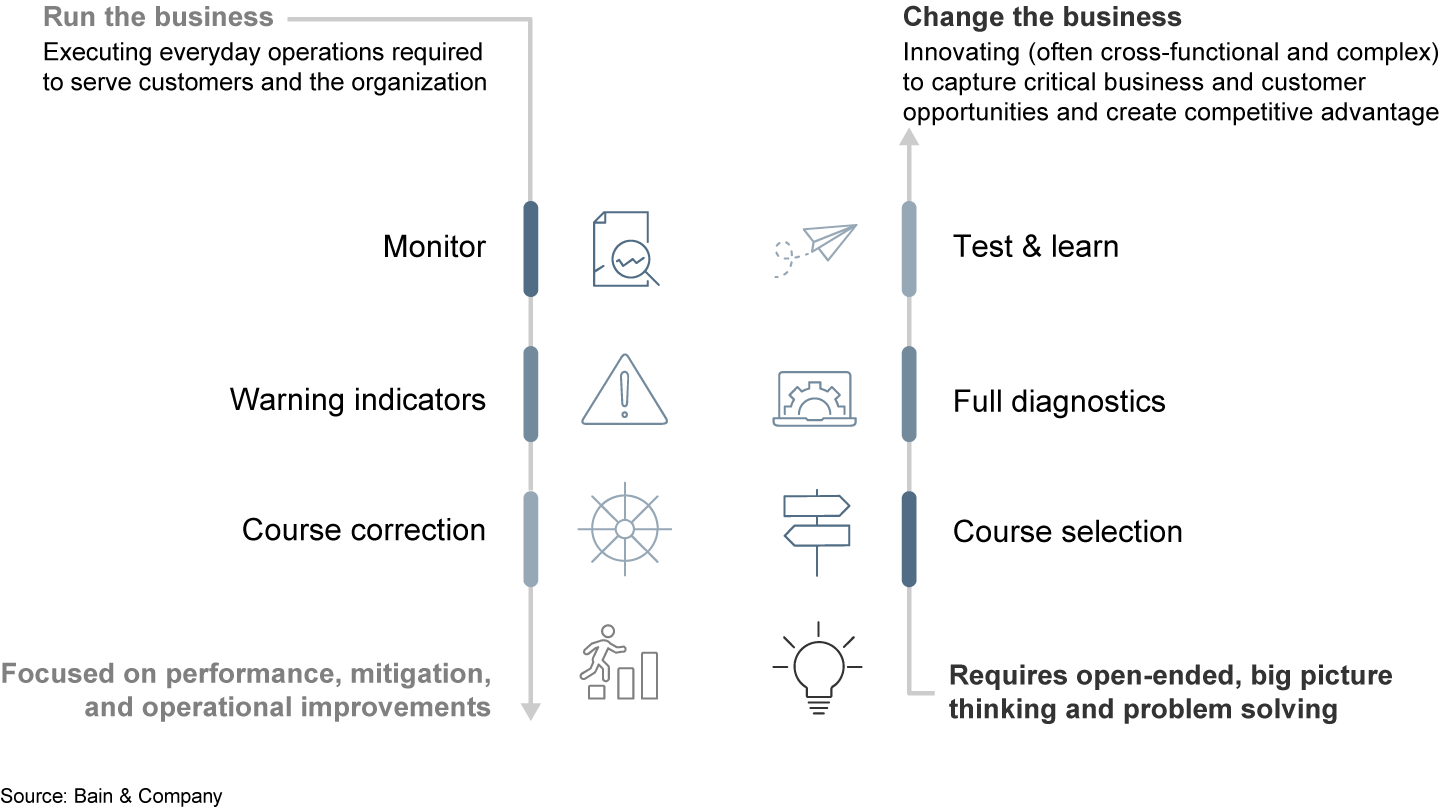
      “Run” and “change” the business efforts differ
      “Run” and “change” the business efforts differ
      “Run” and “change” the business efforts differ

      Run-the-business meetings and change-the-business meetings

      Distinguishing between run and change the business efforts helps the executive team think through and align around their purpose and intent as a group. Often this leads to a realization that they need to focus more of their team time on changing the business. Yes, they still need to monitor operations and remove roadblocks, but they also need to delegate run-the-business issues whenever possible. With this distinction in mind, executives can then begin to tailor their meetings’ structure and cadence to fit their focus, whether run the business or change the business.

      Recognizing this, one technology company has begun to differentiate between change-the-business and run-the-business discussions, in the process establishing a different operating rhythm and making its leadership team more effective. They made these changes following a period of C-suite executive turnover. Starting fresh, the team was open to change.

      They set the foundation by understanding their most critical decisions and who would be accountable for making them. There were almost 60 decisions identified as needing rigorous engagement by the executive leadership and 15 specific strategic priorities set—including diversity and succession planning, product strategy, and marketing.

      The cornerstone of the new executive calendar became a weekly meeting of the CEO and the CEO’s direct reports. A brief business pulse check offered the opportunity to surface urgent run-the-business issues followed by the meeting’s primary focus: strategic, change-the-business issues. This included everything from product launches to acquisition decisions and entering new markets. Longer quarterly business reviews offered the opportunity to delve deeper on operational performance issues and their root causes, and determine the right corrective actions.

      Executives liked the separation of run-the-business and change-the-business topics. The structure helped them spend more time on the right things and cultivate higher-quality discussions. They felt they made better decisions and made them faster.

      Clearly, run-the-business and change-the-business meetings benefit from different designs. Run-the-business meetings focus on the best ways to execute everyday operations effectively and efficiently. This is where executives monitor performance, highlight warning signs, and correct course as needed. They focus on establishing repeatable procedures that create predictable outcomes.

      A brief pulse check offered the opportunity to surface urgent run-the-business issues followed by the meeting’s primary focus: strategic, change-the-business issues.

      A business performance review of the operational running of the business:

      • Should focus on key outcomes and concentrate on those that are deviating meaningfully and materially from the original plan. (There is no greater waste of scarce leadership time than discussing things that are unfolding exactly as expected, or that have a minimal impact on the business, yet this is what many monthly and quarterly reviews are all about.)
      • Should aim to surface the root causes of the issue and then decide how to correct course. 
      • May warrant shorter, more frequent “pulse checks” rather than lengthy, holistic reviews.

      Change-the-business meetings, on the other hand, focus on innovation, capturing business opportunities, and creating competitive advantage. They concentrate on determining future direction and how to pivot as priorities shift, and they differ from operational meetings in focus and approach: 

      • They focus on sharing lessons learned and removing impediments to progress. 
      • Leaders provide input and feedback, but support innovation by empowering their teams to test and learn, embracing an Agile leadership approach. (For more on this, read “The Agile C-Suite” in Harvard Business Review.)
      • They often need to take place frequently—monthly, or even weekly—to keep pace with innovation and provide teams with timely coaching and guidance.

      Each CEO and C-suite will take their own approach. Some companies separate operating and innovation meetings entirely. Others cover both in one gathering but separate the operational discussions from those focused on strategy and innovation. Keeping them distinct helps participants adopt the mindset and behavior suited to the issue at hand. Consider the example of the executive committee at a consumer products company. The group has long met two days out of the month to cover essential topics, but recently began splitting that time. One day they focus on current “run the business” topics. The other they spend working on the future of business, thinking about new opportunities, the capabilities they need to build, and the right strategy to pursue. They regularly invite outside speakers to their growth day. When they launched a transformation program, this model ensured that executives kept abreast of the more than 15 strategic growth, cost, and culture initiatives they were tackling, but they also continued to spend at least a day a month as a team steeped in the details of how the business was performing day in, day out.

      Moving forward

      Whatever its industry, maturity, and current health, any executive team wants to ensure they are working on the right topics in the right ways. Are they spending enough of their time together on changing the business? How can they keep a finger on the pulse of operations in the most efficient manner? Do their meetings match the different needs of running and changing the business?

      A good place to start is with a periodic review of each meeting on the calendar. Do their agendas match the executive team’s proper focus? Where are run- and change-the-business topics converging, and should they be separated? Additional questions flow from that, including whether the right people are attending, and if the cadence is right. Ongoing attention to good meeting hygiene is important, too.

      It’s worth the effort. Well-designed meetings encourage the conversations and mindset that lead to better decisions. Rather than destroying energy, these meetings focus and feed it. 

      저자
      • Headshot of Joost Spits
        Joost Spits
        파트너, Boston
      • Headshot of Marcia Blenko
        Marcia Blenko
        어드바이저 파트너, Boston
      문의하기
      관련 컨설팅 서비스
      • 조직
      • Agile Enterprise
      • Leadership & Talent
      • Operating Model & Org Design
      최적의 솔루션 찾기
      • Dynamic Management System
      Agile Enterprise
      The Agile C-Suite

      A new approach to leadership for the team at the top.

      자세히 보기
      Dynamic Management System
      Answering Five Critical Questions Executives Ask about OKRs

      Far from a mere management fad, objectives and key results help companies focus on their most important goals and quickly adapt when circumstances change.

      자세히 보기
      Managing Change Blog
      M&A’s Leadership Moment

      Why the world’s most effective executives now treat dealmaking as a test of adaptability, not ambition.

      자세히 보기
      Dynamic Management System
      Dynamic Strategic Planning and Budgeting

      Dynamic Strategic Planning and Budgeting is a method to help companies plan and invest during times of great uncertainty.

      자세히 보기
      조직
      On Happiness and Leadership: A Discussion with Arthur C. Brooks

      A Harvard professor, social scientist, and best-selling author, Brooks shares his take on leadership and how to build a culture of workplace happiness.

      자세히 보기
      First published in 3월 2021
      태그
      • 조직
      • Agile Enterprise
      • Dynamic Management System
      • Leadership & Talent
      • Managing Change Blog
      • Operating Model & Org Design

      프로젝트 사례

      조직 Moving Beyond an Operating Model Redesign to Live the Model

      See more related case studies

      조직 Building a winning media salesforce

      See more related case studies

      조직 A Regional Operating Model Lifts European Sales for a Medical Device Maker

      See more related case studies

      베인에 궁금하신 점이 있으신가요?

      베인은 주저 없이 변화를 마주할 줄 아는 용감한 리더들과 함께합니다. 그리고, 이들의 담대한 용기는 고객사의 성공으로 이어집니다.

      급변하는 비즈니스 환경에서 살아남기 위한 선도자의 시각. 월간 Bain Insights에서 글로벌 비즈니스의 핵심 이슈를 확인하십시오.

      *개인정보 정책을 읽었으며 그 내용에 동의합니다.

      Privacy Policy를 읽고 동의해주십시오.
      Bain & Company
      문의하기 환경정책 Accessibility 이용약관 개인정보 보호 쿠키 사용 정책 Sitemap Log In

      © 1996-2026 Bain & Company, Inc.

      문의하기

      무엇을 도와드릴까요?

      • 프로젝트 문의
      • 채용 정보
      • 언론
      • 제휴 문의
      • 연사 초청
      오피스 전체보기