

Brief
Capital-intensive industries exist in a world of painfully low margins. The pressure to realize profits is typically so intense that many management teams struggle just to keep return on capital employed (ROCE) above the cost of capital.
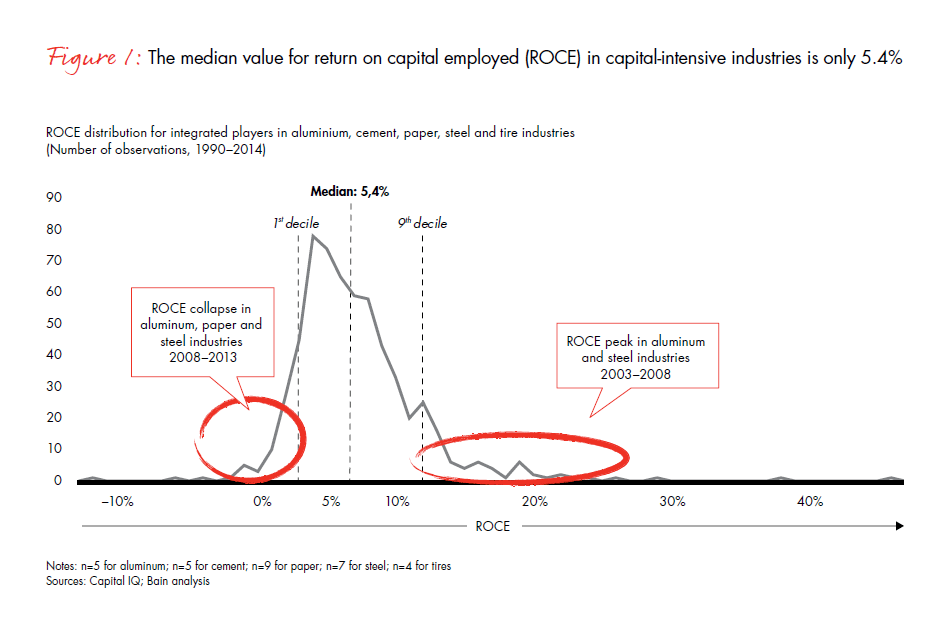
A Bain study of 30 companies across five industries—paper, steel, cement, aluminum and tires—shows that most companies deliver similarly low returns. The distribution of ROCE for capital-intensive industries over the past 25 years centers on a median value of only 5.4%, according to the study (see Figure 1).
The root cause of lower returns is clear. A superabundance of global capital has fueled excess supply in industries such as cement, steel and paper. A chronic supply–demand imbalance, in turn, has forced prices down and depressed profits. Yet capital to finance capex-intensive industries remains widely available—a paradox given their low ROCE.
At the same time, traditional barriers to entry have fallen. Technologies are now widely available and industrial processes are no longer proprietary. Global equipment suppliers and experienced managers rapidly infuse new and smaller players with industry expertise, helping them narrow the gaps in cost and efficiency with established players.
Management teams have several options to compete more effectively in a changed landscape. Improving returns starts with rethinking where to play—and with four strategic steps that many companies often overlook when it comes to improving performance.
Where to play: A more profit-focused portfolio
The most pressing issue for leadership teams in capital-intensive industries is whether to stay in businesses in which margins have been relentlessly driven down. Many companies are choosing to exit low-profit businesses that once were considered to be core. As they rebalance their portfolios, they are migrating up the value-added chain, investing in related sectors where new technologies can provide competitive advantages.
German steelmaker ThyssenKrupp, for example, sold its loss-making American steel finishing plant in 2013 for $1.55 billion in a restructuring shift away from the volatile steel business into higher-margin products and services such as elevators, factory components, auto parts and marine services.
Profit pool mapping is an important tool for assessing whether and where it makes sense to do business. In heavy industries, management teams often are so focused on volumes and tonnage that they overlook where the biggest profit pools are. By understanding the sources and distribution of profits across their industry, companies can gain an inside edge on improving returns.
The premium end of the business typically represents a very large proportion of the profit pool. The best opportunities often cluster there for companies competing in capital-intensive industries. German tire maker Continental, for example, builds premium products that help it capture three times more economic profit than global scale leader Bridgestone. Continental’s better customer mix translates to a deeper profit pool.
Picking the right place to play in the value chain is also critical to improving returns—and the most profitable spot varies across industries. In seamless tube manufacturing, premium connections—a downstream activity—assure perfect sealing after seamless tubes are assembled, driving much higher returns than the upstream activities of tube manufacturing. As a result, a small part of the downstream business makes most of the margin.
How to win: Four strategic steps to improving returns
1. Improve the cost base and review capex continually
In capital-intensive industries where low returns have become endemic, reducing costs and improving capex efficiency are important ways to improve performance. Indeed, capital allocation is just as important as cost—a fact that many companies overlook.
New developing market entrants in capital-intensive industries have built a strong competitive advantage by keeping capex relatively low. By contrast, the focus on cutting costs at many established players means they sometimes lose sight of improving capex. One way to get the balance right: Develop a more disciplined approach to managing capex, and benchmark the company’s performance against the industry’s leaders.
Cost discipline makes a critical difference. One-time efforts usually fail to deliver savings that stick, as our research shows. One explanation is that in tough times, management teams are quick to cut costs, but when the cycle swings up, they tend to take their eye off cost improvement and focus on growth-related priorities.
Developing a rigorous approach to cost improvement and nurturing the right capabilities to optimize working capital can help capital-intensive companies outperform. With cash flow down significantly in the wake of declining metal prices, one large integrated mining company launched a three-year program that reduced costs by 15%, increased production volume and delivered several billion dollars in productivity gains.
2. Build the lowest-cost position
Geography is another key factor for improving returns. Investing in geographies that offer the lowest landed cost position can create a strong competitive advantage. It’s particularly important in asset-heavy industries where the one-time cost of closing and moving businesses is high.
The best-performing firms revisit their geographic footprint regularly, as cost dynamics are constantly evolving. French tire maker Michelin launched a €170 million four-year investment program in Serbia in 2012 to take advantage of a low-cost production zone, doubling their production capacity for entry-level tires.
A global diversified specialty chemicals company based in the US decided to trim its geographic footprint, reducing the total number of plant locations by 32%. The shift improved the company’s ROCE in two ways: It reduced the capital tied up in property, plant and equipment by 5%, and it increased its profit margin. The exercise also helped create clearer performance metrics for underperforming assets.
No question, some asset-heavy industries such as chemicals face special challenges in rationalizing their geographic footprint. If the value of aging plants is low and labor is not a significant cost factor, for example, the one-time cost of closing and moving assets to low-cost geographies can be hard to justify using strictly financial criteria.
Clearly, companies that can choose the lowest-cost geography up front gain a competitive edge. Those in mature industries need to weigh the short-term downside against the longer-term benefits of reducing complexity.
3. Use mergers and acquisitions strategically
Smart acquisitions can help improve performance significantly, but many companies get off to a bad start by investing at the top of the cycle, when prices are at their peak, simply because that’s when cash is available. Leadership teams that take a strategic, disciplined and long-term approach to M&A instead of a tactical and episodic approach can improve returns significantly.
Companies that nurture M&A as a core competence derive the greatest value from them. Their leadership teams devote time to developing a structured roadmap of the most attractive potential targets, making it easier to acquire assets when the right opportunity comes along—and to target acquisitions at the bottom of the cycle.
That’s a tactic ArcelorMittal CEO Lakshmi Mittal turned to his advantage in building the world’s largest steel and mining company from a single mill. In an acquisition spree spanning 25 years, Mittal acquired dozens of near-bankrupt steel mills in economic downswings—even when his company was short on cash. He recognized that despite the investments required to turn around those acquisitions, the total capital invested would be far lower than what would have to be invested in a greenfield plant.
In fact, according to Bain’s study of mergers and acquisitions, the more deals a company does and the more material those deals are to the company’s overall market capitalization, the better the returns. During the 11-year period from 2000 through 2010, companies that averaged more than one deal per year—with deals adding up to more than 75% of the buyer’s market cap—turned in an average total shareholder return well above that of companies in other categories. M&A, in short, is an area where experience and expertise matter a great deal.
Companies that are most experienced in M&A build their capabilities over time. They search hard for merger or acquisition candidates that will add to their operating profit and fuel balanced growth. They pursue nearly as many scope deals as scale deals, moving into adjacent markets as well as expanding their share of existing markets. Most importantly, they create Repeatable Models® for identifying, evaluating and then closing good deals. What they typically find is that there are plenty of good prospects to be pursued and that the risk involved decreases with experience.
4. The service ace
For traditional capital-intensive industries, service can be a highly profitable business in its own right, generating better and faster return on investment than new production facilities, large-scale R&D programs or acquisitions.
A recent Bain study across a broad cross-section of industrial companies showed that service contributed 22% of total revenues and had an average gross margin of 39%—significantly higher than margins on most manufactured products. On average, the service business of these companies grew by 9% annually between 2010 and 2014—nearly double the rate of new equipment sales (see Figure 2).
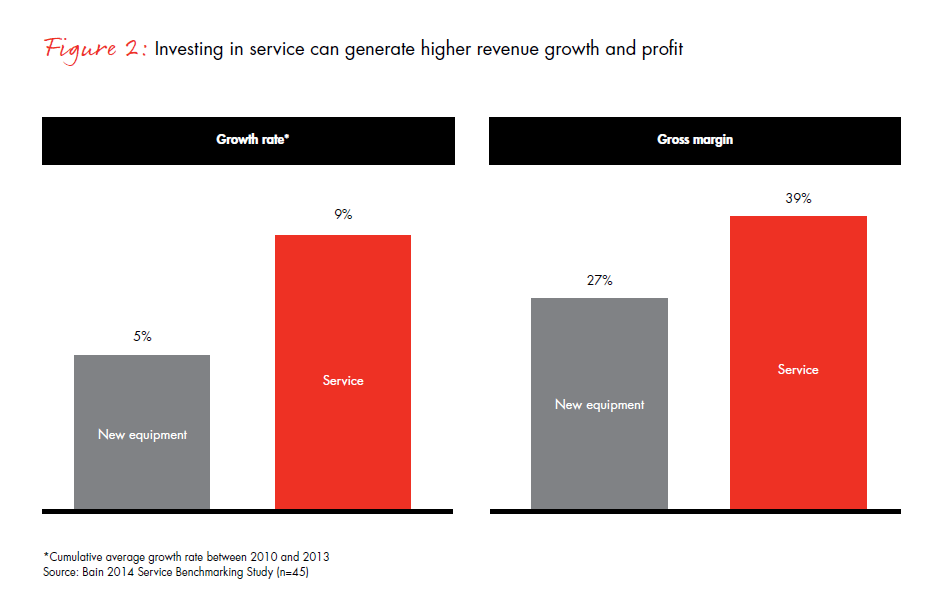
Indeed, for many industrial manufacturers, investing in service is the only way to sustainably grow profits in a tough economic environment. Investing in a service business also lowers capital intensity. A global leader in power equipment decided to invest in service and software due to narrowing profit margins in its core equipment business. Over the next three years, the company’s service business grew three times faster than equipment sales, balancing out a weakness in its core business. And in 2014, its gross margin in service was 42% higher than its gross margin in power equipment.
Investing in a world-class service business can become a strategic ace, elevating a company above competitors in an environment where differentiation on products and cost is difficult to achieve. The range of service opportunities, some larger than others, will vary by industry and company. Here again, mapping profit pools can help identify the potential size of service businesses and those with the greatest returns.
There is no question that companies in capital-intensive industries operate in a difficult environment today. But leadership teams that commit to a bold ambition have opportunities to break away from the pack and achieve double-digit returns significantly above the cost of capital.
Getting there requires a strategic shift toward a more profit-focused portfolio:
- Find the most attractive profit pools in your businesses.
- Adopt a mindset of continual cost improvement and capex optimization.
- Look for opportunities to drive down the company’s landed cost footprint by investing in the right geographies.
- Develop strong in-house M&A expertise and a structured roadmap of potential deals.
- Invest in related service businesses.
Leadership teams that take these steps will not only give returns a powerful boost, they also will help to rebuild competitive advantage and position their companies to win in a changed industrial landscape.
François Rousseau is a partner and director with Bain & Company in the Paris office. He leads Bain France’s Industrial Goods & Services practice. Luca Caruso is a partner and director with Bain & Company’s London office. He is the leader of Bain’s European Industrial Goods & Services practice and a founder of Bain’s Oil & Gas practice.
First published in 10월 2015