

Brief

With growth slowing in developed markets and demand slackening in some key developing ones, executives in the chemicals sector are looking for new ways to grow. Steady margin pressure from new plant openings at the low end of the cost curve exacerbate their challenge, as they try to meet earnings expectations.
Given this, it can be tempting to chase the siren song of “attractive markets,” those that appear to be more profitable or offer higher growth. However, companies may find that by the time they enter those markets, economics have changed, making them less attractive. Or companies underestimate the challenges of entry and learn that the strengths that have served them so well in their core markets may not transfer easily to new ones.

Leadership in Chemicals Is More About What You Do than Where You Do It
It's tempting to chase the siren song of new markets, but investing to outperform in a company's core delivers stronger results.
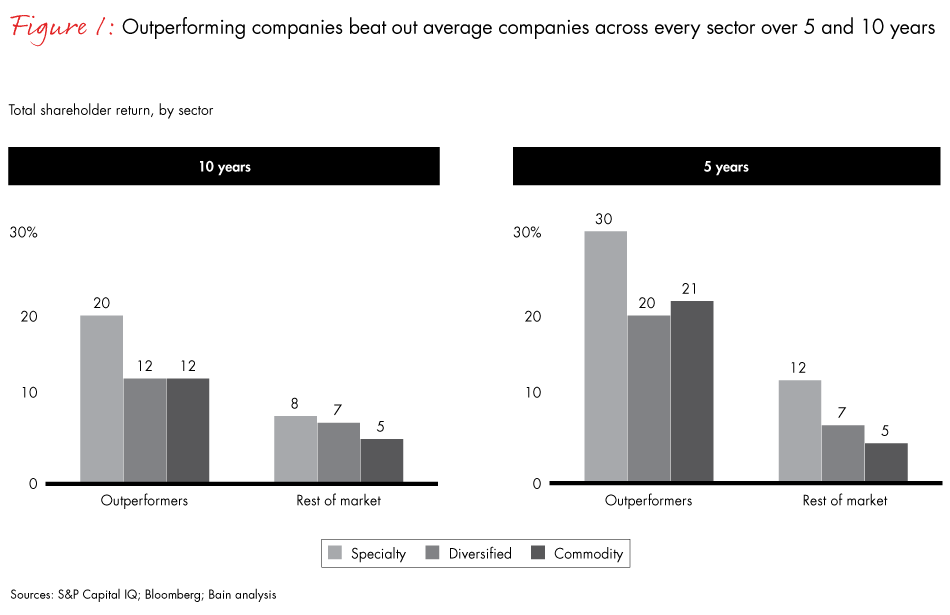
It should be reassuring to those looking for growth that great strategy is more important than great markets. Research by Bain & Company finds that investing to outperform in a company’s core delivers stronger results than expanding into new markets. In most industries, one or two players capture about 80% of the economic profit pool. As a result, even in less attractive markets, the best companies can outperform their cost of capital. This holds true in chemicals: The highest-performing commodity chemical companies grew total shareholder returns by at least 50% more than the average specialty company over 10 years. We find winners in every subsector of chemicals, demonstrating that it’s more about what you do than where you do it (see Figure 1).
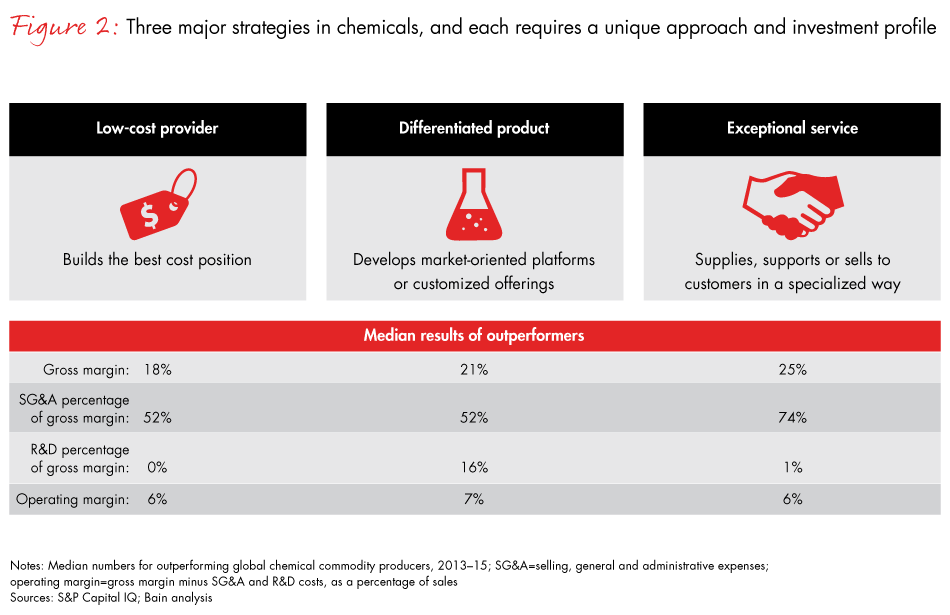
Bain research also finds that among the three major strategies in chemicals—low cost, differentiated products or exceptional service—no single strategy is inherently better than the others. Winners emerge with each model, and margins of outperformers are similar across the board. However, companies get there in different ways, based on choices executives make in allocating resources. Low-cost providers can tolerate lower gross margins, as they will closely manage R&D and sales costs. On the other hand, a differentiated product provider will invest more in R&D with the expectation of capturing higher gross margins, which in turn fuels more R&D (see Figure 2).
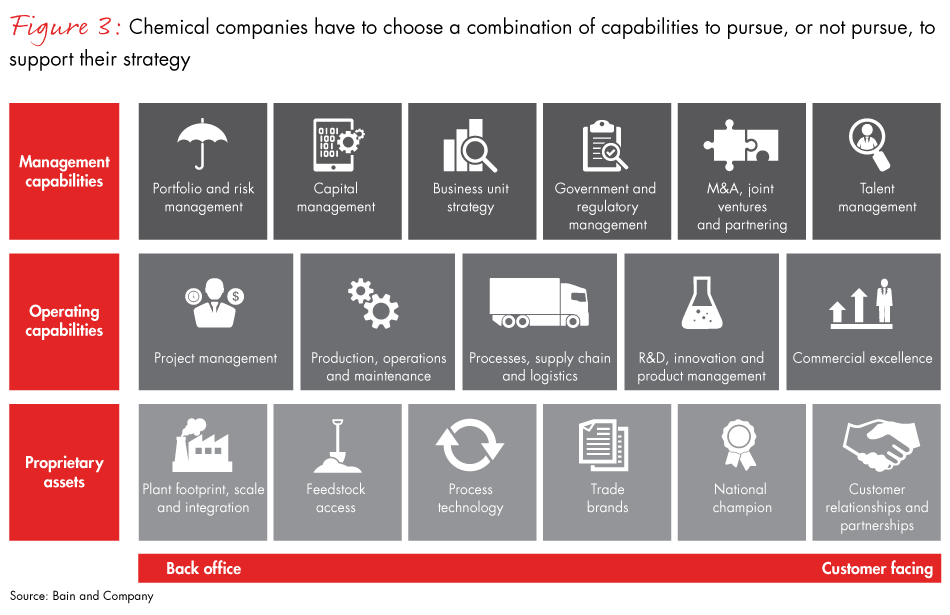
Additionally, there is no single right way to deliver against any of these strategies, and companies can pull together different combinations of capabilities and assets to succeed (see Figure 3). In polyethylene, for example, ExxonMobil pursues a low-cost advantage by building large plants, while Chevron Phillips Chemical keeps costs low through aggressive process improvement. Each approach requires a different focus, yet both have low unit operating costs. What’s most important is understanding how a set of capabilities can lead to your source of differentiation in the marketplace.
What’s more, any of these strategies can work in any market, as long as there are customers who value the proposition. For example, low-cost operations aren’t the only way to win in commodities. In fact, only half of commodity chemicals outperformers are pursuing a low-cost provider strategy—which reflects our broader research that more than 40% of economic leaders across a range of sectors are not the cost leaders. In specialty chemicals, this becomes even more apparent, as outperformers represent a roughly equal mix of low-cost providers, differentiated product providers and exceptional service providers.
Executives have to stick to a strategy and support it with the right capabilities. This may seem simple, but it requires real trade-offs and discipline to define the right combination of capabilities to invest in, choose what not to pursue and avoid trying to be the best in class at everything, for all customers.

Jason McLinn: In Chemicals, Great Strategy Beats Great Markets
Bain Partner Jason McLinn shares how chemical companies can invest to outperform in core markets through three major strategies.
How outperformers make these choices
Companies that consistently outperform others set strategy through a series of steps to evaluate their capabilities, customers and the market.
- Objectively assess your capabilities. Confidence and esprit de corps are essential, but they’re no substitute for data. Too many executives believe they are differentiated without demonstrating their relative strength objectively. An honest assessment takes a cold-eyed view of a company’s capabilities compared with competitors. For a low-cost provider, this means having relevant benchmarks for cost by spending category to ensure you stay ahead of the pack. Companies hoping to win through differentiation might rely more on data about revenue from new products. In either case, there are metrics available to prove out the source of leadership.
- Map your strategy to customer needs. Different segments of customers will base their purchases on different criteria. Leaders identify the customers that value their proposition, then set strategy to meet those customers’ needs, while deprioritizing customers who fall outside the mark. They understand where to focus their sales and marketing efforts. For example, strategies based on exceptional service work best with customers that have a profit profile or level of need that makes them willing to pay more for great technical service or a more reliable supply because it’s a key ingredient to the customers’ success.
- Align your investments and resources to support strategy. Understanding what customers value allows companies to focus their investments on building up the right strengths, whether these are already best in class or need improvement. Leaders continually invest in their strongest capabilities to reinforce their differentiation, often pairing this effort with secondary capabilities to make it harder for competitors to replicate. For example, chemical companies relying on R&D and product development may also increase marketing and sales capability investments to get full value out of their product innovation. This is where resourcing trade-offs really occur; not all categories or capabilities can be fully funded. Therefore, leaders are smart about where they truly differentiate vs. where they simply meet table stakes.
David Schottland, a principal in Bain's Chemicals practice, explains that chemical companies that are trying to put together a coherent portfolio should focus on strategy-sharing and volatility when making important portfolio decisions.
Continuously monitor and adapt
With strategic choices made, companies must follow through on their ambition. Delivery of the strategy takes time, but as the company pursues it, executives have to remain vigilant to keep the organization on course.
- Avoid strategic drift. Sometimes the biggest threat facing chemical companies is their own incrementalism, the small shifts that divert focus from strategic goals. For example, low-cost players are often tempted to improve revenues by introducing more differentiated products—but that raises costs and complexity, and erodes the underpinnings of their strategic premise. Choosing a path and sticking to it, while setting a high bar for any investment that doesn’t fit with the strategy, remains a surer route to success.
- Persist through downturns. Each strategy has its own unique set of threats, and these are often exacerbated during downturns. For example, companies pursuing differentiated-product strategies may hamstring themselves if they cut back on R&D when times are tight, hindering their ability to steal share in a downturn. Here, the key is going back to the decisions that involve capabilities and assets, and making sure any new investment (or cutback in investment) fits within the company’s broader strategic premise.
- Monitor and respond to changing markets. Chemical markets are dynamic, and over time, profit pools shift as technologies and customer preferences change. For example, companies selling into consumer goods relied for years on customers’ interest in product or packaging innovation. Recently, customers of consumer packaged goods have focused more on cost and less on differentiated products, with large implications for their chemical packaging suppliers. Leading companies continuously monitor the market to test whether their strategic choices are still well-founded.
In other words, executives need to strike a balance between allowing their strategies to play out as planned, while also responding to market shifts to remain on course—not unlike the way a sailor will adjust sails for small changes in the wind, to keep a steady tack. Such an approach is the best way for chemicals companies to achieve their strategic goals and meet shareholder expectations, while shying away from opportunities too far from familiar competencies to apply their formula for success.
A checklist for assessing strategic direction
- Which capabilities and assets are the foundations of our strategy? Know the source of your competitive advantage.
- Are we really better than our competitors? Bring compelling data to demonstrate your advantage and quantify its benefits.
- Are we targeting customers that value what we’re selling? Focus on customers that really care about the elements of value you offer, while forgoing customers that do not place the same value on those attributes.
- Are our capabilities and assets strong enough to sustain leadership? Monitor your position and decide whether to reinvest in existing capabilities to extend your lead or shift to a new strategy in response to market changes.
Jason McLinn is a partner in Bain & Company’s Chicago office, Piet de Paepe is a partner in Bain’s Brussels office and David Schottland is a principal in New York. All three work with Bain’s Global Chemicals practice, which Jason leads in the Americas and Piet leads in EMEA.
First published in 11월 2017