

Brief
Picture a Friday night after work in any oil town, from Aberdeen to Calgary or Perth. Drillers and maintenance engineers recount the week’s small victories—not a few of which include boasts of heroic efforts requiring long hours of overtime to fix unexpected problems, or premium prices paid to rush parts and people to where they were urgently needed—all part of the “can do” spirit for which the oil and gas industry is famous.
While these make for good stories, this is no way to run a business. More than ever, oil and gas companies are under tremendous pressure to improve performance and reduce labor overruns due to rising production costs, maturing assets and a talent shortage. Integrated planning—which aims to avoid the urgent jobs that make for great stories—is key to achieving operational excellence. It can improve safety, prevent accidents and work stoppages, and boost the efficiency of operations and resources.
Industry outsiders might be surprised by how often exploration and production (E&P) operators overlook or ignore detailed activity planning, either because more pressing break-fix problems take precedence or because it just seems less interesting in an industry focused on exciting discoveries and new production. Sometimes plans are made but not implemented because they don’t align with the company’s centrally planned strategic and financial priorities. Activity planning often gets dele-gated to inexperienced junior staffers, who may have wildly optimistic assumptions about timing, costs and resource requirements.
Oil and gas companies can find themselves wrestling with logistical and operational issues as they try to stretch increasingly scarce resources and improve performance. However, better planning can help companies overcome and even avoid these obstacles, says Ethan Phillips, a partner in Bain's Oil and Gas practice.
Leading companies take a more disciplined approach, recognizing that improving operational and maintenance planning is a critical step toward operational excellence. It is difficult work, given the many interdependencies to coordinate, but it is essential to ensure safe, reliable, sustainable and cost-effective operations. Inflationary pressures and talent shortages raise the stakes further, making it even more important to properly allocate people, materials and equipment.
This brief, one in a series on operational excellence for oil and gas operations, describes key aspects of integrated planning, including aligning site goals with the larger organization’s business priorities.
Why integrated planning matters
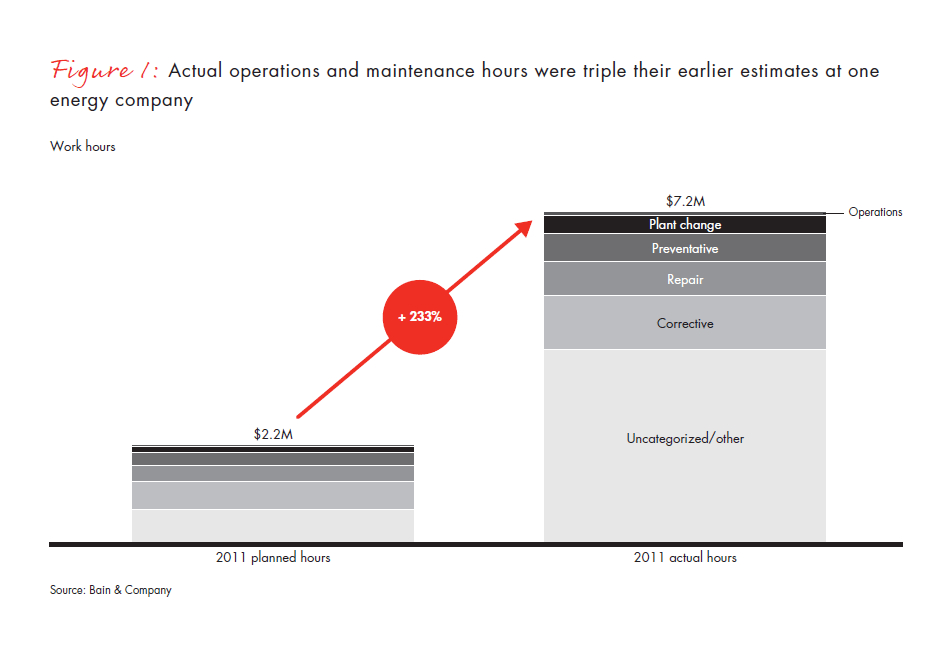
Planned work is safer, more cost-effective and more efficient than unplanned work. Poor planning is expensive since it leads to labor overruns, overtime, missed deadlines and expensive rush orders (see Figure 1). More significant, rushed operations and activities can create unsafe situations. Removing the inefficiencies and nonproductive time from operations contributes to safe, reliable and cost-effective operations.
Bain’s work with oil and gas companies improving their integrated planning skills shows that quality planning improves operational efficiency in significant ways.
- Safer. Integrated planning ensures that adequate focus and resources are allocated to health, safety and environmental (HSE) activities. It reduces the number of rushed tasks that create safety risks.
- Optimized use of resources, including labor, materials and equipment. Rising costs for exploration, development and production of hydrocarbons in more remote regions and in complex geologies make it essential to optimize the use of resources. Also, rising inflationary pressures and a shortage of technical talent make it more important than ever to remove inefficiencies and nonproductive time from the system, resulting in more uptime, availability and reliability.
- A stable plan is critical to successful performance management. It is difficult to hold people accountable for delivering on their commitments without a stable, pressure-tested plan underpinning those commitments.
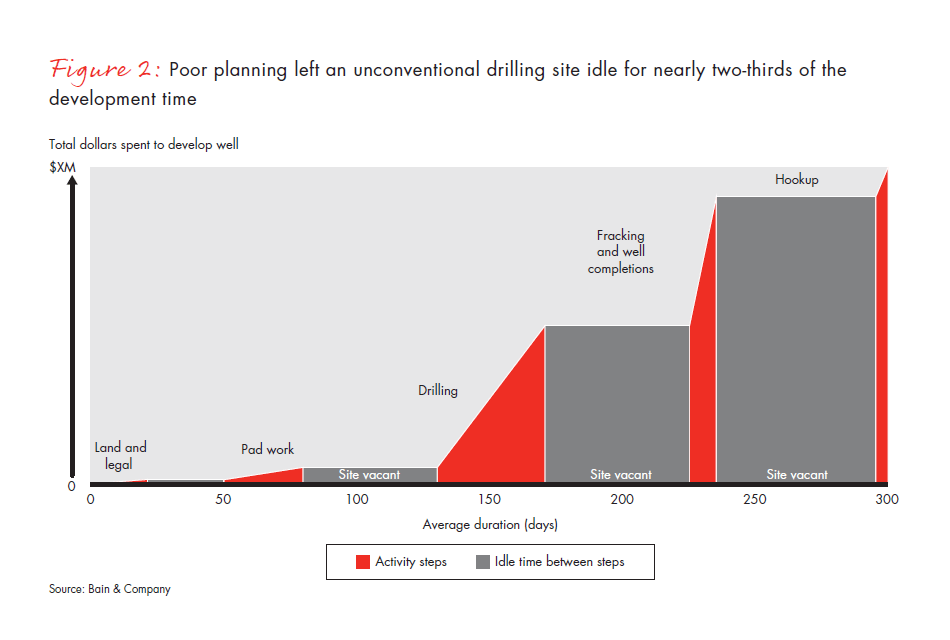
In North America, the rise of unconventional shale plays puts new emphasis on integrated planning as low gas prices have increased the premium on operating and capital efficiency. Many operators are retooling their existing planning processes to adapt to the rapid cycle times and cross-functional decision making that unconventional plays require—and to avoid unproductive idle time (see Figure 2).
Why is integrated planning difficult?
Integrated planning requires coordination across teams and functions, and an extremely disciplined management of change. The trend to functionalize E&P organizations—that is, to manage them from a central function rather than by region—yields many benefits, but it also makes integrated planning all the more vital. A change initiated for good reason in one part of the organization can have unintended consequences in another. For example, at one shale operation, the subsurface contractor wanted to change the drilling program, so it could study the results found in a recently drilled well and then optimize the remaining wells on a pad. But the cost of changing the rig schedule would have been greater than any incremental value they would have been able to generate. Wherever integrated planning sits within the organizational structure, it must work across functions in order to plan effectively.
The industry also suffers from a shortage of good planners, those with many years of experience in planning processes, estimating costs and schedules. This is detailed, repetitive and relentless work, but it ensures that plans are ready to implement before resources are allocated. Veteran planners know the norms for their basin or operating environment. Under their guidance, the organization becomes highly disciplined about not allowing work to proceed without a high-quality plan in place. Strict criteria ensure that any scheduled work is thoroughly vetted before entering the plan, which allows planners to avoid surprises and spot potential problems early. E&P organizations sometimes complain that activities veer off track almost overnight, but our experience suggests that is seldom the case. Usually, the warning signs are apparent well in advance, but poor planning leaves them overlooked.
Another obstacle to integrated planning is having a range of different, unlinked planning systems across the enterprise. One group may depend on planning software from one vendor, another may employ a different package, while a third group makes do with spreadsheets. Management might tolerate this diversity as a nod to autonomy, but it can make integrated planning a piecemeal process.
Finally, planned activities often take a back burner to more urgent corrective and breakdown work, delaying scheduled work indefinitely. This can create a vicious cycle where even well-planned work is constantly delayed, creating a seemingly endless backlog of necessary but not urgent work. Investing extra resources to clear such a backlog is a critical step toward a more stable planning process. Good planning and maintenance can reduce those surprises, but never eliminate them entirely. The best organizations plan for the unexpected, keeping some time and resources in reserve.
Although this type of diligence may sound simple, the well-intentioned “can do” culture of the industry can work against it, leading some operators to forego disciplined planning. The best E&P operators freeze their plans at least 30 days before execution starts, and making changes in this window of time requires approval from senior management.
The rewards of better planning
Leading organizations keep their business priorities in mind as they plan, making sure their investments in people, processes and equipment support larger goals. That means integrating the business planning done at the center with the activity planning that happens at the business unit level and the scheduling that happens on site. That can be a long distance to bridge in some organizations, but the effort pays off.
Sometimes a little experimentation is necessary to strike the right balance. In the upstream units of one large integrated company, each regional unit had historically operated independently, deciding on its own which activities to execute, and when and how to do them. When the company reorganized along functional lines, it developed new centralized models but struggled to find a balance between regional autonomy and central standardization. Eventually, executives established a process that empowered the functions to set global priorities while still allowing the regions to decide how to integrate them into their activity plans. The plan aligned those priorities, from business planning through activity planning and activity scheduling. The process even budgeted time and resources for inevitable emergent work to proceed without a central review and approval process.
Bringing everyone onto a common planning system is another important step in promoting integrated planning, especially when the system links next-day plans with longer-term planning. When a major integrated oil company standardized with one comprehensive system worldwide, it faced resistance from units that had depended on other systems for years. But management sent a strong signal that it would no longer tolerate the confusion of multiple systems. The unification has delivered benefits, such as tighter coordination and improved productivity.
Good integrated planning also builds in allowances for external contingencies. Bain worked with one North American shale gas operator to redesign its field development processes and optimize the value of its shale assets. A new integrated planning process helps the operator develop stable, economically viable annual activity plans based on the current pricing environment for gas and liquids. Tight feedback loops and contingency plans build in enough flexibility to allow the operator to rapidly react to new information—for example, the price of gas—and adjust drilling schedules accordingly, without causing significant disruption to its field operations. Similarly, Bain’s work with an onshore gas producer in Southeast Asia streamlined its planning processes for acquiring land and improving its relationships with local communities for smoother access to and preparation of drilling sites.
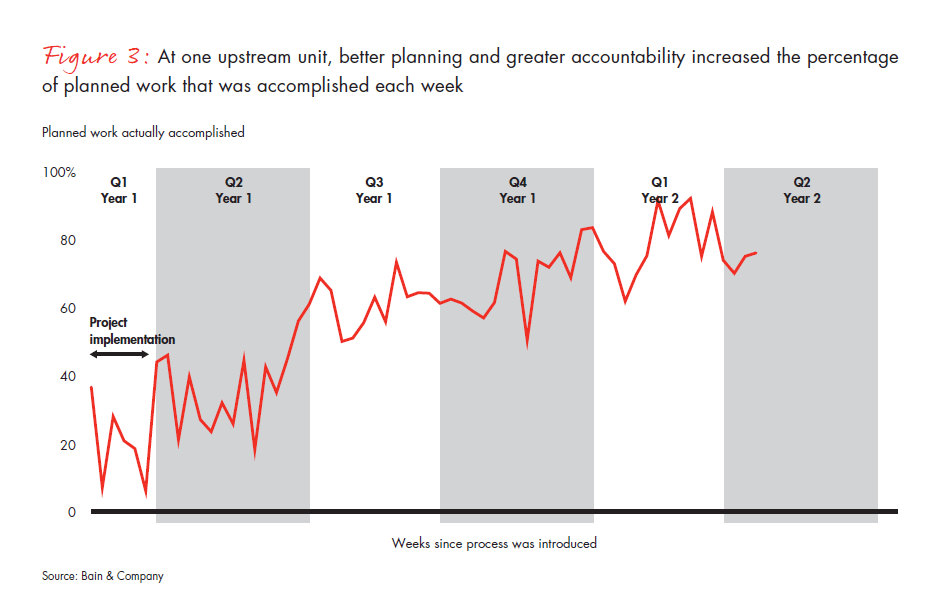
At the site level, the impact of better planning can be almost immediate, with ongoing, sustainable improvement. Examples of improvements that contribute to planning at this level include transparent statistics (including the staff on site or the use of boats and helicopters), better understanding of lead times, linking planning to its effect on oil or gas production and using key performance indicators to assess improvement. At one E&P production facility, improved planning and greater accountability boosted the group’s weekly plan attainment levels dramatically over five quarters, leading to significant improvements in the predictability and efficiency of work (see Figure 3).
Integrated planning creates more efficient and effective operations while reducing safety risks, maximizing uptime and making the best use of resources. It is a key component of Bain’s operational excellence tool kit, which has helped many oil and gas companies plan their path to excellence. For more on our perspective, read the Bain Brief “Operational excellence: The imperative for oil and gas companies.”
John McCreery is a partner in Bain & Company’s Singapore office and leads Bain’s Oil & Gas practice in Asia-Pacific. Ethan Phillips is a partner in Bain’s Houston office.
The authors would like to acknowledge the contribution of Keith Perrin, an adviser with Bain & Company, based in Manila, Philippines.
First published in 5월 2013