

Global Private Equity Report

한눈에 보기
- With global exits at a 10-year low, it’s safe to say it has rarely been harder to sell a portfolio company.
- That’s challenging sellers to think harder and earlier about how to demonstrate the value they’ve added during hold and what’s left on the table for a new owner.
- For many, the time is now to refresh the value-creation plan (or develop a new one) and start showing early results to build credibility.
This article is part of Bain’s 2024 Global Private Equity Report
It seemed promising enough when the sale process started.
A successful midsize fund had put a profitable portfolio company up for auction, and a group of 10 to 12 bidders had quickly RSVP’d to the management presentation. For a moment at least, it looked like all systems go.
Then came the presentation itself. As the bankers worked through the exit story and management tried to answer one tough question after another, the potential bidders began to fidget and look at their phones. Within days they had all disappeared, except for two or three bottom fishers hoping to capitalize on a broken process by snatching the asset at a discount. While the firm was too disciplined to take the bait, the message was clear: The exit motions that had worked so reliably over the previous decade simply weren’t going to cut it in a market turned upside down by stubbornly high interest rates.
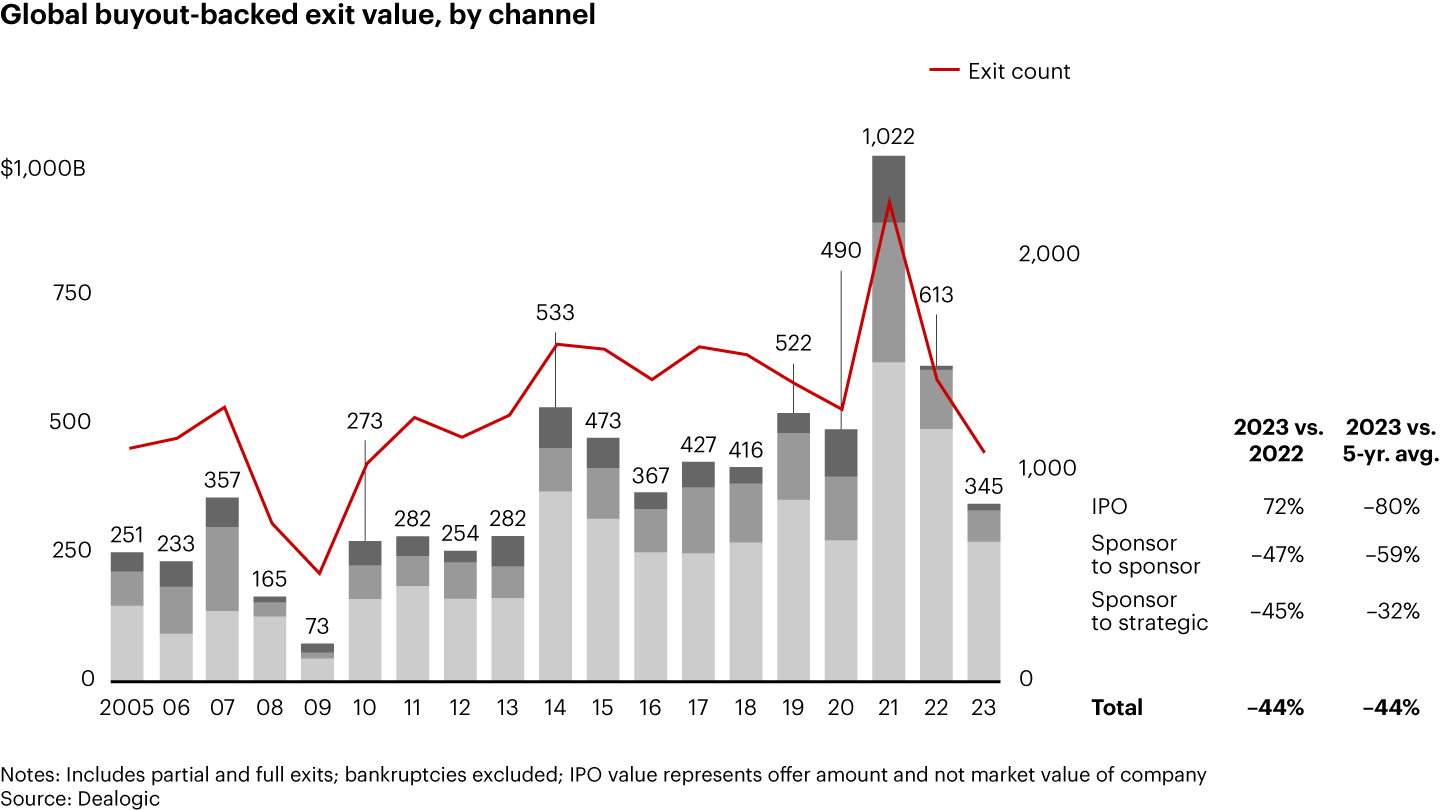
Amid the most challenging environment for closing deals in a generation, some version of this story will doubtless sound familiar to almost any private equity investor. With the cost of debt skyrocketing and multiple expectations still at record highs, exits are at their lowest level since the global financial crisis (see Figure 1).
Figure 1

On the buy side, the problem is simple: In the years when multiple appreciation could reliably provide almost 60% of buyout returns, deal teams and their investment committees were willing to take considerably more risk on speculative upside cases. But that kind of thinking has gone the way of 0% interest rates. Today’s higher financing costs and macro uncertainty mean the margin for error in underwriting a deal has contracted sharply. Buyers are reluctant to bid without convincing evidence that every dollar of projected earnings growth is plausible and achievable.
For sellers—most of whom have never seen a market as paralyzed as this one—the increased scrutiny can be a rude awakening. They’re discovering the hard way that selling anything in today’s market requires much more “show me the money” than most are used to. Over the past year, we’ve seen management presentations falling short in several ways that might not have mattered as much in a more forgiving dealmaking environment:
- The plan doesn’t draw a clear link between actions and results to date.
- It asserts confidently that growth will accelerate or outrun the industry without convincing rationale for why or how.
- Those growth projections are overly reliant on potential adjacencies where the company has yet to demonstrate traction.
- The plan poses an M&A thesis that is heavy on “buy-and-build” and light on evidence that the strategy will accelerate organic growth or drive meaningful margin improvement.
Ideally, of course, a strong exit story is an extension of the original value-creation plan, meaning the company has, in fact, made a step change in performance and effectively positioned itself to capture a new, robust phase of growth. But more often than not—especially in a macro environment like this one—reality intrudes in any number of ways: Things simply don’t work out as planned (can you say pandemic?). The core strategy stalls and/or an adjacency has yet to bear fruit. Maybe the original three-year plan has played out perfectly and the company needs a new strategy to power the next phase of growth.
In these cases, deal and management teams have work to do to refresh their value-creation plans and recalibrate how they are approaching the market. The teams that are closing transactions these days build credibility among buyers in three important ways:
- They provide evidence of action-driven success during the holding period by linking positive results to specific management initiatives.
- They demonstrate that there’s still money on the table by laying out a clear path to future value creation.
- Finally, they present clear reasons to believe by highlighting how the company has put points on the board with a new plan to accelerate revenue or improve profitability in the years to come.
These are attributes that strengthen an exit story in any kind of market. The difference today is that they are compulsory, not “nice to have.”
Action-driven success
One of the more difficult hurdles to get over in the current market is the suspicion that even strong company performance owes more to economic and monetary tailwinds than true operational excellence. Getting past that perception requires a clear demonstration of how a company’s performance has improved and why that is a direct result of the steps management has taken to make it a more efficient competitor.
A good example is Prelios, an Italian alternative asset manager that Davidson Kempner (DK) acquired in 2017. In the four-plus years that DK held the company, earnings before interest, taxes, depreciation, and amortization (EBITDA) had grown by a multiple of 9. Yet in early 2023, a buyer could have easily concluded that the party was over.
Although it started life in the 1990s as a real estate investor, Prelios had successfully evolved into a credit servicing specialist working for both debt investors and banks to help them claw back returns from portfolios of nonperforming loans (NPLs). Two major tailwinds had supported its growth in the wake of the European debt crisis. First, the European Central Bank pressured Italian lenders to sharply reduce their portfolios of NPLs, leading banks to outsource servicing of a large volume of these bad credits. Second, the Italian government helped that effort along by backstopping billions of euros worth of securitizations.
But by the time DK wanted to exit the business in 2022, Italy’s volume of nonperforming debt had slowed. Banks had gotten their balance sheets under control, and investor portfolios had started to level off, raising the question of where Prelios’s next phase of growth would come from.
DK’s answer was to show how the company had changed for the better during ownership and to highlight its established ability to enter new businesses. DK drew a direct link between earnings growth and the work management had done during the firm’s holding period to make Prelios investment professionals more productive. The company had instituted a detailed playbook that included target setting at a granular level, “performance dialogues” that institutionalized workout routines, hot lists of positions to be addressed, slippage monitoring, and coaching on how to fill performance gaps. Leadership also instituted a pay-for-performance plan to incentivize teams and individuals. The outcome was a much cleaner, results-driven organization.
At the same time, Prelios had developed a new plan to leverage its expertise in credit analysis and debt collection in order to move into new businesses. The company had already transitioned from real estate to credit servicing in the early 2000s, and when the NPL business peaked, it had rapidly built an Engine 2 business in servicing unlikely-to-pay loans (UTPs). UTPs are a notch up the troubled-debt ladder from NPLs in that the bank still has a relationship with the borrower. While the credit analysis challenge is similar, the workout process involves a much higher degree of nuanced negotiation, which requires a different kind of talent. To build this new capability, Prelios hired professionals from different industries and backgrounds, trained them in the same operational improvements it had made in the NPL business, and quickly became Italy’s premier UTP specialist. The evolution allowed Prelios to more than double its assets under management.
These initiatives not only led to a steep ramp-up in profitability, but they also preserved revenue growth and created a significantly more efficient culture of performance. When DK agreed to sell Prelios in 2023 for €1.35 billion (giving the firm a fivefold return on investment, according to public sources), the bet was that the company could continue to apply its workout expertise and its business-building skills in mining new asset classes, both in Italy and abroad.
Money on the table
It’s clear that resolving the current disconnect between buyers and sellers can often come down to presenting new sources of value on a platter. Hinting at growth opportunities or regurgitating generic industry research won’t be sufficient. The most effective plans lay out in detail how the next round of initiatives will accelerate revenue growth or capture new efficiencies. To the extent that’s not clear, it will likely require going back to the drawing board in the presale period to either refresh the original value-creation plan or devise a new one.
When The Sterling Group merged two companies to create Safe Fleet in 2013, the combined entity manufactured a portfolio of branded equipment used across different types of vehicles and fleets to enhance safety—products like mirrors, lighting, and grab handles—as well as more sophisticated equipment like video surveillance and telematics to track fleet movement. The strategy was to expand this platform with strategic M&A.
Over the course of Sterling’s hold, the company made more than 10 acquisitions that materially expanded the business. But finding attractive M&A targets had gotten harder, and Sterling knew this would be an issue for potential buyers concerned about maintaining growth. So it encouraged management to start working on a new roadmap—one that not only defined new sources of revenue but also demonstrated why Safe Fleet had a right to win in those areas.
Safe Fleet had successfully established itself across a range of fleet types that included school buses, fire trucks, emergency vehicles, railroad cars, and commercial trucks. The most obvious source of new growth was to expand the roster of products it sold into each vertical. The strongest exit story would have three components: a list of promising new products for each fleet type, a realistic measure of the total accessible market globally, and a justification for why Safe Fleet could expect to thrive in those adjacencies.
An essential part of the “right to win” story was that the company had deep relationships with customers and supply chain partners that often made a big difference in closing what were invariably complex sales processes. In the school bus vertical, for instance, Safe Fleet had relationships with the original equipment manufacturers, dealers, and, critically, school districts, which often have convoluted sourcing procedures. This had enabled a strong record of upselling. Starting with simple hardware like stop signs and hatches, it had successfully moved into selling school districts on the need for fleet management and routing software. That deepened the relationships and enhanced stickiness.
Building a similar story for each of seven fleet types resulted in a new value-creation plan that the next buyer could use to hit the ground running. That helped Sterling sell the company to another fund in 2018 at a return that made Safe Fleet one of the best performers in Sterling’s portfolio.
Reasons to believe
Both Safe Fleet and Prelios were able to provide buyers with objective, fact-based evidence that they know how to succeed in the businesses and activities that would drive growth into the future. But given how reluctant buyers are these days to underwrite value-creation initiatives on spec, the easiest way to build confidence is to produce some early wins.
Since Brad Fauvre and Conan Barker cofounded Velocity Vehicle Group in Southern California 25 years ago, the company has built a global chain of commercial truck dealerships through a proven model of buy, integrate, and improve. It has steadily added new outlets in attractive markets and uses strong process improvement capabilities to speed up service and product delivery, leading to increased regional market share. Its outlets provide the full range of new and used commercial vehicle sales, service, and parts distribution, as well as vehicle rental and leasing.
By the time Velocity partnered with The Cranemere Group in 2019, it had already expanded into Arizona and Nevada. Cranemere, a holding company with permanent capital, shared the founders’ vision to accelerate growth through M&A, and Velocity continued to acquire US dealerships, adding operations in five Southeastern states.
The bolder move, though, was international expansion. Betting that its best-in-class operating model would translate around the world, Velocity acquired dealerships in Australia, Mexico, and Canada, rapidly applying the process improvement formula that had worked so well in the US. Since joining forces with Cranemere, Velocity has more than tripled revenues and meaningfully expanded margins, particularly in the newly acquired dealerships. Roughly half of that growth has come from its international expansion, and, in 2024, Velocity will be generating more revenue internationally than it was from its entire US operation just five years ago.
The international expansion opportunity promises to deliver additional growth for many years to come and is the kind of proven initiative that would demonstrate to a buyer how Velocity can build on its past success. While for many investors this would present a chance to sell and declare victory, Cranemere and the shareholders providing its permanent capital are focused on working in partnership with a world-class management team to reap powerful long-term compounding.
Addressing today’s challenges
The shared moral of these stories is that, in a market as difficult as this one, action is required. Faced with a steadily building exit backlog, it’s going to be important for funds to evaluate—asset by asset—where the current value-creation plan stands, how potential buyers are likely to view a company’s future prospects, and what needs to be done to make each asset stand out in an increasingly crowded market.
Fund managers can start to set priorities by asking a few key questions about each portfolio company:
- Have competitive or market dynamics changed (or will they change), and are we aligned with management around what to do about it?
- Do we know how much gas current strategies have left in the tank, and have we developed a data-driven perspective on the value left to pursue?
- What new initiatives is management working on to spur the next phase of growth, and how much traction has there been so far?
- If those initiatives or traction are lacking, what needs to happen to develop a new plan that will show buyers why this company has potential?
- Is the team in place the right one for the next stage of growth, and are we confident that buyers will see it the same way? What functions or capabilities do we need to strengthen to increase credibility?
All of this helps zero in on one overarching concern: Do we really understand how potential buyers will perceive this company’s performance to date, and have we drawn clear links between specific initiatives and their impact on EBITDA?
Every business is different, and determining what’s working—or what needs to work—is a process. But the time to start developing a bulletproof exit story is now. Spinning a great yarn might have impressed suitors in the past. But objective evidence of both past performance and future potential is what will attract and hold a buyer’s attention today.
Read our 2024 Global Private Equity Report
More from the report
First published in 3월 2024