

Brief

North America’s midstream industry was largely protected from the early shocks of the oil and gas price drops, thanks to long-term contracts with “take or pay” or “minimum volume commitment” provisions that guaranteed payments regardless of volumes. But now, as prices stabilize and the energy sector adapts, the broad effects of low prices are finally beginning to ripple through midstream—and they are likely to continue to play out over the next few years.
Several positive trends are under way. Drilling activity is rising, generating demand for new infrastructure in some basins; liquefied natural gas (LNG) exports from the US are beginning to take off; and more gas is going to Mexico and industrial companies in the US.
However, there are worrying signs that midstream is struggling. Capital expenditures for the 11 largest midstream companies fell by about 15%, from $34 billion in 2014 to $29 billion in 2016, and the trend continues in 2017. In another indicator, the Alerian MLP Index, a bellwether for the midstream industry, has underperformed the S&P 500 over one-, three- and five-year periods.
Our conversations with midstream executives indicate that their greatest concerns center around three trends that are disrupting the sector and putting pressure on returns.
- Stranded assets. Evolving basin economics and persistently low oil and gas prices have left some assets that were once profitable no longer in the money.
- Favorable contracts expiring. Contracts signed in the pipeline boom of the late 2000s are up for renewal.
- Excess capital, including from private equity. More money is chasing fewer deals. An influx of PE-managed investment has changed the game, particularly in the gathering and processing (G&P) part of the industry, as these firms take more aggressive contract terms than incumbent midstream companies.
All of this makes it harder to deliver on the fundamentals of midstream value creation: growth, distribution coverage and balance sheet strength. However, as with any period of uncertainty, midstream executives can navigate their way through these challenging times by identifying a set of plausible scenarios against which they can test the resilience of their portfolios. These scenarios should also help midstream companies plan further into the future and allow them to gain a clear understanding of the cost structures they will need to adopt in order to thrive. (For more on scenario planning, see the Bain Brief “Energy Management in the Age of Disruptions.”)
Shifting industry dynamics
The long-term effects of the collapse in oil and gas prices continue to play out in many ways. Here’s a closer look at the three that are placing particular pressure on midstream.
-
Stranded assets. As oil prices rose, rig counts fell by about half from January 2014 to June 2017. Declines were steep in some basins (the Bakken, Mississippian and Granite Wash), while others rebounded quickly (the Permian, the Scoop/Stack region,1 and Marcellus and Utica). This shift in the supply curve has left some formerly attractive assets stranded in unprofitable positions. Drilling has, of course, focused on sweet spots that can deliver even at lower prices for oil and gas.
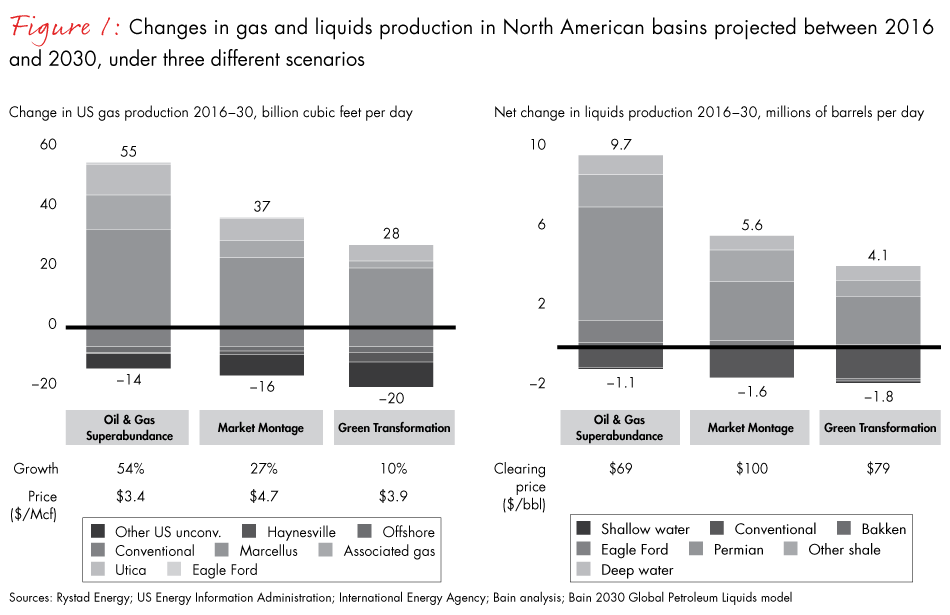
Bain’s research on the economics of energy markets defines plausible scenarios for energy markets through 2030, and identifies several intriguing midstream opportunities (see Figure 1).
- The rapid growth of liquids production in the Permian and Scoop/Stack could produce significant associated gas, up to 11 billion cubic feet per day (Bcf/d)(roughly doubling) depending on the scenario.
- As a result, most other unconventional basins, including the Barnett, Fayetteville, much of the Rockies and others, could decline by up to 50%.
- The associated gas from the Permian tends to contain natural gas liquids (NGLs), like ethane. With the booming demand from petrochemical plants and exports, midstream operators will have a strong incentive to connect this new supply source to the new sources of demand.
- Earnings are coming under pressure as favorable contracts signed in the pipeline boom come up for renewal. Many companies with assets in basins that have seen production drops have been protected from volume declines by favorable contract provisions, such as “take-or-pay” shipper capacity commitments that guarantee minimum levels of payments regardless of how much volume flows through the pipes. Many of these contracts are soon to expire and are likely to be renewed at much lower volumes and rates.
- Private equity is investing heavily in the gathering and processing segments of the chain and with more aggressive contract terms. More than 100 private equity-backed management teams are at work in North America’s midstream industry, pursuing a mix of acquisitions and greenfield development projects, according to data from Mergermarket. Unlike midstream companies, which pursue contracts that offer five to seven years of volume guarantees, PE-managed teams are often looking to sell after only a few years, so they don’t require the same multiyear guarantees.
The first implication of these trends is that overall project returns across the industry are being compressed. There are fewer midstream deals available today, being chased by more capital—and that squeezes margins.
A second implication is that profit pools are shifting. G&P is becoming less profitable with the influx of private equity and as exploration and production (E&P) activity concentrates in fewer places. At the same time, fractionation—the process of separating a mixed stream of non-gas liquids into ethane, butane, propane and other pure products—could become more profitable as demand from the petrochemical industry increases. Long-haul pipelines remain attractive for assets connected to Tier 1 production basins or those that serve growing export and industrial demand. However, high levels of competition in the Permian and Scoop/Stack could crimp margins there. Finally, export facilities are emerging as a rapidly growing opportunity, including pipelines to Mexico and infrastructure to export LNG, ethane and liquefied petroleum gas to international companies looking to gain access to the low-cost feedstocks in North America. Midstream strategies need to take into account how profit pools could continue to shift under various scenarios.
Charting a strategic path
The best way to deal with the uncertain effects of market-shifting forces is for companies to develop a set of scenarios tailored to their specific basins, markets and assets, and then test the robustness of the portfolio and investment projects under each scenario. Companies emerge from this exercise with a better understanding of their portfolio’s strength and a quantification of their risks.
With this foundation in place, midstream executives can take four proactive steps to position their organizations for continued success.
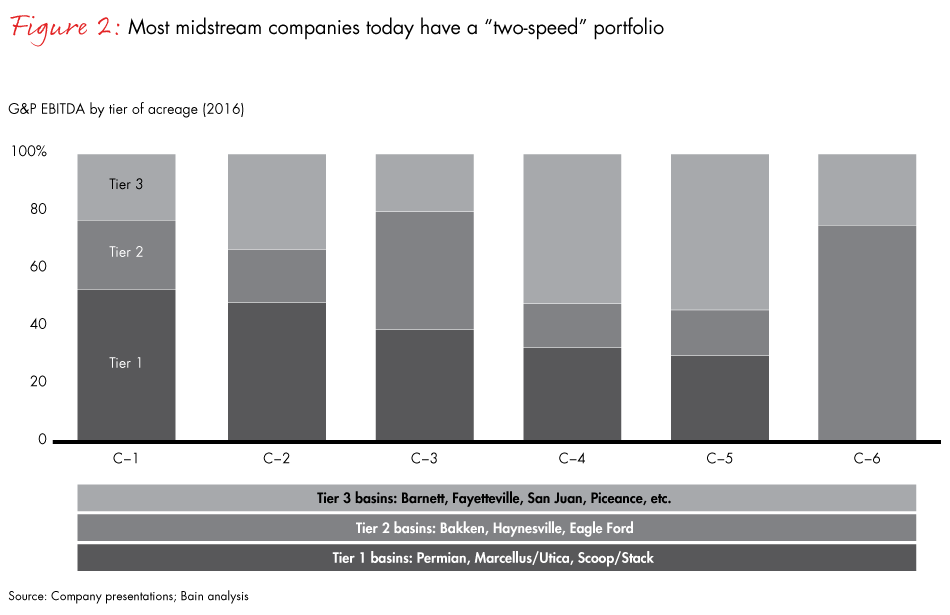
- Improve portfolio resilience. Most midstream companies have a two-speed portfolio, with promising Tier 1 assets, but also assets in Tier 2 and Tier 3 basins that are high on the cost curve today (see Figure 2). By measuring the resilience of their portfolio against projected E&P activity in several scenarios, midstream companies can get a better picture of how to manage these assets. This will help them establish realistic cost reduction targets. Sometimes traditional cost reduction levers are enough to help meet those targets, but in other cases companies may need to consolidate assets within a region, acquire new assets to build scale or sell off assets.
-
Chart a plan for growth beyond the next three years. Most midstream companies have their line of sight on growth projects over the next three years but not beyond that. The old approach of evaluating opportunities on a project-by-project basis worked well when there were many projects vying for capital. Now that an excess of capital is chasing fewer projects, companies need to define their strategic ambitions and determine where to play. Asking key questions can help.
- What business model along the full spectrum of options do we aspire to lead: pure play, integrated master limited partnership (MLP) or diversified energy infrastructure company?
- In which basins and markets can we gain a leading position?
- How much should we vertically integrate? What partnership and acquisition options do we have?
Strategy requires choices, and it’s not possible to build a first or second position in every basin. Increasingly, E&P customers ask midstream companies to provide vertically integrated solutions that can handle multiple commodities—oil, gas and NGLs. This means midstream executives will need to prioritize growth opportunities based on their capabilities to deliver, and then pursue growth organically and through M&A, as well as considering divestitures.
Any plan for growth also needs to address how to win. In this environment, we believe it is critical to differentiate in the eyes of the customer through a commercial excellence program that could include best practices like collocating engineers and project development resources with E&P customers, guaranteeing 24/7 gas control and offering greater flexibility of delivery locations.
-
Put in place the right operating model for G&P assets. Private equity has changed the gathering and processing business. For many years, G&P has sat uneasily in the portfolios of many midstream companies, given its higher risks and faster bidding and development cycle. But the higher rewards have attracted private equity capital, which has exacerbated these dynamics.
As a result, midstream companies are adopting several approaches to maximize the value of their G&P assets, including operating them as a separate business, tailoring their operating models and processes specifically to G&P, and even evaluating whether to spin them off as separate companies.
-
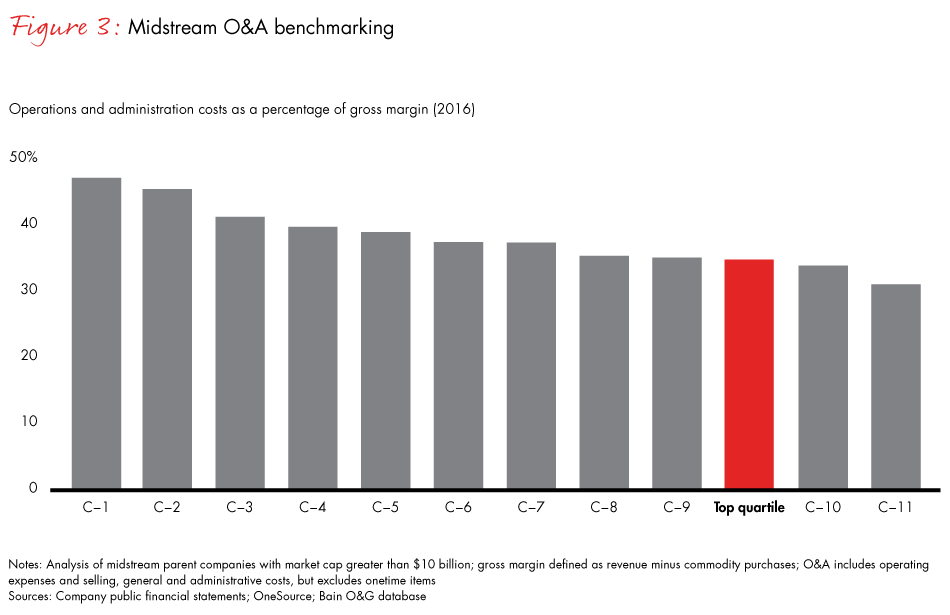
Set an ambitious cost agenda. During the rapid infrastructure buildout of recent years, midstream companies focused on getting pipes in the ground and plants built. Now that growth has slowed, efficiency becomes more important. Most companies have undergone one or more rounds of cost reductions, but executives believe there are further opportunities. Some companies have sold or acquired businesses, and senior managers are asking what the size of their organization should be. Our research indicates there’s still room for improvement: Among the 11 largest midstream companies, each of which has a market cap above $10 billion, large differences in cost performance exist (see Figure 3). On average, companies in the top quartile spent about 25% less on operations and administration, while the laggards in the other quartiles spent anywhere from $50 million to nearly $1 billion more.
A renewed effort at cost reduction begins with a baseline showing how costs and headcount have changed over time. Benchmarking these costs, both at the enterprise level and then by function and business, provides management teams with the data necessary to set realistic ambitions for cost reduction, keeping in mind the trade-offs that will accompany steps like outsourcing. At this point, management teams can begin to identify specific cost-reduction opportunities. Employing techniques like zero-based budgeting and zero-based review, along with more efficient digital technologies, can supercharge results.
Finally, companies should see multiple benefits from cost reduction, beyond the direct impact of lower cost and higher earnings. A second-order effect is that higher earnings will translate into higher distribution coverage, which has a direct correlation to trading multiples like price-to-earnings.
Few signs point to a quick resolution of the market conditions that have driven down oil and gas prices, and the long-term effects will continue to hinder midstream opportunities. However, midstream companies that can strengthen the resilience of their portfolios, take a more strategic approach to investment decisions and cut costs aggressively will put themselves in the best position to not just survive but thrive in the current “lower for longer” environment.
1 Scoop is the South Central Oklahoma Oil Province, and Stack is the Sooner Trend (oilfield) Anadarko (basin), mostly in Canadian and Kingfisher (counties).
Whit Keuer is a partner in Bain & Company’s Dallas office. He works with Bain’s Global Oil & Gas practice.
First published in 8월 2017