

Brief

한눈에 보기
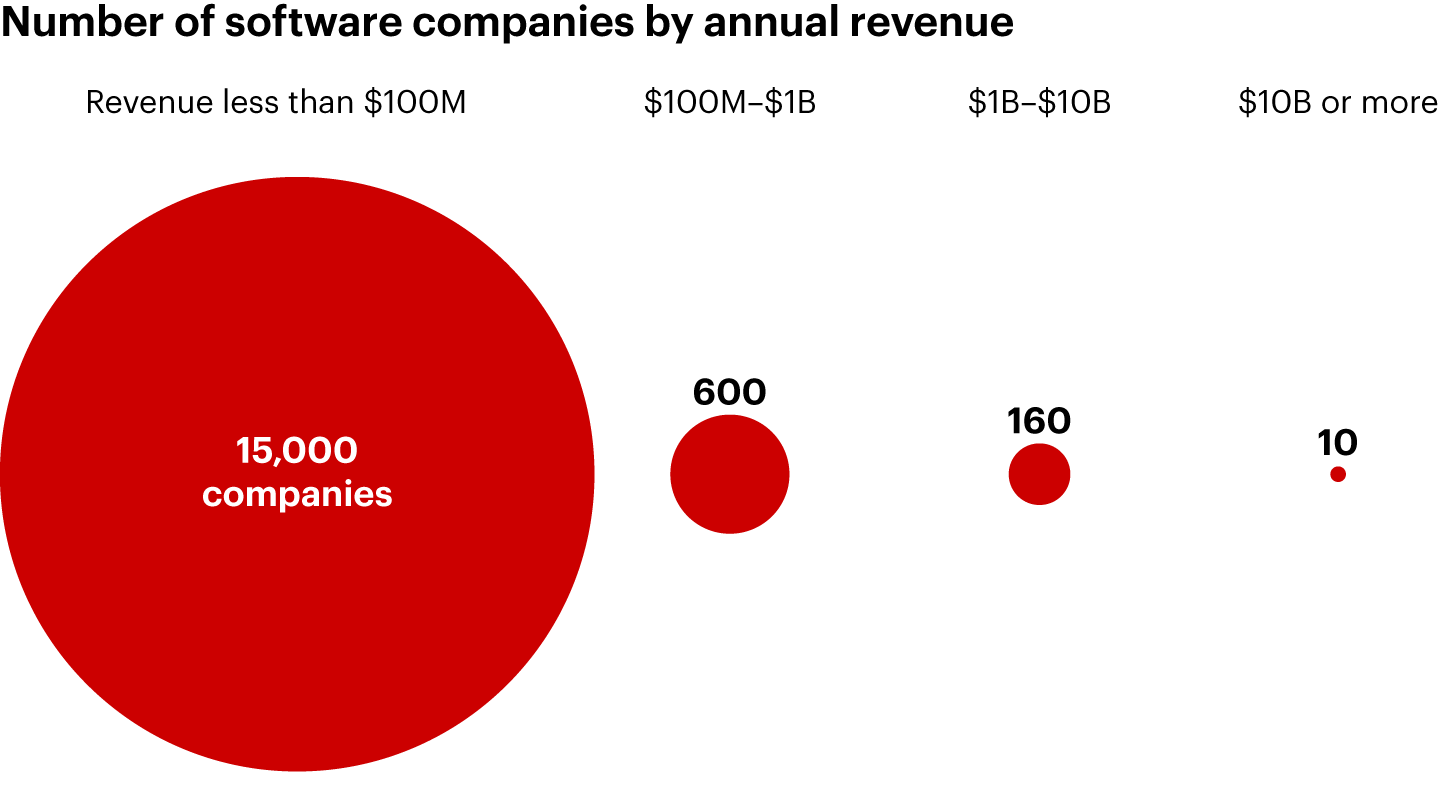
- Only 160 of the approximately 600 software firms with at least $100 million in annual revenue have scaled to $1 billion.
- Most achieved this by expanding their total addressable market, not creating a new market or chasing disruption.
- Aspiring $1 billion companies will need to evolve their initial go-to-market motions, product and R&D capabilities, and M&A strategy.
For software companies that have achieved $100 million in annual revenue, a daunting realization hits as they plot the course to $1 billion: What got the company here won’t get it there.
Most software executives recognize they will probably need to adjust their growth strategy to climb to the next level, but they often don’t know what needs to change or how to execute.
It’s no surprise, then, that so few software companies have been able to sustain growth at scale. Of the approximately 600 companies that have achieved $100 million in annual revenue, only 160 have crossed the chasm to $1 billion (see Figure 1).
Figure 1

The importance of TAM expansion in software
Software companies that reach $1 billion typically get there in one of three ways:
- creating a new market through pioneering products or services;
- significantly growing a market, often by capitalizing on disruption to rapidly gain share; or
- expanding the company’s total addressable market (TAM) by adding product offerings, either organically or via mergers and acquisitions, to serve a broader range of customers or customer needs.
Many executives make the mistake of hoping that their company falls into the first or second group. Few achieve that level of success, and often they don’t know if they’ll make it until they’ve made it. A lot of factors must go their way.
By far, the most common path to $1 billion in revenue for software firms is through TAM expansion. Leading companies recognize this reality and build it into their growth strategy.
Most software companies start by selling one product to one customer segment in primarily one region, with some focused on serving a single industry vertical. Diversifying across these four dimensions can expand the TAM (see Figure 2).
Figure 2
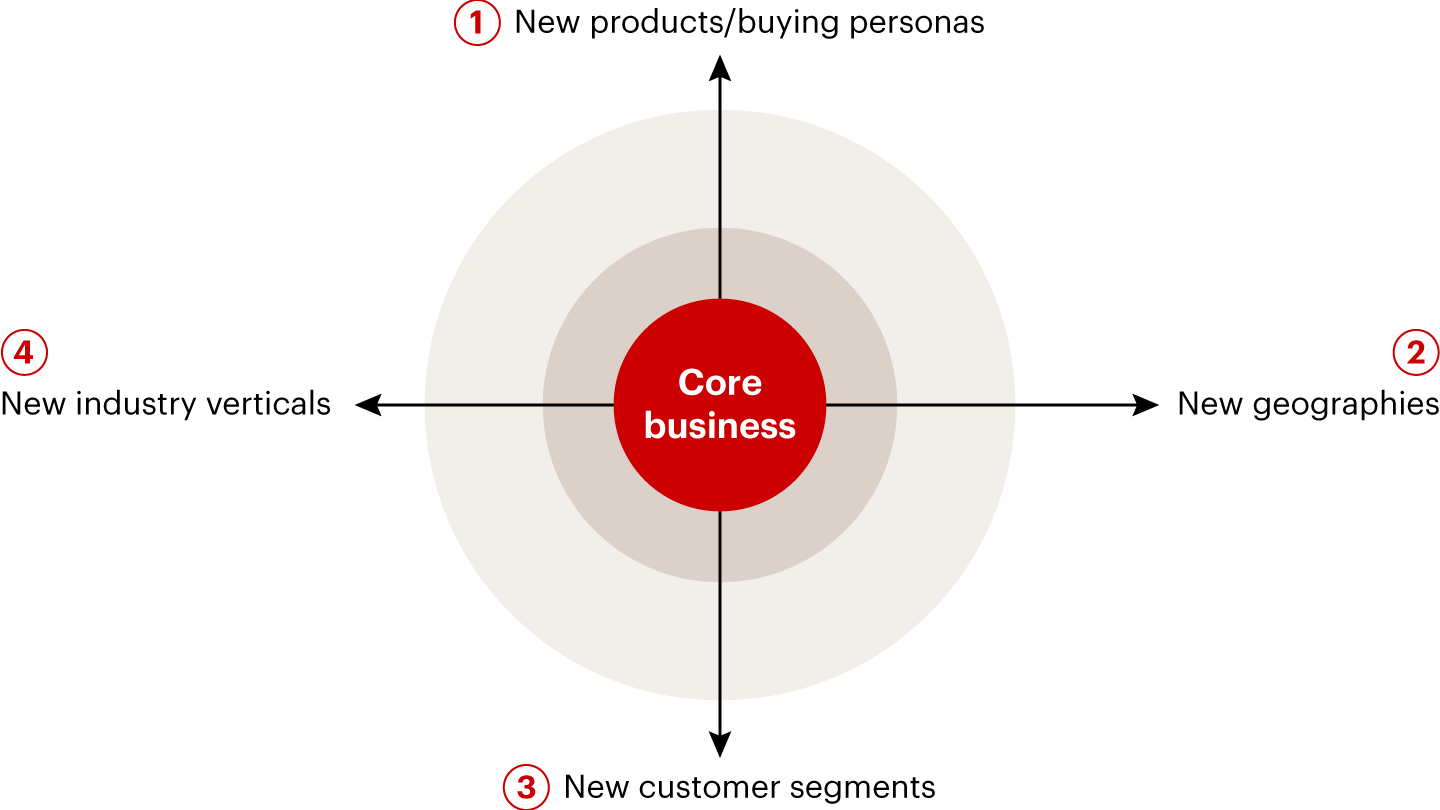

Most $1 billion software companies increase their offerings in more than one of these growth vectors. Our research found that around 80% of software companies with $1 billion to $3 billion in annual revenue sell at least two different major products. Almost all $1 billion software-as-a-service firms that initially focused on a single industry have expanded beyond their core vertical. In addition, our analysis of a group of about 90 $1 billion-plus software firms found that more than two-thirds generate at least 30% of their revenue from outside of their primary region.
That said, the leading companies recognize that TAM expansion must be done strategically, pursuing near adjacencies first to improve the odds of success. The more shared customers, costs, sales channels, capabilities, and competition that an adjacent portfolio move has in common with the core, the stronger a company’s competitive advantage, customer loyalty, and potential profitability will be.
For example, HubSpot started as a US-focused marketing platform for CMOs but evolved into a comprehensive customer platform serving the full C-suite. The company expanded its software product portfolio strategically, layering in sales and customer service solutions to create a complementary set of offerings sold to businesses of various sizes and geographic regions. This logical progression allowed HubSpot to capture a broader market, fueling its rapid growth from more than $100 million in revenue in 2014 to more than $1 billion just seven years later.
Why scaling software companies stall
There are plenty of cautionary tales of scaling software companies whose revenue growth stagnated after reaching $100 million. As they expand, companies often overestimate their ability to build and sell new products, displace sticky alternatives from competitors, and effectively serve different customer groups. The complex buying behavior of large enterprises can be particularly challenging. On top of that, the flush capital market of recent years provided many software companies with seemingly unconstrained budgets to pursue growth, even if the leadership team’s strategy was tenuous.
The bottom line is executive teams frequently underestimate how much the business must evolve to support growth at scale. Many fail to update the go-to-market model to sell several products, often misallocating resources across anchor, growth, and maintenance products. Many suffer breakdowns in cross-functional leadership—the downside of relying too much on a founder’s mentality.
The differences in what’s required on the path to $1 billion can be stark, such as when a company expands to serve new customer segments. Enterprise buyers demand customization and integrations, while smaller businesses prioritize simplicity. Sales cycles vary, as do distribution channels and customer support expectations. Companies that misjudge these nuances risk diluting their focus and stalling growth.
The execution playbook
The probability of reaching $1 billion in yearly revenue isn’t in executives’ favor, but there’s an emerging set of best practices they can follow to increase their odds. Based on our analysis of the market and our work with software companies around the world, the first step is to define the right growth strategy. Leading firms start with their vision of the company once it hits $1 billion, and they work backward from that future state to devise the right roadmap for TAM expansion.
Based on that roadmap, aspiring $1 billion companies invest in developing their go-to-market strategy, product and R&D organization, and corporate capabilities. Here are the key themes to consider in each area.
Rethinking the go-to-market model. As revenue streams diversify, the software go-to-market strategy must evolve to address new buyers and segments.
Selling multiple products often requires moving from “all in one” sales roles focused on chasing new customers to specialized sales teams tasked with both pursuing new customers and convincing existing ones to spend more. The routes to market might multiply, going from direct sales to using resellers, for example. Companies might need to add new sales motions for enterprise customers to complement their product-led growth approach. As the sales team grows larger and more complex, data analytics can help direct its focus and tactics. Strong management becomes essential to ensure best practices get adopted across the larger, more fragmented unit.
Meanwhile, entering new geographies or industries may demand new partnerships. Pricing and packaging need to adapt to a larger product portfolio. Marketing must evolve from a tactical focus on the bottom of the sales funnel to a data-driven approach spanning the full funnel. As growth scales, a well-structured customer success function with clear swim lanes becomes essential.
Zendesk is a case in point. Initially focused on small and midsize businesses, the company expanded into the enterprise market, requiring a fundamental shift in both product design and sales strategy. It introduced an enterprise suite with enhanced customization, security, and compliance features. At the same time, it built out a dedicated field sales team, recognizing that larger customers needed a higher-touch buying experience. Furthermore, it formed customer success teams assigned to each enterprise client. The result? Enterprise accounts grew to represent nearly 40% of Zendesk’s revenue.
Reengineering product strategy and R&D for scale. As companies extend beyond their core product, R&D complexity increases. Balancing investment between sustaining the core business and building for the future requires discipline. Many software leadership teams right now are contemplating AI as the next growth catalyst; succeeding in this area will require a distinct skill set, resourcing level, and pace of product development.
As they scale up, leading product and R&D organizations focus on getting a few tactical things right. These include managing the organizational structures and budgets across multiple products, proactively optimizing developers’ time and productivity, and implementing structured customer feedback loops, such as the Net Promoter ScoreSM system or a customer advisory board.
Building corporate capabilities for the long haul. Until the $100 million mark, software companies can afford to focus almost exclusively on building great products and selling them hard. But on the path to $1 billion, corporate capabilities, including M&A and careful profit management, become mission critical.
M&A, in particular, becomes a core growth engine, not just a one-off tactic. The most successful companies build a repeatable M&A capability that spans strategy, sourcing, diligence, and integration. That means developing a clear M&A thesis linked to the company’s growth goals, setting up rigorous screening processes to find the right deals, executing due diligence, and building a robust integration muscle to deliver value quickly and consistently.
No shortcuts
Reaching $1 billion in software revenue isn’t about a single bold move; it’s about executing the right set of strategic shifts over time. Companies that successfully scale prioritize smart market expansion, adapt their go-to-market strategies, invest in R&D discipline, and build the corporate infrastructure to support sustainable growth.
While there isn’t a one-size-fits-all solution, in Bain’s work with organizations on execution, we’ve found that applying the Founder’s Mentality® approach creates the strong focus required for leadership teams to ensure success. The journey of scaling software companies takes time, but for those who get it right, the payoff is immense.
The authors wish to thank Sushil Upadhyayula for his contributions to this article.

Founder's Mentality
Fast-growing companies can become global leaders without losing the values that helped them succeed. Bain’s research explores how large incumbents can also reignite their growth by recapturing their Founder’s Mentality®.
First published in 5월 2025