
Skip to Content
  • 오피스

    오피스

    미주
    • Atlanta
    • Austin
    • Bogota
    • Boston
    • Buenos Aires
    • Chicago
    • Dallas
    • Denver
    • Houston
    • Los Angeles
    • Mexico City
    • Minneapolis
    • Monterrey
    • Montreal
    • New York
    • Rio de Janeiro
    • San Francisco
    • Santiago
    • São Paulo
    • Seattle
    • Silicon Valley
    • Toronto
    • Washington, DC
    유럽, 중동, 아프리카
    • Amsterdam
    • Athens
    • Berlin
    • Brussels
    • Copenhagen
    • Doha
    • Dubai
    • Dusseldorf
    • Frankfurt
    • Helsinki
    • Istanbul
    • Johannesburg
    • Kyiv
    • Lisbon
    • London
    • Madrid
    • Milan
    • Munich
    • Oslo
    • Paris
    • Riyadh
    • Rome
    • Stockholm
    • Vienna
    • Warsaw
    • Zurich
    아시아, 호주
    • Bangkok
    • Beijing
    • Bengaluru
    • Brisbane
    • Ho Chi Minh City
    • Hong Kong
    • Jakarta
    • Kuala Lumpur
    • Manila
    • Melbourne
    • Mumbai
    • New Delhi
    • Perth
    • Seoul
    • Shanghai
    • Singapore
    • Sydney
    • Tokyo
    오피스 전체보기
  • 얼럼나이
  • 미디어 센터
  • 구독
  • 연락처
  • Korea | 한국어

    지역 및 언어 선택

    글로벌
    • Global (English)
    미주
    • Brazil (Português)
    • Argentina (Español)
    • Canada (Français)
    • Chile (Español)
    • Colombia (Español)
    유럽, 중동, 아프리카
    • France (Français)
    • DACH Region (Deutsch)
    • Italy (Italiano)
    • Spain (Español)
    • Greece (Elliniká)
    아시아, 호주
    • China (中文版)
    • Korea (한국어)
    • Japan (日本語)
  • Saved items (0)
    Saved items (0)

    You have no saved items.

    관심 있는 내용을 북마크하여 Red 폴더에 저장할 수 있습니다. Red 폴더 에서 저장된 내용을 읽거나 공유해보세요.

    Explore Bain Insights
  • 산업
    메인 메뉴

    산업

    • 우주항공, 방산 및 정부 서비스
    • 농업 관련 산업
    • 화학
    • 인프라, 건설 및 건축 자재
    • 소비재
    • 금융 서비스
    • 헬스케어
    • 산업용 기계 및 장비
    • 미디어 및 엔터테인먼트
    • 금속
    • 광업
    • 석유 및 가스
    • 제지 및 패키징 산업
    • 사모펀드
    • 사회 및 공공 부문
    • 유통
    • 기술
    • 텔레콤
    • 운송
    • 여행·여가
    • 유틸리티 및 재생가능 에너지
  • 컨설팅 서비스
    메인 메뉴

    컨설팅 서비스

    • Customer Experience
    • ESG
    • Innovation
    • M&A
    • 운영
    • 조직
    • 사모펀드
    • 고객 전략 및 마케팅
    • 전략
    • AI, 인사이트 및 솔루션
    • Technology
    • 변화 혁신
  • Digital
  • 인사이트
  • 베인 소개
    메인 메뉴

    베인 소개

    • 업무 소개
    • 베인의 신념
    • 구성원 및 리더십 소개
    • 고객 성과
    • 주요 수상 경력
    • 글로벌 파트너사
    Further: Our global responsibility
    • 다양성과 포용
    • 사회 공헌 활동
    • Sustainability
    • World Economic Forum
    Learn more about Further
  • Careers
    메인 메뉴

    Careers

    • Work with Us
      Careers
      Work with Us
      • Find Your Place
      • Our Work Areas
      • Integrated Teams
      • Students
      • Internships & Programs
      • Recruiting Events
    • Life at Bain
      Careers
      Life at Bain
      • Blog: Inside Bain
      • Career Stories
      • Our People
      • Where We Work
      • Supporting Your Growth
      • Affinity Groups
      • Benefits
    • Impact Stories
    • Hiring Process
      Careers
      Hiring Process
      • What to Expect
      • Interviewing
    FIND JOBS
  • 오피스
    메인 메뉴

    오피스

    • 미주
      오피스
      미주
      • Atlanta
      • Austin
      • Bogota
      • Boston
      • Buenos Aires
      • Chicago
      • Dallas
      • Denver
      • Houston
      • Los Angeles
      • Mexico City
      • Minneapolis
      • Monterrey
      • Montreal
      • New York
      • Rio de Janeiro
      • San Francisco
      • Santiago
      • São Paulo
      • Seattle
      • Silicon Valley
      • Toronto
      • Washington, DC
    • 유럽, 중동, 아프리카
      오피스
      유럽, 중동, 아프리카
      • Amsterdam
      • Athens
      • Berlin
      • Brussels
      • Copenhagen
      • Doha
      • Dubai
      • Dusseldorf
      • Frankfurt
      • Helsinki
      • Istanbul
      • Johannesburg
      • Kyiv
      • Lisbon
      • London
      • Madrid
      • Milan
      • Munich
      • Oslo
      • Paris
      • Riyadh
      • Rome
      • Stockholm
      • Vienna
      • Warsaw
      • Zurich
    • 아시아, 호주
      오피스
      아시아, 호주
      • Bangkok
      • Beijing
      • Bengaluru
      • Brisbane
      • Ho Chi Minh City
      • Hong Kong
      • Jakarta
      • Kuala Lumpur
      • Manila
      • Melbourne
      • Mumbai
      • New Delhi
      • Perth
      • Seoul
      • Shanghai
      • Singapore
      • Sydney
      • Tokyo
    오피스 전체보기
  • 얼럼나이
  • 미디어 센터
  • 구독
  • 연락처
  • Korea | 한국어
    메인 메뉴

    지역 및 언어 선택

    • 글로벌
      지역 및 언어 선택
      글로벌
      • Global (English)
    • 미주
      지역 및 언어 선택
      미주
      • Brazil (Português)
      • Argentina (Español)
      • Canada (Français)
      • Chile (Español)
      • Colombia (Español)
    • 유럽, 중동, 아프리카
      지역 및 언어 선택
      유럽, 중동, 아프리카
      • France (Français)
      • DACH Region (Deutsch)
      • Italy (Italiano)
      • Spain (Español)
      • Greece (Elliniká)
    • 아시아, 호주
      지역 및 언어 선택
      아시아, 호주
      • China (中文版)
      • Korea (한국어)
      • Japan (日本語)
  • Saved items  (0)
    메인 메뉴
    Saved items (0)

    You have no saved items.

    관심 있는 내용을 북마크하여 Red 폴더에 저장할 수 있습니다. Red 폴더 에서 저장된 내용을 읽거나 공유해보세요.

    Explore Bain Insights
  • 산업
    • 산업

      • 우주항공, 방산 및 정부 서비스
      • 농업 관련 산업
      • 화학
      • 인프라, 건설 및 건축 자재
      • 소비재
      • 금융 서비스
      • 헬스케어
      • 산업용 기계 및 장비
      • 미디어 및 엔터테인먼트
      • 금속
      • 광업
      • 석유 및 가스
      • 제지 및 패키징 산업
      • 사모펀드
      • 사회 및 공공 부문
      • 유통
      • 기술
      • 텔레콤
      • 운송
      • 여행·여가
      • 유틸리티 및 재생가능 에너지
  • 컨설팅 서비스
    • 컨설팅 서비스

      • Customer Experience
      • ESG
      • Innovation
      • M&A
      • 운영
      • 조직
      • 사모펀드
      • 고객 전략 및 마케팅
      • 전략
      • AI, 인사이트 및 솔루션
      • Technology
      • 변화 혁신
  • Digital
  • 인사이트
  • 베인 소개
    • 베인 소개

      • 업무 소개
      • 베인의 신념
      • 구성원 및 리더십 소개
      • 고객 성과
      • 주요 수상 경력
      • 글로벌 파트너사
      Further: Our global responsibility
      • 다양성과 포용
      • 사회 공헌 활동
      • Sustainability
      • World Economic Forum
      Learn more about Further
  • Careers
    최근 검색어
      최근 방문 페이지

      Content added to saved items

      Saved items (0)

      Removed from saved items

      Saved items (0)

      Technology Report

      Sovereign AI Is the Next Fault Line in the Global Tech Sector

      Sovereign AI Is the Next Fault Line in the Global Tech Sector

      The electronics supply chain was only the start of tech’s global decoupling.

      글 Anne Hoecker, Jonathan Frick, Jue Wang, Balaji Thirumalai, and Karen Harris

      • 읽기 소요시간
      }

      Report

      Sovereign AI Is the Next Fault Line in the Global Tech Sector
      en
      한눈에 보기
      • Sovereign AI blocs are emerging as governments worldwide spend billions of dollars subsidizing domestic computing infrastructure and AI models.
      • Locally based data center providers account for nearly a quarter of new computing capacity coming online in the next few years.
      • Despite sovereign AI momentum, tech incumbents’ global scale and deep coffers provide significant advantages over domestic competitors.
      • Data center operators will enjoy a short-term windfall, but there’s a real risk of overcapacity.

      This article is part of Bain's 2024 Technology Report.

      Explore the report

      As technology companies race to capitalize on breakthroughs in large language models (LLMs) and generative artificial intelligence (AI), executives must now grapple with an additional layer of complexity and opportunity: the emergence of “sovereign” AI blocs around the world.

      De-globalization in technology began with the electronics supply chain, particularly semiconductors. Disruptions from Covid-19 and geopolitical tensions between the US and China (including export controls and restrictive policies on trade and talent) pushed tech companies to rapidly invest in making their supply chains more resilient. They’ve expanded their manufacturing footprints beyond China and created more flexibility within their talent pools. With government support, companies are building new semiconductor hubs in places including the US, India, Germany, and Japan.

      Now the post-globalization movement in technology is spreading to data, AI, security, and privacy. Governments worldwide—including India, Japan, France, Canada, and the United Arab Emirates—are spending billions of dollars to subsidize sovereign AI. In other words, they’re investing in domestic computing infrastructure and AI models developed within their borders, trained on local data and languages.

      While it’s tempting to compare sovereign AI to the decoupling of semiconductor supply chains, the challenges are quite different. For example, compared to the semiconductor market, which has a complex supply chain with intellectual property fragmented throughout, the AI market is easier to enter. This is largely due to open-source LLMs, which make launching new AI products simpler.

      As the sovereign AI push picks up steam, several factors will determine how it plays out.

      Factors favoring sovereign AI

      1. National interests: Governments view localized AI as critical for protecting data privacy, ensuring national security, building or strengthening domestic high-tech ecosystems, and growing their economies. Countries can’t afford to fully rely on others for AI and cloud computing capabilities due to the economic value at stake and the decoupling of the countries leading the AI race—the US and China.
      2. Infrastructure: Like any utility, physical infrastructure for AI and cloud computing must be built somewhere and will require massive capital investments in data centers, computing capacity, and electrical grids. These investments intersect with other national infrastructure issues like the green transition in the electricity grid, which AI’s significant power demand will complicate. Locally based data center providers account for nearly a quarter of new computing capacity coming online in the next few years, while technology hyperscalers are planning to add the most (see Figure 1). It’s also notable that national governments have ordered at least 40,000 graphics processing units (GPUs) themselves over the past year.
      Figure 1
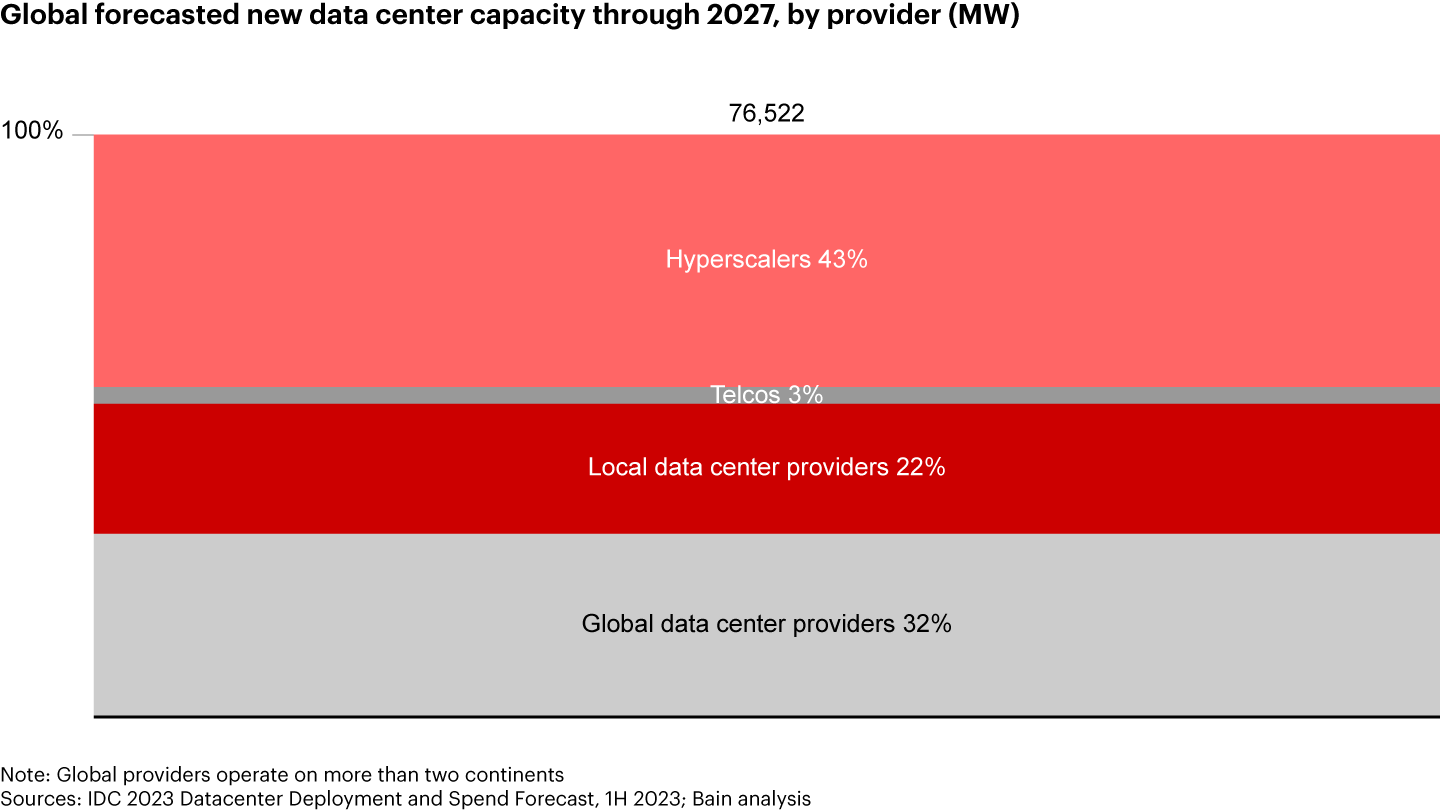
      Nearly a quarter of new data center capacity will come from local providers, with hyperscalers planning the most capacity
      1. Regulatory strategies: AI regulatory strategies are diverging across borders. The leading AI markets—the US, EU, and China—are taking very different approaches so far.
      2. Localization: Many AI models will need to be specific to local languages and context. Some applications will differ across countries to comply with security and privacy regulations and meet local market needs. AI use cases in healthcare, education, and agriculture, for example, will vary greatly between developed and emerging economies.

      Factors working against sovereign AI

      1. Scope of subsidies: Thus far, governments haven’t subsidized national AI initiatives to the extent seen with semiconductor fabs or to the degree likely required to nurture local champions that could compete at scale with global incumbents. (The powerful open-source LLM series Falcon, backed by hundreds of millions of dollars from an arm of the United Arab Emirates government, is a notable exception.)
      2. Global scale: This still provides critical advantages for developing a winning AI platform, including network effects (e.g., access to a large developer ecosystem), deep coffers, and the ability to spread R&D costs across worldwide operations. LLM training costs have grown exponentially over the past few years, with the most expensive models exceeding $100 million (see Figure 2). Although smaller, more cost-efficient models are also being released, the cost dynamics continue to favor large global firms.
      Figure 2
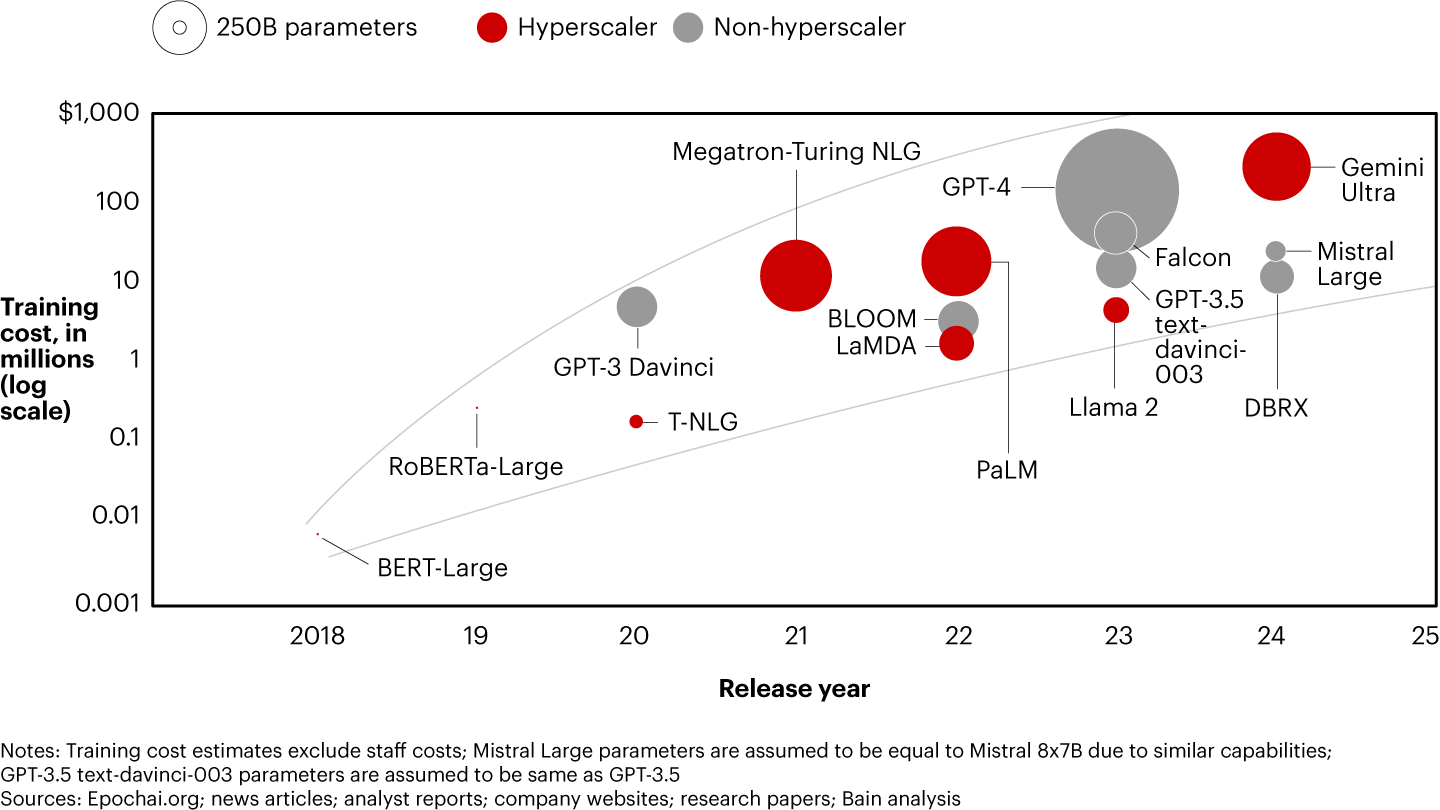
      Large language model training costs have increased exponentially, but smaller, more cost-efficient models are also being released
      1. Incumbents’ adaptation: Global tech companies are adapting to governments’ push for sovereign AI by localizing operations, complying with local rules, and forming joint ventures with local firms.
      2. Practical realities: Aspiring domestic competitors must navigate the same practical realities as multinational companies: significant investments in securing land, regulatory approvals, power, connectivity, and other key elements for AI initiatives.

      Takeaways for executives

      Establishing successful sovereign AI ecosystems will be time-consuming and incredibly expensive. While less complex in some important ways than building semiconductor fabs, these projects require more than securing local subsidies.

      Hyperscalers and other big tech firms may continue to invest in localized operations. This could fragment their ecosystems and R&D globally, though their scale will remain a significant advantage.

      New AI workloads and fragmentation created by sovereignty could enable AI challengers to reach hyperscale. These challengers will need to recognize the power of the current hyperscaler ecosystem and prioritize business opportunities that capitalize on their competitive advantages, while partnering with big tech companies where possible.

      Data center operators and hardware suppliers will enjoy a short-term windfall as companies and governments splurge on computing capacity. Nvidia, for example, projected $10 billion in revenue from governments’ sovereign AI investments in 2024, up from zero last year. However, data center owners risk overcapacity, similar to telecom networks in the early 2000s. Suppliers of silicon and other hardware may see accelerated growth rates level off long-term.

      Lastly, investors have a chance to stake high-value claims in a hot asset class, including new sub-asset classes. For example, secured financing tied to GPUs is becoming a more common form of corporate debt. Successful investors will base bets on a well-defined risk/return profile, deciding between lower-risk investments in “picks and shovels” like GPUs and data centers or higher-risk/higher-reward investments such as LLMs and cloud platforms.

      Read the Next Chapter

      Five Functions Where AI Is Already Delivering

      Read our 2024 Technology Report

      Download the PDF Explore the report

      More from the report

      • Commercializing Innovation

      • Investing in a Shifting Market

      • Scope M&A

      • Sovereign AI

      • Top AI Functions

      • The AI Opportunity

      • Big and Small Computing

      • The AI Chip Shortage

      • The Software Cycle

      • AI in Tech Services

      • Deploying Generative AI

      • Software Development Efficiency

      • Customer Success

      • AI Everywhere

      저자
      • Headshot of Anne Hoecker
        Anne Hoecker
        파트너, Silicon Valley
      • Headshot of Jonathan Frick
        Jonathan Frick
        파트너, London
      • Headshot of Jue Wang
        Jue Wang
        파트너, Silicon Valley
      • Headshot of Balaji Thirumalai
        Balaji Thirumalai
        파트너, Bengaluru
      • Headshot of Karen Harris
        Karen Harris
        Managing Director, Macro Trends Group, New York
      문의하기
      관련 산업
      • 기술
      관련 컨설팅 서비스
      • 어드밴스드 애널리틱스
      • Digital
      최적의 솔루션 찾기
      • Artificial Intelligence
      Technology Report
      Will Agentic AI Disrupt SaaS?

      Disruption is mandatory. Obsolescence is optional.

      자세히 보기
      기술
      Why SaaS Stocks Have Dropped—and What It Signals for Software’s Next Chapter

      A sharp reset in valuations reflects AI-driven disruption, slowing retention, and a growing divide between incumbents and future winners.

      자세히 보기
      Artificial Intelligence Insights
      Want More Out of Your AI Investments? Think People First

      To unlock AI’s exponential productivity potential, companies must modernize workflow and workforce in tandem.

      자세히 보기
      Artificial Intelligence Insights
      Life Sciences’ AI Momentum Requires a Workforce Redesign

      AI scalers aren't waiting for new talent—they're building it.

      자세히 보기
      Technology Report
      State of the Art of Agentic AI Transformation

      Tech-forward enterprises have cracked the code on ROI for AI. Falling behind is riskier than ever as the next wave of agentic AI raises the stakes.

      자세히 보기
      First published in 9월 2024
      태그
      • 기술
      • 어드밴스드 애널리틱스
      • Artificial Intelligence
      • Artificial Intelligence Insights
      • CIO Insights
      • Digital
      • Technology Report

      프로젝트 사례

      지속 가능성 및 기업의 사회적 책임 Can Microchips Turbocharge Sustainability Improvement?

      See more related case studies

      고객 전략 및 마케팅 Increased sales productivity frees selling time and saves millions

      See more related case studies

      성과 개선 Aggressively growing an IT service provider with a high-performance culture

      See more related case studies

      베인에 궁금하신 점이 있으신가요?

      베인은 주저 없이 변화를 마주할 줄 아는 용감한 리더들과 함께합니다. 그리고, 이들의 담대한 용기는 고객사의 성공으로 이어집니다.

      급변하는 비즈니스 환경에서 살아남기 위한 선도자의 시각. 월간 Bain Insights에서 글로벌 비즈니스의 핵심 이슈를 확인하십시오.

      *개인정보 정책을 읽었으며 그 내용에 동의합니다.

      Privacy Policy를 읽고 동의해주십시오.
      Bain & Company
      문의하기 환경정책 Accessibility 이용약관 개인정보 보호 쿠키 사용 정책 Sitemap Log In

      © 1996-2026 Bain & Company, Inc.

      문의하기

      무엇을 도와드릴까요?

      • 프로젝트 문의
      • 채용 정보
      • 언론
      • 제휴 문의
      • 연사 초청
      오피스 전체보기