

Brief

한눈에 보기
- After consumption collapsed, many payments companies focused first on stabilizing their business.
- Now they face medium-term challenges and opportunities, namely the accelerated transition to digital payments. Regulators, for instance, are limiting cash notes and promoting contactless payments.
- Leading companies have started to take action now that will put them in a better position through the economic volatility to come.
- Some are making moves to earn the trust of consumers and merchants. Those that can afford to are going on offense to gain market share. And others are improving their credit risk assessment tools and working capital solutions.
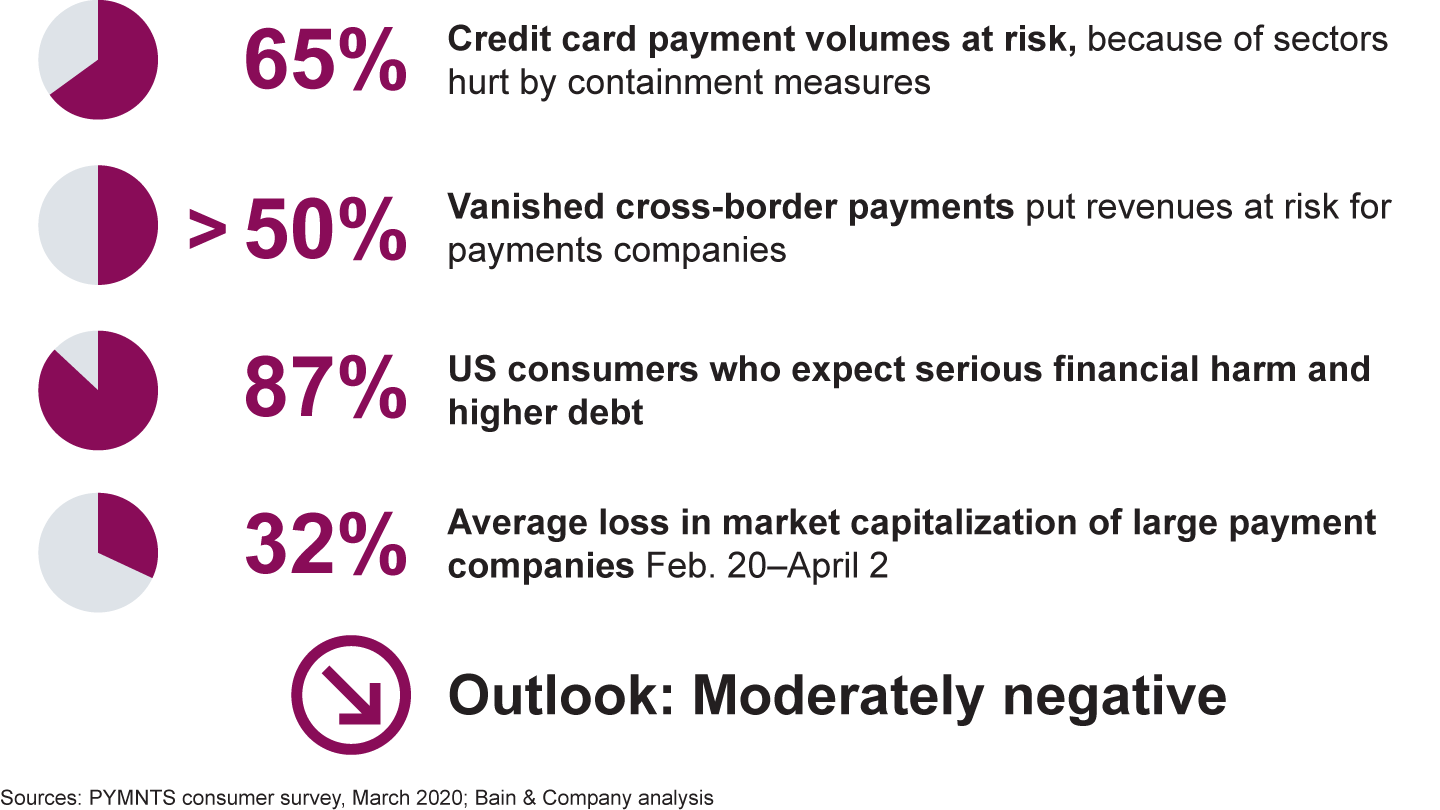
In the wake of its grim toll on health, the coronavirus has caused consumption in many industries to collapse. That, in turn, led the volume of payments for the restaurant, transportation, tourism and other sectors to plunge. Even some e-commerce categories ranging from clothes to furniture have gone quiet. Highly vulnerable sectors account for roughly two-thirds of consumer-to-business payment volumes worldwide, Bain & Company estimates.

Macro Surveillance Platform
For more detail on the business implications of coronavirus from Bain’s Macro Trends Group, log on to the Macro Surveillance Platform. Learn more about the platform >
With the disappearance of most international travel, cross-border transactions have dropped. The higher transaction fees and foreign-exchange spread in these transactions mean that cross-border payments represent more than half of revenues for many payment companies (see Figure 1). As a result, we estimate a roughly 30% decline in 2020 revenues, on average, from companies with high exposure to cross-border payments, such as challenger banks Monzo and Revolut and some card networks.
Figure 1

To be sure, some payments companies have seen demand for their services take off. Payment apps PayPal and Square Cash, for instance, are staffing up across the board, according to the Thinknum job posting database. PayPal job slots have more than doubled so far this year, including for its analytics team as PayPal aims to better understand the rearrangement of societal norms.
Most types of payments companies, however, will need sharp responses to stabilize their business in the near term. They can reduce costs quickly through the following moves:
- reprioritize IT and business projects, postponing or slowing some, canceling others and accelerating those that further business continuity, such as digitalization of contact centers and middle-back office activities;
- shift recruiting to focus only on the highest-priority roles;
- reallocate resources to where they are most needed—for instance, from central office to client support;
- evaluate one-off adjustments to managers’ compensation;
- take a zero-based, clean-sheet approach to nonstrategic costs; and
- release additional cash trapped in the balance sheet through moves such as reducing the stock of point-of-sale terminals.
Contactless, not cash, will be king
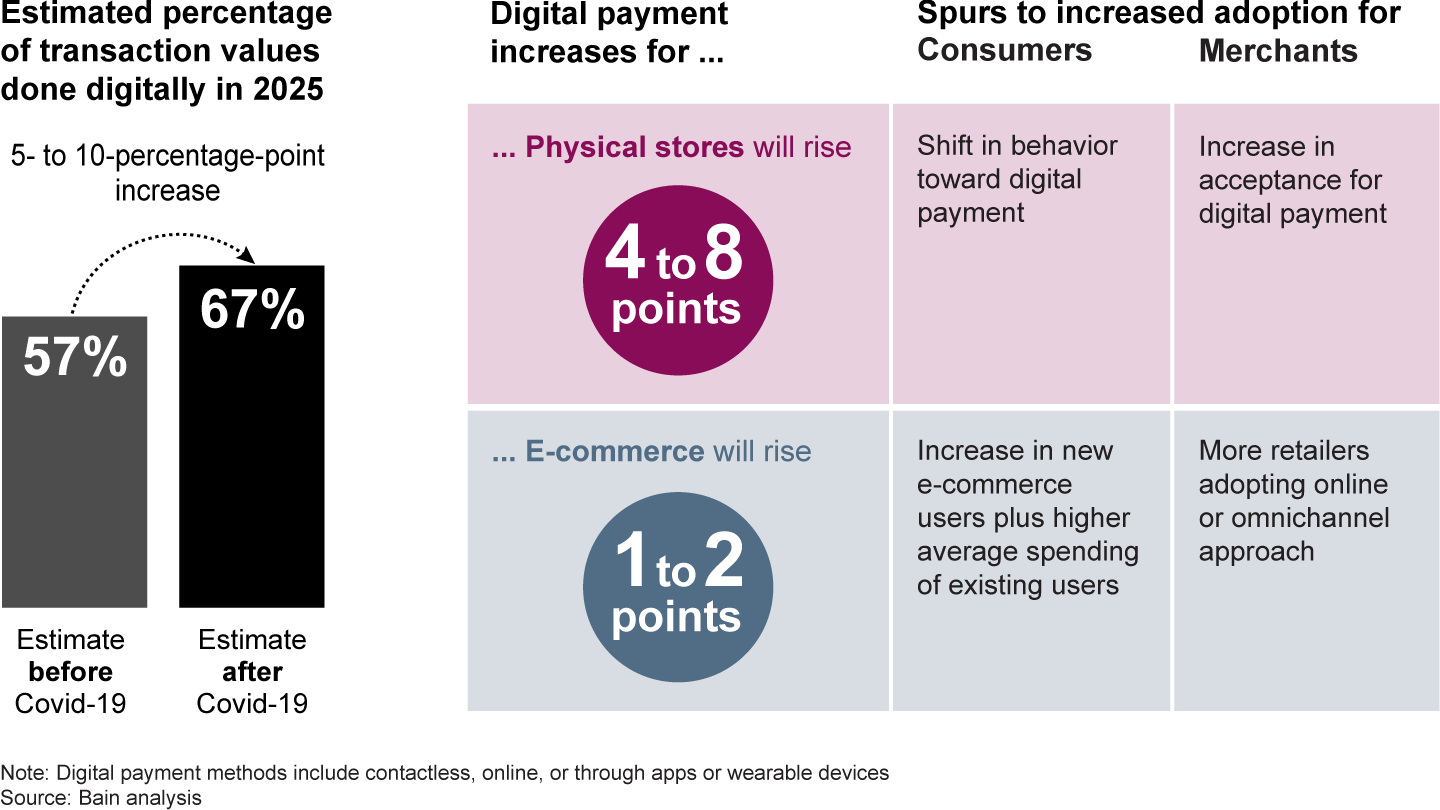
Stabilizing the business is just the first concern. There’s a bigger, structural change occurring—the transition to digital payments—which will accelerate when the economy eventually recovers. By 2025, we estimate that the adoption of digital payments could accelerate by 5 percentage points to 10 percentage points globally, above what was previously anticipated (see Figure 2).
Figure 2

Assuming reliable security features, digital payment systems have much to recommend them. Microorganisms can transfer to credit cards when point-of-sale terminals serve multiple people. Cash and check payments also are expensive and inefficient for the financial system to operate. Physical cards and PIN pads at a store checkout carry similar health risks. As a result, regulators and government agencies have responded by limiting cash in circulation and quarantining bank notes. They also are promoting digital payments through measures such as increasing the limit on contactless transactions in dozens of countries around the world.
Meanwhile, private digital wallet providers such as Ordo have been waiving fees. Merchants have ramped up their e-commerce, delivery and card-not-present capabilities, often in partnership with providers, such as retailers working with Paytm in India and restaurants working with Paymentsense and Delivery Hero in Europe.
Some auto companies that have been offering in-car fuel payment capabilities since early 2017, when Jaguar and Shell launched the first system, now have broader ambitions. Mastercard, for instance, is partnering with self-service kiosk provider Zivelo and restaurant chain Sonic Drive-In to develop a voice-ordering and recommendations system for dynamic menus.
The magnitude of the pandemic’s effects will differ depending on a company’s position on the payment value chain and its customer base. Yet as consumers and merchants speed up their adoption of digital payments, all providers will have to find ways to strengthen their customer relationships, so that they get their fair share of the market. Three broad actions apply here:
1. Earn customers’ trust
Success in payments obviously requires excellent customer service to both consumers and merchants. What’s less obvious is what form that should take when the threat of a renewed pandemic is always lurking.
One effective tactic is to help merchants build a web storefront and pickup and delivery options that do not require signatures. To help customers in financial stress, the options include deferred payments for credit cards, waived subscription fees or free trials.
Square, for instance, is providing clients with tips on how to keep their businesses thriving. Clover provides a list of government, corporate and nonprofit resources that can provide aid. PayPal, Intuit QuickBooks and Square were approved by the US government to distribute loans to small businesses. Intuit QuickBooks will also process payroll information to help more small businesses to get approved.
2. Go on offense to gain market share
Payments companies that can afford to maintain or even boost their marketing have a number of options. Among consumers, they can promote fast enrollment for online or card-on-file transactions. They can also enable instant issuance of prepaid cards for online and physical shopping, targeting young or unbanked consumers.
Among merchants, they can market instant, easy e-commerce and card-not-present services. Merchants in industries that can benefit from stronger e-commerce and delivery capabilities will welcome pay-by-link or pay-later solutions.
Nexi in Italy, for instance, recently offered small merchants use of its pay-by-link service for free. Through the service, customers can pay for products via email, text or social networks. In the UK, Paymentsense launched a dedicated website for taverns and small restaurants to take online orders. The site contains additional marketing resources such as guides to create a branded online page, build customer flyers or issue gift vouchers.
Providers should also consider doubling down on value-added services. This trend has been most evident in Asia, where merchants and consumers leapfrogged over traditional payment solutions to nascent mobile phone offerings. Grab and Gojek, which both began in on-demand ride hailing, have built multifunction apps including payments, to increase customer stickiness. Singapore-based Grab offers food delivery, hotel booking, video, ticketing and travel. Gojek, based in Indonesia, has built a suite of services around its core two-wheeler transport, including food and parcel delivery, ticketing, moving and cleaning.
3. Fine-tune the credit machine
Standard metrics of consumer or merchant creditworthiness may no longer capture the increasingly volatile economic conditions. Credit risk assessment tools will need to be upgraded. Providers should also acquire fraud detection models, especially in categories seeing a sharp rise in e-commerce transactions due to the pandemic.
At the same time, it’s worth evaluating supply chain finance and working capital solutions that help distressed merchants, such as cash advances related to point-of-sale volumes.
For instance, Ebury, a European fintech company, launched an initiative to offer financing to small and medium-sized businesses in the UK and Europe, initially to help them manage their working capital. E-commerce giant Shopify is offering cash advances to merchant clients in Canada. The cash advances are insured by Export Development Canada, and Shopify told the Financial Post that the advances are low risk and seamless, because the company can see the merchant’s selling history and has all of the necessary financial data to make underwriting decisions.
Finally, it’s critical to assess risk in the credit portfolio by client segments, then evaluate temporary suspensions of monthly payments for clients with Covid-related light financial distress (people with a one-month job furlough or small businesses shuttered due to lockdown). For other clients, with deeper financial troubles, define a refinancing process to help them repay their debt.
It’s too soon to guess when the coronavirus will abate, or for how long, or the duration and depth of the current economic downturn. What’s clear, though, is that payments systems have entered a new phase of digital innovation. Thoughtful moves in the areas described here raise the odds of thriving through the digital shift rather than being rendered obsolete.

Coronavirus
The global Covid-19 pandemic has extracted a terrible human toll and spurred sweeping changes in the world economy. Across industries, executives have begun reassessing their strategies and repositioning their companies to thrive now and in the world beyond coronavirus.
Vincenzo Gringoli, Glen Williams, John Ott and Thomas Olsen are partners with Bain & Company’s Financial Services practice. They are based, respectively, in Milan, London, Shanghai and New York.
First published in 4월 2020