
Skip to Content
  • 오피스

    오피스

    미주
    • Atlanta
    • Austin
    • Bogota
    • Boston
    • Buenos Aires
    • Chicago
    • Dallas
    • Denver
    • Houston
    • Los Angeles
    • Mexico City
    • Minneapolis
    • Monterrey
    • Montreal
    • New York
    • Rio de Janeiro
    • San Francisco
    • Santiago
    • São Paulo
    • Seattle
    • Silicon Valley
    • Toronto
    • Washington, DC
    유럽, 중동, 아프리카
    • Amsterdam
    • Athens
    • Berlin
    • Brussels
    • Copenhagen
    • Doha
    • Dubai
    • Dusseldorf
    • Frankfurt
    • Helsinki
    • Istanbul
    • Johannesburg
    • Kyiv
    • Lisbon
    • London
    • Madrid
    • Milan
    • Munich
    • Oslo
    • Paris
    • Riyadh
    • Rome
    • Stockholm
    • Vienna
    • Warsaw
    • Zurich
    아시아, 호주
    • Bangkok
    • Beijing
    • Bengaluru
    • Brisbane
    • Ho Chi Minh City
    • Hong Kong
    • Jakarta
    • Kuala Lumpur
    • Manila
    • Melbourne
    • Mumbai
    • New Delhi
    • Perth
    • Seoul
    • Shanghai
    • Singapore
    • Sydney
    • Tokyo
    오피스 전체보기
  • 얼럼나이
  • 미디어 센터
  • 구독
  • 연락처
  • Korea | 한국어

    지역 및 언어 선택

    글로벌
    • Global (English)
    미주
    • Brazil (Português)
    • Argentina (Español)
    • Canada (Français)
    • Chile (Español)
    • Colombia (Español)
    유럽, 중동, 아프리카
    • France (Français)
    • DACH Region (Deutsch)
    • Italy (Italiano)
    • Spain (Español)
    • Greece (Elliniká)
    아시아, 호주
    • China (中文版)
    • Korea (한국어)
    • Japan (日本語)
  • Saved items (0)
    Saved items (0)

    You have no saved items.

    관심 있는 내용을 북마크하여 Red 폴더에 저장할 수 있습니다. Red 폴더 에서 저장된 내용을 읽거나 공유해보세요.

    Explore Bain Insights
  • 산업
    메인 메뉴

    산업

    • 우주항공, 방산 및 정부 서비스
    • 농업 관련 산업
    • 화학
    • 인프라, 건설 및 건축 자재
    • 소비재
    • 금융 서비스
    • 헬스케어
    • 산업용 기계 및 장비
    • 미디어 및 엔터테인먼트
    • 금속
    • 광업
    • 석유 및 가스
    • 제지 및 패키징 산업
    • 사모펀드
    • 사회 및 공공 부문
    • 유통
    • 기술
    • 텔레콤
    • 운송
    • 여행·여가
    • 유틸리티 및 재생가능 에너지
  • 컨설팅 서비스
    메인 메뉴

    컨설팅 서비스

    • Customer Experience
    • ESG
    • Innovation
    • M&A
    • 운영
    • 조직
    • 사모펀드
    • 고객 전략 및 마케팅
    • 전략
    • AI, 인사이트 및 솔루션
    • Technology
    • 변화 혁신
  • Digital
  • 인사이트
  • 베인 소개
    메인 메뉴

    베인 소개

    • 업무 소개
    • 베인의 신념
    • 구성원 및 리더십 소개
    • 고객 성과
    • 주요 수상 경력
    • 글로벌 파트너사
    Further: Our global responsibility
    • 다양성과 포용
    • 사회 공헌 활동
    • Sustainability
    • World Economic Forum
    Learn more about Further
  • Careers
    메인 메뉴

    Careers

    • Work with Us
      Careers
      Work with Us
      • Find Your Place
      • Our Work Areas
      • Integrated Teams
      • Students
      • Internships & Programs
      • Recruiting Events
    • Life at Bain
      Careers
      Life at Bain
      • Blog: Inside Bain
      • Career Stories
      • Our People
      • Where We Work
      • Supporting Your Growth
      • Affinity Groups
      • Benefits
    • Impact Stories
    • Hiring Process
      Careers
      Hiring Process
      • What to Expect
      • Interviewing
    FIND JOBS
  • 오피스
    메인 메뉴

    오피스

    • 미주
      오피스
      미주
      • Atlanta
      • Austin
      • Bogota
      • Boston
      • Buenos Aires
      • Chicago
      • Dallas
      • Denver
      • Houston
      • Los Angeles
      • Mexico City
      • Minneapolis
      • Monterrey
      • Montreal
      • New York
      • Rio de Janeiro
      • San Francisco
      • Santiago
      • São Paulo
      • Seattle
      • Silicon Valley
      • Toronto
      • Washington, DC
    • 유럽, 중동, 아프리카
      오피스
      유럽, 중동, 아프리카
      • Amsterdam
      • Athens
      • Berlin
      • Brussels
      • Copenhagen
      • Doha
      • Dubai
      • Dusseldorf
      • Frankfurt
      • Helsinki
      • Istanbul
      • Johannesburg
      • Kyiv
      • Lisbon
      • London
      • Madrid
      • Milan
      • Munich
      • Oslo
      • Paris
      • Riyadh
      • Rome
      • Stockholm
      • Vienna
      • Warsaw
      • Zurich
    • 아시아, 호주
      오피스
      아시아, 호주
      • Bangkok
      • Beijing
      • Bengaluru
      • Brisbane
      • Ho Chi Minh City
      • Hong Kong
      • Jakarta
      • Kuala Lumpur
      • Manila
      • Melbourne
      • Mumbai
      • New Delhi
      • Perth
      • Seoul
      • Shanghai
      • Singapore
      • Sydney
      • Tokyo
    오피스 전체보기
  • 얼럼나이
  • 미디어 센터
  • 구독
  • 연락처
  • Korea | 한국어
    메인 메뉴

    지역 및 언어 선택

    • 글로벌
      지역 및 언어 선택
      글로벌
      • Global (English)
    • 미주
      지역 및 언어 선택
      미주
      • Brazil (Português)
      • Argentina (Español)
      • Canada (Français)
      • Chile (Español)
      • Colombia (Español)
    • 유럽, 중동, 아프리카
      지역 및 언어 선택
      유럽, 중동, 아프리카
      • France (Français)
      • DACH Region (Deutsch)
      • Italy (Italiano)
      • Spain (Español)
      • Greece (Elliniká)
    • 아시아, 호주
      지역 및 언어 선택
      아시아, 호주
      • China (中文版)
      • Korea (한국어)
      • Japan (日本語)
  • Saved items  (0)
    메인 메뉴
    Saved items (0)

    You have no saved items.

    관심 있는 내용을 북마크하여 Red 폴더에 저장할 수 있습니다. Red 폴더 에서 저장된 내용을 읽거나 공유해보세요.

    Explore Bain Insights
  • 산업
    • 산업

      • 우주항공, 방산 및 정부 서비스
      • 농업 관련 산업
      • 화학
      • 인프라, 건설 및 건축 자재
      • 소비재
      • 금융 서비스
      • 헬스케어
      • 산업용 기계 및 장비
      • 미디어 및 엔터테인먼트
      • 금속
      • 광업
      • 석유 및 가스
      • 제지 및 패키징 산업
      • 사모펀드
      • 사회 및 공공 부문
      • 유통
      • 기술
      • 텔레콤
      • 운송
      • 여행·여가
      • 유틸리티 및 재생가능 에너지
  • 컨설팅 서비스
    • 컨설팅 서비스

      • Customer Experience
      • ESG
      • Innovation
      • M&A
      • 운영
      • 조직
      • 사모펀드
      • 고객 전략 및 마케팅
      • 전략
      • AI, 인사이트 및 솔루션
      • Technology
      • 변화 혁신
  • Digital
  • 인사이트
  • 베인 소개
    • 베인 소개

      • 업무 소개
      • 베인의 신념
      • 구성원 및 리더십 소개
      • 고객 성과
      • 주요 수상 경력
      • 글로벌 파트너사
      Further: Our global responsibility
      • 다양성과 포용
      • 사회 공헌 활동
      • Sustainability
      • World Economic Forum
      Learn more about Further
  • Careers
    최근 검색어
      최근 방문 페이지

      Content added to saved items

      Saved items (0)

      Removed from saved items

      Saved items (0)

      Technology Report

      US-China Decoupling Accelerates, and Shockwaves Spread

      US-China Decoupling Accelerates, and Shockwaves Spread

      The separation of the world’s two largest economies is growing faster, wider, and deeper than predicted.

      글 Anne Hoecker, Jason Ding, Karen Harris, Ravi Vijayaraghavan, and Jue Wang

      • 읽기 소요시간
      }

      Report

      US-China Decoupling Accelerates, and Shockwaves Spread
      en
      한눈에 보기
      • The Ukraine crisis and Covid-19 have added to preexisting tension, accelerating the geopolitical detangling of China and the US.
      • Ramifications are radiating beyond the two countries, with Europe taking a regulatory lead and Asian countries attracting businesses leaving or seeking alternatives to China.
      • To avoid prematurely cutting off access to markets or lower-cost production, companies must time their decoupling to match the pace of the markets.

      This article is part of Bain's 2022 Technology Report.

      Explore the report

      In the past 12 months, the geopolitical detangling of China and the United States that began several years ago rapidly accelerated. As the world moves away from unconstrained globalization centered on growth and efficiency and toward a fractured system of competing technological standards, higher costs, and increased constraints, technology companies and their leaders must thread a narrow passage. Pull out too soon from lower-cost manufacturing arrangements and a company ends up functioning at a cost disadvantage relative to competitors. Fail to invest enough in the future, and it risks finding itself with an insufficiently robust supply chain when the next unexpected emergency arises.

      Geopolitical concerns are already fueling supply chain diversification and other realignments (see Figure 1). As the Chinese Internet moves further away from the global web and toward its local version, Internet platforms including Airbnb, LinkedIn, and Yahoo have left the market due to censorship or operational difficulties. And recent data indicates that early start-up investment is significantly slowing in China. As investments are made and factories built in new places, a more permanent decoupling becomes more likely. 

      Figure 1
      Amid geopolitical concerns, electronics supply chains are diversifying

      Covid-19 has been a powerful accelerant. Half of the CIOs and CTOs surveyed by Bain in June said that China’s zero-Covid policy has affected their business, and at least a dozen major US technology companies have blamed the lockdown of Shanghai for missing quarterly revenue and earnings estimates.

      The virus has contributed to a talent decoupling as well, reducing the exchange of ideas and innovation as the number of foreigners in China fell by half over the past two years, according to data from the China Demographic and Economic Census, and the share of nonimmigrant visas issued by the US to Chinese citizens dropped from 16% in 2018 to 4% in 2021 (see Figure 2). Student exchange is off sharply too.

      Figure 2
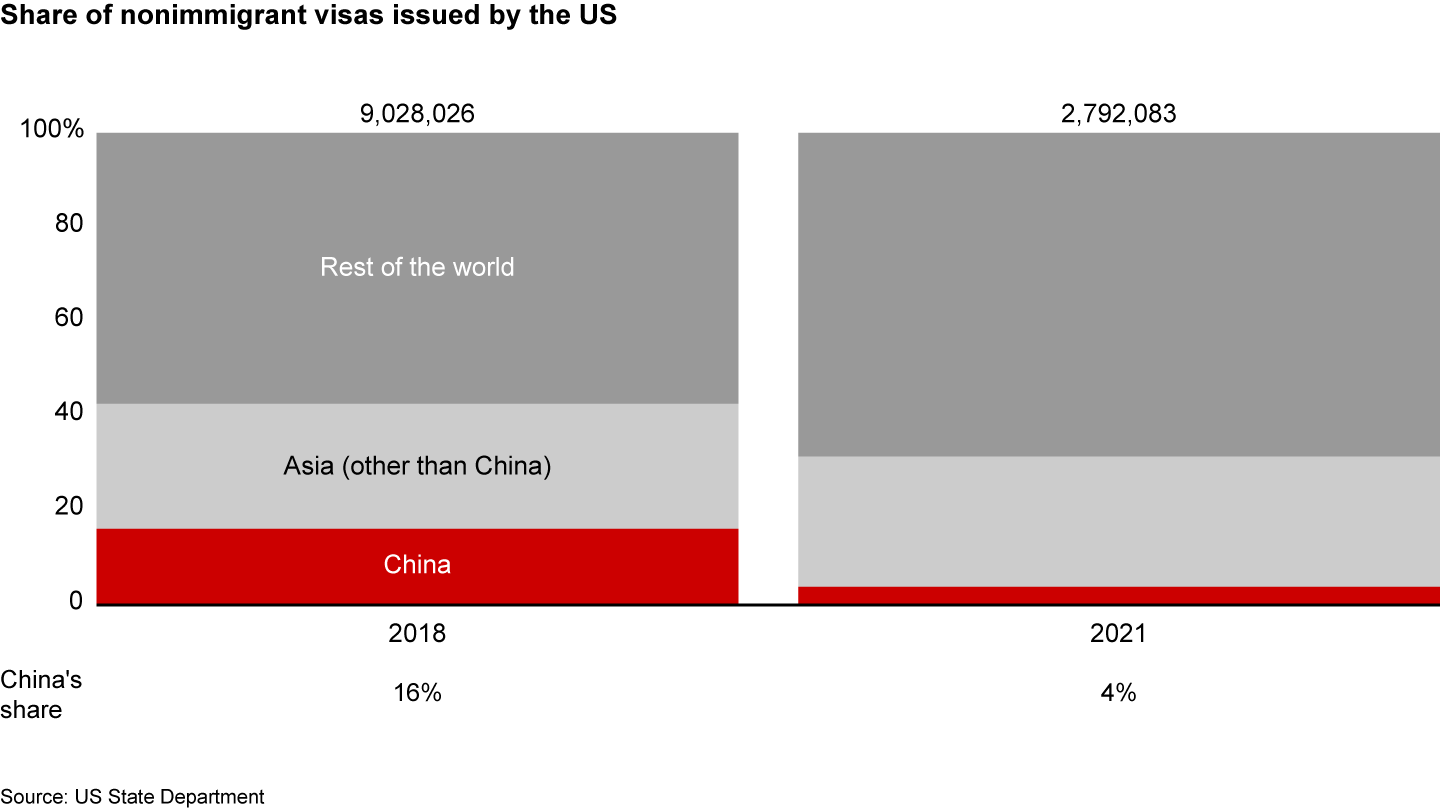
      China’s share of nonimmigrant visas to the US has declined by 75% since 2018

      The Ukraine crisis accentuated companies’ need to make geopolitical moves quickly, and their willingness to prioritize geopolitics over economics in certain instances. By early June, at least 133 technology companies had withdrawn from or suspended operations in Russia. Though Russia is a smaller market and easier for many to exit than China, the degree of response remains remarkable. 

      The ramifications of the US-China decoupling are radiating around the world. 

      China

      China has committed $1.4 trillion over five years to build strategic technologies and digital infrastructure domestically, including 5G, smart cities, and Internet of Things applications for manufacturing.

      In a retreat to something closer to the model multinationals used when they first sought access to China, some companies are closing research and development (R&D) labs and other operations there, and setting up partnerships to sell and distribute products developed and made outside of the country. Companies that retain extensive local operations must comply with regulations that can be quite expensive. Greater China is the largest global market for electric vehicles in terms of both exports and sales, and Tesla’s revenue in China grew more than 120% to $6.7 billion in 2020 after its Shanghai Gigafactory opened. China now accounts for more than 20% of the company’s total revenue. But in a sign of the limits for multinationals, Tesla vehicles have been banned in recent months from districts and certain city streets during political events, apparently due to concern about the data gathered by their cameras and sensors, even though all data is stored inside the country.

      The United States

      The US continues to restrict trade with China and heighten its regulatory oversight of Chinese companies operating in the US. In June, a law blocking most imports from China’s Xinjiang region, home to many Uyghur, went into effect, threatening to further interrupt shipments of polysilicon, a material essential to making solar energy panels, and raise compliance costs. This could add to inflation and, over time, accelerate a shift of some supply chains out of China.

      The CHIPS for America Act, which establishes investments and incentives to support US semiconductor manufacturing, independent R&D, and the supply chain, was signed into law by President Joe Biden in August. China’s Semiconductor Manufacturing International Corp. is on the US Commerce Department’s entity list limiting the company’s access to key US technologies.

      There have been a few glimmers that the US and China could work together. In May, Shanghai’s Semcorp Advanced Materials Group announced it will establish a manufacturing facility in Sidney, Ohio, to make separator film, a key component in electric vehicle batteries. And in August, the two governments reportedly reached an accommodation that would allow US officials to inspect audits of Chinese companies listed on US stock exchanges. The deal could avoid the delisting of more than 200 companies valued at roughly $1 trillion.

      Europe emerges

      Intense scrutiny and regulation of data sharing and privacy has Europe emerging as a regulatory leader. Rising tensions with China are fueling a desire for tech independence, including domestic chip production. In response to Chinese sanctions on European human rights advocates, the European Parliament passed a resolution on May 20, 2021, to freeze ratification of the EU–China Comprehensive Agreement on Investment. Ten months later, Intel announced its initial investment in the EU.

      Asia beyond China

      This region has become something of a buffer zone, attracting businesses leaving or seeking alternatives to China, as well as those seeking to generally broaden their geographic footprint, especially in semiconductors. In addition to domestic and European investments, US semiconductor giant GlobalFoundries is spending more than $4 billion to expand its Singapore wafer plant and capacity. Industry leader Taiwan Semiconductor Manufacturing Co. is boosting to $8.6 billion its investment in a new plant in Kumamoto, Japan. Rohm Semiconductor, a Japanese semiconductor and electronic components designer and manufacturer, has opened a new center in India to tap local engineering talent, technology, and partners, and the South Korean government plans to invest $451 billion in its own chipmakers.

      What should companies do now? 

      Untangling these markets is complex, and even with this year’s acceleration, will take time. Companies must consider what investments they need to balance potential short-term shocks, like the war in Ukraine, with building a long-term, geopolitically resilient business mix. The difficulty of cross-border M&A means companies have to think through smaller acquisitions and new approaches to growth. Planning the talent pipeline for each market, navigating increasing cross-border regulation, and investing in supply chain diversity and resilience are complicated and expensive. All this must happen while managing rising inflation, supply chain shortages, and general market turbulence.

      Pacing the rate of decoupling to reflect what customers and competitors are doing will help companies avoid disadvantaging themselves by prematurely cutting off access to markets or lower-cost production.

      Read the Next Chapter

      Incumbents vs. Disrupters: The Best Defense Is Offense

      Value Evolution

      • The Rise of Growth Equity Investors

      • A Multicloud World

      • Welcome to Web3

      • The US-China Decoupling

      Competitive Battlegrounds

      • Defending against Disruption

      • The Engine 2 Imperative

      • AI’s Next Frontier

      • The Industrial IoT

      Operational Advantage

      • Beyond the Rule of 40

      • Sales Productivity

      • Consumption-Based Pricing

      • Software R&D Efficiencies

      • The Chip Shortage

      • The Circular Economy

      Read our 2022 Technology Report

      Explore the report Download PDF
      저자
      • Headshot of Anne Hoecker
        Anne Hoecker
        파트너, Silicon Valley
      • Headshot of Jason Ding
        Jason Ding
        파트너, Hong Kong
      • Headshot of Karen Harris
        Karen Harris
        Managing Director, Macro Trends Group, New York
      • Headshot of Ravi Vijayaraghavan
        Ravi Vijayaraghavan
        파트너, Singapore
      • Headshot of Jue Wang
        Jue Wang
        파트너, Silicon Valley
      문의하기
      관련 산업
      • 기술
      • Cloud Computing
      • Internet of Things
      • IT Services
      • Semiconductors
      • Software
      Technology Report
      To Scale the Industrial Internet of Things, Don’t Forget Hardware

      Just like software companies, OEMs and hardware makers are critical to getting the industrial IoT to the next level.

      자세히 보기
      Technology Report
      Will Agentic AI Disrupt SaaS?

      Disruption is mandatory. Obsolescence is optional.

      자세히 보기
      CIO Insights
      Despite Tech Layoffs, Competition for Talent Remains Fierce

      Tech workers increasingly value career development opportunities and remote or hybrid work options, while compensation has soared.

      자세히 보기
      Technology Report
      State of the Art of Agentic AI Transformation

      Tech-forward enterprises have cracked the code on ROI for AI. Falling behind is riskier than ever as the next wave of agentic AI raises the stakes.

      자세히 보기
      기술
      Using Hardware to Scale the Industrial Internet of Things

      Bain partners discuss the opportunity for hardware vendors to help companies develop their IoT pilots.

      자세히 보기
      First published in 9월 2022
      태그
      • 기술
      • CIO Insights
      • Cloud Computing
      • Internet of Things
      • IT Services
      • Semiconductors
      • Software
      • Technology Report

      프로젝트 사례

      지속 가능성 및 기업의 사회적 책임 Can Microchips Turbocharge Sustainability Improvement?

      See more related case studies

      고객 전략 및 마케팅 A Go-to-Market Redesign Helps a Tech Company Thrive

      See more related case studies

      Helping a Midsize ERP Player Compete against the Giants

      See more related case studies

      베인에 궁금하신 점이 있으신가요?

      베인은 주저 없이 변화를 마주할 줄 아는 용감한 리더들과 함께합니다. 그리고, 이들의 담대한 용기는 고객사의 성공으로 이어집니다.

      급변하는 비즈니스 환경에서 살아남기 위한 선도자의 시각. 월간 Bain Insights에서 글로벌 비즈니스의 핵심 이슈를 확인하십시오.

      *개인정보 정책을 읽었으며 그 내용에 동의합니다.

      Privacy Policy를 읽고 동의해주십시오.
      Bain & Company
      문의하기 환경정책 Accessibility 이용약관 개인정보 보호 쿠키 사용 정책 Sitemap Log In

      © 1996-2026 Bain & Company, Inc.

      문의하기

      무엇을 도와드릴까요?

      • 프로젝트 문의
      • 채용 정보
      • 언론
      • 제휴 문의
      • 연사 초청
      오피스 전체보기