
Skip to Content
  • Bureaux

    Bureaux

    Amérique du Nord et Amérique du Sud
    • Atlanta
    • Austin
    • Bogota
    • Boston
    • Buenos Aires
    • Chicago
    • Dallas
    • Denver
    • Houston
    • Los Angeles
    • Mexico City
    • Minneapolis
    • Monterrey
    • Montreal
    • New York
    • Rio de Janeiro
    • San Francisco
    • Santiago
    • São Paulo
    • Seattle
    • Silicon Valley
    • Toronto
    • Washington, DC
    Europe, Moyen-Orient et Afrique
    • Amsterdam
    • Athens
    • Berlin
    • Brussels
    • Copenhagen
    • Doha
    • Dubai
    • Dusseldorf
    • Frankfurt
    • Helsinki
    • Istanbul
    • Johannesburg
    • Kyiv
    • Lisbon
    • London
    • Madrid
    • Milan
    • Munich
    • Oslo
    • Paris
    • Riyadh
    • Rome
    • Stockholm
    • Vienna
    • Warsaw
    • Zurich
    Asie et Australie
    • Bangkok
    • Beijing
    • Bengaluru
    • Brisbane
    • Ho Chi Minh City
    • Hong Kong
    • Jakarta
    • Kuala Lumpur
    • Manila
    • Melbourne
    • Mumbai
    • New Delhi
    • Perth
    • Seoul
    • Shanghai
    • Singapore
    • Sydney
    • Tokyo
    Voir tous les bureaux
  • Alumni
  • Presse
  • S’abonner
  • Contacter
  • France | Français

    Sélectionnez votre région et votre langue

    Global
    • Global (English)
    Amérique du Nord et Amérique du Sud
    • Brazil (Português)
    • Argentina (Español)
    • Canada (Français)
    • Chile (Español)
    • Colombia (Español)
    Europe, Moyen-Orient et Afrique
    • France (Français)
    • DACH Region (Deutsch)
    • Italy (Italiano)
    • Spain (Español)
    • Greece (Elliniká)
    Asie et Australie
    • China (中文版)
    • Korea (한국어)
    • Japan (日本語)
  • Saved items (0)
    Saved items (0)

    You have no saved items.

    Bookmark content that interests you and it will be saved here for you to read or share later.

    Explore Bain Insights
  • Expertises Sectorielles
    Menu principal

    Expertises Sectorielles

    • Aerospace et Défense
    • Agroalimentaire
    • Chimie
    • Infrastructures, BTP et Matériaux de Construction
    • Grande Consommation
    • Services Financiers
    • Santé
    • Engins & Equipements Industriels
    • Media et Divertissement
    • Metals
    • Mining
    • Pétrole & Gaz
    • Papier et Emballage
    • Private Equity
    • Secteur Public
    • Distribution
    • Technologie
    • Télécommunications
    • Transportation
    • Travel & Leisure
    • Utilities & Energies Renouvelables
  • Expertises Fonctionnelles
    Menu principal

    Expertises Fonctionnelles

    • Expérience Client
    • ESG
    • Innovation
    • Fusions et Acquisitions
    • Opérations
    • People & Organization
    • Private Equity
    • Sales & Marketing
    • Stratégie
    • IA, Perspectives et Solutions
    • Technology
    • Transformation
  • Digital
  • Points de Vue
  • À propos
    Menu principal

    À propos

    • Notre Activité
    • Nos Valeurs
    • Nos Collaborateurs et Notre Équipe Dirigeante
    • Notre Impact
    • Prix & Récompenses
    • Partenariats Internationaux
    • Evénements
    Further: Our global responsibility
    • Diversité et Inclusion
    • Impact Social
    • Sustainability
    • World Economic Forum
    Learn more about Further
  • Carrières
    Menu principal

    Carrières

    • Rejoignez-nous
      Carrières
      Rejoignez-nous
      • Find Your Place
      • Nos domaines d’expertise
      • Equipes multidisciplinaires
      • Étudiants
      • Stages et programmes
      • Événements de recrutement
    • La vie chez Bain
      Carrières
      La vie chez Bain
      • Blog: Inside Bain
      • Récits de carrière
      • Nos collaborateurs
      • Nos bureaux
      • Soutenir votre évolution professionnelle
      • Groupes d’affinités
      • Avantages chez Bain
    • Histoires d’impact
    • Notre processus de recrutement
      Carrières
      Notre processus de recrutement
      • Ce que vous pouvez attendre
      • Entretiens
    Trouver un poste
  • Bureaux
    Menu principal

    Bureaux

    • Amérique du Nord et Amérique du Sud
      Bureaux
      Amérique du Nord et Amérique du Sud
      • Atlanta
      • Austin
      • Bogota
      • Boston
      • Buenos Aires
      • Chicago
      • Dallas
      • Denver
      • Houston
      • Los Angeles
      • Mexico City
      • Minneapolis
      • Monterrey
      • Montreal
      • New York
      • Rio de Janeiro
      • San Francisco
      • Santiago
      • São Paulo
      • Seattle
      • Silicon Valley
      • Toronto
      • Washington, DC
    • Europe, Moyen-Orient et Afrique
      Bureaux
      Europe, Moyen-Orient et Afrique
      • Amsterdam
      • Athens
      • Berlin
      • Brussels
      • Copenhagen
      • Doha
      • Dubai
      • Dusseldorf
      • Frankfurt
      • Helsinki
      • Istanbul
      • Johannesburg
      • Kyiv
      • Lisbon
      • London
      • Madrid
      • Milan
      • Munich
      • Oslo
      • Paris
      • Riyadh
      • Rome
      • Stockholm
      • Vienna
      • Warsaw
      • Zurich
    • Asie et Australie
      Bureaux
      Asie et Australie
      • Bangkok
      • Beijing
      • Bengaluru
      • Brisbane
      • Ho Chi Minh City
      • Hong Kong
      • Jakarta
      • Kuala Lumpur
      • Manila
      • Melbourne
      • Mumbai
      • New Delhi
      • Perth
      • Seoul
      • Shanghai
      • Singapore
      • Sydney
      • Tokyo
    Voir tous les bureaux
  • Alumni
  • Presse
  • S’abonner
  • Contacter
  • France | Français
    Menu principal

    Sélectionnez votre région et votre langue

    • Global
      Sélectionnez votre région et votre langue
      Global
      • Global (English)
    • Amérique du Nord et Amérique du Sud
      Sélectionnez votre région et votre langue
      Amérique du Nord et Amérique du Sud
      • Brazil (Português)
      • Argentina (Español)
      • Canada (Français)
      • Chile (Español)
      • Colombia (Español)
    • Europe, Moyen-Orient et Afrique
      Sélectionnez votre région et votre langue
      Europe, Moyen-Orient et Afrique
      • France (Français)
      • DACH Region (Deutsch)
      • Italy (Italiano)
      • Spain (Español)
      • Greece (Elliniká)
    • Asie et Australie
      Sélectionnez votre région et votre langue
      Asie et Australie
      • China (中文版)
      • Korea (한국어)
      • Japan (日本語)
  • Saved items  (0)
    Menu principal
    Saved items (0)

    You have no saved items.

    Bookmark content that interests you and it will be saved here for you to read or share later.

    Explore Bain Insights
  • Expertises Sectorielles
    • Expertises Sectorielles

      • Aerospace et Défense
      • Agroalimentaire
      • Chimie
      • Infrastructures, BTP et Matériaux de Construction
      • Grande Consommation
      • Services Financiers
      • Santé
      • Engins & Equipements Industriels
      • Media et Divertissement
      • Metals
      • Mining
      • Pétrole & Gaz
      • Papier et Emballage
      • Private Equity
      • Secteur Public
      • Distribution
      • Technologie
      • Télécommunications
      • Transportation
      • Travel & Leisure
      • Utilities & Energies Renouvelables
  • Expertises Fonctionnelles
    • Expertises Fonctionnelles

      • Expérience Client
      • ESG
      • Innovation
      • Fusions et Acquisitions
      • Opérations
      • People & Organization
      • Private Equity
      • Sales & Marketing
      • Stratégie
      • IA, Perspectives et Solutions
      • Technology
      • Transformation
  • Digital
  • Points de Vue
  • À propos
    • À propos

      • Notre Activité
      • Nos Valeurs
      • Nos Collaborateurs et Notre Équipe Dirigeante
      • Notre Impact
      • Prix & Récompenses
      • Partenariats Internationaux
      • Evénements
      Further: Our global responsibility
      • Diversité et Inclusion
      • Impact Social
      • Sustainability
      • World Economic Forum
      Learn more about Further
  • Carrières
    Recherches les plus fréquentes
    • Agile
    • Digital
    • Stratégie
    Vos recherches précédentes
      Pages récemment visitées

      Content added to saved items

      Saved items (0)

      Removed from saved items

      Saved items (0)

      Etude

      Beyond COP26: An Action Plan for CEOs

      Beyond COP26: An Action Plan for CEOs

      As measures to tackle climate change accelerate, more companies will approach their own carbon transitions with the same results orientation as any other strategic transformation.

      Par Torsten Lichtenau, Jenny Davis-Peccoud, Emmet Gaffney, et Mattias C. Karlsson

      • min
      }

      Etude

      Beyond COP26: An Action Plan for CEOs
      en
      At a Glance
      • In the wake of the 26th Conference of the Parties, a UN conference on climate change, senior executives can expect more regulations, greater demands for climate-related financial disclosures, and closer scrutiny from investors and customers.
      • Many companies have announced ambitious plans to reduce their emissions, in some cases to net zero, but fewer are making great progress turning those ambitions into action.
      • Four initiatives can help: making the carbon transition integral to strategy, finding ways to monetize investments in carbon reduction, embedding the transition into the business, and engaging middle management.

      Managing and mitigating climate change is the greatest challenge of our time, and the 26th UN Conference of the Parties in Glasgow, Scotland—better known as COP26—represents a milestone in the world’s efforts to take concerted action.

      Six years after the landmark Paris Agreement, nations in early November will take stock of the progress they’ve made on previous commitments, including their Nationally Determined Contributions (their commitments to reduce emissions and adapt to climate change) and the goal of mobilizing $100 billion a year to help developing countries adapt to climate change. Countries will continue to try to resolve fundamental regulatory issues, such as Article 6 of the Paris Agreement, which aims to foster voluntary cooperation in implementing NDCs and is critical for developing carbon pricing and markets.

      While the policy work continues, the question that many senior executives of corporations will ask is, “What do we do after COP26 has concluded?”

      Perhaps the most important action they can take is to prepare for a great acceleration. As rapidly as changes were coming before COP26, they’ll almost certainly speed up in such areas as:

      • Regulations. Carbon taxation and emissions-trading schemes that cover 21.5% of global greenhouse gas (GHG) emissions in 2021 will expand, and the price of carbon (already above €60 per ton of carbon dioxide equivalent in the European Union’s Emissions Trading System) will probably continue to rise. Governments will deploy more subsidies to spur change, such as the US Department of Energy’s Energy Earthshots initiative, which aims to reduce the cost of low-carbon hydrogen to $1 per kilogram within a decade.
      • Financial disclosure. Requirements for companies to report on their climate risks will increase. In the UK, pension systems, banks, insurers, and other premium-list companies must already meet the framework of the Task Force on Climate-related Financial Disclosures. Globally, the International Financial Reporting Standards Foundation is laying the groundwork for a set of common reporting standards, and the US Securities and Exchange Commission has invited public input on climate change disclosures.
      • Science-based targets. As more companies set goals to reduce emissions, the Science Based Targets Initiative (SBTi) is growing rapidly as a gold standard for setting ambitious decarbonization targets—with annual growth of 130% in the number of participating companies over the past five years. Companies’ targets are becoming more holistic, including Scope 3 emissions when they make up at least 40% of the total. They’re also more ambitious, with SBTi accepting only Scope 1 and 2 targets in line with the Paris Agreement’s goal of keeping warming within 1.5°C. Targets are also becoming more concrete, with clearer definitions of net-zero carbon emissions and guidelines specific to sectors.
      • Scrutiny from investors. Sustainability, and climate change in particular, has become a key criterion for investors, both active and passive, and increasingly plays a role in investment decisions. For example, the Investment Association, the UK’s trade group for asset managers, plans to issue “amber warnings” for companies that fail to report climate-related financial disclosures. Globally, climate-related behavior increasingly influences investment decisions. The Net Zero Asset Managers Initiative brings together 128 fund managers with $43 trillion under their care in a pledge to make investment decisions that support the goal of net-zero emissions by 2050 or sooner.
      • Customer expectations. As more companies set targets that include not only the Scope 1 and 2 emissions they have the most direct control over, but also Scope 3, they look to their supply chain to help them make further reductions. BMW plans to reduce carbon emissions across the entire life cycle of its vehicles, from production through ownership, by at least 40% by 2030, and is including CO2 performance in its decision process for awarding contracts. Other automakers are committing to procure green steel now, since supply might be constrained in years to come. Volvo has already received its first batch of low-carbon steel from SSAB this past summer.

      Given this acceleration, the focus clearly is shifting from target setting to delivery. In Bain’s work with large companies that are acting on their ambitions and starting to reduce their emissions, four specific principles are guiding decisions that make a tangible difference (see Figure 1).

      Figure 1
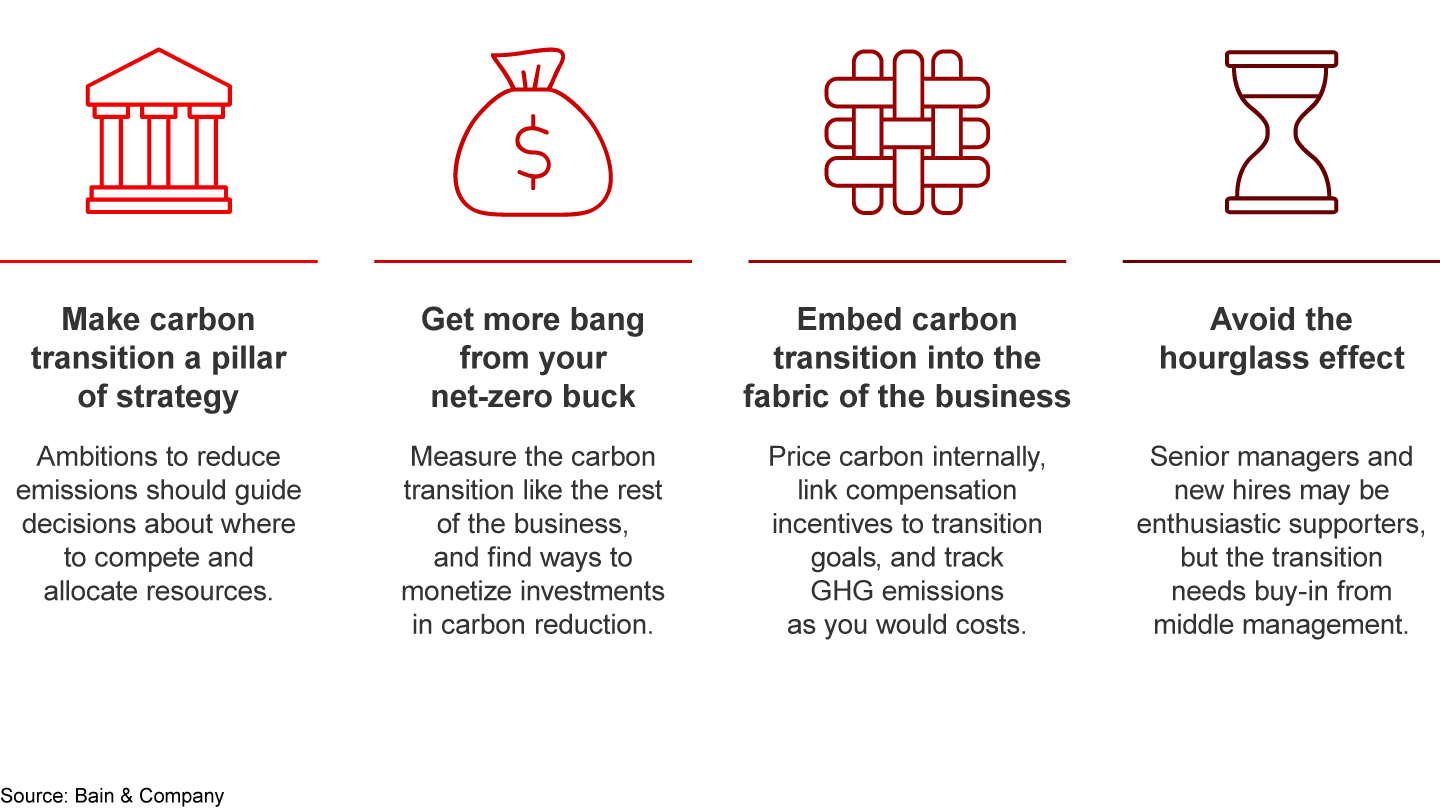
      Four principles help companies move toward their carbon transition goals

      Make carbon transition a pillar of strategy. Too often, sustainability and carbon transition strategies are formulated as afterthoughts. Instead, they should be part of the core strategy process, and address defense (mitigating risks) as well as offense (new opportunities). A company’s ambitions for its carbon transition should guide decisions about where to play (new products, markets that benefit from the transition) and how to win (new business models, low-carbon differentiation), and translate these into resource allocation and capability building. UK supermarket leader Sainsbury’s, for example, is making carbon reduction a cornerstone of its strategy, with pledges to reduce Scope 1 and 2 emissions to net zero by 2040, and working with suppliers to cut Scope 3 emissions by 30% by 2030. Among the concrete steps the retailer has taken recently are switching to energy-saving lithium-ion pallet trucks, and installing its millionth aerofoil, a technology that saves energy in open refrigeration displays.

      Get more bang for your net-zero buck. Increasingly, companies are pushing their carbon transitions with the same rigor as any other business initiative, which means improving the efficiency and effectiveness of the effort while also measuring and reducing cost. For example, Bosch says it has been carbon neutral in Scope 1 and 2 emissions since 2020, which it attributes to developing a unique expertise in energy efficiency and emissions reduction, saving the engineering and technology company hundreds of millions of euros since it started its decarbonization journey in 2007. It’s also about finding opportunities to monetize investments in sustainable technologies. Cemex is selling a range of concrete, Vertua, which contains 70% less embodied carbon and offsets the rest of its emissions to deliver a carbon-neutral product. Upfield, a producer of margarine and other spreads, has identified the opportunity to reposition itself as a leader in plant-based foods by introducing carbon labeling to help consumers make better food choices based on emissions data.

      Embed carbon transition into the fabric of the business. Without the right supporting practices, the best strategy and value creation plan will fall flat. Three tactics in particular are helping companies through their carbon transitions.

      • Pricing. Internal carbon pricing is becoming mainstream; more than 2,000 companies representing $27 trillion of market capitalization have embraced it. Once carbon is priced, companies consider it like any other cost in their decisions about capex, procurement, and R&D, and it guides portfolio decisions. It’s not unusual to see pricing of $50 to $100 or more per ton of CO2 equivalent, with the median of $25 in 2020.
      • Incentives. Linking short-term and long-term incentives to the transition ensures it remains on the agenda. Leading companies have a significant share of variable pay linked to sustainability and deploy these incentives across the organization. For example, Danone ties 20% of senior executives’ annual compensation to social and environmental targets.
      • Tracking. Leading companies increasingly treat GHG emissions as they would cost, and they track, report, and manage them similarly. Instead of a once-a-year, compliance-driven, Excel-based exercise, they use the latest software-as-a-system platforms like Persefoni to extract data from their systems and convert activities into precise carbon emissions. This helps them understand their footprint and guides improvement.

      Avoid the hourglass effect. Sustainability initiatives have a lower success rate than other transformations, with only 7% of them meeting all of their goals, compared with 12% of all change efforts. One reason is the hourglass effect. Top management embraces the transition, and new workers have often chosen their employer based on sustainability credentials. That leaves middle management to translate the ambition into reality, while also managing revenue, cost, and safety. These staffers may have limited knowledge of the topic and little experience managing trade-offs. Leadership can help by simplifying targets, clarifying trade-offs, and providing the training and education that employees need to make good strategic decisions. As with any transformation, a rigorous change-management program ensures successful results.

      The transition away from carbon and toward net-zero emissions is likely to be a top priority for many executives for the rest of their careers. The work will take decades, but it begins with a pragmatic set of meaningful steps. Here are several key questions to help get started on the Monday after COP26.

      • Is carbon transition integral to our strategy and taken into consideration in decisions about where to compete and how to allocate resources?
      • Do we address both defense (transition and physical risks from carbon transition) as well as offense (commercial opportunities from carbon leadership)?
      • Do we have a plan to monetize our carbon leadership with our customers, by gaining market share or premium pricing?
      • Have we embedded a meaningful internal carbon price to inform decisions across the organization?
      • Are we able to track, report, and manage greenhouse gas emissions as we do cost?
      • Are incentives linked to success in carbon reduction?
      • Is there a person accountable for managing change for our carbon transition?
      Auteurs
      • Headshot of Torsten Lichtenau
        Torsten Lichtenau
        Associé, London
      • Headshot of Jenny Davis-Peccoud
        Jenny Davis-Peccoud
        Associé, Amsterdam
      • Headshot of Emmet Gaffney
        Emmet Gaffney
        Alumni, Chicago
      • Headshot of Mattias C. Karlsson
        Mattias C. Karlsson
        Associé, Stockholm
      Contactez-nous
      Synergies sectorielles
      • Energie et Ressources Naturelles
      Expertises fonctionnelles transverses
      • Développement Durable et Responsabilité Sociétale des Entreprises (RSE)
      Bain Insights for the World Economic Forum
      Food System Transformation: The Time Is Now

      More sustainable food and agriculture offers one of our best shots at reversing climate change and environmental degradation while improving health and livelihoods around the world.

      Voir plus
      Bain Insights for the World Economic Forum
      Circular Transformation of Industries: The Role of Partnerships

      Unveiling the transformative potential of circularity in industry, this white paper delves into the vital role of partnerships as a fundamental catalyst to pave the way for a sustainable, resilient and prosperous future.

      Voir plus
      Energie et Ressources Naturelles
      Mining M&A

      The next frontier isn’t about avoiding failure; it’s about mastering repeatable success.

      Voir plus
      Développement Durable et Responsabilité Sociétale des Entreprises (RSE)
      How AI Is Starting to Transform Circular Packaging

      There are 15 AI use cases companies across the value chain can use today to accelerate circularity.

      Voir plus
      Bain Insights for the World Economic Forum
      Reuse, Remanufacturing, Recycling, and Robocabs: Circularity in the Automotive Industry

      Boosting circularity can do more than just reduce emissions and the use of new materials; it should also generate new value.

      Voir plus
      First published in mars 2021
      Mots clés
      • Bain Insights for the World Economic Forum
      • Développement Durable et Responsabilité Sociétale des Entreprises (RSE)
      • Energie et Ressources Naturelles

      Comment nous avons aidé nos clients

      Stratégie New products propel profitability for metals manufacturer

      Lire l’étude de cas

      Fusions et Acquisitions An OFS captures post-merger growth synergies

      Lire l’étude de cas

      Fusions et Acquisitions Broader market plus tighter sales strategy equals big success for a portfolio company

      Lire l’étude de cas

      Vous souhaitez continuer cette conversation ?

      Nous aidons des dirigeants du monde entier à matérialiser des impacts et des résultats pérennes et créateurs de valeur dans leurs organisations.

      Les points de vue de Bain : notre perspective sur des problématiques auxquelles sont confrontées les entreprises à travers le monde, envoyés chaque mois dans votre boîte de réception. 

      *J’ai lu la politique de confidentialité et j’accepte les conditions.

      Merci de lire notre politique de confidentialité.
      Bain & Company
      Contactez-nous Sustainability Accessibility Conditions d’utilisation Politique de Confidentialité Cookie Policy Mentions Légales Sitemap Log In

      © 1996-2026 Bain & Company, Inc.

      Contacter Bain

      Comment pouvons-nous vous aider ?

      • Business inquiry
      • Career information
      • Press relations
      • Partnership request
      • Speaker request
      Voir tous les bureaux