
Skip to Content
  • Bureaux

    Bureaux

    Amérique du Nord et Amérique du Sud
    • Atlanta
    • Austin
    • Bogota
    • Boston
    • Buenos Aires
    • Chicago
    • Dallas
    • Denver
    • Houston
    • Los Angeles
    • Mexico City
    • Minneapolis
    • Monterrey
    • Montreal
    • New York
    • Rio de Janeiro
    • San Francisco
    • Santiago
    • São Paulo
    • Seattle
    • Silicon Valley
    • Toronto
    • Washington, DC
    Europe, Moyen-Orient et Afrique
    • Amsterdam
    • Athens
    • Berlin
    • Brussels
    • Copenhagen
    • Doha
    • Dubai
    • Dusseldorf
    • Frankfurt
    • Helsinki
    • Istanbul
    • Johannesburg
    • Kyiv
    • Lisbon
    • London
    • Madrid
    • Milan
    • Munich
    • Oslo
    • Paris
    • Riyadh
    • Rome
    • Stockholm
    • Vienna
    • Warsaw
    • Zurich
    Asie et Australie
    • Bangkok
    • Beijing
    • Bengaluru
    • Brisbane
    • Ho Chi Minh City
    • Hong Kong
    • Jakarta
    • Kuala Lumpur
    • Manila
    • Melbourne
    • Mumbai
    • New Delhi
    • Perth
    • Seoul
    • Shanghai
    • Singapore
    • Sydney
    • Tokyo
    Voir tous les bureaux
  • Alumni
  • Presse
  • S’abonner
  • Contacter
  • France | Français

    Sélectionnez votre région et votre langue

    Global
    • Global (English)
    Amérique du Nord et Amérique du Sud
    • Brazil (Português)
    • Argentina (Español)
    • Canada (Français)
    • Chile (Español)
    • Colombia (Español)
    Europe, Moyen-Orient et Afrique
    • France (Français)
    • DACH Region (Deutsch)
    • Italy (Italiano)
    • Spain (Español)
    • Greece (Elliniká)
    Asie et Australie
    • China (中文版)
    • Korea (한국어)
    • Japan (日本語)
  • Saved items (0)
    Saved items (0)

    You have no saved items.

    Bookmark content that interests you and it will be saved here for you to read or share later.

    Explore Bain Insights
  • Expertises Sectorielles
    Menu principal

    Expertises Sectorielles

    • Aerospace et Défense
    • Agroalimentaire
    • Chimie
    • Infrastructures, BTP et Matériaux de Construction
    • Grande Consommation
    • Services Financiers
    • Santé
    • Engins & Equipements Industriels
    • Media et Divertissement
    • Metals
    • Mining
    • Pétrole & Gaz
    • Papier et Emballage
    • Private Equity
    • Secteur Public
    • Distribution
    • Technologie
    • Télécommunications
    • Transportation
    • Travel & Leisure
    • Utilities & Energies Renouvelables
  • Expertises Fonctionnelles
    Menu principal

    Expertises Fonctionnelles

    • Expérience Client
    • ESG
    • Innovation
    • Fusions et Acquisitions
    • Opérations
    • People & Organization
    • Private Equity
    • Sales & Marketing
    • Stratégie
    • IA, Perspectives et Solutions
    • Technology
    • Transformation
  • Digital
  • Points de Vue
  • À propos
    Menu principal

    À propos

    • Notre Activité
    • Nos Valeurs
    • Nos Collaborateurs et Notre Équipe Dirigeante
    • Notre Impact
    • Prix & Récompenses
    • Partenariats Internationaux
    • Evénements
    Further: Our global responsibility
    • Diversité et Inclusion
    • Impact Social
    • Sustainability
    • World Economic Forum
    Learn more about Further
  • Carrières
    Menu principal

    Carrières

    • Rejoignez-nous
      Carrières
      Rejoignez-nous
      • Find Your Place
      • Nos domaines d’expertise
      • Equipes multidisciplinaires
      • Étudiants
      • Stages et programmes
      • Événements de recrutement
    • La vie chez Bain
      Carrières
      La vie chez Bain
      • Blog: Inside Bain
      • Récits de carrière
      • Nos collaborateurs
      • Nos bureaux
      • Soutenir votre évolution professionnelle
      • Groupes d’affinités
      • Avantages chez Bain
    • Histoires d’impact
    • Notre processus de recrutement
      Carrières
      Notre processus de recrutement
      • Ce que vous pouvez attendre
      • Entretiens
    Trouver un poste
  • Bureaux
    Menu principal

    Bureaux

    • Amérique du Nord et Amérique du Sud
      Bureaux
      Amérique du Nord et Amérique du Sud
      • Atlanta
      • Austin
      • Bogota
      • Boston
      • Buenos Aires
      • Chicago
      • Dallas
      • Denver
      • Houston
      • Los Angeles
      • Mexico City
      • Minneapolis
      • Monterrey
      • Montreal
      • New York
      • Rio de Janeiro
      • San Francisco
      • Santiago
      • São Paulo
      • Seattle
      • Silicon Valley
      • Toronto
      • Washington, DC
    • Europe, Moyen-Orient et Afrique
      Bureaux
      Europe, Moyen-Orient et Afrique
      • Amsterdam
      • Athens
      • Berlin
      • Brussels
      • Copenhagen
      • Doha
      • Dubai
      • Dusseldorf
      • Frankfurt
      • Helsinki
      • Istanbul
      • Johannesburg
      • Kyiv
      • Lisbon
      • London
      • Madrid
      • Milan
      • Munich
      • Oslo
      • Paris
      • Riyadh
      • Rome
      • Stockholm
      • Vienna
      • Warsaw
      • Zurich
    • Asie et Australie
      Bureaux
      Asie et Australie
      • Bangkok
      • Beijing
      • Bengaluru
      • Brisbane
      • Ho Chi Minh City
      • Hong Kong
      • Jakarta
      • Kuala Lumpur
      • Manila
      • Melbourne
      • Mumbai
      • New Delhi
      • Perth
      • Seoul
      • Shanghai
      • Singapore
      • Sydney
      • Tokyo
    Voir tous les bureaux
  • Alumni
  • Presse
  • S’abonner
  • Contacter
  • France | Français
    Menu principal

    Sélectionnez votre région et votre langue

    • Global
      Sélectionnez votre région et votre langue
      Global
      • Global (English)
    • Amérique du Nord et Amérique du Sud
      Sélectionnez votre région et votre langue
      Amérique du Nord et Amérique du Sud
      • Brazil (Português)
      • Argentina (Español)
      • Canada (Français)
      • Chile (Español)
      • Colombia (Español)
    • Europe, Moyen-Orient et Afrique
      Sélectionnez votre région et votre langue
      Europe, Moyen-Orient et Afrique
      • France (Français)
      • DACH Region (Deutsch)
      • Italy (Italiano)
      • Spain (Español)
      • Greece (Elliniká)
    • Asie et Australie
      Sélectionnez votre région et votre langue
      Asie et Australie
      • China (中文版)
      • Korea (한국어)
      • Japan (日本語)
  • Saved items  (0)
    Menu principal
    Saved items (0)

    You have no saved items.

    Bookmark content that interests you and it will be saved here for you to read or share later.

    Explore Bain Insights
  • Expertises Sectorielles
    • Expertises Sectorielles

      • Aerospace et Défense
      • Agroalimentaire
      • Chimie
      • Infrastructures, BTP et Matériaux de Construction
      • Grande Consommation
      • Services Financiers
      • Santé
      • Engins & Equipements Industriels
      • Media et Divertissement
      • Metals
      • Mining
      • Pétrole & Gaz
      • Papier et Emballage
      • Private Equity
      • Secteur Public
      • Distribution
      • Technologie
      • Télécommunications
      • Transportation
      • Travel & Leisure
      • Utilities & Energies Renouvelables
  • Expertises Fonctionnelles
    • Expertises Fonctionnelles

      • Expérience Client
      • ESG
      • Innovation
      • Fusions et Acquisitions
      • Opérations
      • People & Organization
      • Private Equity
      • Sales & Marketing
      • Stratégie
      • IA, Perspectives et Solutions
      • Technology
      • Transformation
  • Digital
  • Points de Vue
  • À propos
    • À propos

      • Notre Activité
      • Nos Valeurs
      • Nos Collaborateurs et Notre Équipe Dirigeante
      • Notre Impact
      • Prix & Récompenses
      • Partenariats Internationaux
      • Evénements
      Further: Our global responsibility
      • Diversité et Inclusion
      • Impact Social
      • Sustainability
      • World Economic Forum
      Learn more about Further
  • Carrières
    Recherches les plus fréquentes
    • Agile
    • Digital
    • Stratégie
    Vos recherches précédentes
      Pages récemment visitées

      Content added to saved items

      Saved items (0)

      Removed from saved items

      Saved items (0)

      Etude

      Bringing the Power of Enterprise Technology to Decarbonization

      Bringing the Power of Enterprise Technology to Decarbonization

      Chief information officers’ next challenge is to help their companies and their value chains become more sustainable.

      Par Uwe Schmid, Nitesh Prakash, Marc van der Vleugel, et Jim Claunch

      • min
      }

      Etude

      Bringing the Power of Enterprise Technology to Decarbonization
      en
      • Enterprise technology (computers, data centers, communications networks) accounts for up to 10% of global electricity use, but companies can also use digital technology to reduce their emissions.
      • Software applications can help monitor and manage greenhouse gas emissions in a company’s own operations as well as up and down the value chain.
      • By making operations more efficient, digital technology and automation can also help the entire organization reduce its carbon footprint.
      • Within the enterprise technology function, rethinking some basic operating principles can further reduce emissions.

      Although the benefits of digital technology on sustainability efforts are becoming clearer to some executives, many are still unaware of the specific ways in which enterprise technology can help a company achieve its net zero ambitions—namely, by monitoring total emissions and by improving efficiency across the value chain.

      But enterprise technology has always enabled companies in their business and transformations, and it has an outsized role to play in helping companies meet their carbon reduction goals in at least three ways.

      • Enabling the transition: New applications will be critical to help companies monitor their total greenhouse gas emissions and track their progress toward meeting reduction targets.
      • Accelerating the pace of change: By increasing efficiency across a company’s operations as well as its interactions with suppliers, enterprise technology can help reduce emissions across the value chain.
      • Rethinking enterprise technology solutions: Finally, the enterprise technology function will need to rethink some of its basic operating principles to reduce the emissions of its own operations.

      In our work with clients, we’re seeing executives recognize the role of enterprise technology in monitoring and reducing emissions, primarily as a defensive tool—that is, using technology to ensure compliance with regulations or pledges. But some companies also recognize the advantage of going on the offense. Reducing emissions often goes hand in hand with reducing energy usage and the associated costs.

      Beyond that, some companies are setting out to gain competitive advantage in their markets either by reducing the greenhouse gases emitted during operations or by producing and marketing low-carbon alternative products. For example, machine manufacturer Voith has chosen to play offense, defining sustainability as a company value that helps it gain competitive advantage. Voith sees sustainability as being in line with its efforts to improve efficiency, aiming to reduce its consumption of energy and water by up to 30%. The company at first built its own database for tracking sustainability issues, then it teamed up with environmental, safety, and health software provider Quentic to develop a broad suite based on international standards, thereby reducing the effort it takes Voith to track and verify its sustainability data.

      Enabling the transition: Monitor emissions

      As with any improvement program, reducing emissions requires understanding your starting point and then measuring progress. Without those insights, executives are flying blind, unable to identify the largest opportunities for improvement, and have little capacity to monitor progress. Increasingly, companies have a wide variety of options from which to choose for measuring not only emissions but also for meeting environmental, social, and corporate governance (ESG) performance goals.

      Software-as-a-service solutions: Many providers of risk management and ESG monitoring software are expanding their capabilities to deliver reports on carbon footprint. The market is still young and very fragmented, so companies have a wide range to choose from, depending on their specific industry and compliance needs. Arizona-based Persefoni, a recently announced strategic partner of Bain’s, automates the calculation, management, and reporting of carbon usage data. Its cloud platform can ingest data from thousands of sources, including SAP or Oracle enterprise software, then it calculates carbon emissions based on international standards and provides results for disclosure and reporting purposes.

      Bespoke solutions: Some companies build their own systems to track emissions and other ESG data. This is a natural outgrowth of the way that most companies start out, tracking and collating their own carbon data. Investing in a robust, custom solution may be the right approach for companies planning to use this capability for strategic advantage. For example, agribusiness company Olam has developed its own cloud-based platform, AtSource, which tracks its social and environmental footprint across the complete supply chain as part of its efforts to meet its sustainability commitments while also providing a new, differentiated offer to customers.

      Enterprise resource planning: Enterprise resource planning (ERP) systems, which already have extensive experience with meeting regulatory constraints in certain verticals, are upgrading to monitor and report on carbon emissions. ERP systems already have access to the relevant resources, including data management systems. Companies can use ERP’s current capabilities as a starting point and then extend it by gathering data from a much more varied data landscape. SAP recognized customers’ ever-growing need for environmental data, so it developed an extension, the SAP Sustainability Control Tower, which spans systems and resources beyond the core product.

      Distributed ledgers: Blockchain technologies offer traceability, transparency, security, speed, and efficiency—all of which could be used to track carbon emissions within an organization and across its supply chain. Blockchain ledgers could also be used for tracking rare metals (for example, cobalt used in batteries) or food supply chains. One example is GuildOne, a technology provider to the energy industry that is championing the use of blockchain for carbon credits. GuildOne manages a blockchain exchange for oil and gas royalties; a similar system for carbon credits could create a common registry for greenhouse gas emissions on a transparent and traceable platform.

      Platform providers: All three major cloud service providers (Amazon Web Services, Google Cloud Platform, Microsoft Azure) are well positioned to provide advanced analytical services. All three are developing ESG strategies based on providing cloud and analytical services and using technologies that include artificial intelligence, machine learning, the Internet of Things, and smart grid solutions, which they are piloting with key customers.

      Accelerating the pace of change: Improve sustainability

      Enterprise technology can also play an outsized role in helping to manage emissions and other sustainability issues across the organization and beyond, up and down the value chain (see Figure 1). For example, as companies think more about sustainability in the design and sourcing of new products, they are likely to require new sources of data and higher levels of integration with suppliers—activities that the enterprise technology function will enable.

      Figure 1
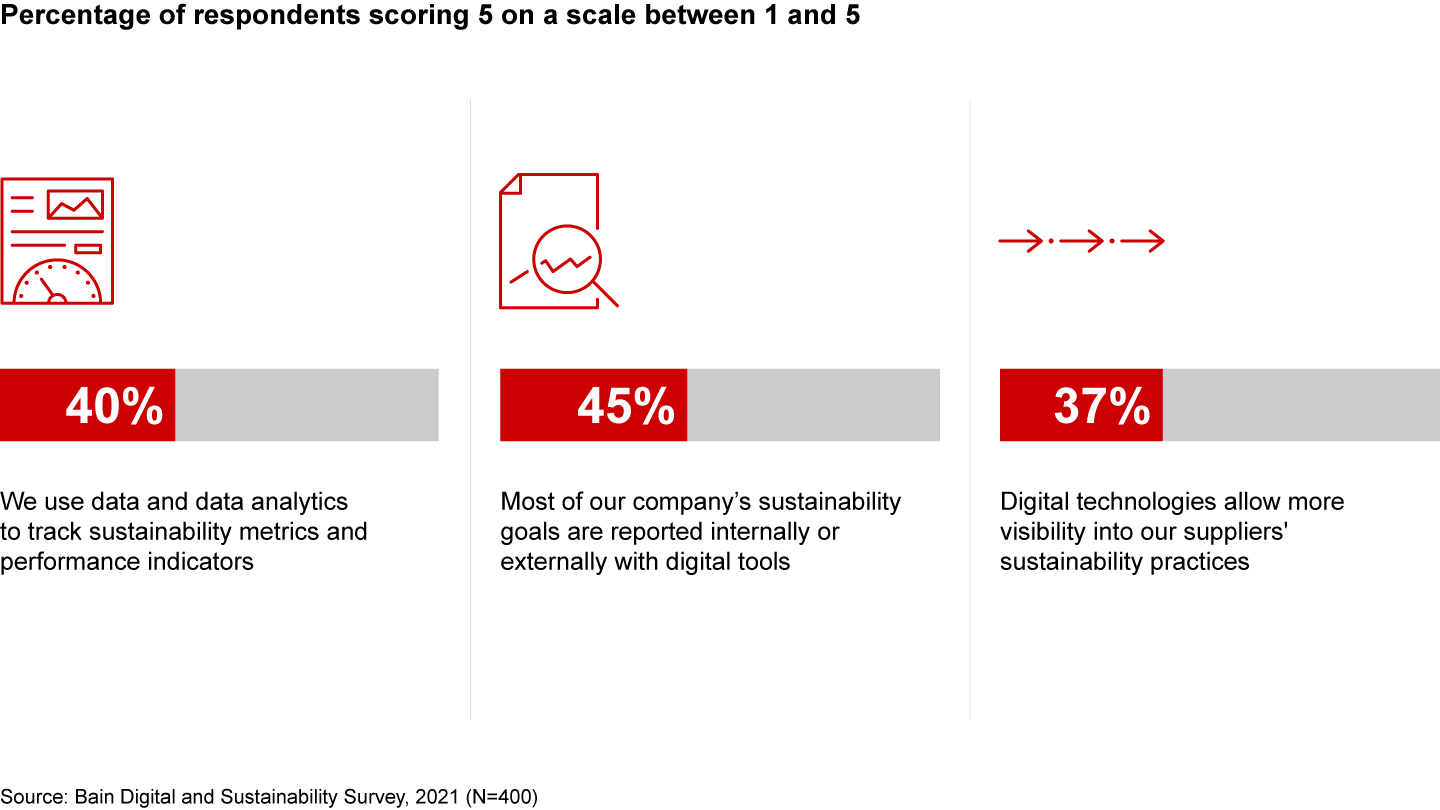
      Digital technologies and data allow greater oversight and transparency into sustainability progress

      Enterprise software will also be critical in helping companies ensure sustainability throughout the value chain. Some of this will come from third-party services running on company ERP and procurement systems. EcoVadis, for example, which supplies sustainability ratings on businesses in global chains, has introduced an application programming interface (API) for SAP Ariba Supplier Risk, integrating sustainability details into SAP’s solution for managing supplier relationships. The API gives users access to EcoVadis’s database of suppliers, including scores and improvements on areas such as the environment, social, and ethical criteria; it also monitors for media mentions of supplier partners.

      Rethinking solutions: Reduce IT’s carbon footprint

      Enterprise technology operations have a significant carbon footprint, accounting for about 10% of the world’s electricity use (30% data centers, 40% network, and 30% end user devices). Data centers, in particular, have come under increased scrutiny recently as the extent of their energy consumption has become more widely known. Increasingly, enterprise technology leaders will need to include sustainability as a factor in their decision making, and they could become a model for other functions in the organization. For example, although cloud services can be more energy efficient than maintaining one’s own data centers, most decisions about going cloud first don’t take into consideration the energy consumption of the communications infrastructure necessary for data transfers between the cloud and the enterprise.

      %

      Enterprise technology uses up to 10% of the world’s electricity

      Enterprise technology’s role in getting started

      Any chief information officer who’s heard the statement “sustainability is the new digital” knows that they are being called upon to help lead the next big transformation while the previous one is still underway. There are many steps to take, but three important actions will help get the process started.

      Play defense or offense? Every company’s sustainability journey begins with a clear understanding of the starting point and a vision of what it hopes to accomplish. Defining sustainability strategy requires executives to decide whether they are playing defense (doing what’s necessary to meet regulatory or other compliance demands) or whether they want to play offense (investing to gain a competitive advantage). For either starting point, enterprise technology will play an important role, implementing the systems that will measure and monitor carbon footprint and applying new technologies to the company’s functions to raise energy efficiency all around.

      Identify capability gaps. This is particularly important: In most cases, companies have not carefully monitored their carbon footprint, and so learning to do so is akin to developing new muscles. Some vendors, such as EcoVadis, offer ESG maturity assessments that can help companies understand where they are in the process and what they have to do to reach their goals. Beyond getting a snapshot of where a company stands, these metrics must be incorporated into the ongoing measurement of success not only for the company but also for the upstream suppliers and downstream customers that contribute to its scope 3 emissions.

      Build sustainability into the organization. IT operations have been designed with cost and speed efficiency in mind, but now architects and developers must begin to consider sustainability as well. IT leaders will have to guide these decisions so that sustainable becomes an integral part of the design and measurement of these systems reflected in key performance indicators. The shift to a cloud-based infrastructure is one that’s ripe for rethinking. Consider, for example, that when a team joins a cloud-based video conference, large amounts of data must travel from the users back to a remote data center (probably operated by one of the major cloud service providers) and then back to each user. About two-thirds of the emissions generated by this type of application come from the data transfer rather than the data center or end users. This is the case even when some or all of the meeting attendees are in close proximity (the same city or even the same building). More advanced and more intelligent systems will rely on edge computing, which can manage much of the processing closer to the users, thus saving on data transfer costs and emissions.

      Given all these opportunities for enterprise technology to play a significant role in reducing emissions, executive leaders of the function should feel empowered to become champions of the sustainability transformation. Bain research finds that about 40% of executives surveyed believe that digital technologies have already had a positive impact on sustainability outcomes. As technology enables more reductions and greater sustainability, that number is likely to rise.

      Acknowledgment

      The authors would like to thank Joël Goossens, professor of computer science at Université Libre de Bruxelles, for valuable discussions on the carbon emissions of IT systems.

      Auteurs
      • Uwe Schmid
        Expert Associate Partner, Frankfurt
      • Headshot of Nitesh Prakash
        Nitesh Prakash
        Associé, London
      • Headshot of Marc van der Vleugel
        Marc van der Vleugel
        Associé, Brussels
      • Headshot of Jim Claunch
        Jim Claunch
        Associé, Houston
      Contactez-nous
      Synergies sectorielles
      • Engins et Equipements Industriels
      Expertises fonctionnelles transverses
      • Développement Durable et Responsabilité Sociétale des Entreprises (RSE)
      • Technologies de l'information
      Comment pouvons-nous vous aider ?
      • Technology Strategy and Transformation
      Technology Strategy and Transformation
      Most Enterprise Technology Functions Have Set Sustainability Goals

      Nearly as many have prioritized initiatives to meet those goals, but fewer are using software to track ESG metrics.

      Voir plus
      Engins et Equipements Industriels
      Machinery & Equipment M&A

      As more companies discover software’s value as a growth engine, more will need to hone their M&A skills.

      Voir plus
      Technology Strategy and Transformation
      The New AI Stack: Speed, Scale, and Real-World ROI

      AWS re:Invent 2025 demonstrated how agents, fine-tuned models, and custom silicon are redefining performance and productivity for enterprises.

      Voir plus
      Technologies de l'information
      Achilles’ Heel to Accelerator: How Digital Can Create Sustainability Leadership

      Companies need to upgrade their technology to meet sustainability goals, but few believe that they have the capabilities to do so today.

      Voir plus
      Engins et Equipements Industriels
      Microfactories: The Back-to-Local Moment

      Automation could allow much smaller factories to operate closer to consumers and deliver more bespoke products.

      Voir plus
      First published in novembre 2021
      Mots clés
      • Développement Durable et Responsabilité Sociétale des Entreprises (RSE)
      • Engins et Equipements Industriels
      • Technologies de l'information
      • Technology Strategy and Transformation

      Comment nous avons aidé nos clients

      Stratégie A Steel Company Seeks to Regain Market Leadership

      Lire l’étude de cas

      Stratégie A Conglomerate Charts a New Global Strategy

      Lire l’étude de cas

      Technologies de l'information Bridging the Gap Between Business and Technology

      Lire l’étude de cas

      Vous souhaitez continuer cette conversation ?

      Nous aidons des dirigeants du monde entier à matérialiser des impacts et des résultats pérennes et créateurs de valeur dans leurs organisations.

      Les points de vue de Bain : notre perspective sur des problématiques auxquelles sont confrontées les entreprises à travers le monde, envoyés chaque mois dans votre boîte de réception. 

      *J’ai lu la politique de confidentialité et j’accepte les conditions.

      Merci de lire notre politique de confidentialité.
      Bain & Company
      Contactez-nous Sustainability Accessibility Conditions d’utilisation Politique de Confidentialité Cookie Policy Mentions Légales Sitemap Log In

      © 1996-2026 Bain & Company, Inc.

      Contacter Bain

      Comment pouvons-nous vous aider ?

      • Business inquiry
      • Career information
      • Press relations
      • Partnership request
      • Speaker request
      Voir tous les bureaux