

Etude
With competition from digital start-ups intensifying amidst a low-interest environment, many banks and insurance companies are looking for ways to lower their cost structures. They struggle with a large amount of low-value activity at branch and contact centers, where it’s common for less than one-fifth of activity to involve selling and where 50% to 70% of call volumes could be avoided. They also continue to rely heavily on paper-based, manual processes—for mortgages and insurance claims, for example—and on risk and compliance checks that are redundant and outdated.
Many of these holdover processes offer ample opportunity for achieving efficiencies. Fintech start-up Lenda, for example, was able to shorten the processing time for a home loan to just 21 days, compared with an average of 60 days in the US mortgage industry, by allowing borrowers to complete the entire process online. And Lenda aims to reduce it even further, to seven days.
For a while now, financial services companies have used lean techniques to take out cost and raise productivity. Yet two-thirds of lean programs either don’t deliver the desired level of cost reduction or can’t sustain the savings, according to a Bain & Company assessment of 17 financial institutions.
When lean programs fall short, they typically suffer from some combination of the following:
- A fixation on cost, which never inspires people and can compromise the quality of the customer experience, rather than on making life easier for customers, which employees do care about.
- Edicts from senior management, with little commitment of time from the senior team and little attempt to ignite enthusiasm and generate demand from the front lines.
- Short-term design. Lean initiatives often get bolted on to a few processes, whereas sustained improvements require fundamental changes to operations.
- Use of a pilot project that is rigged to succeed. By selecting an easy process and motivated managers, an institution can essentially guarantee the success of its pilot and can tell investment analysts it’s making progress on cost. Then, when the company tries to scale up the initiative, it proves unviable.
- Overreliance on IT systems. When the IT doesn’t live up to its promise, frontline behavior doesn’t change and it’s impossible to realize planned efficiencies.
Lean programs that focus on cost-cutting rarely meet the goals that financial services firms set out to achieve. Companies stand to gain more from "hothouse" programs—smaller, easily scalable pilot projects—that allow them to identify, test and deploy meaningful customer service improvements, says Peter Stumbles, leader of Bain's Financial Services practice in the Asia-Pacific region.
Lean with customers in mind
Fortunately, there’s a better approach to lean, one that combines production efficiency with a customer-centered perspective. Rather than focusing on an incremental redesign of individual steps, high-performing financial institutions emphasize end-to-end process redesign to eliminate the root causes of waste. That makes the experience better for customers and employees.
These leaders take on the complicating aspects of their organization, including compliance, risk management and regulation, which over the years add many checks, processes and steps that no longer add value. One can usually remove redundant checks and simplify processes, creating a faster, more convenient experience for customers while still meeting stringent risk and compliance requirements. This more integrated approach is well worth the effort, given the major opportunities to reduce bad and avoidable volumes of cash handling in branches; eliminate manual authentication, handoffs and repeat calls in contact centers; and promote convenient, digitally enabled customer self-service, among other improvements.
That’s what a Japanese insurer found when it tackled some of its core processes in underwriting, sales and distribution. Instead of launching small pilots and selective lean projects, the senior leaders committed to a multiyear program sponsored by the CEO. The program started with the hardest functions first, then ran in sequential waves to address easier support functions.
Notably, the program was consistently led by frontline supervisors and employees, with a center of excellence to provide support. The company seeded sponsors and change agents into groups like the salesforce in order to keep up momentum. And it built strong lean capabilities in the front lines so that they could continually pursue lean improvements, year after year.
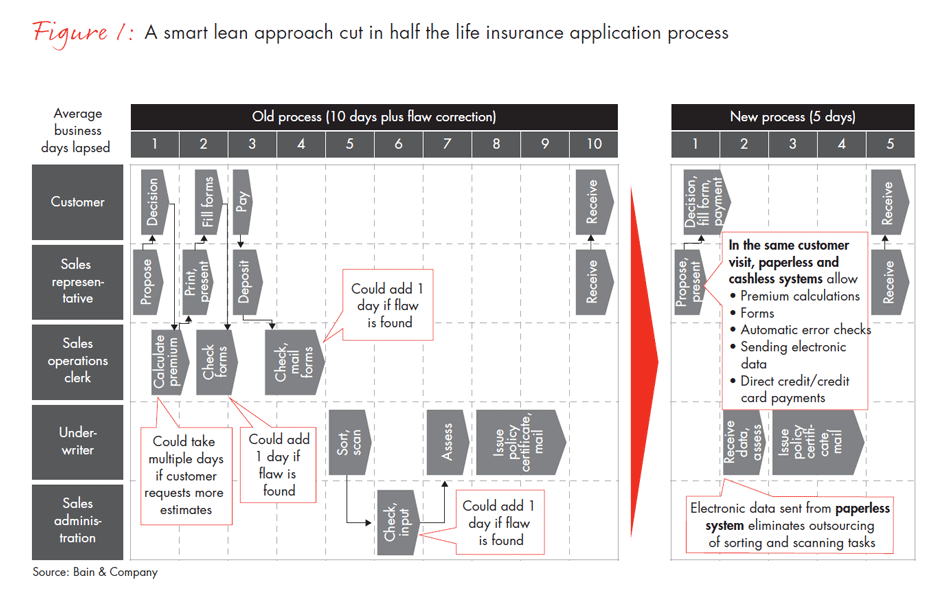
The results exceeded initial expectations. The Japanese insurer raised productivity by 5% per year over five years; reduced costs by 20%; and improved customer loyalty through such measures as cutting the typical life insurance product application processing time by half, to five days (see Figure 1).
A hothouse for growth
As part of a smart lean approach, the concept of a pilot seems intuitive. But in practice it’s difficult to draw useful lessons from a small pilot. Companies typically stack the deck for success: They pick one or two locations with the best and most motivated managers, the easiest problems to address and the most receptive customers—and they ensure adequate staffing for the project. Executives watch the results carefully, hoping to use them to tell investors a good story.
As a consequence, small pilots often fail to subsequently roll out at large scale. They rarely can handle a more complex process, or average managers or less receptive customers. When the main unit of cost consists of people, improvements to a process at one branch have a tiny effect and become difficult to expand to a meaningful size.
In conjunction with its market assessment and pilot tests, one regional bank in the US launched a number of “branch of the future” pilots with new technology and incentives for customers to migrate to digital channels. It piloted at two branches—one at a university campus and another in an affluent neighborhood. Given that most of the bank’s customer base consists of lower-income households in rural areas, the pilot strategy had little relevance for the wider branch network.
In contrast, a hothouse test environment focuses on average processes, average customers and average locations—and it ensures enough variation among these to represent the entire network. Two dozen bank branches in neighborhoods with different demographics provide a more realistic proving ground than just a handful of branches that look alike. A bank will learn, for example, that lower-performing units need additional training in order to succeed, or that some locations won’t work at all. In addition, small benefits quickly become bankable at the larger hothouse scale. For example, a change in the service and staffing model across 20 branches could generate a 10% savings equal to two full-time equivalent employees, freeing up time for higher-value activities.
Staffing the hothouse with scalability in mind from the start raises the odds of long-term success. If the business case permits 80 dedicated employees on a rollout across 1,000 branches, design a hothouse of 50 branches with only four dedicated employees.
A hothouse also provides a bank or insurer the chance to try out process modifications in a relatively contained manner. That helps risk and compliance officers become more comfortable with the changes. And thorough testing gives business unit leaders the confidence that changes can be rolled out across the enterprise.
Take the process of cash reconciliation at bank branches. One bank saw that daily reconciliation, undertaken as a result of historical risk and compliance rules, was no longer required. It tested weekly reconciliation at a diverse subset of branches and found that it could be scaled up throughout the branch network. At another Asian bank, managers were being asked to sign off on a huge number of tasks and ended up ticking the boxes without real scrutiny. Through a hothouse, the bank was able to reduce the volume of redundant signoffs by focusing on those that truly mitigated a current risk.
Hothouses work best when they’re built to specifications infused with lean principles:
- Identify the must-win battles. There are a critical few changes that will both reduce costs and improve the customer experience. Evaluate initiatives based on capacity created, ease of implementation and the effect on customers.
- Push the boundaries and tolerate failure. Try activities that might initially cause discomfort, like changing service scripts or service levels. Even if they fail, the organization can learn and build experience that helps take improvements to the next level.
- Let the front line lead. A sense of ownership among frontline staff is essential to unleashing their creativity. They should be backed by sponsors at all levels of the organization; these sponsors can help free up needed resources and clear roadblocks.
- Reach for transformational, not incremental, change. A willingness to challenge sacred cows, through steps such as taking a clean-sheet approach to compliance, is the only way to deliver a step-change improvement in capacity.
- Travel light. Going light on resources at the start sets realistic expectations for subsequent rollout across the wider network.
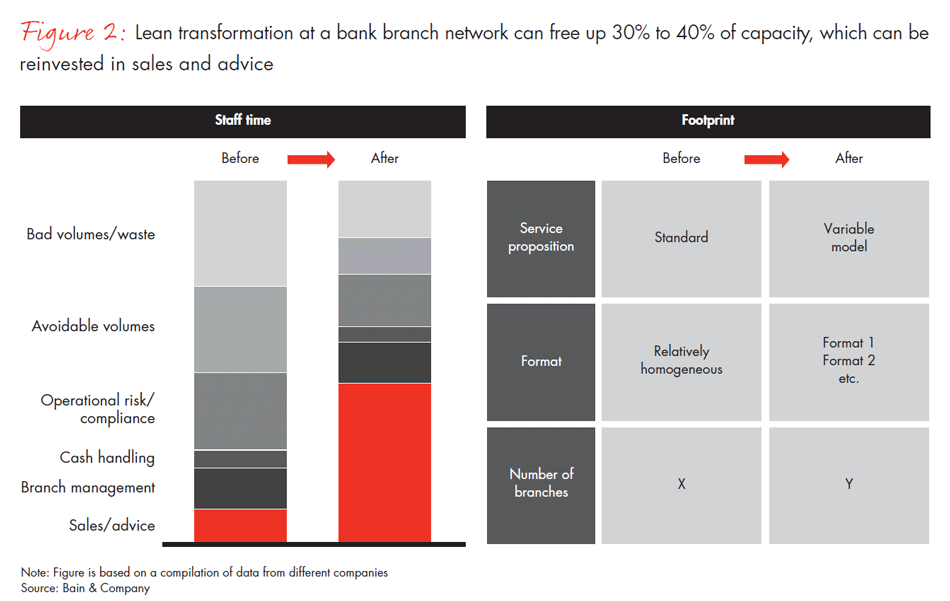
The hothouse approach helped an Australian retail bank simplify its branch processes. The bank determined that roughly half the activity at its branches could be classified as non-revenue generating noise or, at best, discretionary. About one-third of branch activity related to cash transactions. Root-cause analysis showed the procedures that could help get these volumes out of the branch. In a hothouse of 23 branches, the bank redirected cash and check deposits and withdrawals to smart ATMs, modified teller scripts to coach customers on using digital channels and modified counter service levels.
The test worked well, and the bank was able to roll out the changes throughout its network. Addressing cash transactions and other branch processes resulted in a number of tangible benefits for the bank overall, including a 10% reduction in branch staff capacity, which freed up time for higher-value activities like selling and serving customers; a threefold increase in ATM usage for deposits; accelerated migration of customers to digital channels; a reduction in customer complaints by nearly one-fourth; and a rise in employee engagement (see Figure 2).
Trust and control—preconditions for behavior change
Hothouse design won’t in itself guarantee that lean efforts show lasting success, of course. Companies also have to devise and execute a realistic plan to change behavior throughout the organization in order to sustain the improvements.
To earn the engagement of tellers, salespeople, claims adjusters and others at the front lines—so that they change their own behavior to implement lean improvements— senior leaders must put themselves in their employees’ shoes. Cost and efficiency goals rarely motivate people; employees will revert to the old ways if possible when cost is the focus. But the goal of simplifying life for customers, and for employees in doing their job, can instill a sense of greater trust and control, which are preconditions for behavior change.
At the Australian bank, the new head of contact centers didn’t just ask employees to focus sharply on the customer experience, he also changed scorecards to include the experience plus first call resolution. By carefully managing the transition and keeping a sharp eye on average handle time, the contact centers were able to increase their customer loyalty score and employee engagement even as costs dropped 20%.
A lean approach that centers on improving the customer experience and shifting employee behavior around that experience will not only raise productivity but also earn customer loyalty. And when the front line gets truly engaged, this lean will stick.
Peter Stumbles leads Bain & Company’s Financial Services practice in the Asia-Pacific region and is based in Sydney. Richard Fleming is a partner with the Financial Services practice and leads the firm’s Results Delivery practice in the Americas. He is based in New York.
First published in mai 2015