

Etude
As Maersk ramped up its shipping business in China, it faced a major hurdle: in order to win in the emerging Chinese market, the company needed reliable internal logistics—transporting goods from growing economic centers in central and western China to seaports in the south and east. Without the right people to manage these operations, Maersk’s entire strategy would be in jeopardy.
Leadership supply, a/k/a the “war for talent,” is a perennial item on every executive’s agenda. CEOs and other leaders devote considerable time and resources to finding, developing and deploying the people they need in critical jobs throughout the organization. But the conventional tools—recruitment and retention efforts, training programs and the like—often do no more than keep a company in the game. Essential as they are, they rarely help an organization pull away from the competition. And they’re woefully inadequate for acute challenges such as expanding rapidly in a new market.
A more fruitful approach, we have found, is to approach the talent issue from a different viewpoint entirely—that of decisions. Ultimately, any organization’s performance depends on its decision effectiveness. Consistently high performers make good decisions, make them quickly and execute them well. They know which decisions are most important to creating value, and they make sure that those decisions get the attention they deserve. Research shows that decision effectiveness correlates tightly with financial results.
A focus on decisions allows executives to look at people issues differently. Rather than asking whether their company is winning the war for talent—a question that can be addressed only over a period of years—leaders can pose questions that are immediately actionable.
Which jobs have the greatest impact on the organization’s critical decisions? Who are our best people, as measured by their ability to make and execute key decisions? How do we ensure that those top performers have the greatest impact on the important decisions? Actions based on these questions allow leaders to address talent challenges quickly and effectively.
Let’s look at how to go about it.
Identify the positions with the biggest impact on decisions
An organization’s leaders must first determine which positions have the greatest impact on critical decisions. That depends, of course, on how the company creates value and on how it plans to grow in the future. A position as head of global IT, for example, will be more important in a company that relies on IT as a competitive advantage than in a company whose priorities lie elsewhere. The role of marketing director for Europe will be particularly critical for a company launching new products in the region.
Often, however, the key positions are not high level jobs at all, because the critical decisions must be made and executed farther down in the organization. Consider three examples:
• Maersk’s strategy for China turned on its ability to move goods from the interior to the coast. The critical decisions turned out to involve management of river terminals and building partnerships with Chinese transport companies. The people who held those jobs would have the biggest impact on the strategy’s success.
• Amazon.com has expanded partly through savvy merchandising decisions, including special prices and shipping discounts, suggestions for complementary purchases and targeted email notices about new offerings. The people who make and execute these essential decisions are frontline employees, supervisors and line managers.
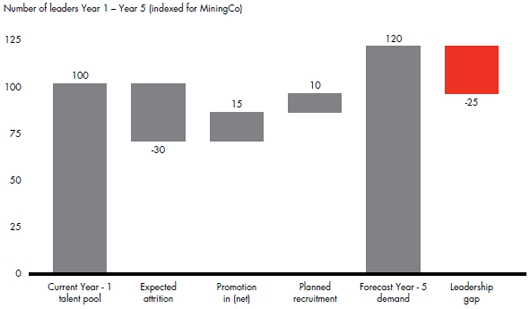
• A South Africa–based mining company was suffering from performance problems and recurring safety issues. To get back on track, it needed more people capable of making good decisions about mine operations—in short, qualified mining engineers.
None of the key positions in these examples are senior-level jobs. But it matters a great deal who holds them. Some of the individuals in the jobs, moreover, will be “linchpin” employees—well-respected veterans whom others rely upon for guidance—and so even more essential to the organization’s performance.
In this way, a decision-led approach provides a different answer to the question of which jobs are most important. And it helps a company establish priorities. No organization can expect to win the war for talent across the board. But if a company knows exactly which jobs have the greatest impact on critical decisions, it can focus its efforts on filling those positions with the best people it can possibly get.
Assessing talent
But who are those “best people”? Every company has a performance-assessment process, of course, but not every company assesses all the right traits. A decision orientation shows that one essential competency for leadership is the ability to make critical decisions quickly and well, and to see them executed effectively. If an organization doesn’t assess this skill directly, it won’t know who its best people are no matter how well it gauges them on other capabilities. Assessing decision attributes is especially important now, as today’s organizations often require a different set of skills than those needed in the past. Work is more collaborative. Decision accountabilities are distributed more widely. Sandy Ogg, Unilever’s chief human resources officer, remarks that “In the old world, we needed a lot of independent four-hundred-meter runners. Today, we need a four-by-one-hundred relay team.”
Some companies find not only that they must focus their evaluation on decision skills, but also that they need to tighten up the entire performance-management process. At the mining company, for instance, fully 80 percent of individuals were rated above average, even though the company had been underperforming. Senior managers didn’t know who the strongest people were or what skills and capabilities they possessed. So the company’s managers recalibrated the review process, establishing clearer performance standards and refusing to tolerate grade inflation. High performers under the new system received not only increases in pay but also better career development, training opportunities and retention packages. Those with lower ratings received coaching and eventual outplacement, if necessary.
It is fashionable to rotate leaders to a new position every couple of years, on the assumption that this will broaden their experience. But once you put the right people in roles that have the biggest impact on key decisions, you’re likely to want to keep them there, because the jobs play to their strengths. A Gallup survey cited by Marcus Buckingham and Donald O. Clifton found that employees who answered “strongly agree” to the question, “At work, do you have the opportunity to do what you do best every day?” were likely to be more satisfied and more productive than others. Other data bear out this conclusion. In food retailing, stores’ operating performance correlates strongly with the tenure of store managers. In banking, retention of branch managers correlates with customer retention. Shinhan Bank, unlike many banks in Korea, makes a point of promoting its senior leaders from within. It expects those leaders to have spent a substantial part of their careers honing their skills in the branches, which have the authority to make most of the bank’s critical decisions regarding customers. The policy has helped Shinhan Bank become the second-largest bank in the country and one of the top scorers in customer satisfaction.

Decide & Deliver
Learn more about the five steps that leading organizations use to make great decisions quickly and execute them effectively.
Matching individuals with jobs—and reducing the demand for talent
Once you know your critical positions and your top performers, you can assess the degree of overlap. One technology company, for example, identified its mission-critical positions and found that fewer than 30 percent were filled by top performers. When the company then asked how many of its top performers were in mission-critical positions, the answer was only 40 percent. Thinking about deployment from a decision perspective helped this company redeploy people to make the most of its talent pool and improve decision effectiveness.
But some companies may find that they are facing a talent shortage even when they have carefully identified key jobs and top performers. That’s when organizations typically step up long-term efforts aimed at boosting recruitment and retention. In the meantime, companies can redesign their organization and operations with decisions in mind, thereby making the best use of the talent they have right now.
One tactic, for instance, is to focus specialist jobs only on decisions requiring specialist skills. The job of mine manager at the South African company used to include responsibilities that went far beyond mining: the managers had to make decisions about such matters as working with local communities, managing hospitals and overseeing worker accommodations. When the company began providing managers with support staff dedicated to the non-mining parts of the job, managers were freed up to spend more time on the decisions for which their skills were indispensable. Such moves can often be accomplished relatively quickly.
The company also redesigned its operating standards with the same goal in mind. In the past, the company’s mines and processing plants operated according to many different rule books. Each mine typically had its own style of working, its own technical systems and equipment, its own standards and its own metrics. Mine managers who transferred from one mine to another had to be exceptionally skilled and experienced simply to get up to speed in making and executing decisions.
The company believed it could increase productivity by making all these elements consistent from one mine to another, thereby facilitating the key decisions. After studying the franchise model in retail and service industries, it designed what it called “franchise rules of the game,” known internally as FROGs. It standardized methods, equipment, engineering, planning techniques and so on, so that a manager entering a new mine would see and do much the same things as in any other mine. To avoid the bureaucracy that often accompanies detailed rules such as FROGs, managers themselves helped design the rules.
This simplification of the company’s operations had a double effect. It reduced the demand for highly skilled talent, because less experienced people could now take over as mine managers and make the required decisions. Veterans, in turn, could take on jobs with larger spans of decision making. After the change, the performance of individual managers rose by up to 20 percent.
Conclusion
While most companies understand the importance of leadership supply, they still find themselves struggling with practical ways to put the issue squarely on the table. A decision focus gives them a means to do so. It also sends two powerful messages: Decisions are what matter in this organization, and both people and processes will be evaluated on the extent to which they contribute to good, speedy decision making and execution. That kind of clarity frees everyone up to concentrate on getting things decided and done—and in the process, to improve the organization’s performance.
Paul Rogers is the managing partner of Bain’s London office and leads Bain’s Global Organization practice. Alan Bird is a partner in Bain & Company’s London office and Bain’s global expert on leadership supply. Lori Flees is a partner in Bain’s Houston office and a senior member of Bain’s Global Organization practice.
First published in mars 2011