
Skip to Content
  • Bureaux

    Bureaux

    Amérique du Nord et Amérique du Sud
    • Atlanta
    • Austin
    • Bogota
    • Boston
    • Buenos Aires
    • Chicago
    • Dallas
    • Denver
    • Houston
    • Los Angeles
    • Mexico City
    • Minneapolis
    • Monterrey
    • Montreal
    • New York
    • Rio de Janeiro
    • San Francisco
    • Santiago
    • São Paulo
    • Seattle
    • Silicon Valley
    • Toronto
    • Washington, DC
    Europe, Moyen-Orient et Afrique
    • Amsterdam
    • Athens
    • Berlin
    • Brussels
    • Copenhagen
    • Doha
    • Dubai
    • Dusseldorf
    • Frankfurt
    • Helsinki
    • Istanbul
    • Johannesburg
    • Kyiv
    • Lisbon
    • London
    • Madrid
    • Milan
    • Munich
    • Oslo
    • Paris
    • Riyadh
    • Rome
    • Stockholm
    • Vienna
    • Warsaw
    • Zurich
    Asie et Australie
    • Bangkok
    • Beijing
    • Bengaluru
    • Brisbane
    • Ho Chi Minh City
    • Hong Kong
    • Jakarta
    • Kuala Lumpur
    • Manila
    • Melbourne
    • Mumbai
    • New Delhi
    • Perth
    • Seoul
    • Shanghai
    • Singapore
    • Sydney
    • Tokyo
    Voir tous les bureaux
  • Alumni
  • Presse
  • S’abonner
  • Contacter
  • France | Français

    Sélectionnez votre région et votre langue

    Global
    • Global (English)
    Amérique du Nord et Amérique du Sud
    • Brazil (Português)
    • Argentina (Español)
    • Canada (Français)
    • Chile (Español)
    • Colombia (Español)
    Europe, Moyen-Orient et Afrique
    • France (Français)
    • DACH Region (Deutsch)
    • Italy (Italiano)
    • Spain (Español)
    • Greece (Elliniká)
    Asie et Australie
    • China (中文版)
    • Korea (한국어)
    • Japan (日本語)
  • Saved items (0)
    Saved items (0)

    You have no saved items.

    Bookmark content that interests you and it will be saved here for you to read or share later.

    Explore Bain Insights
  • Expertises Sectorielles
    Menu principal

    Expertises Sectorielles

    • Aerospace et Défense
    • Agroalimentaire
    • Chimie
    • Infrastructures, BTP et Matériaux de Construction
    • Grande Consommation
    • Services Financiers
    • Santé
    • Engins & Equipements Industriels
    • Media et Divertissement
    • Metals
    • Mining
    • Pétrole & Gaz
    • Papier et Emballage
    • Private Equity
    • Secteur Public
    • Distribution
    • Technologie
    • Télécommunications
    • Transportation
    • Travel & Leisure
    • Utilities & Energies Renouvelables
  • Expertises Fonctionnelles
    Menu principal

    Expertises Fonctionnelles

    • Expérience Client
    • ESG
    • Innovation
    • Fusions et Acquisitions
    • Opérations
    • People & Organization
    • Private Equity
    • Sales & Marketing
    • Stratégie
    • IA, Perspectives et Solutions
    • Technology
    • Transformation
  • Digital
  • Points de Vue
  • À propos
    Menu principal

    À propos

    • Notre Activité
    • Nos Valeurs
    • Nos Collaborateurs et Notre Équipe Dirigeante
    • Notre Impact
    • Prix & Récompenses
    • Partenariats Internationaux
    • Evénements
    Further: Our global responsibility
    • Diversité et Inclusion
    • Impact Social
    • Sustainability
    • World Economic Forum
    Learn more about Further
  • Carrières
    Menu principal

    Carrières

    • Rejoignez-nous
      Carrières
      Rejoignez-nous
      • Find Your Place
      • Nos domaines d’expertise
      • Equipes multidisciplinaires
      • Étudiants
      • Stages et programmes
      • Événements de recrutement
    • La vie chez Bain
      Carrières
      La vie chez Bain
      • Blog: Inside Bain
      • Récits de carrière
      • Nos collaborateurs
      • Nos bureaux
      • Soutenir votre évolution professionnelle
      • Groupes d’affinités
      • Avantages chez Bain
    • Histoires d’impact
    • Notre processus de recrutement
      Carrières
      Notre processus de recrutement
      • Ce que vous pouvez attendre
      • Entretiens
    Trouver un poste
  • Bureaux
    Menu principal

    Bureaux

    • Amérique du Nord et Amérique du Sud
      Bureaux
      Amérique du Nord et Amérique du Sud
      • Atlanta
      • Austin
      • Bogota
      • Boston
      • Buenos Aires
      • Chicago
      • Dallas
      • Denver
      • Houston
      • Los Angeles
      • Mexico City
      • Minneapolis
      • Monterrey
      • Montreal
      • New York
      • Rio de Janeiro
      • San Francisco
      • Santiago
      • São Paulo
      • Seattle
      • Silicon Valley
      • Toronto
      • Washington, DC
    • Europe, Moyen-Orient et Afrique
      Bureaux
      Europe, Moyen-Orient et Afrique
      • Amsterdam
      • Athens
      • Berlin
      • Brussels
      • Copenhagen
      • Doha
      • Dubai
      • Dusseldorf
      • Frankfurt
      • Helsinki
      • Istanbul
      • Johannesburg
      • Kyiv
      • Lisbon
      • London
      • Madrid
      • Milan
      • Munich
      • Oslo
      • Paris
      • Riyadh
      • Rome
      • Stockholm
      • Vienna
      • Warsaw
      • Zurich
    • Asie et Australie
      Bureaux
      Asie et Australie
      • Bangkok
      • Beijing
      • Bengaluru
      • Brisbane
      • Ho Chi Minh City
      • Hong Kong
      • Jakarta
      • Kuala Lumpur
      • Manila
      • Melbourne
      • Mumbai
      • New Delhi
      • Perth
      • Seoul
      • Shanghai
      • Singapore
      • Sydney
      • Tokyo
    Voir tous les bureaux
  • Alumni
  • Presse
  • S’abonner
  • Contacter
  • France | Français
    Menu principal

    Sélectionnez votre région et votre langue

    • Global
      Sélectionnez votre région et votre langue
      Global
      • Global (English)
    • Amérique du Nord et Amérique du Sud
      Sélectionnez votre région et votre langue
      Amérique du Nord et Amérique du Sud
      • Brazil (Português)
      • Argentina (Español)
      • Canada (Français)
      • Chile (Español)
      • Colombia (Español)
    • Europe, Moyen-Orient et Afrique
      Sélectionnez votre région et votre langue
      Europe, Moyen-Orient et Afrique
      • France (Français)
      • DACH Region (Deutsch)
      • Italy (Italiano)
      • Spain (Español)
      • Greece (Elliniká)
    • Asie et Australie
      Sélectionnez votre région et votre langue
      Asie et Australie
      • China (中文版)
      • Korea (한국어)
      • Japan (日本語)
  • Saved items  (0)
    Menu principal
    Saved items (0)

    You have no saved items.

    Bookmark content that interests you and it will be saved here for you to read or share later.

    Explore Bain Insights
  • Expertises Sectorielles
    • Expertises Sectorielles

      • Aerospace et Défense
      • Agroalimentaire
      • Chimie
      • Infrastructures, BTP et Matériaux de Construction
      • Grande Consommation
      • Services Financiers
      • Santé
      • Engins & Equipements Industriels
      • Media et Divertissement
      • Metals
      • Mining
      • Pétrole & Gaz
      • Papier et Emballage
      • Private Equity
      • Secteur Public
      • Distribution
      • Technologie
      • Télécommunications
      • Transportation
      • Travel & Leisure
      • Utilities & Energies Renouvelables
  • Expertises Fonctionnelles
    • Expertises Fonctionnelles

      • Expérience Client
      • ESG
      • Innovation
      • Fusions et Acquisitions
      • Opérations
      • People & Organization
      • Private Equity
      • Sales & Marketing
      • Stratégie
      • IA, Perspectives et Solutions
      • Technology
      • Transformation
  • Digital
  • Points de Vue
  • À propos
    • À propos

      • Notre Activité
      • Nos Valeurs
      • Nos Collaborateurs et Notre Équipe Dirigeante
      • Notre Impact
      • Prix & Récompenses
      • Partenariats Internationaux
      • Evénements
      Further: Our global responsibility
      • Diversité et Inclusion
      • Impact Social
      • Sustainability
      • World Economic Forum
      Learn more about Further
  • Carrières
    Recherches les plus fréquentes
    • Agile
    • Digital
    • Stratégie
    Vos recherches précédentes
      Pages récemment visitées

      Content added to saved items

      Saved items (0)

      Removed from saved items

      Saved items (0)

      Etude

      Committees that work

      Committees that work

      Committees can be time sinks and morale killers, but they don’t have to be. With facts in hand, you can tackle the tyranny of bad committees.

      Par James Hadley and Jenny Davis-Peccoud

      • min

      Etude

      Committees that work
      en

      Executives’ visions of liberation:

      • A truck manufacturer cuts its committees in half, from 30 to 15. Before, said one manager, “We didn’t have a clue which committees we had to send our people to in order to get a final approval.”

      • A mining company does even better: It eliminates more than 40 committees, leaving just 10. “We used to have a ‘Red Book’ that listed all the committees. We burned it—literally—and started over.”

      • “I spend almost all my day in committee meetings,” complains a deputy director at an investment fund. Then the fund agrees to a new policy: No member of the leadership team can sit on more than three committees, and the time spent attending and preparing for committee meetings should not exceed 20% of total working hours.

      Committees can be the bane of an executive’s life. They eat up countless hours. Many don’t accomplish much. And they proliferate like rabbits. Key leaders can wind up serving on six, eight, even 10 committees. Trouble is, committees are indispensable. From the CEO-led executive committee to product-development committees and so on, committees enable a company to get its work done. At their best, committees are an efficient way of assembling people. They facilitate debate on important issues, and they can be effective forums for decision making. So the challenge is to manage committees well: to get the most out of them while nipping their dysfunctional traits in the bud.

      Gather facts, then establish procedures

      Any review of a company’s committees needs to start with a solid fact base. How many committees are there? How much time do people spend on them? What role does each one play? Listing all the committees on a single page is usually revealing. Quantitative data helps too. One company, for instance, uses Outlook data to calculate time spent in meetings and thus to quantify the cost.

      Facts in hand, you can tackle the tyranny of bad committees. In our experience, good committee management turns on three central precepts.

      1. Design committees like an architect. Form follows function, architects like to say. First, identify the function you want a committee to perform—typically, a specified role in a well-defined set of critical decisions. Then establish the committee and give it an appropriately defined charter. The investment fund mentioned earlier, attempting to rationalize a host of ill-defined committees, adopted a handful of ironclad rules. A committee should exist only if it plays an explicit role in decisions that have a material impact on the company’s performance and objectives, and only if good recommendations or decisions require diverse perspectives from departments and functions. Only about 40% of the investment fund’s committees survived such screens.

      2. Assign people to committees carefully—and set them up to succeed. The makeup of any committee obviously has to match the committee’s functional requirements: the right skills, seniority levels and representation from relevant functions or departments. But that’s only the start of getting the committee composition right.

      Size, for instance, is a critical variable. Though some committees may need more members, Bain research suggests that six or seven people is usually the best number for a committee. More than that and the committee’s effectiveness is likely to drop sharply. The group has to include at least one respected, experienced individual who can serve as chair and another who has the communication and attention-to-detail skills required for a recording secretary.

      Equally important: a reasonable workload. Committees can’t function when their members are spread too thin. We favor the investment fund’s approach: Put strict limits on the number of committees executives can serve on. Spell out expectations about how much time the committees will require. It’s often helpful to have term limits on individual committee service. Term limits not only spread the responsibility, they ensure that the same people aren’t always required to be on every committee.

      3. Run committees using best-practice disciplines. Some committee meetings quickly degenerate into talk fests and socializing. Even those that ostensibly focus on business matters can get on the wrong track. An insurance company we worked with found that its executive committee devoted 40% of its time to “informing” members of new developments and only 20% considering decisions.

      One antidote to this lack of focus is to build agendas around the key decisions. The most effective companies typically draft agendas prior to the meeting that specify the purpose of the meeting and the time allocated to each item. Meeting organizers circulate the agendas and supporting documents at least 48 hours beforehand.
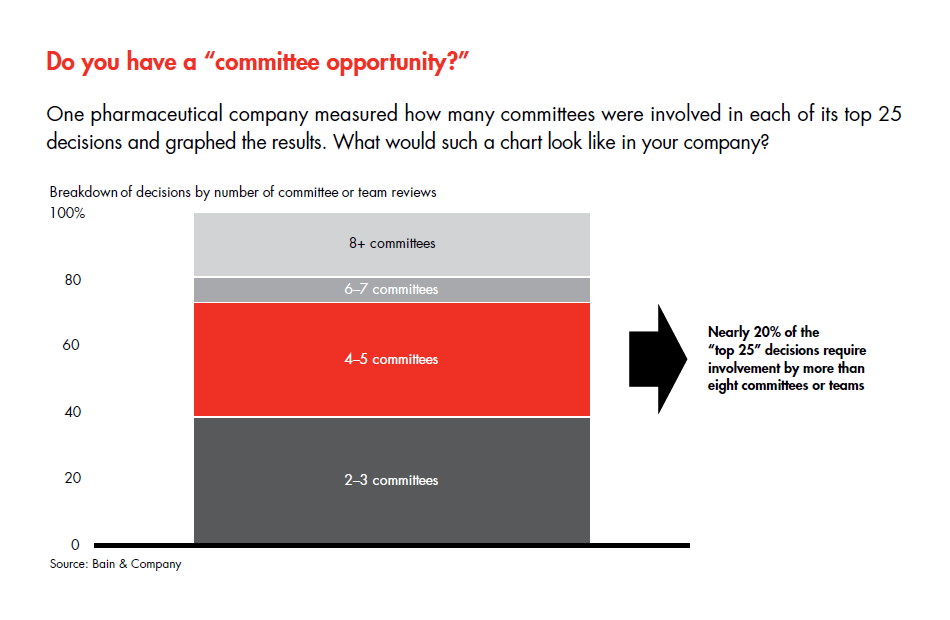

      di-committees-that-work-fig-01_embed

      At the meetings themselves, the chair ensures good discipline, often including the use of symbols and reminders that help keep everyone on track. (See our previous article, “Refresh, refocus, remind: Nine practical tips to keep meetings centered on decisions and action.”) The chair also has to help the group clarify by its decision-making mechanism. Is it participative, with the chair gathering input and then making the decision? Is it consensus? Majority vote? Finally, the secretary has to record decisions, communicate the relevant action items and time frames to all concerned and ensure follow-up.

      A well-functioning committee system, like liberty, requires eternal vigilance. We hesitate to suggest a committee to manage committees—that might be overkill—but we do think it’s essential to track how committees and their members perform over time. Some companies, for instance, incorporate committee contributions into individual performance reviews. Also, it’s worth remembering that committees function best when every other element of the organization—its structure, processes, culture and so on—is clearly focused on decisions.

      Committees can be time sinks and morale killers, but they don’t have to be. Effective committees make decisions, see that those decisions are executed and give every member the well-justified feeling that they are actually getting something done.

      James Hadley is a partner in Bain’s Dubai office and is a leader in Bain’s Global Strategy practice. Jenny Davis-Peccoud is the senior director of Bain’s Global Organization practice. She is based in London.


      di-committees-that-work-fig-01_full
      Auteurs
      • Headshot of James Hadley
        James Hadley
        Associé, London
      Contactez-nous
      Expertises fonctionnelles transverses
      • Organisation
      Organisation
      Measuring decision effectiveness

      Good, fast decision making and execution produce good financial results.

      Voir plus
      Organisation
      Refresh, refocus and remind: Nine practical tips to keep meetings centered on decisions and action

      Meetings. No company can live without them, but it sure is hard to live with them.

      Voir plus
      Organisation
      When a New Organizational Structure Isn’t Enough: How to Truly Live Your Operating Model

      The goal of any organizational redesign is for people to work differently, but that only happens if leaders invest in changing the work itself.

      Voir plus
      Organisation
      Shift to Vertical: David Haines, Group CEO, Flora Food Group

      What does it take to stay connected to your customers when scale and complexity threaten to pull you away? 

      Voir plus
      Organisation
      Leading with Dynamism: AI and the Future of Top Teams

      In the age of AI, dynamic leadership—not just digital tools—is a true competitive advantage.

      Voir plus
      First published in août 2012
      Mots clés
      • Organisation

      Comment nous avons aidé nos clients

      Stratégie A Bold New Strategy Restores a Bank to a Leadership Position

      Lire l’étude de cas

      Organisation Centralization boosts performance for an energy giant

      Lire l’étude de cas

      Organisation A Regional Operating Model Lifts European Sales for a Medical Device Maker

      Lire l’étude de cas

      Vous souhaitez continuer cette conversation ?

      Nous aidons des dirigeants du monde entier à matérialiser des impacts et des résultats pérennes et créateurs de valeur dans leurs organisations.

      Les points de vue de Bain : notre perspective sur des problématiques auxquelles sont confrontées les entreprises à travers le monde, envoyés chaque mois dans votre boîte de réception. 

      *J’ai lu la politique de confidentialité et j’accepte les conditions.

      Merci de lire notre politique de confidentialité.
      Bain & Company
      Contactez-nous Sustainability Accessibility Conditions d’utilisation Politique de Confidentialité Cookie Policy Mentions Légales Sitemap Log In

      © 1996-2026 Bain & Company, Inc.

      Contacter Bain

      Comment pouvons-nous vous aider ?

      • Business inquiry
      • Career information
      • Press relations
      • Partnership request
      • Speaker request
      Voir tous les bureaux