

Etude

En Bref
- European banks have long struggled with low profitability, shrinking pools of traditional revenue, a fragmented industry, and competition from nonbank competitors.
- During Covid-19, banks provided financing and loan extensions, aided by state guarantees, but had to raise their levels of loan loss provisioning, which essentially wiped out return on equity.
- Europe is launching a massive economic recovery plan, but governments will soon lift the suspension of loan repayments. We thus project that the flow of new nonperforming loans across Europe will total between €0.9 trillion and €1.2 trillion through 2022.
- Given their low profitability and the coming surge of nonperforming loans, banks will need to manage those loans, accelerate digitalization and cost reduction, find new sources of revenue growth and sustainability, and undertake selective consolidation.
As Europe prepares for its biggest recovery plan since right after World War II, most banks in the region bear scars from more than a year of Covid-19 and widespread shutdowns of business and everyday life. Many banks were limping along even before the pandemic. Now each one faces a classic choice: whether and how to use a crisis to remake their business and outgrow competitors, or stick with their current model, in the vain hope of inertial recovery, and possibly fade into irrelevance.
Troubles before the storm
Well before the pandemic, European banks have suffered for years from structurally low return on equity—for example, around 5% return on equity (ROE) both in the European Union (EU) and the UK in 2019. That’s well below the 8% to 10% average cost of equity for the industry. The cost-income ratio, meanwhile, has been stuck at around 66% on average.
Behind these numbers, several problems plague incumbent banks. First, there’s a wide digital gap between young neobanks and incumbents, which limits the incumbents’ performance in cost, speed, and the customer experience. At the end of 2019, Bain & Company’s Digitalization Index recorded a gap of over 50 points (out of 100) between pure digital banks and traditional banks. Incumbents lagged especially in the use of digital around product complexity, customer experience, operating model, technology, and data.
A second problem involves the evaporation of profitability in traditional revenue pools. For example, Bain analysis finds that in most southern European banking markets, revenues from commercial loans over €250,000 averaged only a 1% return net of loan loss provisions, on average, whereas credit cards and consumer loans provided a more than 5% risk-adjusted return.
In addition, the industry remains too fragmented. As of 2019, the top three players in each market owned only up to 50% of deposits, creating a strong case for further market consolidation.
Comes the pandemic
Covid-19 and the attendant shutdowns caused a severe contraction of Europe’s economies, with GDP declines for 2020 of 6.5% for the EU and 9.8% in the UK. Public debt soared throughout the region, as governments issued loan guarantees of more than €400 billion.
The industry’s ROE dropped in 2020 to 1.5% in the EU and 2.5% in the UK (see Figure 1). Loan loss provisions almost doubled in the EU and more than tripled in the UK.
Figure 1
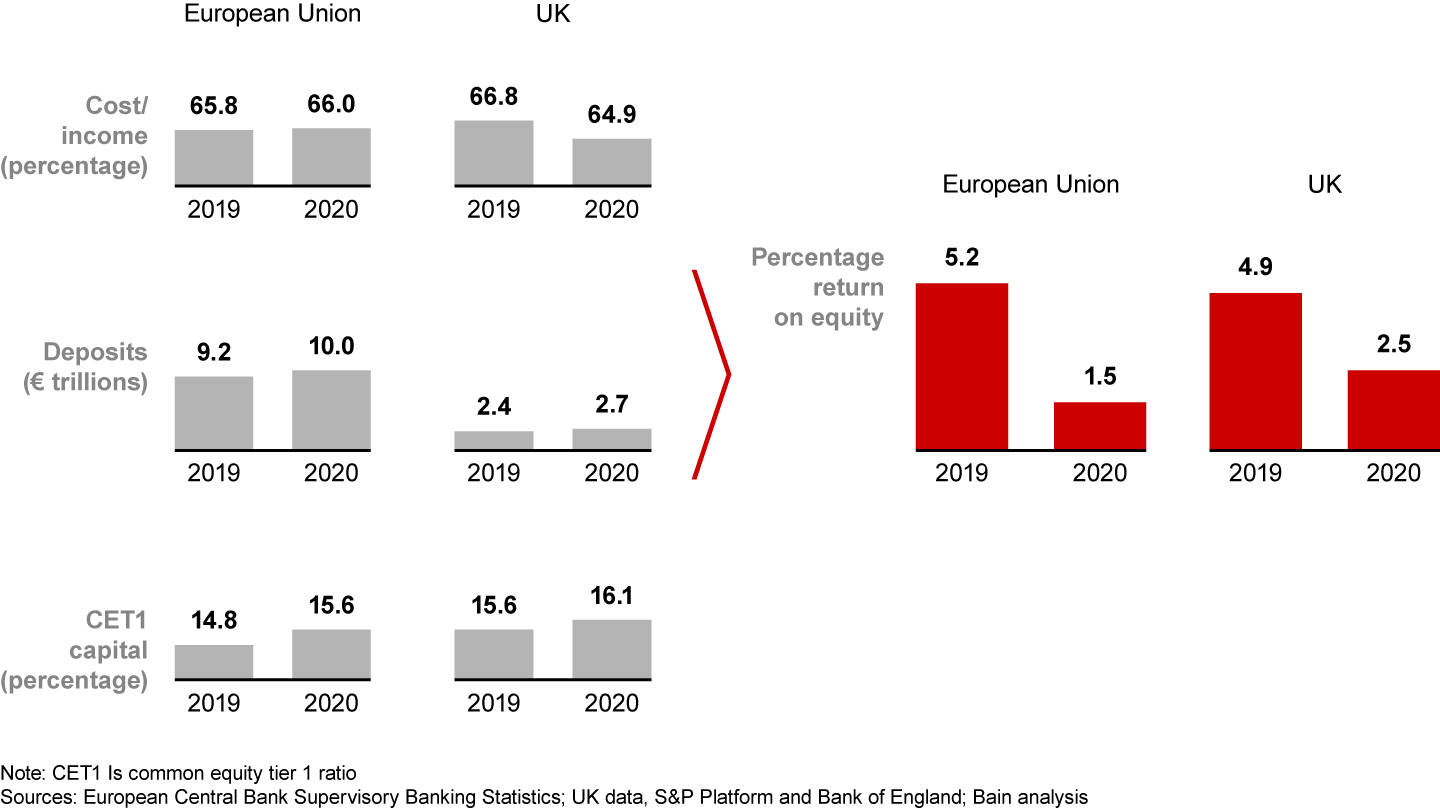

Following regulators’ persuasion to limit dividends and capital distribution, banks now have unprecedented levels of capital, with an average 15.6% common equity tier 1 ratio (CET1) in the EU and 16.1% in the UK. The recent 2021 stress test of 50 major banks by the European Banking Authority confirms that banks have sufficient capital to survive a significant economic downturn, even on top of the pandemic shutdown, over a three-year horizon. Despite an average decrease in the CET1 ratio of 485 basis points among these banks, they would still have a CET1 ratio above 10%.
For investors, the net result of the damage so far: Europe’s 17 largest banking institutions delivered a total shareholder return of –1% over three years through 2020, and just 1% over five years.
At the same time, greater sensitivity on social issues has caused banks with a better environmental, social, and governance (ESG) profile to log an extra 500 basis points in shareholder return during the pandemic. Indeed, sustainability has in some respects become the next digital.
Looking ahead, Europe’s GDP is likely to rise throughout 2021, as the €807 billion NextGenerationEU plan—roughly seven times today’s value of the postwar Marshall Plan—takes hold to support recovery and spur private investments. Banks have an additional €800 billion in available capital buffers—think of it as “lending dry powder”—to make available. A total of €1.6 trillion in funds, or 14% of current GDP, thus could make its way through the region’s economy. Beyond growth prospects, stressed market conditions will make consolidation options more favorable between stronger and weaker banks. Regulators recognize the need for consolidation; the ECB, for instance, has contemplated measures such as liquidity waivers, simplification of local regulatory scrutiny, and revised requirements for capital calls.
An immediate challenge: nonperforming loans
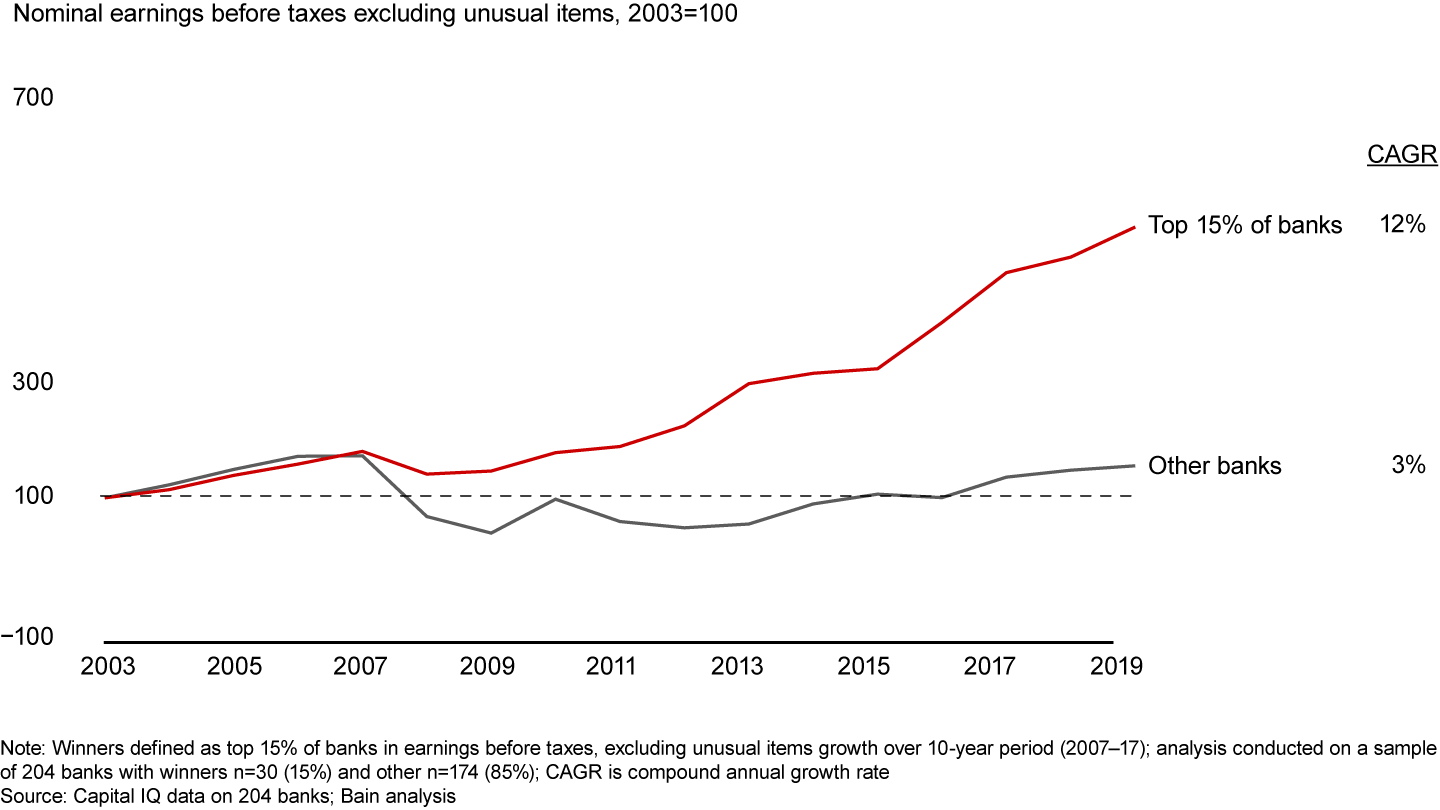
Economic crises have always been moments when the fortunes of firms within an industry were more quickly reshaped. History teaches that crises are always a crucial moment to reshape the fortunes of players within any sector. After the last financial crisis, for instance, top-quartile banks, as measured by earnings before taxes, outgrew the bottom quartile by 9 percentage points each year of the past decade, according to Bain analysis of Capital IQ data (see Figure 2).
Figure 2

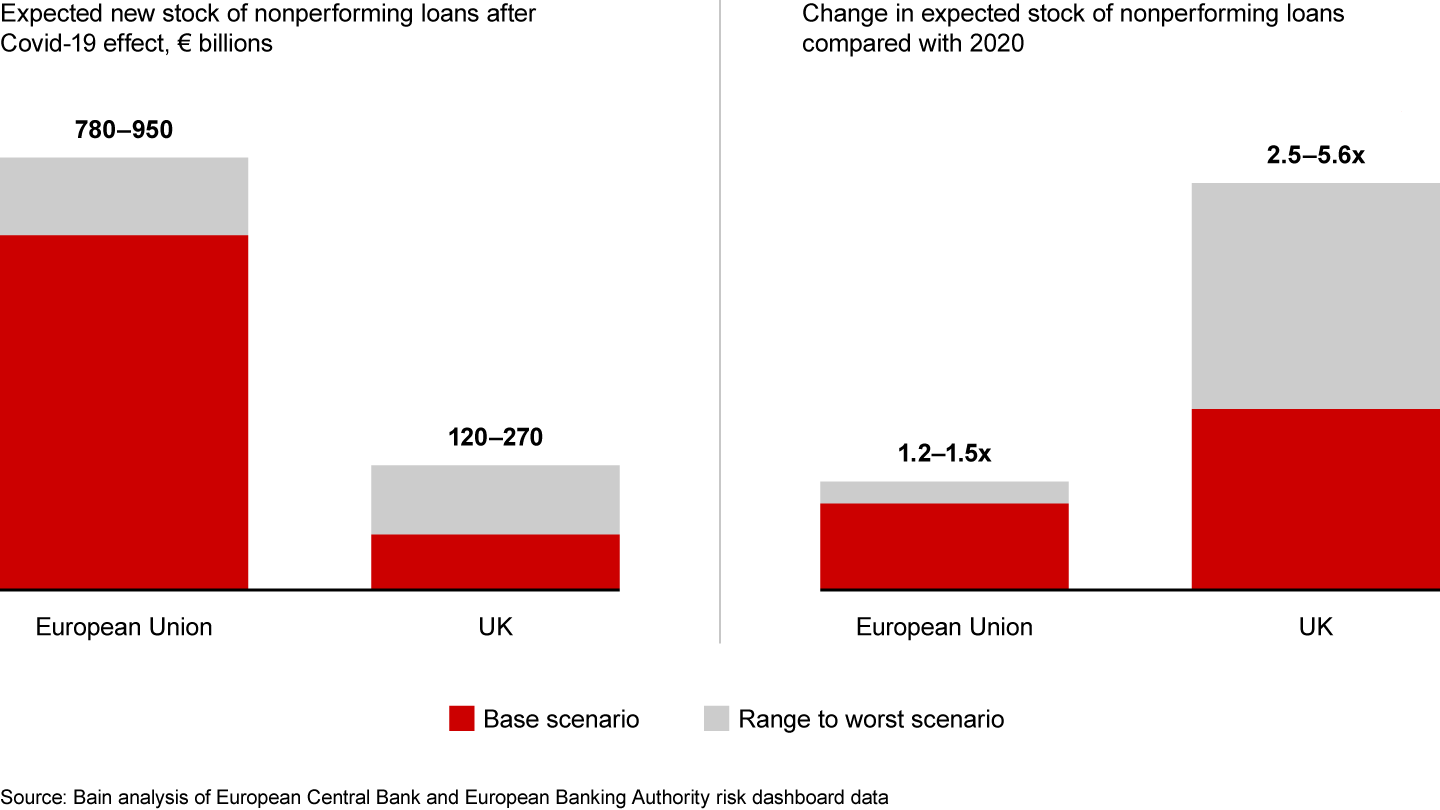
An immediate challenge is to isolate and neutralize the effects of the imminent surge of bad loans. We project the flow of new nonperforming loans across Europe will total between €0.9 trillion and €1.2 trillion, starting near the end of 2021 and following through to 2022, when governments lift the suspension of loan repayments (see Figure 3).
Figure 3

This amounts to a sizable legacy of Covid-19. But it is manageable if banks take a proactive stance. Banks will need to identify which parts of their loan portfolio feel the most stress, and cluster those loans according to factors such as state guarantees or other collateral, the share of wallet each customer spends with the bank, and loan-loss provisions already put in place as a buffer. Each cluster will require a tailored program, as well as improvements in skills, workflows, decision making, monitoring, and overall strategy.
One European institution with a loan portfolio of more than €400 billion is heavily exposed to retail and small and midsize enterprise (SME) segments. It redesigned management of nonperforming loans by setting up new workflows, workout units, and agreements with specialized servicers. It created a set of decision trees to suggest the most suitable strategy for each client, based on relevant characteristics defined through artificial-intelligence-enhanced smart clustering. As a result, the bank increased its collection recovery rate by 5 percentage points.
Five imperatives for recovery
Once they develop a solid plan for nonperforming loans, banks can turn their attention to five broader issues that were evident before the pandemic and take on greater urgency today:
- Faster digitalization
- Cost containment
- New sources of profitable growth
- Sustainable purpose
- Consolidation
Let’s review each in turn.
Accelerated digitalization. All traditional banks have launched digital initiatives, of course. But with customers increasingly buying financial services products from fintechs and major technology companies, it’s important for senior executives to honestly assess the speed of their digital progress and accelerate investments in the areas that matter most to customers and to the bank’s economics.
Customers overwhelmingly prefer digital channels for routine banking interactions, Bain surveys have found. They want easy and intuitive channels to research and buy products, as well as personalized marketing and services. Delivering a strong customer experience and making digital a pillar of a bank’s strategy entails agile methods, flexible IT architecture, and advanced analytics capabilities. Most banks will also benefit from collaboration with technology firms, in order to access the relevant innovations that can improve the experience.
Given how broad digital transformation can be, it’s essential to prioritize and sequence investments. A large southern European banking group decided to double down on digital at the core of its strategy. It assessed point of departure with the use of a Digital Transition Index, a quantitative metric that gives a complete view of digital’s role in every business and process at a detailed level—every customer segment, product, and function within the bank. That assessment enabled the bank to quantify the trade-offs involved in each potential digital investment. For example, it identified the operations and business areas that are not digital; the ones that, although digitized, do not provide a consistent experience across channels; the software assets that need an architectural revamp; and, finally, the data that is not yet fully governed or monetized. This exercise enables senior managers to make informed decisions about what to prioritize first.
Sustained cost control. Beyond quick cost-cutting moves, a long-term, sustainable approach to cost control depends on senior leaders setting the ambition and employees at all levels surfacing cost reduction opportunities. A culture of zero-based budgeting starts with a clean sheet on spending, rather than assuming “last year’s budget plus or minus x%.” Consistent with that culture, simplifying the operating model will allow a bank to better use automation and digital technologies to take out costs.
Two functions deserve special attention for costs. With work likely to occur at both home and office locations, banks should rethink their use of real estate. They can eliminate nonfunctional spaces and optimize functional ones by adopting technologies that enable centralized oversight of operating conditions and employee engagement. In addition, banks should improve their procurement and capture savings through smarter use of digital tools such as straight-through processing, and by leveraging robotics and migration to cloud.
One large European banking group with an addressable cost base of over €3 billion decided to apply a radical zero-based redesign to all support and control functions in order to reach short- and midterm targets. The bank harmonized its methodology across functions and benchmarked itself against leading organizations. So far, it has realized more than 15% gross savings and is on track for further savings through 2022.
The search for profitable growth. As revenue pools have shifted, many bank executives have been shocked at the extent of profits draining away and the speed with which competitors outpaced them to carve leadership positions in attractive niches. Facing up to the reality, then, is an essential prelude to taking action and making the most of opportunities that emerge from the recovery.
In Italy, where a large share of the NextGenerationEU program will be directed, Intesa Sanpaolo recently announced it will double down on its recovery plan by making available over €400 billion of its resources, focusing principally on initiatives related to the themes of green transition, infrastructure, and critical supply chains.
Liquidity and wealth management is also an area that could hold appeal as the economy rebounds and personal savings get plowed back into investments. To boost fee income, however, banks will have to raise the quality of the offering, advice, and services. Advanced analytics can help in this regard by better detecting client needs, boosting the quality of commercial proposition, and improving customer insights.
One European bank reconfigured its wealth management business model to cut the share of liquid deposits over total assets from 20% to 10%. Revenues increased by 60 basis points, costs dropped by 40 basis points, and for each €100 million converted this way, the bank realized €1 million in net profits.
Sustainable purpose. Increasingly, elements of sustainability are figuring as key components of any bank’s growth. Having the institution itself become sustainable, and also offering products and advice related to such issues as decarbonization and climate risk, entails reconfiguring internal processes around risk management, the supply chain, real estate, and other functions. Far from being only a matter of compliance, achieving a sustainable profile can translate to better bank economics and greater resilience.
A leading European financial institution recently drew up an ESG roadmap, identifying which actions would help reach its target of becoming world class in the area. Actions range from evolving its offering, to accelerating the composition of its loan portfolio, to new procurement policies. It estimates that this ESG transformation will reduce its cost of risk by 15 basis points and its cost of funding by 10 basis points—a total 15% improvement on pretax profits.
Stepped-up consolidation. Recent mergers and acquisitions have been driven largely to expand market share. In Italy, Intesa Sanpaolo acquired UBI to increase its market share to what we estimate is almost 30% of total assets, and Crédit Agricole bought Creval to reach a 7% share. In Spain, Bankia and Caixa merged to become the largest domestic bank ahead of Santander and BBVA, and Unicaja and Liberbank also moved forward to integrate.
Some private equity funds have also shown greater interest in banking assets of late. For example, Cerberus bought HSBC France, and JC Flowers and Bain Capital took a 10% interest in the Co-Operative Bank in the UK.
The pace is bound to pick up, given that assets are relatively cheap right now. Domestic deals involving smaller banks will respond to cost and regulatory pressures. Opportunistic cross-border deals will surface in the absence of good domestic opportunities and the push by regulators for larger, healthier institutions that will be able to compete globally. And some deals will expand a bank’s scope, by acquiring fintechs whose valuations have fallen.
Indeed, leading banks understand that inorganic growth has become a routine component of strategy, to expand growth opportunities, achieve economies of scale, and acquire technologies or capabilities that would be too expensive or time consuming to develop internally. The most successful acquirers hew to a proven sequence:
- Find the right deal. They routinely examine their current portfolio to identify areas to strengthen, and they proactively screen the market for potential candidates.
- Systematically assess before the deal. They’re clear about what will create value, in order to avoid overpayment. Diligence includes IT risk assessment and stress testing the balance sheet, regulatory terms, and possible state support.
- Integrate carefully. They tailor integration to the nature of the deal, with an eye to value creation. They adhere to clear milestones and timelines for implementation.
Sometimes it makes sense to pause—but not today. The time for hesitation has passed. Just as in the aftermath of the global financial crisis, joining the top- or bottom-quartile performers will not result from mere chance. Banks that deal now with the key challenges and opportunities discussed here stand a far better chance of thriving during postpandemic years and building a durable competitive advantage no matter what new challenges emerge.
First published in août 2021