
Skip to Content
  • Bureaux

    Bureaux

    Amérique du Nord et Amérique du Sud
    • Atlanta
    • Austin
    • Bogota
    • Boston
    • Buenos Aires
    • Chicago
    • Dallas
    • Denver
    • Houston
    • Los Angeles
    • Mexico City
    • Minneapolis
    • Monterrey
    • Montreal
    • New York
    • Rio de Janeiro
    • San Francisco
    • Santiago
    • São Paulo
    • Seattle
    • Silicon Valley
    • Toronto
    • Washington, DC
    Europe, Moyen-Orient et Afrique
    • Amsterdam
    • Athens
    • Berlin
    • Brussels
    • Copenhagen
    • Doha
    • Dubai
    • Dusseldorf
    • Frankfurt
    • Helsinki
    • Istanbul
    • Johannesburg
    • Kyiv
    • Lisbon
    • London
    • Madrid
    • Milan
    • Munich
    • Oslo
    • Paris
    • Riyadh
    • Rome
    • Stockholm
    • Vienna
    • Warsaw
    • Zurich
    Asie et Australie
    • Bangkok
    • Beijing
    • Bengaluru
    • Brisbane
    • Ho Chi Minh City
    • Hong Kong
    • Jakarta
    • Kuala Lumpur
    • Manila
    • Melbourne
    • Mumbai
    • New Delhi
    • Perth
    • Seoul
    • Shanghai
    • Singapore
    • Sydney
    • Tokyo
    Voir tous les bureaux
  • Alumni
  • Presse
  • S’abonner
  • Contacter
  • France | Français

    Sélectionnez votre région et votre langue

    Global
    • Global (English)
    Amérique du Nord et Amérique du Sud
    • Brazil (Português)
    • Argentina (Español)
    • Canada (Français)
    • Chile (Español)
    • Colombia (Español)
    Europe, Moyen-Orient et Afrique
    • France (Français)
    • DACH Region (Deutsch)
    • Italy (Italiano)
    • Spain (Español)
    • Greece (Elliniká)
    Asie et Australie
    • China (中文版)
    • Korea (한국어)
    • Japan (日本語)
  • Saved items (0)
    Saved items (0)

    You have no saved items.

    Bookmark content that interests you and it will be saved here for you to read or share later.

    Explore Bain Insights
  • Expertises Sectorielles
    Menu principal

    Expertises Sectorielles

    • Aerospace et Défense
    • Agroalimentaire
    • Chimie
    • Infrastructures, BTP et Matériaux de Construction
    • Grande Consommation
    • Services Financiers
    • Santé
    • Engins & Equipements Industriels
    • Media et Divertissement
    • Metals
    • Mining
    • Pétrole & Gaz
    • Papier et Emballage
    • Private Equity
    • Secteur Public
    • Distribution
    • Technologie
    • Télécommunications
    • Transportation
    • Travel & Leisure
    • Utilities & Energies Renouvelables
  • Expertises Fonctionnelles
    Menu principal

    Expertises Fonctionnelles

    • Expérience Client
    • ESG
    • Innovation
    • Fusions et Acquisitions
    • Opérations
    • People & Organization
    • Private Equity
    • Sales & Marketing
    • Stratégie
    • IA, Perspectives et Solutions
    • Technology
    • Transformation
  • Digital
  • Points de Vue
  • À propos
    Menu principal

    À propos

    • Notre Activité
    • Nos Valeurs
    • Nos Collaborateurs et Notre Équipe Dirigeante
    • Notre Impact
    • Prix & Récompenses
    • Partenariats Internationaux
    • Evénements
    Further: Our global responsibility
    • Diversité et Inclusion
    • Impact Social
    • Sustainability
    • World Economic Forum
    Learn more about Further
  • Carrières
    Menu principal

    Carrières

    • Rejoignez-nous
      Carrières
      Rejoignez-nous
      • Find Your Place
      • Nos domaines d’expertise
      • Equipes multidisciplinaires
      • Étudiants
      • Stages et programmes
      • Événements de recrutement
    • La vie chez Bain
      Carrières
      La vie chez Bain
      • Blog: Inside Bain
      • Récits de carrière
      • Nos collaborateurs
      • Nos bureaux
      • Soutenir votre évolution professionnelle
      • Groupes d’affinités
      • Avantages chez Bain
    • Histoires d’impact
    • Notre processus de recrutement
      Carrières
      Notre processus de recrutement
      • Ce que vous pouvez attendre
      • Entretiens
    Trouver un poste
  • Bureaux
    Menu principal

    Bureaux

    • Amérique du Nord et Amérique du Sud
      Bureaux
      Amérique du Nord et Amérique du Sud
      • Atlanta
      • Austin
      • Bogota
      • Boston
      • Buenos Aires
      • Chicago
      • Dallas
      • Denver
      • Houston
      • Los Angeles
      • Mexico City
      • Minneapolis
      • Monterrey
      • Montreal
      • New York
      • Rio de Janeiro
      • San Francisco
      • Santiago
      • São Paulo
      • Seattle
      • Silicon Valley
      • Toronto
      • Washington, DC
    • Europe, Moyen-Orient et Afrique
      Bureaux
      Europe, Moyen-Orient et Afrique
      • Amsterdam
      • Athens
      • Berlin
      • Brussels
      • Copenhagen
      • Doha
      • Dubai
      • Dusseldorf
      • Frankfurt
      • Helsinki
      • Istanbul
      • Johannesburg
      • Kyiv
      • Lisbon
      • London
      • Madrid
      • Milan
      • Munich
      • Oslo
      • Paris
      • Riyadh
      • Rome
      • Stockholm
      • Vienna
      • Warsaw
      • Zurich
    • Asie et Australie
      Bureaux
      Asie et Australie
      • Bangkok
      • Beijing
      • Bengaluru
      • Brisbane
      • Ho Chi Minh City
      • Hong Kong
      • Jakarta
      • Kuala Lumpur
      • Manila
      • Melbourne
      • Mumbai
      • New Delhi
      • Perth
      • Seoul
      • Shanghai
      • Singapore
      • Sydney
      • Tokyo
    Voir tous les bureaux
  • Alumni
  • Presse
  • S’abonner
  • Contacter
  • France | Français
    Menu principal

    Sélectionnez votre région et votre langue

    • Global
      Sélectionnez votre région et votre langue
      Global
      • Global (English)
    • Amérique du Nord et Amérique du Sud
      Sélectionnez votre région et votre langue
      Amérique du Nord et Amérique du Sud
      • Brazil (Português)
      • Argentina (Español)
      • Canada (Français)
      • Chile (Español)
      • Colombia (Español)
    • Europe, Moyen-Orient et Afrique
      Sélectionnez votre région et votre langue
      Europe, Moyen-Orient et Afrique
      • France (Français)
      • DACH Region (Deutsch)
      • Italy (Italiano)
      • Spain (Español)
      • Greece (Elliniká)
    • Asie et Australie
      Sélectionnez votre région et votre langue
      Asie et Australie
      • China (中文版)
      • Korea (한국어)
      • Japan (日本語)
  • Saved items  (0)
    Menu principal
    Saved items (0)

    You have no saved items.

    Bookmark content that interests you and it will be saved here for you to read or share later.

    Explore Bain Insights
  • Expertises Sectorielles
    • Expertises Sectorielles

      • Aerospace et Défense
      • Agroalimentaire
      • Chimie
      • Infrastructures, BTP et Matériaux de Construction
      • Grande Consommation
      • Services Financiers
      • Santé
      • Engins & Equipements Industriels
      • Media et Divertissement
      • Metals
      • Mining
      • Pétrole & Gaz
      • Papier et Emballage
      • Private Equity
      • Secteur Public
      • Distribution
      • Technologie
      • Télécommunications
      • Transportation
      • Travel & Leisure
      • Utilities & Energies Renouvelables
  • Expertises Fonctionnelles
    • Expertises Fonctionnelles

      • Expérience Client
      • ESG
      • Innovation
      • Fusions et Acquisitions
      • Opérations
      • People & Organization
      • Private Equity
      • Sales & Marketing
      • Stratégie
      • IA, Perspectives et Solutions
      • Technology
      • Transformation
  • Digital
  • Points de Vue
  • À propos
    • À propos

      • Notre Activité
      • Nos Valeurs
      • Nos Collaborateurs et Notre Équipe Dirigeante
      • Notre Impact
      • Prix & Récompenses
      • Partenariats Internationaux
      • Evénements
      Further: Our global responsibility
      • Diversité et Inclusion
      • Impact Social
      • Sustainability
      • World Economic Forum
      Learn more about Further
  • Carrières
    Recherches les plus fréquentes
    • Agile
    • Digital
    • Stratégie
    Vos recherches précédentes
      Pages récemment visitées

      Content added to saved items

      Saved items (0)

      Removed from saved items

      Saved items (0)

      Etude

      Healthy living: Economic necessity and business opportunity

      Healthy living: Economic necessity and business opportunity

      How business leaders can understand, advance and shape the market for Healthy Living.

      Par Norbert Hueltenschmidt, Tamara Olsen and Vijay Vishwanath

      • min

      Etude

      Healthy living: Economic necessity and business opportunity
      en

      Healthy living, once relegated to the Style section of newspapers and magazines, is front-page news all over the world. More than half of all deaths now result from largely preventable, noncommunicable diseases (NCDs) like cancer, cardiovascular disease and diabetes. A quarter of all NCD-related deaths affect people under the age of 60, thus killing individuals in their most productive years. Experts estimate that loss in economic output due to premature death and disability from NCDs will consume up to 5% of global GDP by 2030 and cost $47 trillion in the next two decades. In the US alone, life expectancy for the average American could decline by as much as five years due to obesity-related illnesses. In the developing world, NCD risk factors are climbing at an alarming rate as well. Physical activity in China, for example, has declined by almost 50% over the past 20 years.

      “The Charter for Healthy Living” report and “Toolkit for Joint Action,” launched at the 2013 World Economic Forum in collaboration with Bain & Company, illustrate the depth of the problem and provide a framework for multistakeholder action. Governments have learned they cannot solve these problems on their own. Business has a major role to play because the private sector can bring unique resources and competence to the table.

      Business leaders, policy makers and consumers are beginning to understand the need to move beyond outdated disease models and to think about “health” and “care” as separate but equal concepts—more cost-effective care for an aging and sicker population and investments in health so that we can pay for care and keep GDP growth on track (see Figure 1). Better care will require stronger integration of services, earlier diagnoses and smarter use of data and new technologies. Keeping people healthy will necessitate exponentially better health education and information, such as evidence-based incentives for healthy behavior and innovative health and well-being services and community projects on every continent.


      healthy-living-economic-necessity-fig-01_embed

      Some industry leaders are already taking action because they understand that markets are changing. They have identified new opportunities to advance the availability of healthy products and services. And they are starting to shape their brand and market around healthy living (see Figure 2). Whether you are in the business of producing drugs, food, beverages, shoes or delivering medical care, healthy living is not just a minor challenge; it is a matter of economic survival.
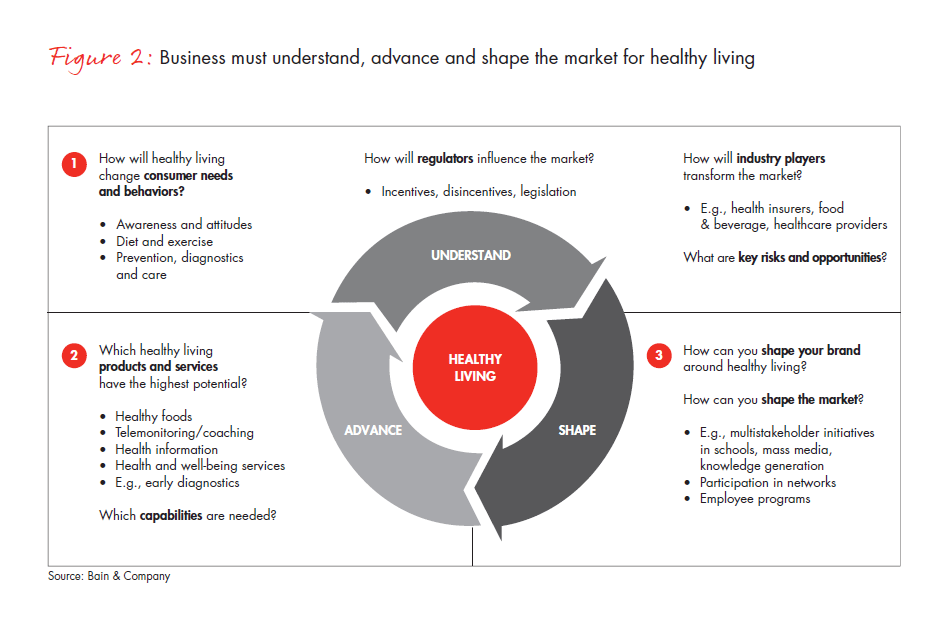

      healthy-living-economic-necessity-fig-02_embed

      Understand how healthy living will impact your core markets

      All sectors of society recognize that the market is changing, but not all agree on how best to respond. Policy makers are demanding change and some have attempted to mandate it. Denmark was the first nation to introduce a fat tax in 2011, only to revise it one year later when it did not achieve the required behavior change. New York city’s effort to limit the size of sugary drinks was put on hold by a court ruling. Regulators are learning that it is difficult to force changes in eating habits through legislation and regulation, but these initial setbacks will not stop them from trying to promote healthy lifestyles in the future.

      The public is demanding change, too. Consumers want to better manage their own and their families’ health. They are seeking health information on Internet sites like the Mayo Clinic and WebMD, whose websites have approximately 100 million visitors per month. They are looking for diets that promote and sustain weight loss, for exercise programs that are customized to their individual preferences and budget, and for smartphone technologies that can monitor and support their health and well-being. Companies hoping to keep up with these changes must learn more about what information consumers use before they make a purchasing decision and which tools actually change behavior. They must research the most effective means for changing behavior. Behavioral change is particularly hard to achieve in the healthy living context, but insights and tools from the behavioral sciences can help. Studies show that consequences such as rewards, praise and peer feedback are up to four times more effective in changing behavior than are antecedents or upfront information and incentives (see the Bain Brief “Changing behaviors to deliver business results.”)

      On the care side, there is strong momentum for better integration of services to guide patients through the system more efficiently, to avoid duplicative diagnoses and to provide personalized treatments. More integrated care will include innovations such as the fully functional eHealth system in Denmark, accountable care organizations (ACOs) in the US and an increasing number of clinical protocols and medical decision aids that help doctors and patients make the right treatment decisions.

      These market changes present major new business opportunities, but they also carry risks, such as a declining demand for some products or a new, more integrated healthcare customer landscape.

      A clear vision of healthy living and its anticipated business impact should be a core component of corporate strategies and business models.

      Infographic

      Healthy living: The business opportunity

      How business leaders can understand, advance and shape the market for Healthy Living.

      Advance healthy living products and services

      Many, if not most, products and services have a health-related component. In the food and beverage industry, there is a clear opportunity to develop and market new, healthy products at various price points and to educate consumers about these products. General Mills is among the leaders in the field. Since 2005, it has improved the nutrition profile of 64% of its US retail volume through initiatives such as whole grain addition and sodium and sugar reduction.

      Health insurance companies are starting to focus more on keeping people healthy, thus transforming themselves into health promotion companies. Discovery, a South African-based health insurance company, has introduced a very successful consumer-focused health insurance product called “Vitality.” Vitality includes a broad incentive-based program that offers rewards such as discounts on vacations, flights and consumer products to members for practicing healthy behaviors. An evaluation showed that hospital admission rates were 7.4% lower for cardiovascular disease, 13.2% lower for cancers and 20.7% lower for endocrine and metabolic diseases for highly engaged members.

      Teleconsultation and telecoaching are on the rise, and not only in emerging markets where lower-cost solutions are needed to provide medical care. In the UK, several Internet pharmacies, such as ChemistDirect and Pharmacy2U, provide free online medical consul-tations for selected indications. These programs hope to promote customer loyalty on the part of profitable private-pay customers and patients with chronic diseases. Telemonitoring is entering a new era, thanks to widely available smartphone technology. Bosch Healthcare, a leading home healthcare system provider, recently announced a partnership with a wireless technology company, Great Call, to develop innovative mobile health applications that elderly patients can easily use. Dozens of companies, such as AliveCor, SHL/SmartHeart or ineedMD, provide devices that measure heart activity remotely and allow patients to send results di-rectly to their providers without having to leave home.

      As consumers increasingly seek a more holistic approach to staying healthy, the market for alternative wellness services, such as spa treatments and herbal remedies, is responding as well. It is still an open question as to which of these products will be most profitable or which will truly change behavior, but the market is not waiting for a final answer.

      Taking full advantage of healthy living business opportunities will require deep customer insights, combined with the right capabilities and an innovative mindset.

      Shape your brand and shape the market

      Health insurance companies like Aetna and Kaiser Permanente are selling more than health or care; they are creating new products and services to build their brand around health and not just illness. Aetna recently announced a partnership with “PatientsLikeMe,” designed to provide members with links to information about their conditions and treatments. Aetna’s health and stress management program won a platinum-level award, as a “Best Employer for Healthy Lifestyles” in 2012. Kaiser Permanente launched an “Every Body Walk!” program, which targets the general public. CEO George Halvorson stressed the fact that the number of new diabetes cases could be cut in half if people walked just 30 minutes a day, five days a week.

      Corporate healthy living initiatives will become more and more standard and an integral part of brand building. Companies that want to have an impact beyond the confines of their own organization can find practical advice in the World Economic Forum’s Healthy Living Toolkit about how to be effective in a multistakeholder environment. Sometimes a single company takes the initiative. Nike, a company that famously makes sporting goods, understood that physical activity was declining as economies were growing and developing. But Nike also understood that simply manufacturing more shoes would not improve physical activity. So it helped launch the “Designed to Move” initiative, in cooperation with sports associations, academic researchers and the media, to promote an action agenda to increase physical activity worldwide. Nike may very well sell more shoes as a result of this initiative, but the additional benefits will endure beyond its immediate market for years to come.

      Corporate interest in employee wellness is gaining momentum. In the US, company spending on wellness programs has doubled since 2009. The primary goals of these programs are to reduce absenteeism, improve productivity and increase employee retention and satisfaction. More must be done to increase the effectiveness of these programs through a combination of creative approaches, such as “walking meetings” or smart cafeteria design, which implements Brian Wansink’s research on the psychology of food consumption.

      These are just some of the ways companies can promote healthy living and grow their business at the same time. Any company embarking on a healthy living initiative would do well to ask itself the following questions: Are we well positioned to meet the inevitable changes and challenges? Can we readily identify our most attractive healthy living growth opportunities? Is health part of our balance sheet? Do we have a clear vision of how healthy living will shape our market and workforce two to five years down the road? Do we know what capabilities we will need to build? Do we have a comprehensive program that allows for effective evaluation in place? Today’s answers to these questions will determine tomorrow’s front-page news.


      healthy-living-economic-necessity-fig-01_full

      healthy-living-economic-necessity-fig-02_full
      Auteurs
      • Headshot of Norbert Hueltenschmidt
        Norbert Hueltenschmidt
        Associé, Zurich
      • Tamara Olsen
        Former Partner, Boston
      • Headshot of Vijay Vishwanath
        Vijay Vishwanath
        Advisory Partner, Boston
      Contactez-nous
      Synergies sectorielles
      • Grande Consommation
      • Santé
      Santé
      Multistakeholder collaboration for healthy living: Toolkit annex

      The templates in this document complement the guidance offered in the Multistakeholder Collaboration for Healthy Living: Toolkit for joint action.

      Voir plus
      Multistakeholder collaboration for healthy living: Toolkit for joint action

      Healthy living is not just a health agenda; it is an imperative for all of society. Collaboration among all stakeholders is the only systematic way to promote better well-being.

      Voir plus
      Santé
      The charter for healthy living

      Chronic conditions such as heart disease, diabetes and obesity pose threats to the human race.

      Voir plus
      Santé
      Weight-Loss Drug Users Spend Less on Groceries, Fast Food

      GLP-1 drugs result in notable drops in food spending. By 2030, as many as one in four Americans may have tried them.

      Voir plus
      Top Digital Use Cases by Industry

      Bain’s research identifies the most useful digital applications, including those that offer the best opportunities for competitive advantage.

      Voir plus
      First published in mai 2013
      Mots clés
      • Grande Consommation
      • Santé

      Comment nous avons aidé nos clients

      A Food Company’s Bold Play to Restore Margin and Growth

      Lire l’étude de cas

      Développement Durable et Responsabilité Sociétale des Entreprises (RSE) A Consumer Products Giant Accelerates Its Sustainability Agenda

      Lire l’étude de cas

      Stratégie Client et Marketing Designing a Sales Compensation Plan Based on an Unusual Metric

      Lire l’étude de cas

      Vous souhaitez continuer cette conversation ?

      Nous aidons des dirigeants du monde entier à matérialiser des impacts et des résultats pérennes et créateurs de valeur dans leurs organisations.

      Les points de vue de Bain : notre perspective sur des problématiques auxquelles sont confrontées les entreprises à travers le monde, envoyés chaque mois dans votre boîte de réception. 

      *J’ai lu la politique de confidentialité et j’accepte les conditions.

      Merci de lire notre politique de confidentialité.
      Bain & Company
      Contactez-nous Sustainability Accessibility Conditions d’utilisation Politique de Confidentialité Cookie Policy Mentions Légales Sitemap Log In

      © 1996-2026 Bain & Company, Inc.

      Contacter Bain

      Comment pouvons-nous vous aider ?

      • Business inquiry
      • Career information
      • Press relations
      • Partnership request
      • Speaker request
      Voir tous les bureaux