

Etude

Telstra refers to them as T-Times. At Apple stores they’re called Daily Downloads. Zappos dubs them Zuddles. But the terminology doesn’t matter much—most companies just refer to them as huddles.
Huddles are short, interactive team meetings, usually 15 to 30 minutes. They take place regularly, often daily or weekly. And they serve a variety of important purposes in the Net Promoter SystemSM.
Building commitment. Huddles reconnect people to a company’s core mission. They reinforce employees’ commitment to serve customers better and create more promoters.
How they do this varies from one company to another. Team leaders at Apple’s Daily Downloads give a shoutout to an individual who gets a 10 rating or a heartfelt thank-you from a customer. Team members at many Enterprise Rent-A-Car locations vote on which of them delivered the best service during the past week. Other companies use videos or role-playing to help employees learn best practices. The specifics are less important than the fact that there’s a regular part of every day or week devoted to discussing customer feedback and ways to improve. It’s a constant reminder to team members that earning the enthusiastic advocacy of customers is the company’s core objective.
Giving and receiving help. Huddles also enable team members to work together rather than separately. They encourage people to share problems and potential solutions. They build a sense of collaboration and teamwork.
Much of the collaboration happens in the discussion of customer feedback. Employees talk over issues they have been struggling with and compare notes about possible solutions. They commit to making improvements, and they hold one another accountable for taking action. (“Over the next two weeks, I will try out Alison’s new approach to explaining how the claims process works.”) Usually, the vast majority of concerns employees hear from customers are issues they can address—or at least influence—within the team. That process often starts with the huddle.
Escalating broader issues. Huddles are a crucial link between the Net Promoter System’s inner loop and its outer loop (see Figure 1). They give employees a chance to identify issues that require attention of another function or level of the organization.
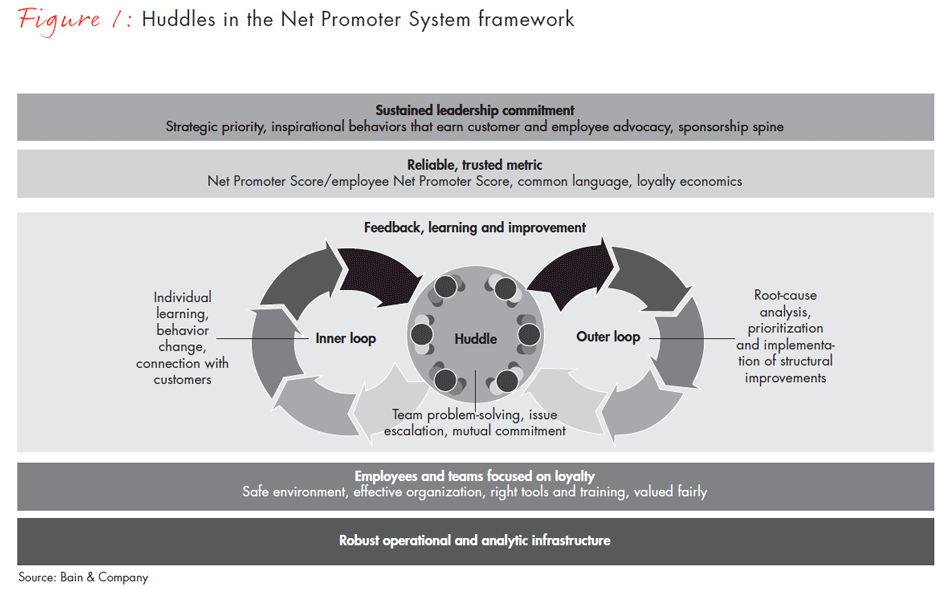
Maybe, for example, a couple of people mention a corporate policy or procedure they believe needs to be changed. Others chime in—“Yes, I’ve run into that same issue; what can we do about it?” The supervisor channels concerns and suggestions like these to the central Net Promoter® team—to the outer loop. That team prioritizes the employees’ concerns along with issues raised directly by customers. Then it puts the highest-priority issues in front of leaders who can make the necessary decisions.
Huddles aren’t just for frontline employees. Every unit and function can benefit from them, up to and including the senior management team—and a senior team that huddles regularly is sending a powerful message to the organization. “We do [a T-Time] actually once a month, and we have to look at things that we as a team can do,” says David Thodey, who was CEO of Telstra until earlier this year. The senior leaders might decide “to go and spend more time as a team in the contact center, or go and see what’s going on in this [other] part of the business.” It’s a mechanism, he adds, for facilitating discussion and helping people make commitments. And the message is not lost on people elsewhere in the organization, since Thodey makes a point of asking about others’ T-Times. The senior team is modeling the behaviors it wants to see.
So the huddle is the keystone in the Net Promoter System arch. It helps teams develop a feeling of ownership for the customer experience and for their own experience as employees. It gives them a direct channel of communication to other functions in the organization, and a vehicle for proposing changes. It’s a primary facilitator of culture and behavior change in an organization, and it’s a big step on the road toward creating a self-directing, self-correcting workforce.
Why does all this matter? One reason is that there’s a direct link between employee advocacy—the feeling that you really love your job and that this is a terrific place to work—and customer loyalty. Employees are generally satisfied when they have the basics, such as a safe workplace, fair pay and the tools they need to do the job. But they become advocates only when they believe that they are important contributors to an important mission, when they feel a sense of teamwork and connection with their colleagues, and when they have the autonomy to learn and grow. Regular huddles help make that belief a reality, so they’re an essential ingredient of customer loyalty. If you want employees who are energetic, enthusiastic and creative, you can’t do without huddles.
There’s another reason as well. Something happens to a team when its members meet regularly. People get to know one another better. They come to feel that they aren’t alone on the job, that they have support from friends and colleagues, and that they have a place to take their concerns. “What’s great is to see how the huddle can make employees more comfortable giving each other feedback outside of these walls,” says a regional manager at Enterprise Rent-A Car. “They’re challenging each other and patting each other on the back when it’s due.”
Rob Markey, a global leader in Bain's Customer Strategy & Marketing practice, discusses why regular get-togethers—often daily or weekly—are a critical element of the system.
Types of huddles
Of course, huddles aren’t all the same. Companies and businesses are different. Teams are different. Depending on a team’s situation and needs, the focus may vary from time to time among several archetypes:
- Customer huddles. These huddles focus on recent customer feedback—scores, verbatim comments, sometimes a recording of an interaction on the phone. They often call out a great performance by a team member with a particularly happy customer. They also identify challenges or opportunities that have arisen based on customer feedback. Team members explore the issues, figure out what they can do about those issues in their own teams and determine whether they need help from others in the organization. Customer huddles don’t necessarily try to solve a problem; they just explore it and see whether it merits further action. Apple’s Daily Downloads are mostly in this category.
- Coordination huddles. Many companies—particularly in retail or hospitality—hold coordination huddles every day. They review what’s on the calendar for that day, discuss coordination issues and help teams prepare themselves. When a big hotel operates flawlessly as a thousand convention guests descend upon it, coordination huddles have probably played a role.
- Project huddles. Ever watched a “daily scrum” in a company that uses the popular scrum method of software development? It’s a short, stand-up meeting at the beginning of each day. Team members say what they did yesterday and what they plan to do today. They identify potential obstacles and make sure they’re on track.
- Process or metrics huddles. Here, the group focuses on key performance indicators—average handling time or first-call resolution for a call center, sales revenue for a store—whatever those indicators might be. Team members ask themselves how they are doing in meeting their business or financial objectives. If they aren’t doing as well as they should be, what’s getting in the way? Where are the opportunities for improvements? Liberty Mutual has a “Huddle Board” that includes sections for operational metrics, customer feedback and employee feedback.
- Team huddles. The purpose of these huddles is to review how the team is working together. The team leader collects input—usually anonymous, often with the help of an online tool—from members prior to the huddle. Leaders might ask whether people feel they’re accomplishing the team’s mission and whether they’re feeling motivated and inspired. They ask “why” questions as well, like “What do you wish we were doing differently?” The leader can use the anonymous feedback to put issues on the table that might be uncomfortable to talk about. The group can then explore those issues and identify potential solutions.
- Values huddles. Great companies have great values and live them every day. But that doesn’t happen automatically; people throughout the organization need regular opportunities to hear the values, discuss them and let their leaders know when the company isn’t living up to them. Capella Hotels and Resorts, a luxury chain, has 24 service standards—standards that set its hotels apart from competitors. Teams at all of its hotels discuss one of these standards in huddles every single day.
The cadence of huddles can be daily, weekly or even monthly, depending on the team’s working style and needs. A call-center or store team might get together daily to talk about feedback from the day before and what’s likely to happen during today’s shift. A group in finance or legal might meet only once every few weeks, because things in that unit don’t change as quickly. The frequency also depends, of course, on how often the group gets feedback from customers. A frontline team is receiving a constant stream of feedback, which is why such teams usually meet every day.
How to lead great huddles
Good huddles don’t happen without practice and experience. Making them happen requires a special set of skills, and team leaders may need training to develop these skills.
In the best huddles, for instance, every team member prepares in advance and is an active contributor to the discussion. Leaders also prepare, and they encourage this participation. They ask open-ended questions and encourage team members to offer suggestions, rather than feeling compelled to provide a solution to every problem or defend the company’s policies or technology. They delegate part or all of the agenda to other people, rather than running everything themselves, and they let those individuals run that discussion. They explore why somebody is saying something rather than cutting them off. In short, they develop a sort of Socratic method for leading the huddles.
All this is harder than most companies—and most managers—recognize. Team leaders are often inclined to talk all the time. They may react defensively when people express concerns. They may assume it’s part of their job to solve every problem or explain every company process or policy that comes up. Changing these attitudes and behaviors usually requires not only training, but also a good deal of practice. Eventually it will come naturally to high-functioning teams, but nearly every team and team leader has to develop the skills over time.
Finally, good huddles generally end with people taking responsibility for specific follow-up. Participants agree on actions they will take; they commit to making improvements; and they report back to the group in subsequent huddles.
Huddles require a commitment on the part of leaders throughout the organization. They’re easy to skip or to treat casually. But companies that become loyalty leaders don’t make that mistake. They understand that huddles are an essential vehicle for building customer advocacy and for fostering a deep level of employee engagement. If you aren’t doing huddles, you are missing one of the most powerful mechanisms of the Net Promoter System to transform your organization.
Rob Markey is a partner and director with Bain & Company’s New York office and leads the firm’s Global Customer Strategy & Marketing practice. He is coauthor of the best seller The Ultimate Question 2.0: How Net Promoter Companies Thrive in a Customer-Driven World.
Net Promoter® is a registered trademark of Bain & Company, Inc., Fred Reichheld and Satmetrix Systems, Inc. Net Promoter SystemSM is a trademark of Bain & Company, Inc., Fred Reichheld and Satmetrix Systems, Inc.
First published in août 2015