

Etude

En Bref
- Many private equity firms are missing the mark when it comes to projecting margin improvement at the companies they are targeting.
- One reason is that they approach due diligence as a series of unrelated questions targeting issues such as potential cost reduction or possible areas of expansion.
- Real insight comes from an integrated diligence process that unifies the analysis and measures how a move in one part of the business affects others.
From the outside looking in, it’s hard to argue that private equity’s performance has been anything but impressive over the past decade. By just about any metric—from investment value and fund-raising to returns—the recovery from the global financial crisis has delivered an extraordinary period of growth and profits for investors.
Yet viewed from the inside, the data is less convincing. Bain & Company research shows that PE firms too often fail to capture the margin improvement they anticipated at a deal’s outset. This isn’t evident in the returns data since many deals in the current cycle benefited from the general rise in asset prices, which made up for the shortfall in margin improvement (and then some). But it does suggest that the industry’s robust performance has had more to do with macroeconomic tailwinds than organic value creation.

Integrated Due Diligence: The Big Picture
Bain’s Rebecca Burack joins Hugh MacArthur in the first of a series of conversations about how integrated due diligence helps firms reverse the trend of backsliding margins.
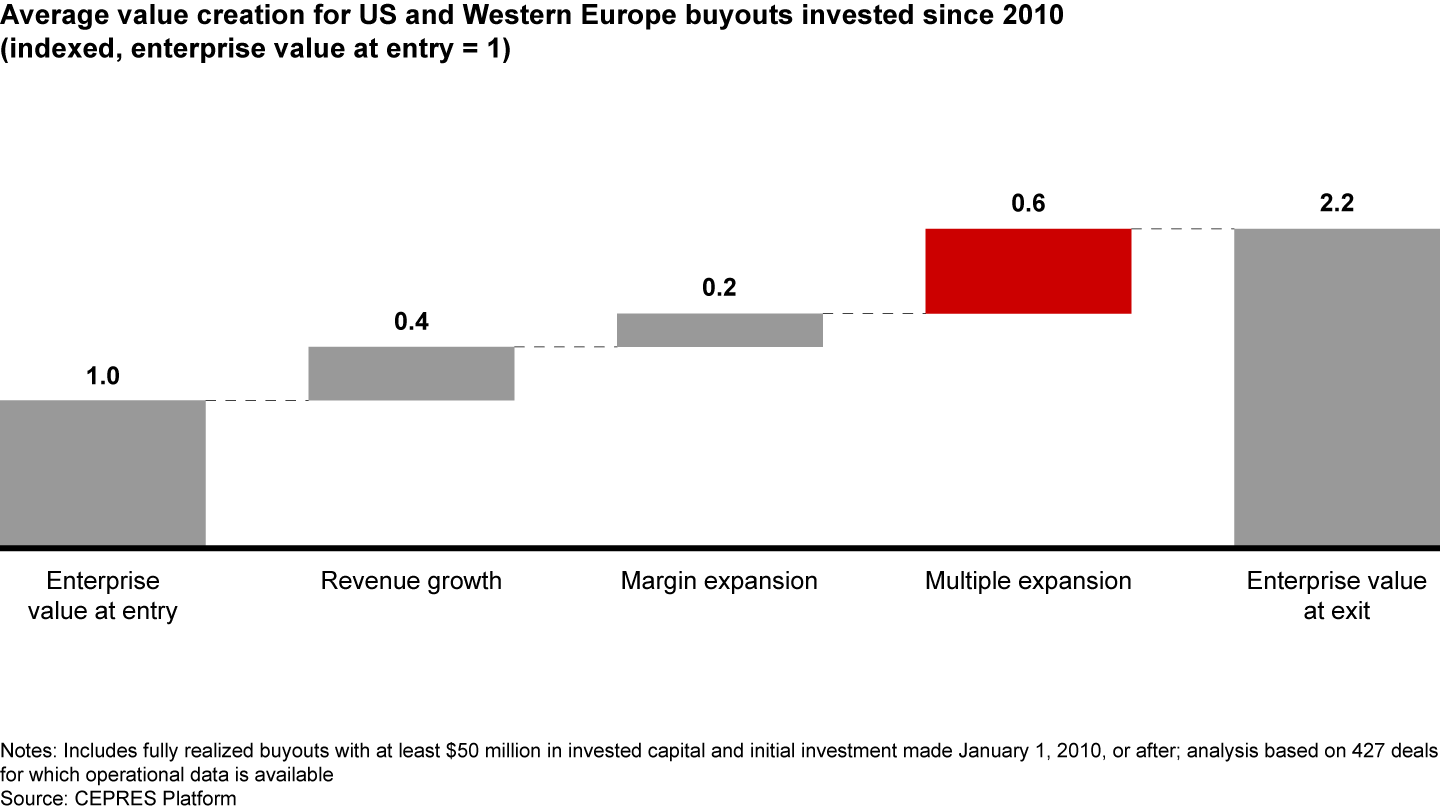
Multiple expansion has been responsible for about half of the value creation globally since the financial crisis, according to data from CEPRES, a provider of investment analytics and data solutions for private capital markets (see Figure 1). Many private equity firms, meanwhile, are missing the mark by a long shot when it comes to projecting margins. Bain analyzed the outcomes of 65 mature deals invested in since the global financial crisis, for which we had full access to fund and management projections. We found that most of them (71% of investments) fell short of projected margins—and not by a little. On average, margins ended up 330 basis points below the deal model forecast.
Figure 1

Why do firms have so much trouble delivering on their projections? More often than not, it traces back to faulty approaches to due diligence. Firms and their advisers tend to structure diligence as a series of discrete questions about the target company’s strategy, its commercial prowess or its cost structure, as if those things had no connection to each other. From management interactions to adviser roles, the effort is siloed, which limits the buyer’s understanding of how each aspect of the business relates to the others.
Back to the future
The PE firms that get it right use an integrated approach. They design the diligence process from the outset to build a 360-degree view of the company’s potential, considering key interdependencies between strategy and operations and quantifying their impact. Instead of evaluating potential operational changes in a vacuum, for instance, integrated due diligence considers those moves in the context of the company’s market opportunity, competitive realities and management bandwidth. This leads to a different set of questions. Rather than simply asking, “What level of cost savings can we underwrite?” the inquiry becomes, “If we cut over here, will it compromise an opportunity to expand a business over there? Is that opportunity really worth the investment, or is there more value in cutting costs? What’s the potential margin impact of either decision?”
For old hands in the private equity industry, a holistic approach like this will sound familiar. In the early 1990s, most firms analyzed companies this way, deploying small teams with an integrated agenda. Consider Berkshire Partners’ buyout of Carter’s in 2001. A leading manufacturer of baby wear and kids’ pajamas, Carter’s had a gold-plated reputation among parents and a near 40% market share with core customers. But its traditional retail channels—department stores and boutiques—were under siege from big-box stores. Berkshire recognized the opportunity to ignite growth by helping Carter’s break in with Walmart and Target, which seemed easy given its brand strength. But an analysis of the company’s supply chain showed that it would have to cut product cost, reduce lead times and significantly improve fulfillment rates to meet the stringent standards the big-box buyers were setting. This insight pushed cost considerations to the fore as a key element of an integrated plan to boost growth. Other priorities, such as international expansion, had to be deferred, given a realistic assessment of management bandwidth and the company’s investing capacity. What emerged was an ambitious, but pragmatic, value-creation plan that helped Berkshire capture a 6x return when Carter’s went public.
As the industry has matured, both deals and the way firms go after them have become much more complex. One consequence is that most firms no longer tackle diligence as a unified inquiry. Instead, they divvy up the effort between internal resources and a selection of outside specialists, with limited discussion of how the findings from one group might affect conclusions from another. One adviser might perform a strategic assessment that gauges market opportunities, while another produces a separate operational assessment looking at areas like the supply chain, pricing or technological readiness. Often they do not compare notes or share intelligence. This segmentation creates blind spots because it fails to capture the interdependencies between strategy, operations, and commercial, technical or innovation capabilities. Had Berkshire based its commercial deal thesis for Carter’s on the promise of big-box expansion alone, for instance, it would have overlooked critical factors like fill-rate performance, skewing its revenue growth and margin expectations.
Integrated from the outset
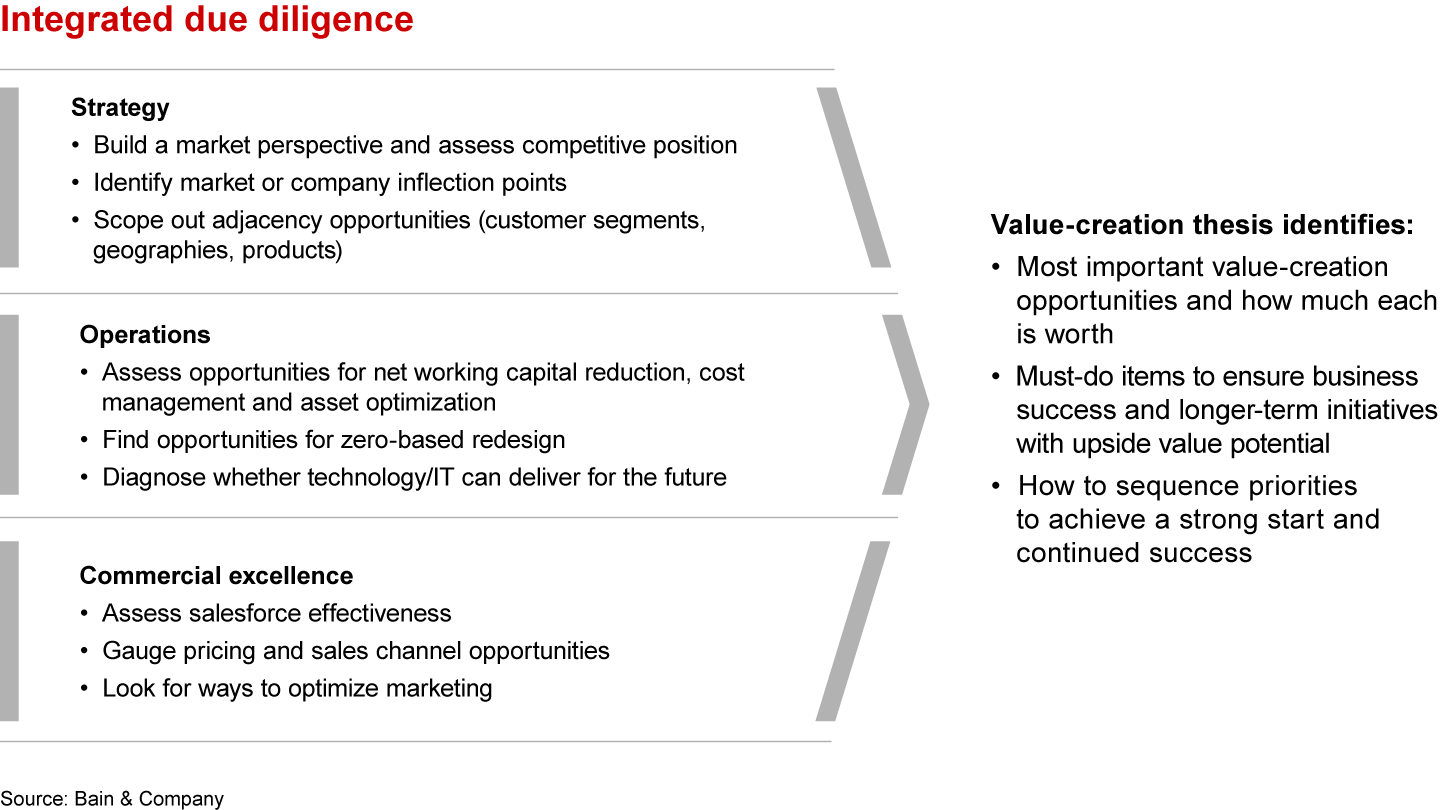
Integrated due diligence has three main areas of focus: strategy, operations and commercial excellence (see Figure 2). The analysis isn’t siloed into separate efforts but synthesized into a single, unified assessment of value potential. This helps the firm avoid making operational projections divorced from strategic considerations and vice versa. It also sets up the right discussions with management about trade-offs between priorities and how many opportunities leaders can realistically tackle in parallel.
Figure 2

An integrated approach starts with process design. From the beginning, it’s essential to structure an inquiry that assumes there will be interdependencies and opens the lines of communication between those performing the various strands of due diligence. Take the recent buyout of an industrial company with a complex portfolio of business units built over the years from various acquisitions. Each unit had its own level of profitability, growth potential and competitive position. Management’s plan was to accelerate growth organically by investing across these businesses to improve sales. The company’s leaders had also targeted a list of potential M&A candidates.
Given that existing leadership had missed many prior targets, the deal team questioned whether management could be relied on to execute. It also seemed clear that the company’s general and administrative costs were out of line. Cutting G&A and looking for efficiencies at the business unit level was one path forward. But the deal team chose a wider lens. Instead of simply wondering, “How do we fix these businesses?” the team asked itself, “What is the optimal portfolio for this company, and how could we create the most value by making changes to the businesses that remain at its core?” To find out, the team hired a primary adviser to pursue several lines of inquiry at once—strategy, commercial and operational diligence—along with a second boutique adviser providing input on growth projections for a subset of the business units.
After a thorough set of competitive and market assessments, it became clear that the company should divest nearly a third of its businesses. A smaller remaining core allowed leadership to refocus investment, reduce complexity and cut a large chunk out of corporate G&A expenses. A tighter portfolio also simplified the challenge of IT integration and trimmed the list of M&A targets. The more specific deal thesis enabled the team to better evaluate management’s skill set relative to the challenge and to tee up a search for potential new leadership while the diligence was underway.
Critical to the success of this effort was communication. The deal team and its advisers worked collaboratively on a daily basis, and all parties participated in meetings to hammer out the overall plan and projections. This approach differed sharply from how most bidders work. Typically, firms divide cost opportunities, market and competitive analysis, and IT into three separate streams of inquiry. Each is managed by a disparate adviser, with no mechanism for tying their views together into a single, integrated deal thesis.
Informed choices
Assessing how the interplay of strategy, operations and commercial capabilities affects future value leads to much deeper insight. It makes a buyer smarter by measuring with precision how decisions in one area of the business might change assumptions in another. That doesn’t always lead to a single answer but rather to a nuanced understanding of the options. For a buyer evaluating a European manufacturer of high-end baby products, an integrated diligence approach produced a range of informed ways to improve future margins.
Diligence in this case involved diagnosing market growth opportunities: broader distribution of the current core products, expansion into adjacencies, further geographic expansion (notably in the US and Asia) and accelerating the company’s online sales. It also involved a detailed assessment of the target company’s level of commercial excellence. It evaluated how well the brand and products performed in-store, how strong the relationships were with retailers and how effective the salesforce was. In concert, the diligence effort took a close look at costs. Were there opportunities to reorganize the operating model to find efficiencies, while building a new “cost culture” at the company?
Integrating these inquiries into a single analysis, the diligence identified a spectrum of potential outcomes based on the mix of revenue and cost initiatives. At one end was a slow-growth scenario, under which the company would increase revenues in the low single digits annually. In this case, the company would significantly improve EBITDA margins and produce reasonable returns by streamlining its overhead and sales organization, focusing on R&D expense, and trimming product costs. At the same time, the diligence uncovered a potential double-digit growth scenario. It was contingent on investing in a larger organization to take advantage of untapped markets and adjacencies. This scenario could plausibly turbocharge EBITDA margins well beyond the low-growth scenario, but there was more risk: The cost takeout was lower given the additional investment required.
For the buyer, this analysis set up multiple paths to a good deal. If the more aggressive, high-growth strategy delivered, the buyout would be a home run. If not, the buyer could still rely on making the company more efficient and achieve significant margin improvement. Integrating the diligence effort quantified these choices and allowed the firm to weigh the balance between cost-cutting and revenue growth. A full appreciation of the risks involved made it much easier to bet on the top line.
Finding a way to generate growth and increase margins will only become more crucial in the years ahead. With multiples already at record highs and signs of an economic downturn plentiful, returns for any deal that isn’t supported by real business improvement will likely come under pressure. Most industries are undergoing rapid technological disruption of one kind or another, which is shifting profit pools and creating a new hierarchy of winners and losers. The ongoing boom in mergers and acquisitions can upend long-held business assumptions by consolidating a supplier base or giving a customer or competitor more market power. All of it increases the likelihood that a company will need to alter its strategy, strengthen operations and manage costs in ways that are highly interdependent.
Integrated due diligence is the only way to really understand how pulling a lever in one area of the business will affect assumptions in another. It produces insights that a one-dimensional approach to diligence can’t. Unifying the effort into a single inquiry allows deal sponsors to build a solid value-creation plan that identifies both a full-potential vision for the business and what it will cost in time and resources to get there. Most important, it sets up PE firms to succeed by spotting the most viable and realistic path to new value. And in a downturn, when firms can no longer rely on multiple expansion to mask underperformance, that can create an invaluable competitive advantage.
For more on how firms are using integrated due diligence to get a better handle on valuing companies, we invite you to check out Dry Powder: The Private Equity Podcast, a wide-ranging discussion of issues PE investors wrestle with every day.
Miles Cook is a Bain & Company partner and a member of the firm’s Private Equity practice. Emilio Domingo is also a partner with the Private Equity practice. Saleel Kulkarni is a partner with Bain’s Consumer Products and Private Equity practices. Alexander De Mol is a partner with the Private Equity practice. Miles is based in Bain’s Atlanta office, Emilio in London, Saleel in Boston and Alexander in London.
First published in octobre 2019