

Etude
Who makes the most money in the tire market? The answer may surprise you, because the industry leaders in terms of pure scale don’t even come close. Germany’s Continental AG captures three times more economic profit (return above cost of capital) than global scale leader Bridgestone. With lower production costs and a better customer mix, Continental takes home by far the largest share of the tire industry’s economic profit despite its relative scale disadvantage.
Scale provides a powerful competitive benefit, there’s no debating that. In fact, a recent Bain & Company analysis of 315 companies across 45 markets worldwide shows that the scale leader is also the economic leader in 60% of cases. No surprise: Companies have long focused on building scale because the largest among them can spread costs over the widest base, wield the most market influence and benefit from the most accumulated experience.
But when we looked more closely at the companies making the most money, and how they are doing it, we found that those creating exceptional value don’t rely on scale alone. Firms taking full advantage of leadership economics reach well beyond scale to develop superior assets and capabilities that allow them to break through the normal range of performance and set ambitious new industry standards.
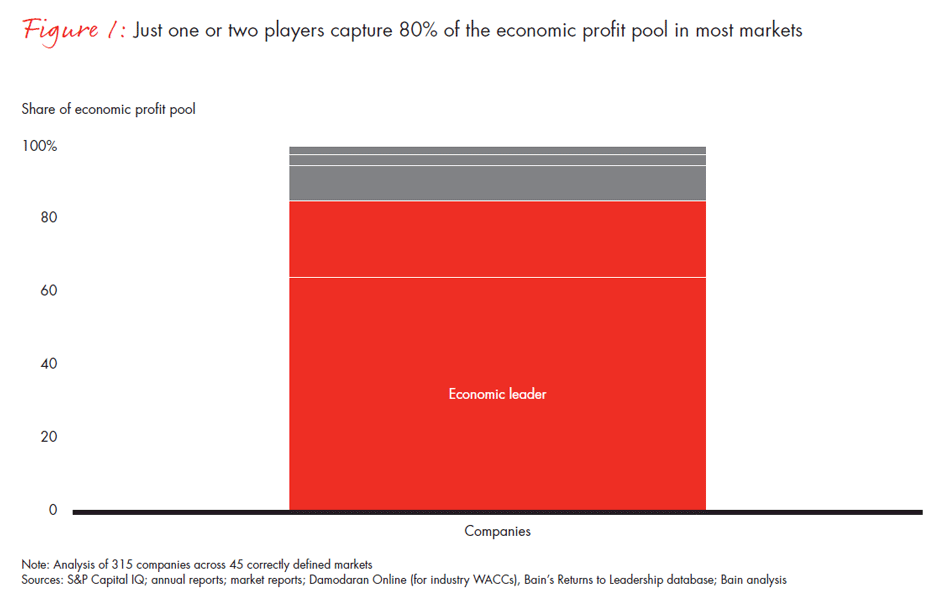
Strikingly, we found that, on average, 80% of the economic profit pool was concentrated in the hands of just one or two players in each market, when correctly defined by shared customers, costs and capabilities (see Figure 1). These strong performers generated nearly two times their cost of capital in profits. But while superior relative scale was often a powerful factor in performance, it wasn’t always decisive. Among the economic leaders in our research, 40% weren’t scale leaders at all, like Continental.
Thinking beyond scale
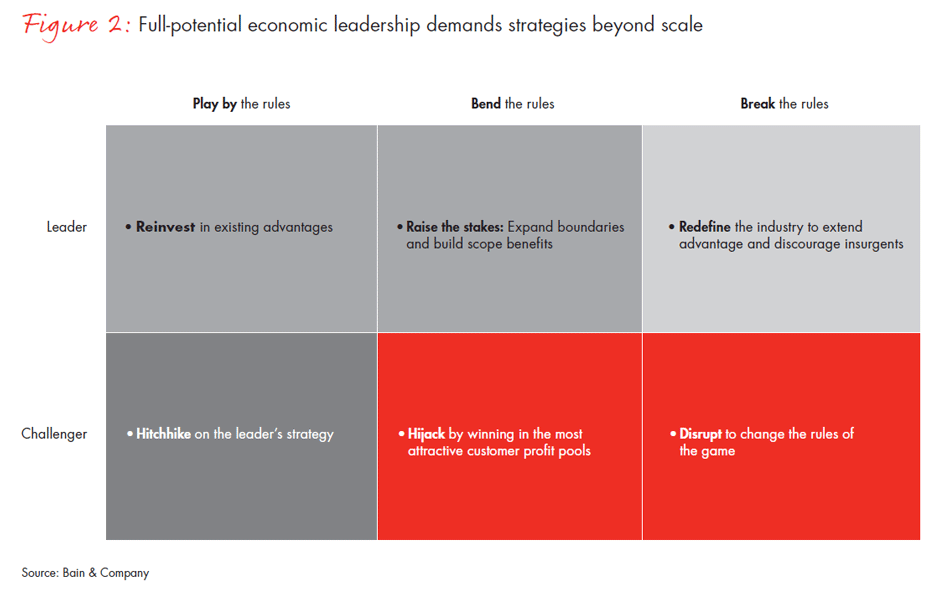
The best-performing companies, it turns out, achieve economic leadership by focusing their resources and augmenting the power of scale using an array of assets and capabilities that surpass those of competitors. This means that leaders need to stretch their full-potential ambition and challengers can and should play to win (see Figure 2). Across industries, the winners concentrate on developing four critical attributes:
- Valuable assets. Strong, proprietary assets can often trump the benefits of scale by improving costs or boosting a company’s ability to offer premium products or services. The leading pharmaceutical companies win by developing the best patent portfolio in the right categories. Similarly, in the oil and gas industry, a company’s track record in bringing the most attractive new fields into production is a stronger predictor of success than pure scale.
- Superior capabilities. Unlocking those powerful assets—and the full benefits of scale—requires strong capabilities. If you’re ExxonMobil or Shell, the ability to pump the most oil at the lowest cost is hard to beat. But strong capabilities can also turn smaller companies into economic leaders. In the US personal auto insurance market, Progressive has been able to outperform the scale leader by using better underwriting algorithms to select the best customers and price risk more effectively.
- The most attractive customers. Every market has a group of customers that is more lucrative than others. The companies that attract them command the highest margins. These customer groups are stickier and not as price sensitive, and they cost less to serve. Verizon’s superior network, for instance, allows it to attract the most business customers, giving it the highest average revenue per user among major mobile telecom providers in the US.
- The benefits of scope. When Procter & Gamble shares advertising, chemical and packaging costs across its diverse family of brands, it benefits from wider scope than its rivals, both in terms of products and geographies. Similarly, Apple generates greater “premiumness” for its customers by building an ecosystem with its software, devices, content, storage and retail capabilities. Creating scope and remaining focused is not easy; companies need to choose their opportunities carefully. Competing in related markets is no substitute for creating fundamental strength in each correctly defined market.
So how do companies achieve economic leadership? By linking these elements together to develop an ambitious strategy that explicitly targets higher performance. That is how Continental outperforms scale leader Bridgestone by such a wide margin. Continental has set up a network of manufacturing plants in low-cost countries, which gives it a cost base competitors can’t match. It has developed a world-class set of capabilities for running those plants, standardized across all its facilities. Through strong relationships with the leading German auto manufacturers, it has adapted its product mix for the most lucrative customers. And by expanding its scope selectively to provide other automotive systems and components, Continental can bundle products and create a distinctive partnership with its customers.

Size isn't everything
The best companies—the economic leaders in their industries—are not always the biggest.
Challenger strategies
Companies like Continental demonstrate that the classic strategic imperative for challengers—build scale or get out—is only one of several options. Growing rapidly through M&A, for instance, might still be the most efficient path to scale leadership. But investing in leapfrog technology, lower-cost processes or better models for reaching the customer are equally valid options.
The crucial consideration: How can a company best marshal its resources to build distinctive advantage? Smaller companies hoping to challenge scale leaders should make bold, forceful choices about what path to take, then commit to their choice and invest aggressively to move as far and as fast along that path as possible. Most challengers have three broad strategies available to them:
- The hitchhike strategy. Although large incumbents have scale advantages, they are also married to the rules they have set. Challengers have opportunities to hitch onto an existing market and win using differentiated capabilities and learning systems to create more value. In smartphones, for instance, Samsung hitchhiked on Apple’s iPhone strategy and pricing. It used strong network relationships and go-to-market capabilities to carve out a place as the industry’s scale leader and low-cost producer.
- The hijack strategy. Hitchhiking may be the easiest strategy if the scale leader lets you get away with it. But aggressive challengers can also hijack the industry profit pool by winning over the best customers or by introducing something new that creates additional demand among this lucrative group. BMW, for instance, pulled off this strategy in the global automotive market by developing a premium brand and gradually extending it into other corners of the car business—from city cars to SUVs and super cars. Borealis followed a similar path in plastics by focusing on the highest-value polyolefin markets, such as wire and cable applications and high-pressure gas pipe.
- Disruption. The ultimate judo move for a challenger is to render the leader’s scale advantage obsolete by changing the rules of the game. Amazon wreaked havoc on the big-box retail segment with its ubiquitous Internet retailing engine. And Southwest Airlines showed how to make money in air travel with a low-cost, no-frills service strategy. Digitalization is opening opportunities for disruption in many industries. Witness Netflix: First it disrupted the Blockbuster brick-and-mortar model and then disrupted itself when it moved from mailing DVDs to streaming. What’s clear, however, is that disruption is about more than just innovation. It requires breaking the existing rules of the game to build economic leadership.
Raising the bar for leaders
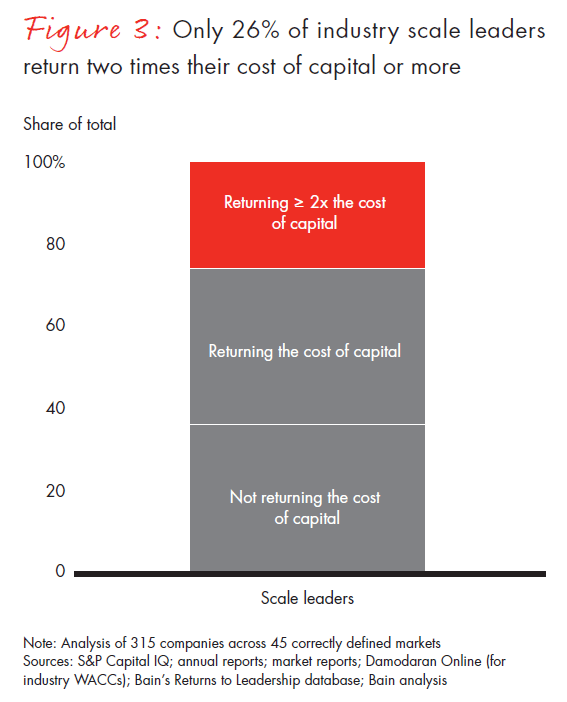
The paradox of leadership is that the largest companies often fail to take full advantage of leadership economics. As we mentioned previously, the top performers in our research returned an average of nearly two times their weighted average cost of capital. But among the scale leaders in each market, only 26% hit or surpassed that target; 36% didn’t even return their cost of capital (see Figure 3).
Market leaders often achieve their scale position by virtue of superior assets and capabilities. But it’s not uncommon for incumbents to settle in to defend their position and risk becoming complacent. The strongest leaders are significantly more focused and intentional about what they do with their leadership. They set a full-potential ambition and stretch toward it aggressively by taking full advantage of their scale and augmenting it with other attributes. Typically they follow at least one of three paths:
- Play by the rules. Industry incumbents have the unique opportunity to extend their economic leadership by sticking to the established rules of the game and executing better than anybody else. While this sounds simple, it is anything but. The company must maximize the scale and asset advantages of its core business by developing capabilities that allow it to reduce costs and build quality faster than competitors. That means learning and investing while avoiding the complexity that can stifle returns. Intel is a prime example. The semiconductor leader set the rules of the game early on in the chip industry and has rarely strayed from them. Others have threatened, but Intel has stayed ahead by moving rapidly down the learning curve to introduce a more powerful chip every 18 months.
- Bend the rules. Playing by the rules is fine. But stretching toward full potential may require bending the rules a little, or in some cases, a lot. That can mean using core strengths to generate new opportunities, as Starbucks did when it created an international brand and standardized a carefully designed coffee-drinking experience, allowing the company to transform local coffee markets and earn higher returns. Spain’s Telefonica bent the rules in telephony by rolling out both mobile and fixed-line service, allowing it to provide a bundle no one else could match.
- Break the rules. This is clearly the most difficult strategy for a large, incumbent company, because most leaders are heavily invested in winning by the current rules. Sometimes, however, leading companies can use their size and clout to reshape the rules to their advantage. DeBeers, for instance, changed the model in the diamond business from a supply-based source of competitive advantage to a more demand-driven strategy, tapping into hidden assets rooted in the company’s unique relationship with customers and the power of the De Beers brand. And IBM used its scale, deep customer relationships and technical expertise to move from hardware producer to a high-margin provider of software and services.
James Hadley, a leader of Bain's Strategy practice, explains how smaller players look to challenge market leaders, and what established companies should do to avoid complacency.
As we’ve seen, economic leadership is immensely valuable. In most markets, one or two companies make all the money while others either struggle to return their cost of capital or destroy value. But the companies that achieve the highest levels of leadership economics bring more to the game than simply scale. They make important choices about where they will focus their time and investments, and then work rigorously to develop the assets and capabilities that generate superior returns. They begin by asking some critical questions:
- Are we stretching our ambition beyond current industry performance standards?
- Do we have a clear path to leadership economics either as a challenger or leader?
- Are we developing proprietary assets, honing superior capabilities, winning with the most attractive customers and creating the benefits of scope?
Arriving at the right answers usually requires company leaders to push past “normal” performance and profit expectations. Scale helps, but companies that consistently outperform their competition and take full advantage of leadership economics are fueled by an ambition to aim higher and a determination to build competitive advantage beyond scale.
Nicolas Bloch is a partner with Bain & Company in Brussels, where he coleads the firm’s Global Strategy practice. James Hadley and Ouriel Lancry are partners in Bain’s London and Chicago offices, respectively. James leads the firm’s Strategy practice in Europe, the Middle East and Africa, and Ouriel leads the Strategy practice in the Americas. Jenny Lundqvist manages Bain’s Strategy practice in Europe, the Middle East and Africa; she is based in Stockholm.
First published in février 2015