
Skip to Content
  • Bureaux

    Bureaux

    Amérique du Nord et Amérique du Sud
    • Atlanta
    • Austin
    • Bogota
    • Boston
    • Buenos Aires
    • Chicago
    • Dallas
    • Denver
    • Houston
    • Los Angeles
    • Mexico City
    • Minneapolis
    • Monterrey
    • Montreal
    • New York
    • Rio de Janeiro
    • San Francisco
    • Santiago
    • São Paulo
    • Seattle
    • Silicon Valley
    • Toronto
    • Washington, DC
    Europe, Moyen-Orient et Afrique
    • Amsterdam
    • Athens
    • Berlin
    • Brussels
    • Copenhagen
    • Doha
    • Dubai
    • Dusseldorf
    • Frankfurt
    • Helsinki
    • Istanbul
    • Johannesburg
    • Kyiv
    • Lisbon
    • London
    • Madrid
    • Milan
    • Munich
    • Oslo
    • Paris
    • Riyadh
    • Rome
    • Stockholm
    • Vienna
    • Warsaw
    • Zurich
    Asie et Australie
    • Bangkok
    • Beijing
    • Bengaluru
    • Brisbane
    • Ho Chi Minh City
    • Hong Kong
    • Jakarta
    • Kuala Lumpur
    • Manila
    • Melbourne
    • Mumbai
    • New Delhi
    • Perth
    • Seoul
    • Shanghai
    • Singapore
    • Sydney
    • Tokyo
    Voir tous les bureaux
  • Alumni
  • Presse
  • S’abonner
  • Contacter
  • France | Français

    Sélectionnez votre région et votre langue

    Global
    • Global (English)
    Amérique du Nord et Amérique du Sud
    • Brazil (Português)
    • Argentina (Español)
    • Canada (Français)
    • Chile (Español)
    • Colombia (Español)
    Europe, Moyen-Orient et Afrique
    • France (Français)
    • DACH Region (Deutsch)
    • Italy (Italiano)
    • Spain (Español)
    • Greece (Elliniká)
    Asie et Australie
    • China (中文版)
    • Korea (한국어)
    • Japan (日本語)
  • Saved items (0)
    Saved items (0)

    You have no saved items.

    Bookmark content that interests you and it will be saved here for you to read or share later.

    Explore Bain Insights
  • Expertises Sectorielles
    Menu principal

    Expertises Sectorielles

    • Aerospace et Défense
    • Agroalimentaire
    • Chimie
    • Infrastructures, BTP et Matériaux de Construction
    • Grande Consommation
    • Services Financiers
    • Santé
    • Engins & Equipements Industriels
    • Media et Divertissement
    • Metals
    • Mining
    • Pétrole & Gaz
    • Papier et Emballage
    • Private Equity
    • Secteur Public
    • Distribution
    • Technologie
    • Télécommunications
    • Transportation
    • Travel & Leisure
    • Utilities & Energies Renouvelables
  • Expertises Fonctionnelles
    Menu principal

    Expertises Fonctionnelles

    • Expérience Client
    • ESG
    • Innovation
    • Fusions et Acquisitions
    • Opérations
    • People & Organization
    • Private Equity
    • Sales & Marketing
    • Stratégie
    • IA, Perspectives et Solutions
    • Technology
    • Transformation
  • Digital
  • Points de Vue
  • À propos
    Menu principal

    À propos

    • Notre Activité
    • Nos Valeurs
    • Nos Collaborateurs et Notre Équipe Dirigeante
    • Notre Impact
    • Prix & Récompenses
    • Partenariats Internationaux
    • Evénements
    Further: Our global responsibility
    • Diversité et Inclusion
    • Impact Social
    • Sustainability
    • World Economic Forum
    Learn more about Further
  • Carrières
    Menu principal

    Carrières

    • Rejoignez-nous
      Carrières
      Rejoignez-nous
      • Find Your Place
      • Nos domaines d’expertise
      • Equipes multidisciplinaires
      • Étudiants
      • Stages et programmes
      • Événements de recrutement
    • La vie chez Bain
      Carrières
      La vie chez Bain
      • Blog: Inside Bain
      • Récits de carrière
      • Nos collaborateurs
      • Nos bureaux
      • Soutenir votre évolution professionnelle
      • Groupes d’affinités
      • Avantages chez Bain
    • Histoires d’impact
    • Notre processus de recrutement
      Carrières
      Notre processus de recrutement
      • Ce que vous pouvez attendre
      • Entretiens
    Trouver un poste
  • Bureaux
    Menu principal

    Bureaux

    • Amérique du Nord et Amérique du Sud
      Bureaux
      Amérique du Nord et Amérique du Sud
      • Atlanta
      • Austin
      • Bogota
      • Boston
      • Buenos Aires
      • Chicago
      • Dallas
      • Denver
      • Houston
      • Los Angeles
      • Mexico City
      • Minneapolis
      • Monterrey
      • Montreal
      • New York
      • Rio de Janeiro
      • San Francisco
      • Santiago
      • São Paulo
      • Seattle
      • Silicon Valley
      • Toronto
      • Washington, DC
    • Europe, Moyen-Orient et Afrique
      Bureaux
      Europe, Moyen-Orient et Afrique
      • Amsterdam
      • Athens
      • Berlin
      • Brussels
      • Copenhagen
      • Doha
      • Dubai
      • Dusseldorf
      • Frankfurt
      • Helsinki
      • Istanbul
      • Johannesburg
      • Kyiv
      • Lisbon
      • London
      • Madrid
      • Milan
      • Munich
      • Oslo
      • Paris
      • Riyadh
      • Rome
      • Stockholm
      • Vienna
      • Warsaw
      • Zurich
    • Asie et Australie
      Bureaux
      Asie et Australie
      • Bangkok
      • Beijing
      • Bengaluru
      • Brisbane
      • Ho Chi Minh City
      • Hong Kong
      • Jakarta
      • Kuala Lumpur
      • Manila
      • Melbourne
      • Mumbai
      • New Delhi
      • Perth
      • Seoul
      • Shanghai
      • Singapore
      • Sydney
      • Tokyo
    Voir tous les bureaux
  • Alumni
  • Presse
  • S’abonner
  • Contacter
  • France | Français
    Menu principal

    Sélectionnez votre région et votre langue

    • Global
      Sélectionnez votre région et votre langue
      Global
      • Global (English)
    • Amérique du Nord et Amérique du Sud
      Sélectionnez votre région et votre langue
      Amérique du Nord et Amérique du Sud
      • Brazil (Português)
      • Argentina (Español)
      • Canada (Français)
      • Chile (Español)
      • Colombia (Español)
    • Europe, Moyen-Orient et Afrique
      Sélectionnez votre région et votre langue
      Europe, Moyen-Orient et Afrique
      • France (Français)
      • DACH Region (Deutsch)
      • Italy (Italiano)
      • Spain (Español)
      • Greece (Elliniká)
    • Asie et Australie
      Sélectionnez votre région et votre langue
      Asie et Australie
      • China (中文版)
      • Korea (한국어)
      • Japan (日本語)
  • Saved items  (0)
    Menu principal
    Saved items (0)

    You have no saved items.

    Bookmark content that interests you and it will be saved here for you to read or share later.

    Explore Bain Insights
  • Expertises Sectorielles
    • Expertises Sectorielles

      • Aerospace et Défense
      • Agroalimentaire
      • Chimie
      • Infrastructures, BTP et Matériaux de Construction
      • Grande Consommation
      • Services Financiers
      • Santé
      • Engins & Equipements Industriels
      • Media et Divertissement
      • Metals
      • Mining
      • Pétrole & Gaz
      • Papier et Emballage
      • Private Equity
      • Secteur Public
      • Distribution
      • Technologie
      • Télécommunications
      • Transportation
      • Travel & Leisure
      • Utilities & Energies Renouvelables
  • Expertises Fonctionnelles
    • Expertises Fonctionnelles

      • Expérience Client
      • ESG
      • Innovation
      • Fusions et Acquisitions
      • Opérations
      • People & Organization
      • Private Equity
      • Sales & Marketing
      • Stratégie
      • IA, Perspectives et Solutions
      • Technology
      • Transformation
  • Digital
  • Points de Vue
  • À propos
    • À propos

      • Notre Activité
      • Nos Valeurs
      • Nos Collaborateurs et Notre Équipe Dirigeante
      • Notre Impact
      • Prix & Récompenses
      • Partenariats Internationaux
      • Evénements
      Further: Our global responsibility
      • Diversité et Inclusion
      • Impact Social
      • Sustainability
      • World Economic Forum
      Learn more about Further
  • Carrières
    Recherches les plus fréquentes
    • Agile
    • Digital
    • Stratégie
    Vos recherches précédentes
      Pages récemment visitées

      Content added to saved items

      Saved items (0)

      Removed from saved items

      Saved items (0)

      Etude

      Tapping Latent Demand in Personal Lending

      Tapping Latent Demand in Personal Lending

      Banks’ success in personal lending will hinge on taking a more data-driven approach.

      Par Joe Fielding and Martin Magnone

      • min
      }

      Etude

      Tapping Latent Demand in Personal Lending
      en

      The US personal lending market has been jolted by a raft of new competitors. Fintech startups, large technology firms, even venerable investment banks such as Goldman Sachs have made incursions, and competition will only intensify over the next few years. To capture their fair share of the profit pool in this $1.54 trillion market, traditional banks will have to redefine their business models through a tailored approach that is based on a much more nuanced understanding of the financial and experience needs of their target customers.

      There is significant economic opportunity on the line for lenders, especially for banks with major credit card businesses, which have seen their fee revenues under pressure and their costs rise for rewards programs, increasing their reliance on revolving balances. For one thing, the US personal lending market is large, fragmented and surprisingly underserved. The leading five banks account for only about 35% of the market (excluding credit cards and home equity lines of credit), with a long tail of medium and small commercial banks, credit unions and alternative financing providers serving this sector.

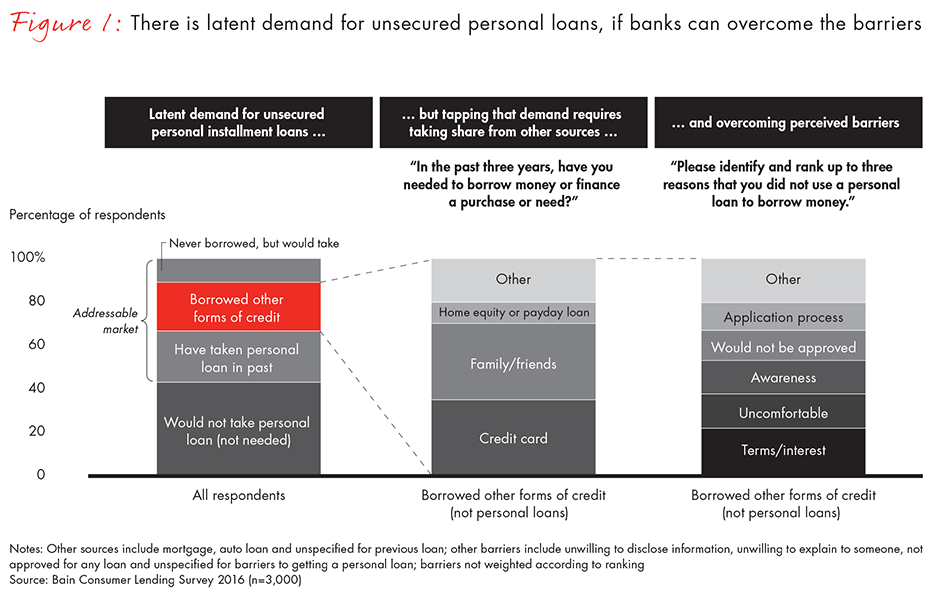
      Significant latent demand exists in personal, unsecured installment loans, despite the many potential solutions available to borrowers and prospects, a new Bain & Company survey of 3,000 US consumers found (see Figure 1). Moreover, personal lending offers an attractive and sustainable source of revenue, compared with declining interchange fees for credit cards.

      Direct lenders powered by technology that improves a specific aspect of the lending activity chain—origination, underwriting, fulfillment or servicing—pose the greatest threat to incumbent banks. Leading technology firms such as Apple and Amazon have brands that resonate with consumers, and they can seamlessly integrate lending with their established product and service models. Apple now offers phone leasing, and Amazon moved into student lending in partnership with Wells Fargo, though political opposition forced them to end the venture. Other digital service platforms could serve as launch pads for lending products, including the payment wallets of Google and Samsung, and the new Facebook M virtual assistant.

      demand-in-personal-lending-fig01_embed

      Banks still have inherent strengths they can build on, in order to retain and gain share in this profitable sector. In distribution, traditional branch-based lending still matters in loan origination, though digital channels will become dominant within the next five years, we believe. Direct alternative lenders must rely on their investors’ confidence to be able to fund sustained loan growth, whereas banks can leverage low-cost deposits to manage through economic cycles. Banks also possess a wealth of data on their customers, from longitudinal data on money movement to data on cross-channel servicing behavior, which can be used to predict consumer acceptance of products, ability and willingness to pay, and early warning of potential default for portfolio management. That gives banks a platform for innovation that enables them to differentiate themselves from niche entrants.

      Even with these potential advantages, it is almost impossible for a bank to excel in every personal lending category with all types of consumers in their diverse needs.

      To succeed, banks will have to make explicit decisions on where to play—that is, which customer segments, product types and risk characteristics to emphasize and which to cede. In parallel, they will have to make choices on how to win—which lending capabilities they will excel in, and which can be at parity with the rest of the industry.

      Joe Fielding, a partner with Bain's Financial Services practice, shares three steps that banks can take to compete with a raft of new competitors and retain and gain share in this profitable sector.

      Consumers’ attitudes and perceptions about lending are critical to inform lending strategies, and Bain’s new survey offers insights in this regard. The survey found:

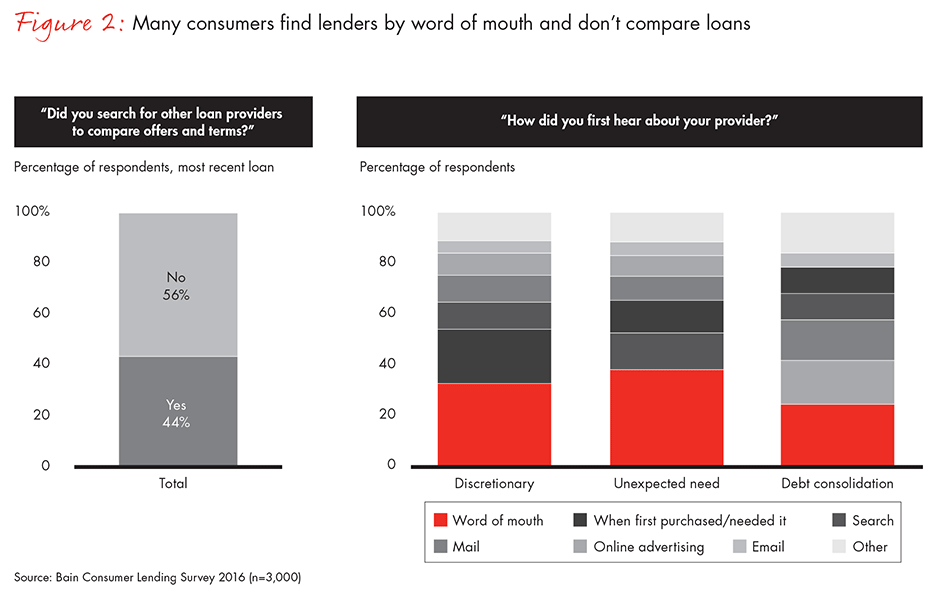
      • Customer advocacy matters. One-third of respondents found their current provider through word of mouth (see Figure 2). This underscores the importance of creating an experience that will delight customers and lead them to recommend the bank to friends and family.
      • Distribution and marketing matter in loan origination. Of respondents who take a loan, more than half do not compare offers across different lenders; they just take the first one they encounter. Being at the right place at the right time plays a big role in acquiring new business.
      • Many prospective borrowers are not well served by current lending alternatives. Some 22% of customers who qualify for a personal loan choose to borrow in ways that make less financial sense, such as taking a payday loan, revolving a balance on credit cards, or borrowing from family or friends. This behavior often stems from barriers including lack of awareness, lack of trust or difficulty with the application process—not just from creditworthiness or price.
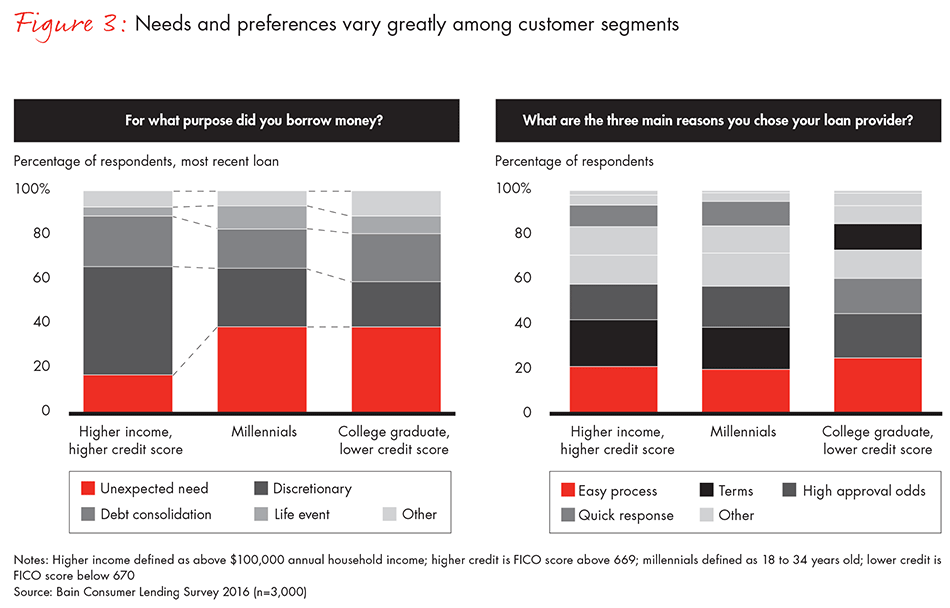
      • Banks have to excel on several specific attributes, not just on price. The reasons for choosing a lender, or for deciding not to borrow from an institution, depend on the purpose of the loan, the customer’s demographics and even the distribution channel chosen. For example, respondents with strong credit scores care more about loan terms, while respondents with poor to fair credit scores care much more about high odds of approval and a fast, easy application process (see Figure 3). For respondents using branches, customer service and low interest rates have greater weight; those applying through digital channels cite an easy process as a key factor in their application decision.
      demand-in-personal-lending-fig02_embed

      demand-in-personal-lending-fig03_embed

      The survey analysis and our experience working with leading banks suggests that an effective personal lending model rests on four pillars.

      1. Tailor the lending experience to the customer’s needs. One way that niche lenders have shaken up the personal lending market is through innovative distribution and origination. For example, for people who are interested in purchasing artwork at the lower end of the market, spending $10,000 or even $1,000 all at once can feel financially irresponsible. Online lender Art Money seeks to change the mental math. Using Art Money, customers pay a minimum 10% deposit, take the artwork home and pay the remaining balance over 9 months, interest-free. The clean, attractive Art Money website has an easy application process, which runs a credit check in about 15 seconds, and it links to participating galleries. The average amount of more than 500 loans granted since Art Money’s launch in April 2015 has been around $5,000, and Art Money reported there have been no defaults through October 2016.

        At many banks, by contrast, lending officers ask consumers about the intended use of the funds for the purpose of underwriting, but regardless of the reason given, the overall process and experience comes in one flavor. Yet because the emotional and rational criteria for choosing a lender vary so widely by loan purpose and demographics, it’s critical to recognize how each event that triggers borrowing— buying artwork, debt consolidation, emergency dental surgery, a wedding—merits a tailored approach by the bank. There is ample room for banks to innovate in distribution and origination, particularly for affluent mass-market customers who are not desperate for cash, want an easy process and seek what they perceive as a good deal.

      2. Build a modular, repeatable model across multiple lending experiences. Banks should make it easy for the consumer to apply and get fast approval, with a minimum of data input needed by him or her, and on a fully digital/mobile interface integrated with the payment/disbursement platform. Customers often want the flexibility of multiple payment options.

        The process should give the customer a feeling of being in control, for example, by signaling that he or she will be approved. And it should address anxieties around borrowing through clear, simple language about, say, the dollar cost of interest per month rather than the more abstract concept of annual percentage rate.

        Models are repeatable when they have modular components that can be scaled up, including origination and underwriting workflows, risk and pricing analytic engines, fulfillment and servicing operations, and capabilities in designing and managing a great customer experience.

      3. Develop large-scale marketing and distribution capabilities. Lenders must be able to reach customers to raise awareness through marketing, at the point of sale, and through both digital and physical distribution. Banks may need intermediaries or partners to get close to the moment of need. For example, wedding planners or retailers could receive funds directly and offer loans as part of the overall service to consumers.
      4. Make the model durable through the cycle. The lending model should be resilient to ups and downs through the business and credit cycle, along the three dimensions of funding, compliance and underwriting. To ensure that funding is stable, banks should leverage access to low-cost funding, including securitization, which requires modular, standardized approaches to product design in origination and servicing. For compliance and regulatory oversight, using automated engines to codify and apply rules will provide both consistency and clarity. Finally, underwriting that takes advantage of available behavioral and application data can provide superior risk-based decisions, outcomes and returns.

        US consumers have more choices than ever for personal loans, notably through tech-savvy companies with strong brands and massive reach. Banks that assume their current lending operations will roll along at acceptable growth rates risk a rude surprise as customers shift to alternatives that are easier to negotiate and faster to approve applications. Those banks that take a more tailored approach to become highly relevant to consumers’ particular needs at the right moment stand a far better chance of presenting a strong proposition that both delights consumers and improves the bank’s economics.

      Joe Fielding is a partner and Martin Magnone is a principal in Bain & Company’s Financial Services practice. They are based in New York.


      demand-in-personal-lending-fig01_full

      demand-in-personal-lending-fig02_full

      demand-in-personal-lending-fig03_full
      Auteurs
      • Headshot of Joe Fielding
        Joe Fielding
        Associé, New York
      Contactez-nous
      Synergies sectorielles
      • Services Financiers
      Services Financiers
      Customer Loyalty in Retail Banking: Global Edition 2016

      Cost savings hinge on promoting mobile adoption.

      Voir plus
      Banking
      Retail Banks Wake Up to Digital Lending

      Our benchmark survey highlights the capability gaps and the potential for banks to defend their profit pools.

      Voir plus
      Services Financiers
      Rethinking Transformation: Lawrence Lam on Leading Change at Prudential

      Frankie Leung speaks with Lawrence Lam, CEO of Prudential Hong Kong, about organizational transformation and sustaining change through a people-led approach.

      Voir plus
      Services Financiers
      Banking M&A

      As conditions shift, leading banks are fusing scale with scope to create future-ready organizations.

      Voir plus
      Services Financiers
      The Gap Between AI Strategy and Reality Is Execution

      AI’s eventual reshaping of financial services is clear, and now it’s a question of who can sequence, scale, and sustain execution across the enterprise.

      Voir plus
      First published in janvier 2017
      Mots clés
      • Services Financiers

      Comment nous avons aidé nos clients

      Développement Durable et Responsabilité Sociétale des Entreprises (RSE) Voluntary Carbon Markets: A Bank Moves Early to Seize the Opportunity

      Lire l’étude de cas

      Amélioration de la Performance Lean Six Sigma solves a commercial bank's growth problem

      Lire l’étude de cas

      Technologies de l'information Bridging the Gap Between Business and Technology

      Lire l’étude de cas

      Vous souhaitez continuer cette conversation ?

      Nous aidons des dirigeants du monde entier à matérialiser des impacts et des résultats pérennes et créateurs de valeur dans leurs organisations.

      Les points de vue de Bain : notre perspective sur des problématiques auxquelles sont confrontées les entreprises à travers le monde, envoyés chaque mois dans votre boîte de réception. 

      *J’ai lu la politique de confidentialité et j’accepte les conditions.

      Merci de lire notre politique de confidentialité.
      Bain & Company
      Contactez-nous Sustainability Accessibility Conditions d’utilisation Politique de Confidentialité Cookie Policy Mentions Légales Sitemap Log In

      © 1996-2026 Bain & Company, Inc.

      Contacter Bain

      Comment pouvons-nous vous aider ?

      • Business inquiry
      • Career information
      • Press relations
      • Partnership request
      • Speaker request
      Voir tous les bureaux